Passerby vs Passersby vs Passerbyers: Meaning, Plural & Examples
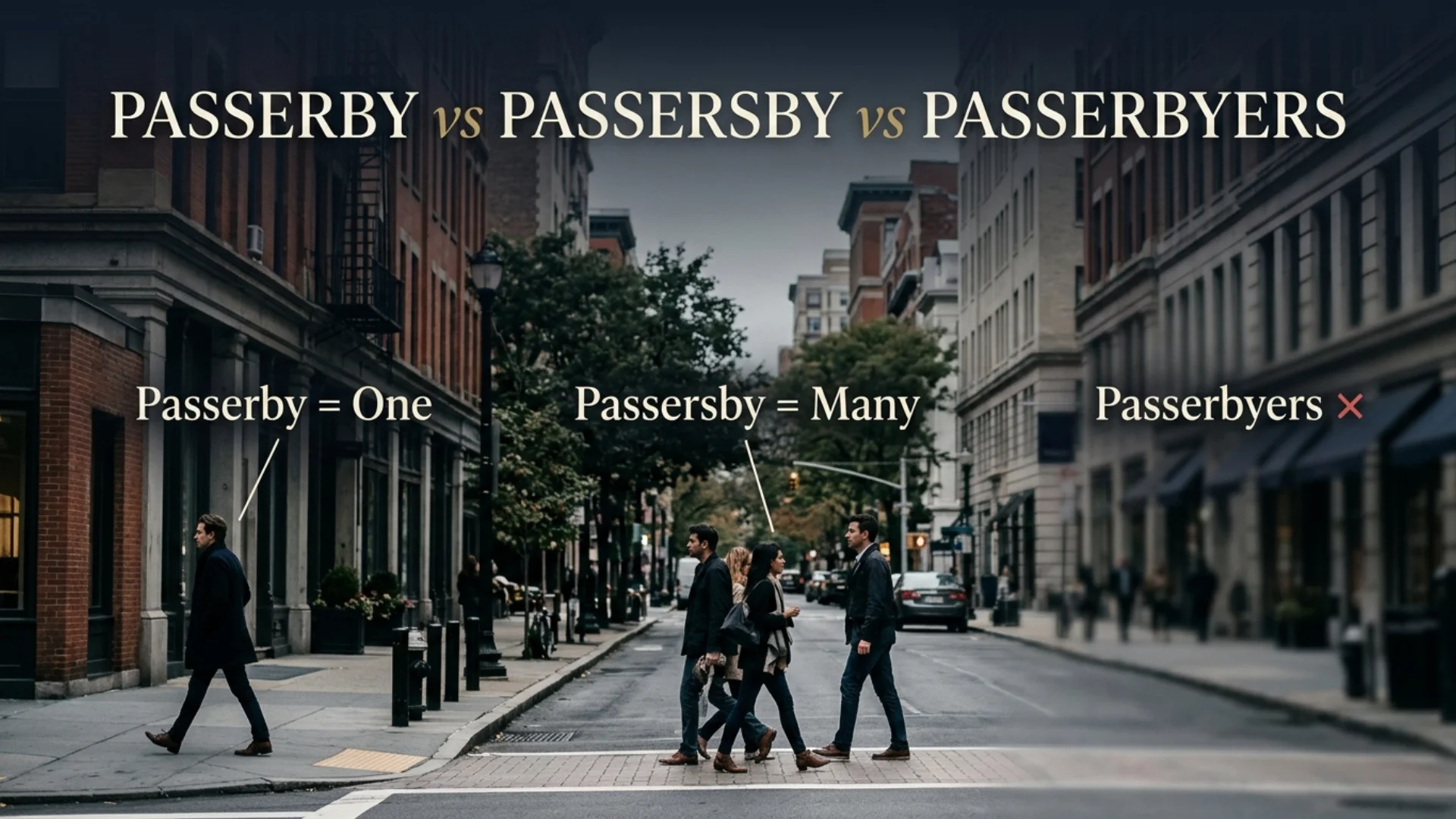
Passerby is singular, passersby is the standard plural, and passerbyers is not standard English.
The basic rule is:
- One person: a passerby
- Two or more people: passersby
- Passerbyers: incorrect in standard English
- Passerbys: also incorrect as the normal plural
Examples:
A passerby stopped to help.
Several passersby stopped to help.
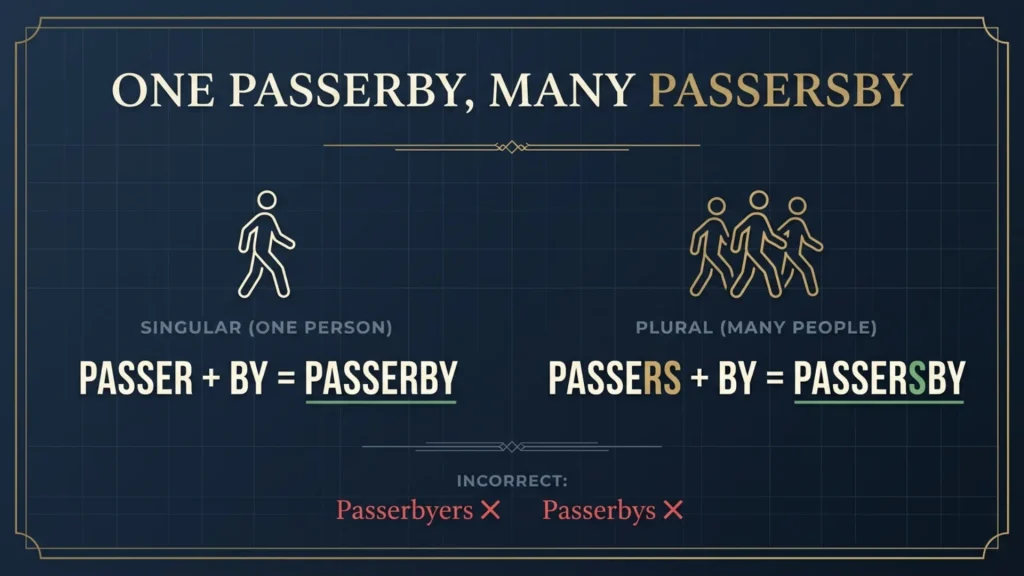
The unusual plural exists because passerby is built around the noun passer. When there is more than one person, passer becomes passers, while by stays unchanged.
So:
passer + by → passerby
passers + by → passersby
Passerby vs Passersby vs Passerbyers: Quick Answer
| Form | Correct? | Number | Meaning |
|---|---|---|---|
| passerby | Yes | Singular | One person passing by |
| passersby | Yes | Plural | Two or more people passing by |
| passer-by | Yes | Singular variant | One person passing by |
| passers-by | Yes | Plural variant | Two or more people passing by |
| passerbys | No | Intended plural | Nonstandard plural |
| passerbyers | No | Intended plural | Nonstandard word |
The easiest memory trick is:
One passerby. Several passersby.
What Does Passerby Mean?
A passerby is a person who happens to pass a particular place, event, or person.
The person usually is not part of what is happening. They simply happen to be nearby while passing.
Examples:
A passerby noticed the smoke.
A passerby called an ambulance.
The police questioned a passerby who had seen the accident.
A passerby returned the lost wallet.
The word can describe someone:
- walking past
- driving past
- cycling past
- moving through an area
- witnessing something by chance
Merriam-Webster lists passerby as a noun and gives passersby as its plural. Merriam-Webster: passerby
What Is the Plural of Passerby?
The correct plural is:
passersby
Not:
passerbys
and not:
passerbyers
Examples:
Three passersby witnessed the crash.
Several passersby stopped to watch.
The performer attracted a crowd of passersby.
Two passersby helped the injured cyclist.
Why Is the Plural Passersby?
The spelling makes more sense when you separate the compound:
passer + by
The main noun is passer, meaning someone who passes.
The word by describes the person’s movement or relationship to the place.
To make the noun plural, you pluralize the meaningful noun:
passer → passers
while leaving:
by
unchanged.
Therefore:
passerby → passersby
English could have made this easy and put the s at the end like a civilized language, but apparently that would have deprived grammar websites of employment.
Why Isn’t It Passerbys?
Most English nouns form their plurals by adding -s to the end:
car → cars
visitor → visitors
stranger → strangers
That pattern may make passerbys seem logical.
However, passerby is a compound whose main noun comes before by, so the plural marker appears inside the compound.
Correct:
passersby
Incorrect:
passerbys
Is Passerbyers a Word?
Passerbyers is not the standard plural of passerby.
Avoid it in:
- academic writing
- business writing
- professional emails
- reports
- news writing
- school assignments
- formal correspondence
Use:
passersby
instead.
Incorrect:
Several passerbyers gathered near the entrance.
Correct:
Several passersby gathered near the entrance.
Why Do People Write Passerbyers?
The mistake is understandable.
English frequently creates words for people using endings such as -er:
- work → worker
- run → runner
- teach → teacher
- drive → driver
A writer may unconsciously treat passerby as if it needs another ending to describe multiple people.
But passerby already refers to the person.
You do not need to turn it into passerbyer before making it plural.
Think:
one passerby
two passersby
That is the entire system.
Passerby Singular
The singular form is:
passerby
Use it for exactly one person.
Examples:
A passerby gave me directions.
One passerby stopped near the gate.
The passerby heard someone shouting.
A helpful passerby called the police.
Words that normally signal the singular include:
- a
- an
- one
- each
- every
So:
one passerby
is correct.
Not:
one passersby
Passersby Plural
Use passersby whenever you mean more than one passerby.
Examples:
Two passersby saw what happened.
Many passersby ignored the sign.
Several passersby stopped to take photographs.
The street was crowded with passersby.
Plural signals include:
- two
- several
- many
- few
- numerous
- some
- multiple
Therefore:
many passersby
not:
many passerby
Passerby Multiple: Which Form Do You Use?
If there are multiple people, use:
passersby
Examples:
Multiple passersby reported the incident.
The police interviewed several passersby.
A group of passersby gathered nearby.
Do not write:
multiple passerbyers
or:
multiple passerbys
Passerby or Passer-By?
Both passerby and passer-by are established spellings.
The closed form:
passerby
is very common in modern writing.
The hyphenated form:
passer-by
also appears, particularly in some British usage and dictionary traditions.
Whichever form you use, the plural follows the same underlying rule.
Closed:
passerby → passersby
Hyphenated:
passer-by → passers-by
For another example of English deciding that one perfectly reasonable spelling was not enough, see GrammarRead’s guide to Goodbye vs Good Bye vs Good-bye.
Passersby or Passers-By?
Both can be legitimate depending on whether you use the closed or hyphenated singular form.
If you write:
passerby
use:
passersby
If you write:
passer-by
the corresponding plural is:
passers-by
For most modern general writing, passerby / passersby is the simplest choice.
Is There a Hyphen in Passersby?
Normally, passersby is written as one word without a hyphen.
However, the variant:
passers-by
also exists.
So you may encounter:
Several passersby stopped.
or:
Several passers-by stopped.
Do not mix the forms carelessly within the same document. Consistency makes the writing cleaner.
Passerby Meaning in Simple Words
In simple terms, a passerby is:
someone who happens to pass by a place
For example, imagine someone walking down a street when they notice an accident.
They did not plan to attend the accident.
They simply happened to be passing the location.
That person is a:
passerby
If five people happened to pass the same location, they are:
passersby
Passerby Synonyms
Depending on context, alternatives include:
- bystander
- pedestrian
- passer
- onlooker
- stranger
- witness
- observer
- wayfarer
- traveler
These words are not perfect synonyms in every situation.
Passerby vs Bystander
A passerby emphasizes someone passing the location.
A bystander emphasizes someone present near an event without directly participating.
A passerby can become a bystander if they stop to watch.
Example:
A passerby stopped and became one of the bystanders watching the rescue.
Passerby vs Pedestrian
A pedestrian is specifically a person traveling on foot.
A passerby describes someone’s relationship to a location or event.
Someone driving past could potentially be described as passing by, while pedestrian specifically concerns walking.
Passersby Synonyms
Possible alternatives to passersby include:
- bystanders
- pedestrians
- people passing
- people walking past
- onlookers
- witnesses
- strangers nearby
- pedestrians passing the area
Choose according to meaning.
For example:
Several passersby stopped after the crash.
could sometimes become:
Several bystanders stopped after the crash.
But the words emphasize slightly different things.
Passersby Pronunciation
Passersby is pronounced as the plural of passerby.
Think of it as:
passers + by
The stress falls naturally across the compound rather than treating by as a new plural ending.
The important grammatical point is that the plural s belongs to passers, not the end of the entire word.
How to Use Passerby in a Sentence
Here are singular examples:
- A passerby stopped to help.
- One passerby called the police.
- A passerby noticed the broken window.
- The passerby gave us directions.
- A passerby found the missing wallet.
- The injured cyclist was helped by a passerby.
- A passerby heard the alarm.
- One passerby recognized the suspect.
- A passerby took a photograph.
- The officer interviewed a passerby.
- A passerby opened the gate.
- The dog followed a passerby.
- A passerby reported the fire.
- A helpful passerby carried the bags.
- One passerby stayed until help arrived.
Passersby in a Sentence
Here are plural examples:
- Several passersby stopped to watch.
- Two passersby called emergency services.
- Passersby gathered around the performer.
- Several passersby witnessed the collision.
- The noise attracted nearby passersby.
- Passersby helped move the fallen bicycle.
- The police questioned several passersby.
- Curious passersby looked through the gate.
- Many passersby noticed the unusual display.
- Two passersby offered assistance.
- Passersby took photographs of the parade.
- Several passersby heard the explosion.
- The protest caught the attention of passersby.
- Local passersby stopped near the scene.
- Passersby were asked to keep moving.
Passerby Possessive Form
The possessive form for one passerby is:
passerby’s
Examples:
The passerby’s phone fell onto the pavement.
A passerby’s statement helped the investigation.
The passerby’s quick response saved time.
The apostrophe comes before s because the noun is singular.
Passersby Plural Possessive
The plural form is:
passersby
To make the plural possessive, write:
passersby’s
This may look strange because the plural word does not end in s.
Compare:
children → children’s
men → men’s
passersby → passersby’s
Examples:
The passersby’s statements were recorded by police.
The passersby’s attention turned toward the noise.
When the plural does not already end in s, standard possessive formation normally adds:
‘s
This is a useful distinction because writing:
passerby’s
could refer to one passerby, while context determines that:
passersby’s
refers to multiple passersby collectively possessing something.
Passerby vs Passersby Possessive Table
| Form | Number | Possessive |
|---|---|---|
| passerby | Singular | passerby’s |
| passersby | Plural | passersby’s |
Examples:
The passerby’s coat was wet.
One passerby.
The passersby’s reports were consistent.
Multiple passersby.
Why Compound Nouns Sometimes Pluralize in the Middle
Passerby is not completely alone.
English has several compound nouns where the main noun receives the plural marker rather than the final word.
Examples:
| Singular | Plural |
|---|---|
| passerby | passersby |
| mother-in-law | mothers-in-law |
| father-in-law | fathers-in-law |
| sister-in-law | sisters-in-law |
| runner-up | runners-up |
The central principle is to identify the main noun.
In:
mother-in-law
the actual person is the mother, so:
mothers-in-law
Likewise, in:
passerby
the person is the passer, giving:
passersby
English compounds can be awkward enough that even native speakers hesitate. GrammarRead’s Timeslot vs Time Slot guide covers another case where word formation creates unnecessary uncertainty.
Common Incorrect Forms
Passerbyers
Incorrect:
Three passerbyers helped.
Correct:
Three passersby helped.
Passerbys
Incorrect:
Several passerbys were watching.
Correct:
Several passersby were watching.
Passerbies
Incorrect:
Two passerbies approached.
Correct:
Two passersby approached.
Passer-Bys
If you use the traditional hyphenated form, write:
passers-by
not:
passer-bys
One Passerby or One Passersby?
Use:
one passerby
because passerby is singular.
Incorrect:
One passersby saw the accident.
Correct:
One passerby saw the accident.
Two Passerby or Two Passersby?
Use:
two passersby
Incorrect:
Two passerby called for help.
Correct:
Two passersby called for help.
Many Passerby or Many Passersby?
Use:
many passersby
because many requires a plural noun in this context.
Correct:
Many passersby stopped.
Incorrect:
Many passerby stopped.
Several Passerby or Several Passersby?
Use:
several passersby
Correct:
Several passersby reported the incident.
Not:
Several passerby reported the incident.
Passerby vs Bystander vs Onlooker
These terms overlap but are not identical.
Passerby
Someone passing a location.
A passerby noticed the accident.
Bystander
Someone present near an event without being directly involved.
Bystanders watched the firefighters work.
Onlooker
Someone actively watching an event.
Onlookers gathered around the street performer.
A person might begin as a passerby, stop and become a bystander, then actively watch as an onlooker.
Because apparently English needed three words for different stages of standing near someone else’s business.
Formal and Informal Usage
Use passersby in both formal and informal standard writing.
It is suitable for:
- essays
- reports
- journalism
- professional writing
- fiction
- academic writing
- emails
Example:
Witnesses and passersby were interviewed by investigators.
Avoid passerbyers even if you occasionally encounter it in casual online writing.
Frequency on social media does not magically turn a mistake into the preferred standard form.
Passerby Spelling
The standard closed spelling is:
passerby
Notice:
- no space
- no apostrophe
- normally no hyphen
The plural is:
passersby
Not:
- passerbys
- passersbys
- passerbies
- passerbyers
For another spelling issue where English offers competing-looking forms, GrammarRead’s Combating vs Combatting guide explains why spelling patterns are not always as predictable as we’d prefer.
Quick Memory Trick
Break the word into:
PASSER + BY
Ask:
Who is the person?
The:
passer
If there are several people:
passers
Now put by back:
passers + by
Result:
passersby
So remember:
One PASSER by.
Several PASSERS by.
Frequently Asked Questions
Is there a hyphen in passersby?
The modern closed spelling passersby does not require a hyphen. The variant passers-by also exists when using the hyphenated singular passer-by.
What is the plural form of a passerby?
The standard plural of passerby is passersby.
One passerby.
Several passersby.
Is “passerby” singular or plural?
Passerby is singular.
Use passersby for two or more people.
What is the plural possessive form of “passerby”?
The plural is passersby, and its possessive form is passersby’s.
Example:
The passersby’s statements were recorded.
Is passerbyers a word?
Passerbyers is not the standard English plural. Use passersby instead.
Which is correct, passersby or passers-by?
Both forms can occur. Passersby corresponds to the closed singular passerby, while passers-by corresponds to passer-by. The closed forms are simple and common in modern writing.
What is another word for passersby?
Depending on context, alternatives include bystanders, pedestrians, onlookers, witnesses, or simply people passing by.
How do you say multiple passerbys?
You do not normally say or write passerbys. The plural is:
passersby
So:
multiple passersby
is correct.
What does “passersby” mean?
Passersby means two or more people who happen to pass a person, place, or event.
Example:
Several passersby stopped to help after the accident.
Final Answer
The difference between passerby vs passersby vs passerbyers is straightforward:
Passerby = one person
Passersby = two or more people
Passerbyers = nonstandard and should be avoided
The plural looks unusual because passerby is built around the noun passer. You pluralize the person:
passer → passers
while leaving:
by
unchanged.
Therefore:
passerby → passersby
If you remember only one line, make it:
One passerby, many passersby.