Informational vs Informative: Meaning, Difference & Examples
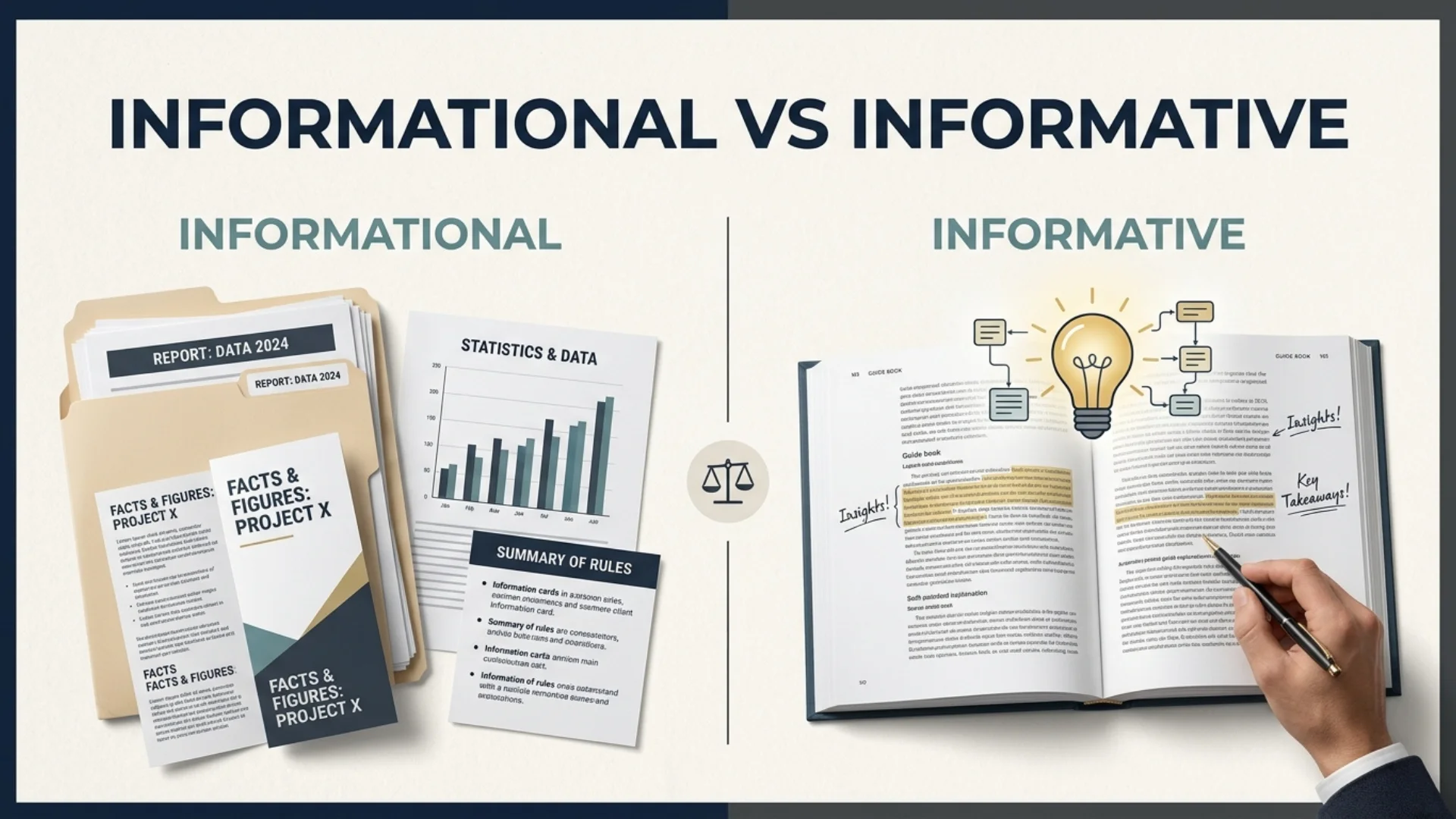
Informational vs informative is a subtle English usage question because both adjectives relate to information and often overlap. The practical difference is usually this: informational describes something that contains, relates to, or is intended to provide information, while informative describes something that actually gives useful knowledge or helps someone understand a subject better.
An informational brochure is a brochure designed to give information. An informative brochure is one you judge to be useful, educational, or revealing. In many contexts both words are possible, but the emphasis changes.
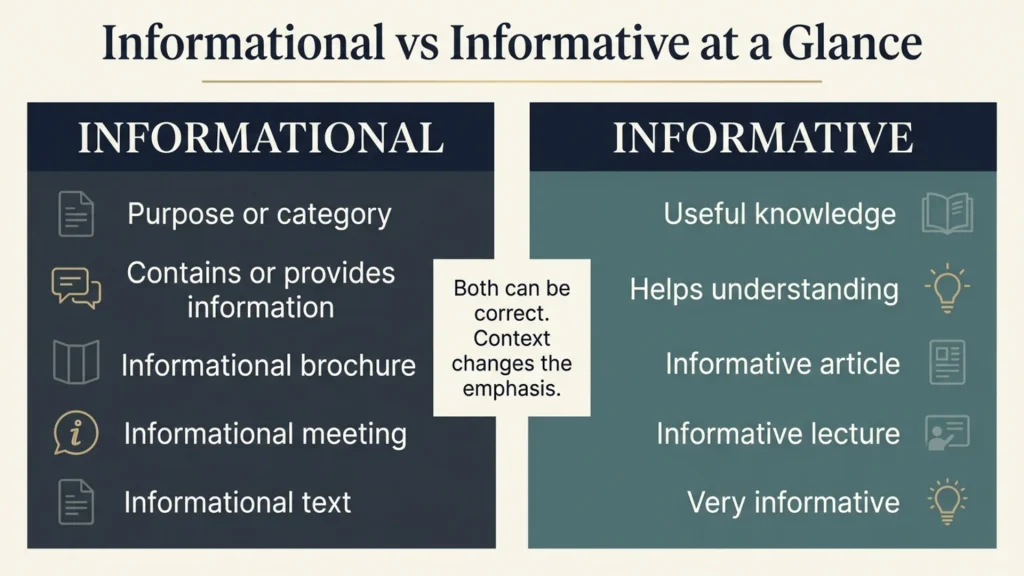
Quick Answer: Informational vs Informative
| Word | Core Meaning | Typical Use | Example |
|---|---|---|---|
| Informational | Containing, relating to, or intended to provide information | Purpose, category, function | We received an informational packet. |
| Informative | Providing useful information or knowledge | Usefulness, educational value, result | The presentation was very informative. |
A useful memory trick is:
- Informational = what something is for.
- Informative = how useful the information is.
That is a helpful distinction, not an absolute law. Standard dictionary definitions overlap, so some sentences can correctly use either word.
What Does Informational Mean?
Informational is an adjective meaning containing information or relating to the provision of information. It often classifies a document, meeting, website, sign, resource, or activity by its purpose.
The Cambridge Dictionary definition of informational describes it as containing information and, in business usage, as relating to or providing information.
Common Informational Examples
- informational brochure
- informational website
- informational meeting
- informational document
- informational poster
- informational video
- informational interview
- informational materials
- informational text
- informational campaign
In these phrases, informational usually tells us the purpose or type of the thing.
Informational in a Sentence
- The school sent an informational packet to new students.
- We attended an informational meeting about the program.
- The website contains informational resources for parents.
- The museum installed several informational signs beside the exhibits.
- The company created an informational video explaining the new policy.
What Does Informative Mean?
Informative is an adjective meaning providing useful information, knowledge, or understanding. It often evaluates the quality or usefulness of a book, talk, article, lesson, explanation, or discussion.
Common Informative Examples
- informative article
- informative presentation
- informative discussion
- informative book
- informative guide
- informative lecture
- informative explanation
- informative report
- informative answer
- informative video
Informative in a Sentence
- The lecture was surprisingly informative.
- Her article gives a clear and informative overview of the issue.
- Thank you for the informative presentation.
- The documentary was both entertaining and informative.
- His answer was brief but highly informative.
Informational vs Informative: The Main Difference
The easiest distinction is between classification and evaluation.
Informational Classifies
Use informational when you are describing the role, purpose, or category of something.
Example: “This is an informational booklet for new employees.”
The sentence tells us what kind of booklet it is. It does not necessarily say whether the booklet is useful, clear, or well written.
Informative Evaluates
Use informative when you are saying that something actually teaches, explains, or gives useful knowledge.
Example: “The booklet was very informative.”
Now the speaker is judging the booklet positively because it provided useful information.
Can Informational and Informative Be Interchangeable?
Sometimes, yes.
Because both words can describe material that gives information, there are sentences where either word works:
- an informational article
- an informative article
- an informational video
- an informative video
- an informational presentation
- an informative presentation
The difference is usually in emphasis.
| Phrase | What It Emphasizes |
|---|---|
| informational article | The article belongs to the category of content designed to provide information |
| informative article | The article successfully gives useful knowledge |
| informational presentation | The presentation is intended to inform |
| informative presentation | The presentation was useful and educational |
English, being English, refuses to provide a perfectly neat fence between two almost-identical adjectives. The distinction is useful, but context still matters.
Informative vs Informational Writing
Informative writing is the more common term for a mode of writing whose purpose is to explain, describe, or teach without primarily trying to persuade the reader.
Informational writing is also used, especially in educational contexts, and may refer to writing that presents factual information.
Informative Writing
Informative writing usually:
- explains a topic
- presents facts
- defines terms
- describes a process
- compares ideas
- answers how or why questions
- aims to improve understanding
Informational Writing
Informational writing often emphasizes the factual or explanatory purpose of the text. In classrooms, the related term informational text is widely used for nonfiction writing designed to inform, explain, or describe.
So if you are naming a school writing mode, informative writing often sounds more natural. If you are classifying the type or function of a text, informational text is especially common.
Informational Text vs Informative Text
Both expressions can be grammatical, but they do slightly different jobs.
- Informational text usually identifies a type of nonfiction text whose purpose is to present facts, explanations, or ideas.
- Informative text usually suggests that the text is useful or effective at informing the reader.
For example:
“Students analyzed the features of informational text.”
Here, informational names a category.
“The article was clear and informative.”
Here, informative evaluates the article.
Informational Features
The phrase informational features can have several meanings depending on context. In reading and education, informational text features may include:
- headings
- subheadings
- captions
- tables
- charts
- diagrams
- glossaries
- indexes
- labels
- fact boxes
These features help readers locate and understand factual material quickly.
Informational Purposes
Something created for informational purposes is intended to provide information rather than, for example, constitute legal advice, make a binding offer, entertain, or persuade.
Common phrases include:
- for informational purposes only
- provided for informational purposes
- informational use
- informational material
- informational resource
Here, informational is usually better than informative because the sentence is describing purpose, not judging usefulness.
Informational Session vs Information Session
Both informational session and information session are grammatical and widely used.
Information Session
Information session uses the noun information as a modifier. It is a very natural phrase for a meeting where an organization explains a program, job, course, application process, or service.
Example: “The university is holding an information session for applicants.”
Informational Session
Informational session uses the adjective informational and means essentially the same thing: a session intended to provide information.
Example: “Join our informational session to learn about the fellowship.”
You do not need to “correct” one to the other automatically. Both occur in professional and academic English.
Informational Social Influence vs Informative Influence
In psychology, the established term is informational social influence.
It describes situations in which people accept information from others as evidence about reality, often because they believe the group knows more or is more likely to be correct.
Informative influence is not the standard name for this social-psychology concept. This is one case where replacing informational with informative changes established terminology rather than merely changing style.
Is Informational a Word?
Yes. Informational is a standard English adjective.
It is especially common before nouns:
- informational brochure
- informational meeting
- informational content
- informational resource
- informational interview
It is not an error, unnecessary jargon, or a fake corporate word, despite occasionally sounding like one.
Is Informative a Word?
Yes. Informative is a standard English adjective and is often used after linking verbs such as be, seem, and find.
- The article was informative.
- The lecture seemed informative.
- I found the guide informative.
This pattern is one reason informative often sounds more natural when giving an opinion about something.
Is “Very Informative” Correct?
Yes. Very informative is completely standard English.
Examples:
- That was a very informative meeting.
- Your explanation was very informative.
- I found the course very informative.
- The article is concise but very informative.
You can also use:
- highly informative
- extremely informative
- particularly informative
- surprisingly informative
- useful and informative
Can a Person Be Informative?
Yes, although English speakers more often describe a person’s comments, explanation, presentation, answer, or conversation as informative.
These are natural:
- She was very informative during the interview.
- The guide was friendly and informative.
- Our instructor was informative without overwhelming us.
If you mean the person knows a lot, words such as knowledgeable, well-informed, or informed may be more precise.
Informational as an Adjective, Not a Noun
Informational is normally an adjective.
Correct:
- informational material
- informational content
- informational purposes
The base noun is information.
So:
- information = noun
- informational = adjective
- informative = adjective
- inform = verb
Informational or Information?
Use information when you need a noun.
Correct: “We need more information.”
Use informational when you need an adjective describing a noun.
Correct: “We need more informational materials.”
Do not write:
Incorrect: “We need more informational.”
Unless a highly specialized context has turned the adjective into a nominal expression, standard everyday English expects a noun after informational.
Informational Synonyms
The best synonym depends on the noun being described.
- information-related
- explanatory
- factual
- descriptive
- educational
- instructional
- reference
- advisory
Not every synonym is interchangeable. For example, an informational notice may be factual without being educational.
Informative Synonyms
Common synonyms for informative include:
- instructive
- educational
- enlightening
- illuminating
- useful
- helpful
- revealing
- explanatory
- insightful
If you are praising a guide, lecture, or article, instructive, enlightening, and useful are often good alternatives.
What Is the Opposite of Informative?
There is no single perfect antonym for every sentence. Depending on context, you might use:
- uninformative
- unhelpful
- vague
- misleading
- confusing
- empty
- superficial
Uninformative is the most direct grammatical opposite.
Common Spelling Mistakes
The correct spellings are:
- informational
- informative
Common incorrect spellings include:
- imformational
- imformative
- informitive
- informatonal
- informaitonal
A simple spelling cue is to keep the base word inform visible in your mind:
inform → information → informational
inform → informative
Informative Meaning in Hindi
Informative can be translated into Hindi as ज्ञानवर्धक, meaning something that increases knowledge. Depending on context, सूचनाप्रद or सूचनात्मक can also be used for something that provides information.
The exact translation depends on whether the English sentence emphasizes useful knowledge or simply the provision of information.
Informative and “Informatif”
In Indonesian, informatif is used for something that provides useful information or is informative. English learners sometimes search phrases such as informatif adalah or apa itu informatif; in English, the closest everyday adjective is usually informative.
Which Word Should You Use?
| If You Mean… | Usually Choose |
|---|---|
| Designed to provide information | Informational |
| Contains information | Informational |
| Belongs to an information-related category | Informational |
| Gave me useful knowledge | Informative |
| Helped me understand something | Informative |
| Educational or enlightening | Informative |
More Examples: Informational or Informative?
Brochure
Informational brochure: a brochure intended to provide information.
Informative brochure: a brochure that provides useful information effectively.
Meeting
Informational meeting: a meeting whose purpose is to explain something.
Informative meeting: a meeting you found useful and educational.
Website
Informational website: a website mainly designed to provide facts or reference material.
Informative website: a website that successfully teaches or explains.
Video
Informational video: a video made to communicate information.
Informative video: a video that actually gives useful knowledge.
Report
Informational report: a report whose role is to present information.
Informative report: a report judged to be useful or enlightening.
A Simple Test for Choosing the Right Word
Ask one question:
Am I describing the purpose/type, or am I evaluating the usefulness?
- If it is about purpose or category, choose informational.
- If it is about usefulness or learning value, choose informative.
If either interpretation works, both words may be acceptable.
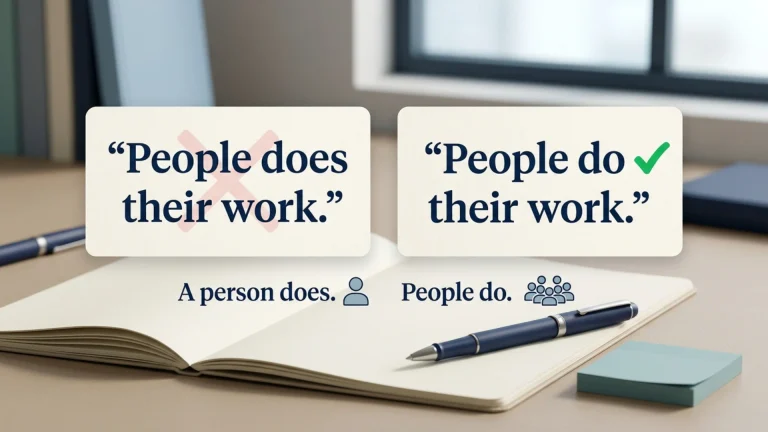
This type of near-identical grammar choice is similar to other usage questions where a sentence can be grammatical but still sound more natural one way. Our guides to People Do or People Does and Was There or Were There cover two other common English form choices.
Frequently Asked Questions
Is It Correct to Say “Very Informative”?
Yes. Very informative is standard English and means very useful in providing information or knowledge.
Is “Informational” a Word?
Yes. Informational is a standard adjective meaning containing, relating to, or providing information.
What Are Examples of Informational Writing?
Examples include factual reports, explanatory articles, textbooks, instructions, encyclopedia entries, brochures, reference guides, and nonfiction texts designed primarily to inform.
What Does It Mean If Something Is Informative?
It means the thing gives useful information, knowledge, or understanding. Calling a lecture informative is usually a positive evaluation.
Which Is Correct: “Informational” or “Informative”?
Both are correct. Use informational for purpose, type, or relation to information; use informative when emphasizing useful knowledge or educational value.
What Is a Better Word for “Informative”?
Depending on context, good alternatives include instructive, educational, enlightening, illuminating, useful, helpful, and insightful.
What Is Another Word for “Informational”?
Possible alternatives include factual, explanatory, educational, reference, descriptive, and information-related, depending on the sentence.
Can You Describe a Person as Informative?
Yes. A person can be informative if they provide useful information, although knowledgeable or well-informed may sound more natural when describing the person generally.
What Is the Opposite of Informative?
Uninformative is the most direct opposite. Depending on context, vague, unhelpful, confusing, superficial, or misleading may also fit.
Final Answer
The difference between informational vs informative is mainly one of emphasis. Informational usually describes something connected with, containing, or intended to provide information. Informative usually describes something that successfully gives useful knowledge or improves understanding.
So an event can be informational because its purpose is to give information, and the same event can also be informative if attendees actually learn something useful from it.