Goodbye vs Good Bye vs Good-bye: Which Spelling Is Correct?
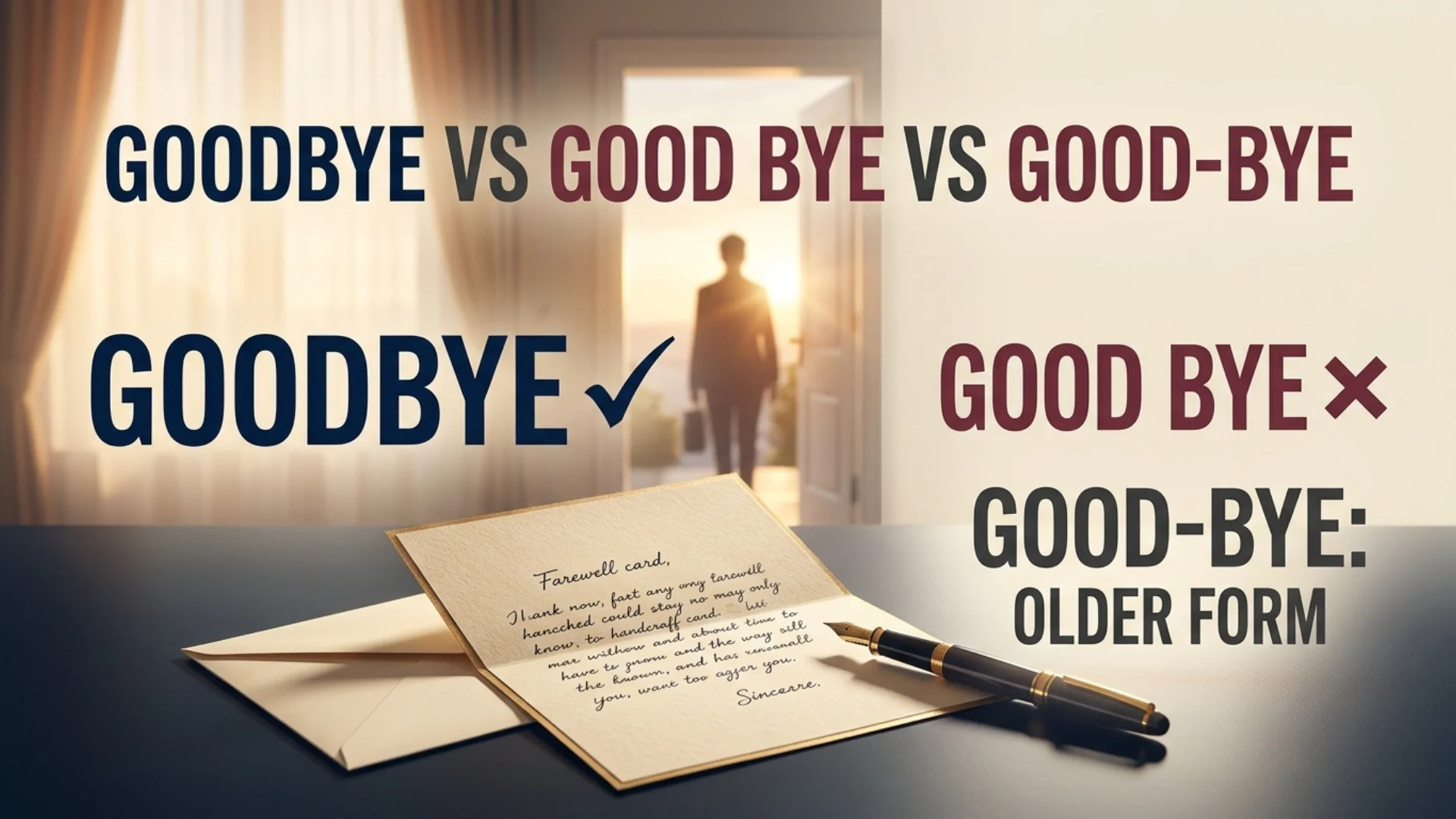
Goodbye vs Good Bye vs Good-bye looks like a choice between three reasonable spellings, but modern English strongly favors one form: goodbye.
The practical rule is simple:
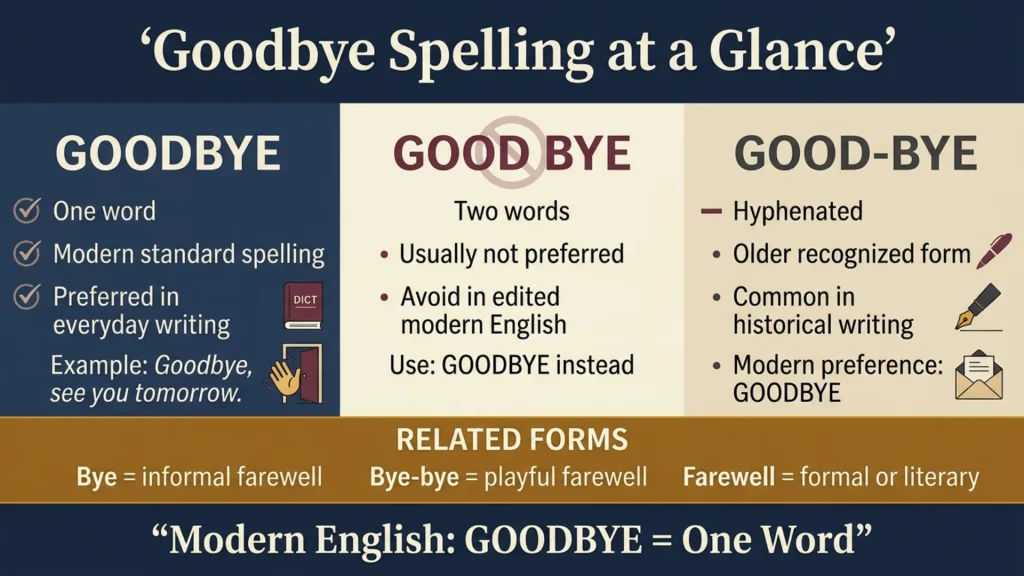
Goodbye is the standard modern spelling.
Good-bye is an older hyphenated variant that still appears occasionally.
Good bye as two separate words is generally not the preferred spelling in edited modern English.
So if you are writing an email, essay, article, message, letter, or social media post and want the safest form, write goodbye.
Quick Answer: Goodbye, Good Bye, or Good-bye?
| Form | Modern Status | Best Use |
|---|---|---|
| Goodbye | Standard and preferred | General modern English |
| Good-bye | Older variant | Historical or intentionally old-fashioned writing |
| Good bye | Usually avoided | Not the standard modern form |
| Good by | Incorrect for the farewell | Avoid |
Major modern dictionaries list goodbye as the standard headword and define it as the expression used when someone leaves. Cambridge Dictionary
Is Goodbye One Word?
Yes. Goodbye is normally written as one word in modern English.
Correct:
Goodbye, Sarah. See you tomorrow.
Less preferred:
Good bye, Sarah.
Older variant:
Good-bye, Sarah.
If you are wondering whether goodbye is one word or two, the modern answer is straightforward: write it as one word.
Also check: Impatient vs Inpatient
Why Do People Write “Good Bye”?
The confusion makes sense because good and bye are both recognizable English words.
Writers see expressions such as:
- good morning
- good evening
- good night
and naturally assume goodbye should follow the same pattern.
It does not.
Goodbye has become an established single word, while good morning and good night remain separate expressions.
English could have made all of these follow one tidy pattern. It declined the opportunity, naturally.
Is “Good Bye” Correct?
In modern edited English, good bye is generally not the preferred spelling.
You may encounter it in:
- informal messages
- older writing
- learner English
- stylized writing
- accidental spacing
But if your goal is standard contemporary spelling, use:
goodbye
Example:
We said goodbye before leaving.
Not:
We said good bye before leaving.
Is “Good-bye” Correct?
Good-bye is a historical and still recognizable variant, but it looks dated compared with goodbye.
You are most likely to encounter the hyphenated spelling in:
- older novels
- historical documents
- older dictionaries
- vintage correspondence
- deliberately old-fashioned writing
For ordinary modern writing, there is usually no reason to add the hyphen.
Modern
She waved goodbye.
Older Style
She waved good-bye.
Both are understandable, but goodbye is the cleaner contemporary choice.
Is Goodbye Hyphenated?
Usually, no.
The standard modern form is:
goodbye
not:
good-bye
The hyphenated spelling has historical legitimacy, but modern spelling has largely settled on the closed form.
If you are writing for a specific publisher or organization with its own style guide, follow that guide. Otherwise, goodbye is the safest choice.
Goodbye vs Good Bye vs Good-bye at a Glance
| Question | Answer |
|---|---|
| Is goodbye one word? | Yes |
| Is good bye standard? | Usually no |
| Is good-bye possible? | Yes, but old-fashioned |
| Which spelling should I use? | Goodbye |
| Is bye a real word? | Yes |
| Can goodbye be a noun? | Yes |
| Can goodbye be an exclamation? | Yes |
| Is goodbye hyphenated today? | Usually no |
What Does Goodbye Mean?
Goodbye is used when someone is leaving or when people are parting.
It can function as an exclamation:
Goodbye! Have a safe trip.
It can also function as a noun:
Their goodbye was surprisingly emotional.
I never got a chance to say goodbye.
The exact emotional weight depends on context.
A goodbye can be:
- casual
- affectionate
- formal
- sad
- permanent
- temporary
- dramatic
- routine
Saying goodbye to a coworker until tomorrow is very different from saying goodbye to someone moving to another country, even though the spelling remains mercifully unchanged.
Goodbye as an Exclamation
As an exclamation, goodbye directly marks a departure.
Examples:
Goodbye, everyone!
Goodbye, and thank you for your help.
Goodbye. I’ll call you tomorrow.
The word can stand alone or appear inside a longer farewell.
Goodbye as a Noun
As a noun, goodbye refers to the act or words of parting.
Examples:
We exchanged quick goodbyes.
That was a difficult goodbye.
She left without saying goodbye.
The plural is:
goodbyes
not:
goodbye’s
The apostrophe version would normally indicate possession, not a plural.
Goodbye vs Bye
Bye is a shorter and more informal version of goodbye.
Compare:
Goodbye, Professor Williams.
Bye, Jack!
Both are correct.
Goodbye can sound more complete or deliberate, while bye often sounds lighter and more casual.
Neither is automatically rude.
Goodbye vs Bye-Bye
Bye-bye is more playful and informal than either goodbye or bye.
It is common:
- with young children
- between family members
- in affectionate conversation
- in deliberately playful speech
For professional communication, goodbye or another formal closing is usually more appropriate.
When Should You Use Goodbye?
Use goodbye when you want a neutral, universally understood farewell.
It works naturally in:
| Context | Example |
|---|---|
| Conversation | Goodbye, see you soon. |
| Goodbye, and thanks again for your help. | |
| Travel | We said goodbye at the airport. |
| Work | She said goodbye to her colleagues. |
| Emotional parting | It was difficult to say goodbye. |
| Storytelling | He turned, waved goodbye, and left. |
Is Goodbye Formal or Informal?
Goodbye is neutral enough for both formal and informal situations.
Its tone depends largely on what surrounds it.
Compare:
Goodbye, Mr. Harrison. Thank you for your time.
with:
Goodbye! See you tomorrow!
The first sounds professional.
The second sounds casual.
The spelling does not change.
Can You Use Goodbye in an Email?
Yes, although it is less common as a conventional email sign-off than phrases such as:
Regards, Best wishes, Sincerely, or Take care.
At the end of a final conversation, however, goodbye may be perfectly appropriate.
Example:
Thank you for all your support over the past three years. Goodbye, and I wish everyone on the team continued success.
For an ordinary Tuesday email to someone you will message again in forty minutes, goodbye may sound unnecessarily final.
Goodbye vs Farewell
Farewell and goodbye overlap, but their tones differ.
Goodbye is neutral and everyday.
Farewell often sounds:
- more formal
- more emotional
- literary
- ceremonial
- permanent
Compare:
Goodbye, I’ll see you next week.
with:
Farewell, my old friend.
The second clearly has more dramatic furniture in the room.
Goodbye vs See You Later
See you later suggests that another meeting is expected.
Goodbye does not make the same promise.
Compare:
See you later!
This implies another meeting.
Goodbye.
This may be temporary or permanent depending on context.
For casual everyday departures, see you, see you later, and catch you later can sound warmer than a bare goodbye.
Goodbye vs Good Night
These are not interchangeable.
Goodbye marks departure.
Good night is normally used when parting late in the day, going to sleep, or wishing someone a pleasant night.
Example:
Goodbye. I’ll see you next month.
Good night. Sleep well.
You can even use both together:
Goodbye, and good night.
How Do You Spell Goodbye?
Correct modern spelling:
G-O-O-D-B-Y-E
Correct:
goodbye
Common alternatives and mistakes include:
good bye
good-bye
good by
If you only want one spelling to remember, keep:
goodbye
Is It “Good By” or “Goodbye”?
Use goodbye.
Good by is not the normal spelling of the farewell.
The word by has completely different grammatical uses:
Stand by the door.
The book was written by Orwell.
That has nothing to do with the farewell bye.
What Does “Bbye” Mean in Chat?
Bbye is an informal chat spelling usually intended to mean bye-bye or simply bye.
It is not standard formal English.
Examples:
Bbye, talk tomorrow!
Okay bbye ❤️
You might see similar informal spellings such as:
byee
byeee
bai
bb
Their meanings depend on the conversation and community.
For edited writing, use bye or goodbye.
Why Do People Say Goodbye Instead of Bye?
Goodbye can sound more complete, intentional, or formal.
Bye is shorter and more casual.
Compare:
Goodbye, and thank you for everything.
with:
Bye!
The first may fit an important departure.
The second works beautifully when someone is merely going to the supermarket.
Neither form is inherently better. The situation determines which sounds natural.
How to Say Goodbye in a Classy Way
If goodbye feels too plain for a formal or elegant situation, alternatives include:
| Situation | Elegant Farewell |
|---|---|
| Professional | It was a pleasure speaking with you. |
| Friendly | Until next time. |
| Formal | Wishing you all the best. |
| Warm | Take good care of yourself. |
| Emotional | I’ll remember our time together fondly. |
| Traditional | Farewell, and best wishes. |
| Future-focused | I hope our paths cross again. |
These sound more polished because they add context rather than replacing goodbye with a magically sophisticated synonym.
What Is the Kindest Way to Say Goodbye?
A kind goodbye usually combines the farewell with warmth or appreciation.
For example:
Take care of yourself.
Thank you for everything.
I hope we see each other again soon.
Wishing you happiness in what comes next.
I’ll miss you. Please stay in touch.
The kindest wording depends on the relationship.
A farewell to a retiring coworker should probably not sound like the final scene of a tragic romance.
What Is the Coolest Way to Say Goodbye?
Casual alternatives include:
Later
Catch you later
See ya
Peace
I’m out
Until next time
Take it easy
Catch you around
“Cool” language ages quickly, so use slang that fits your actual social group instead of borrowing vocabulary from a teenager on TikTok and hoping nobody notices.
How Does Gen Z Say Goodbye?
There is no single official Gen Z farewell.
Depending on the person, platform, and context, you may see:
bye
byeee
later
cya
ttyl
peace
I’m out
gtg
see u
Stretching letters, such as byeee, can make a message feel friendlier, playful, dramatic, or sarcastic depending on context.
These are texting conventions, not formal spelling replacements for goodbye.
What Does “Farewell but Not Goodbye” Mean?
The phrase generally means:
We are parting now, but I do not consider this the end of our relationship.
It expresses hope that the people involved will meet, speak, or reconnect again.
That makes it especially suitable for:
- retirement
- graduation
- relocation
- leaving a workplace
- temporary separation
It is more emotional than an ordinary see you later.
Why Shouldn’t We Say Goodbye?
There is no grammatical rule saying you should not say goodbye.
Some people personally avoid the word because it can feel:
- too final
- emotionally heavy
- formal
- associated with permanent separation
They may prefer:
see you later
until next time
take care
see you soon
That is a matter of emotion, culture, or personal preference, not correctness.
What Is the Four-Word Trick to Say Goodbye?
There is no universally recognized grammar rule called the four-word trick to say goodbye.
Different relationship, communication, and social-media advice sources use different four-word farewell formulas.
A practical four-word goodbye could be:
Take care of yourself.
or:
Hope to see you.
or:
Until we meet again.
These are examples of concise farewells, not official English-language rules.
Goodbye in Text Messages
In texting, goodbye may feel slightly more serious than bye.
Compare:
Bye 😊
with:
Goodbye.
The second can look final or emotionally distant when written without extra context.
Texting tone can change dramatically through:
- punctuation
- emojis
- capitalization
- stretched spellings
- surrounding sentences
For example:
BYE 😂
does not communicate the same emotional tone as:
Goodbye.
Grammar has survived worse. Relationships may not.
Goodbye in Formal Writing
Use goodbye if the word itself is needed.
Examples:
The retiring director said goodbye to the staff.
Her farewell speech gave employees an opportunity to say goodbye.
The final chapter says goodbye to several long-running characters.
Avoid casually switching between goodbye and good-bye within the same piece.
Consistency matters.
Goodbye in British and American English
Goodbye works in both modern British and American English.
The hyphenated good-bye is historically familiar in both traditions, but the closed form is now the practical default for contemporary writing.
You therefore do not need separate American and British spellings in normal modern usage.
Goodbye in Indonesian Searches
English learners may search phrases such as goodbye atau good bye, meaning they are trying to determine whether English uses the joined or separated form.
The correct modern English spelling is:
goodbye
In Indonesian, goodbye may be translated depending on context with farewell expressions such as selamat tinggal or sampai jumpa.
The exact translation changes depending on whether the separation is temporary or more final.
“Goodbye Adalah” and “Arti Kata Goodbye”
For Indonesian learners, goodbye adalah essentially asks what goodbye is, while arti kata goodbye asks for its meaning.
The simple meaning is:
a farewell said when leaving or parting
It can correspond to different Indonesian farewell expressions depending on context.
What Does “गुड बाय” Mean?
Hindi learners sometimes write the English pronunciation as गुड बाय.
The English word goodbye means a farewell said when leaving.
Common Hindi equivalents can include अलविदा or other context-specific ways of taking leave.
The important English spelling rule remains:
goodbye, one word.
Goodbye or Good-bye in Other Languages
Search phrases such as goodbye ou good-bye or goodbye atau good-bye usually reflect learners comparing the two English forms.
Regardless of the learner’s native language, the modern English recommendation remains:
Use goodbye.
The hyphenated good-bye is understandable but dated.
Common Goodbye Spelling Mistakes
| Form | Recommendation |
|---|---|
| goodbye | Correct and preferred |
| good-bye | Older variant |
| good bye | Usually avoid |
| good by | Incorrect for farewell |
| goodby | Nonstandard variant in most modern writing |
| goodbeye | Misspelling |
| goodbuy | Wrong word entirely |
Easy Memory Rule
Remember:
If you are leaving, join the word before you leave.
good + bye = goodbye
Admittedly not linguistic scholarship of the century, but it does stop the space bar from getting involved.
Frequently Asked Questions
What does “bbye” mean in a chat?
Bbye usually means bye-bye or simply bye. It is an informal texting abbreviation rather than standard written English.
How do you say goodbye in a classy way?
Try “It was a pleasure,” “Until next time,” “Wishing you all the best,” or “I hope our paths cross again.” The best choice depends on how formal and emotional the situation is.
What does “farewell but not goodbye” mean?
It means that people are separating now but hope or expect their connection to continue. The phrase suggests that the separation is not considered permanent.
Why do people say goodbye instead of bye?
Goodbye can sound more complete, deliberate, or formal, while bye is shorter and more casual.
Why shouldn’t we say goodbye?
There is no grammatical reason to avoid goodbye. Some people prefer alternatives because goodbye can feel emotionally final.
What is the four-word trick to say goodbye?
There is no official English-language rule with that name. Short four-word farewells such as “Take care of yourself” or “Until we meet again” can work well depending on context.
What is the coolest way to say goodbye?
Casual options include later, peace, see ya, catch you later, take it easy, and I’m out. Which sounds natural depends heavily on the speaker and social setting.
How does Gen Z say goodbye?
There is no universal Gen Z version. Informal digital forms include bye, byeee, cya, ttyl, gtg, peace, later, and see u.
What is the kindest way to say goodbye?
Add warmth or appreciation: “Take care of yourself,” “Thank you for everything,” “I’ll miss you,” or “I hope we meet again soon.”
Is goodbye one word or two?
Goodbye is one word in standard modern English.
Is goodbye hyphenated?
Normally, no. Use goodbye. The older good-bye spelling is still recognizable but generally unnecessary in contemporary writing.
Final Thoughts
For Goodbye vs Good Bye vs Good-bye, the modern rule is easier than the number of search variations makes it look.
Use goodbye in normal contemporary writing.
Use good-bye only if you deliberately want an older spelling or are reproducing historical language.
Avoid good bye as the standard farewell spelling.
So whether you are writing a message, email, article, essay, or actual farewell, the safest form is:
Goodbye.
One word. No hyphen. No tiny grammatical farewell ceremony required.