Here Is or Here Are? Correct Usage, Grammar Rules & Examples
Handing someone a document, pointing at an arriving bus, or starting an email with an attachment — "here is" and "here are" are phrases English speakers use dozens of times a day. Yet choosing between them trips up learners and native speakers alike. Should you write "here is the details" or "here are the details"? Is "here's the keys" acceptable?
The confusion comes from word order. In most English sentences the subject comes first ("The keys are here"), but with "here is" and "here are" the order flips: the verb comes before the noun it agrees with. Once you understand that the verb must match the noun after it — not the word "here" — the choice becomes automatic. This guide gives you the rule, the exceptions, plenty of examples, and practice exercises so you never hesitate again.
Quick Answer: Here Is or Here Are?
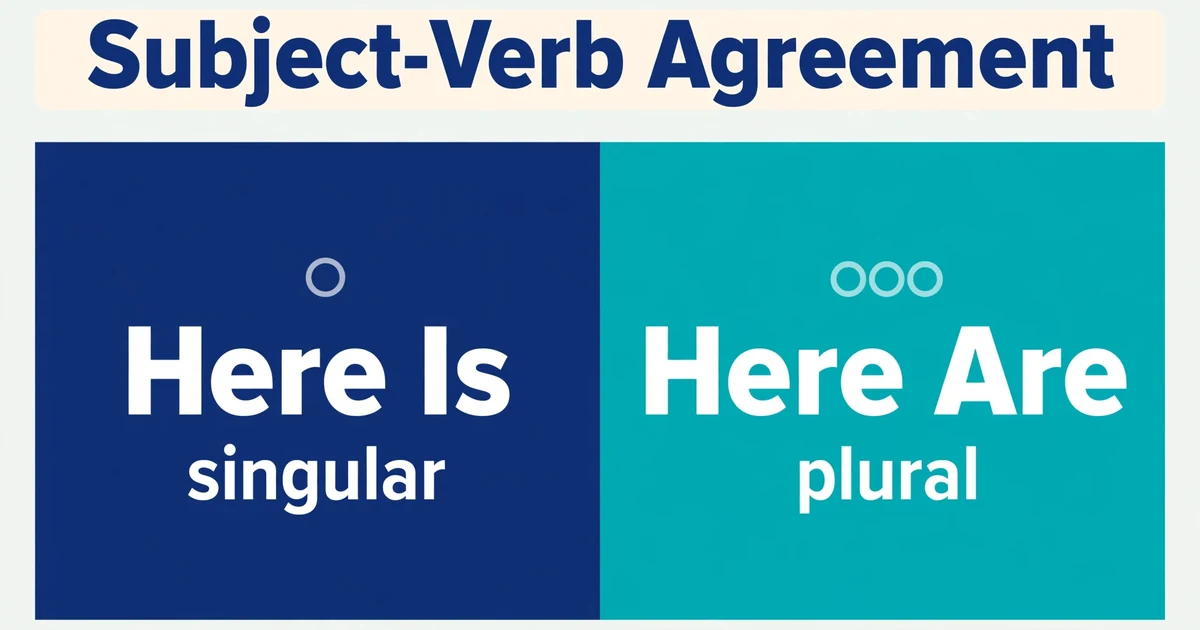
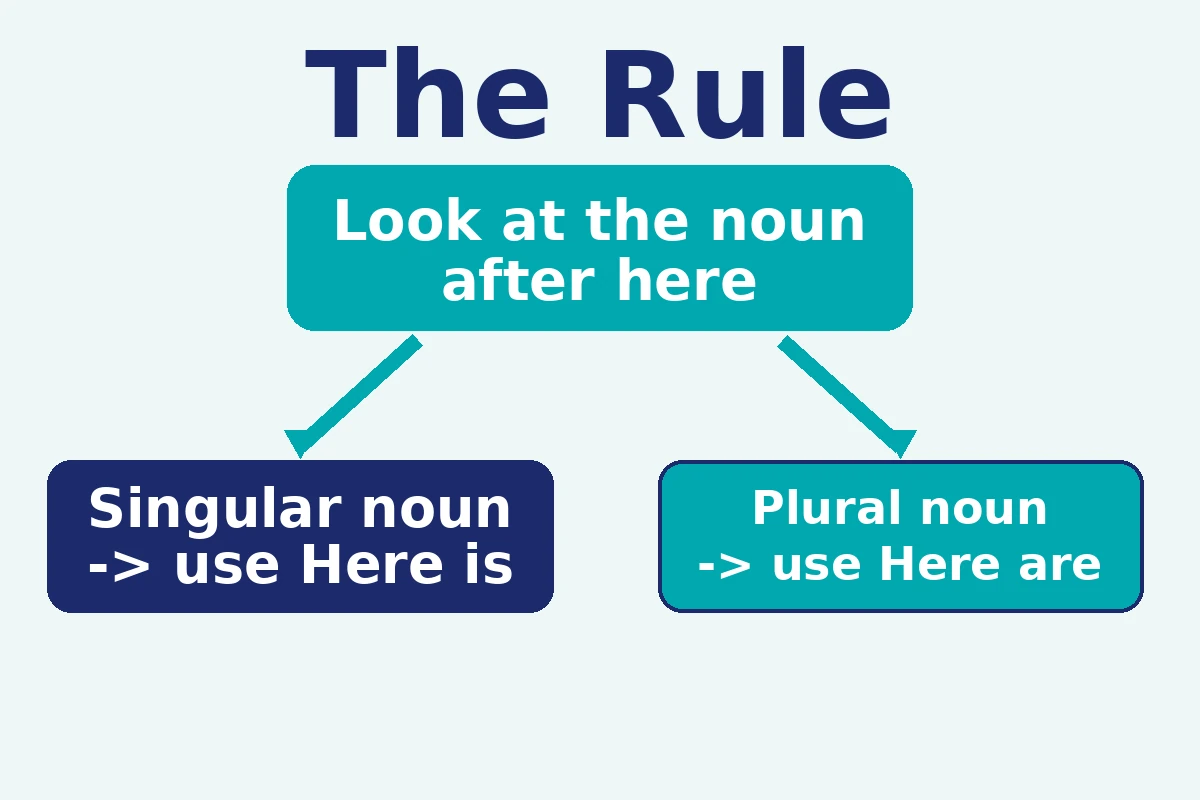
Use "here is" with singular nouns and uncountable nouns. Use "here are" with plural nouns. The word "here" is not the subject — the noun that follows the verb is. Match the verb to that noun.
- Here is your phone. (one phone → singular)
- Here are your keys. (many keys → plural)
- Here is some information. (information is uncountable → singular)
If you can replace the noun with "it," use "is." If you can replace it with "they," use "are": "It is your phone" → "Here is your phone." "They are your keys" → "Here are your keys."
The Grammar Behind It: Why the Verb Follows the Noun
In a normal English sentence, the subject comes before the verb: "The report is ready." But "here is" and "here are" use inverted word order — the verb comes first, and the real subject comes after it.
Think of "here" as a pointer word, not the subject. It simply announces that something is being presented. The grammatical subject is the noun phrase that follows:
- Here is [the report]. → "The report" is singular, so the verb is "is."
- Here are [the reports]. → "The reports" is plural, so the verb is "are."
This is the same pattern as "there is" and "there are," which also place the verb before the subject. The difference is meaning: "there is/are" states that something exists, while "here is/are" presents something to the listener — usually something visible, handed over, or just mentioned. For a full breakdown of the existential pattern, see our guide on there have been or there has been and was there or were there.
Grammar references describe this as subject-verb agreement applying to an inverted sentence: the verb still agrees with its subject in number, even though the subject appears after the verb. Purdue OWL's guide to subject-verb agreement covers the general principle that every verb must match its subject — and Cambridge's guide to agreement confirms the same rule across British and American English.
Comparison Table: Here Is vs Here Are
| Form | Use it with | Example | Correct? |
|---|---|---|---|
| Here is | Singular nouns (one person or thing) | Here is your passport. | Correct |
| Here is | Uncountable nouns (cannot be counted) | Here is some advice. | Correct |
| Here are | Plural nouns (more than one) | Here are your tickets. | Correct |
| Here is | A list beginning with a singular noun | Here is a pen and two notebooks. | Correct |
| Here are | A list beginning with a plural noun | Here are two pens and a notebook. | Correct |
| Here is | Plural nouns | Here is the files. | Wrong |
| Here are | Singular nouns | Here are the file. | Wrong |
Correct Examples in Real Contexts
Everyday conversation
- Here is your coffee.
- Here are your keys.
- Here is the book you asked for.
- Here are the photos from our trip.
- Here is some water for you.
- Here are the kids — they finally arrived!
Emails and business writing
- Here is the report you requested.
- Here are the attachments for your review.
- Here is a summary of yesterday's meeting.
- Here are the updated figures for the third quarter.
- Here is my feedback on your proposal.
Academic writing
- Here is the result of the survey.
- Here are the results of the survey.
- Here are the sources I cited in my essay.
- Here is the data table for reference. (In most writing, "data" is treated as a mass noun; in formal scientific style it can be plural — "here are the data.")
Presenting people
- Here is Dr. Smith.
- Here is our new manager, Anna.
- Here are my parents.
- Here are Tom and Jerry.
Lists
- Here is a pen, a notebook, and a ruler for you.
- Here are the main points: first, the budget; second, the timeline.
- Here is the list of winners. ("List" is singular — the verb agrees with "list," not "winners.")
Incorrect vs Correct: Common Mistakes Explained
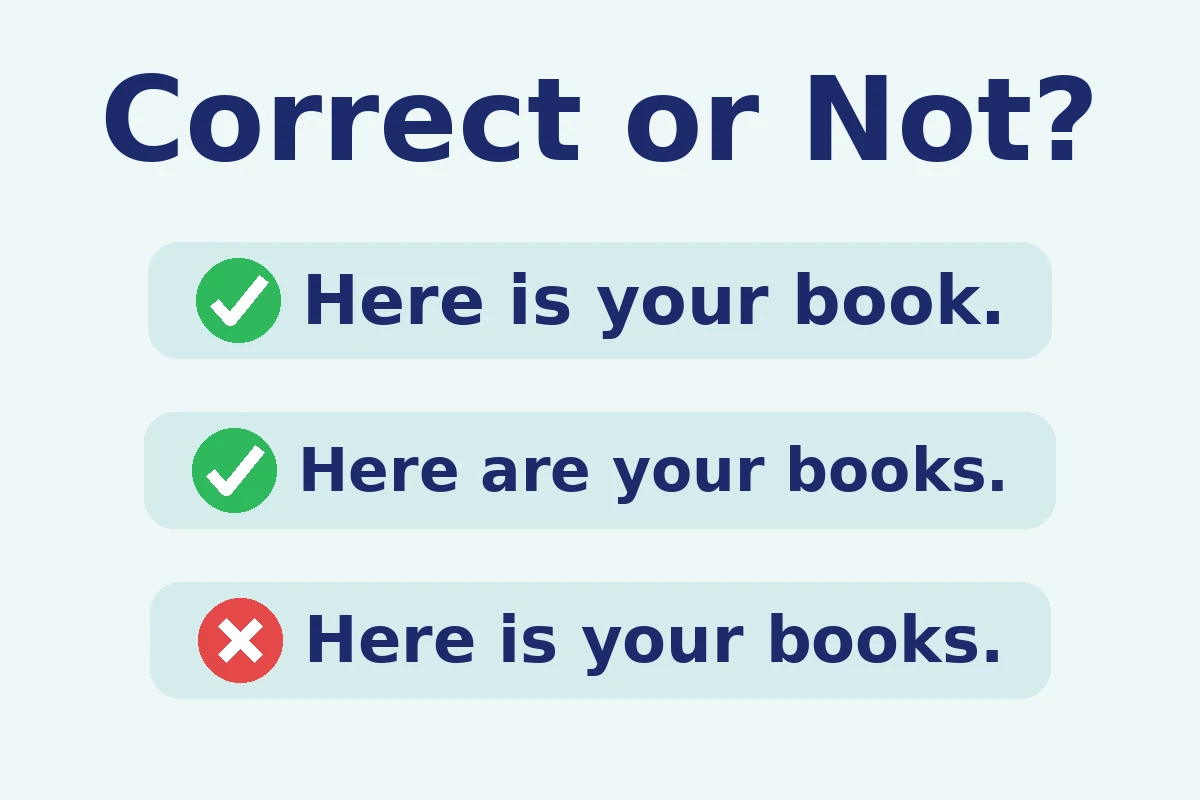
Incorrect: Here is the keys.
Correct: Here are the keys.
Why: "Keys" is plural, so the verb must be "are." The word "here" never decides the verb.
Incorrect: Here are the information you asked for.
Correct: Here is the information you asked for.
Why: "Information" is an uncountable noun. Uncountable nouns are always grammatically singular, even when they refer to a large amount.
Incorrect: Here's the documents.
Correct: Here are the documents.
Why: "Here's" is the contraction of "here is" only — it can never mean "here are." In casual speech people say "here's" before plurals, but avoid it in writing.
Incorrect: Here is John and Mary.
Correct: Here are John and Mary.
Why: Two people make a plural subject. (Note: "Here's John and Mary" is common in relaxed speech, but use "here are" in writing.)
Incorrect: Here is it.
Correct: Here it is.
Why: With pronouns, English uses normal word order — the pronoun comes before the verb. Likewise, say "here they are," never "here are they."
Incorrect: Here are a pen and a notebook.
Correct: Here is a pen and a notebook.
Why: In a list, the verb agrees with the first noun. "A pen" is singular, so use "is."
Rules and Exceptions
1. Uncountable nouns always take "is"
Words like information, advice, furniture, milk, water, news, and homework cannot be counted, so they are grammatically singular: "Here is some advice," "Here is the news." A frequent error is "here is some" vs "here are some" — the answer depends entirely on the noun: "here is some water" (uncountable) but "here are some cookies" (plural countable).
2. In lists, the verb agrees with the first noun
"Here is a pen and two notebooks" is correct because "a pen" comes first and is singular. Flip it — "Here are two notebooks and a pen" — and "are" becomes correct. This is called proximity agreement, and it is the standard rule taught for these constructions.
3. Collective nouns: American vs British English
In American English, collective nouns are usually singular: "Here is the team." In British English, a collective noun can take a plural verb when the speaker is thinking of the individual members: "Here are the team" is acceptable in British usage. When in doubt, treat collective nouns as singular — it is correct in both varieties.
4. "Here's" is only "here is"
The contraction "here's" always expands to "here is." There is no standard contraction of "here are" in writing (the spoken "here're" exists but is awkward and best avoided). So "here's your keys" is technically wrong, even though you will hear it in casual conversation.
5. Notional agreement in casual speech
You will often hear native speakers say "Here's the files" or "Here's John and Mary." This is notional or informal agreement — the speaker treats the phrase as a fixed chunk. It is widespread in speech but still considered incorrect in formal writing, exams, and professional emails.
6. Pronouns flip the order back
As shown above, pronouns don't follow the inverted pattern: "Here it is," "Here she comes," "Here they are." This is worth memorizing separately since learners often produce "here is it" by over-applying the rule. For more on tricky pronoun-verb pairings, see anyone has or anyone have.
Real-World Usage
In a workplace email, the correct form signals professionalism: "Here are the contracts for your signature" reads as careful; "Here is the contracts" reads as careless. Recruiters and managers do notice.
In customer service, the phrases are constant: "Here is your receipt," "Here are your boarding passes." Getting them right keeps the interaction smooth.
In academic writing, precision matters most with tricky nouns. "Here is the data" is fine in general writing, but some scientific journals require "data" as a plural ("here are the data") — check your style guide.
In conversation, don't stress about the informal "here's the keys." Native speakers say it all the time. Just keep it out of anything written and formal.
Easy Memory Technique: The It/They Swap
Whenever you hesitate, cover the word "here" with your thumb and replace the noun with a pronoun:
- "Here is your bag" → "It is your bag" → sounds right → use is.
- "Here are your bags" → "They are your bags" → sounds right → use are.
If "it is" fits, write "here is." If "they are" fits, write "here are." Two seconds, correct every time.
Practice Exercises
Choose "is" or "are" for each sentence.
- Here ___ the book you lent me.
- Here ___ some milk for your cereal.
- Here ___ the students waiting outside.
- Here ___ a list of the winners.
- Here ___ your parents at the door.
- Here ___ the information you asked for.
- Here ___ my umbrella and your raincoat.
Answer Key
- is — "book" is singular.
- is — "milk" is uncountable, always singular.
- are — "students" is plural.
- is — the verb agrees with the head noun "list" (singular), not "winners."
- are — "parents" is plural.
- is — "information" is uncountable, always singular.
- is — in a list, the verb agrees with the first noun ("umbrella" is singular).
Frequently Asked Questions
Is "here is" singular or plural?
"Here is" is singular. Use it with singular nouns ("here is your ticket") and uncountable nouns ("here is some news"). For plural nouns, always use "here are."
Is it "here is some" or "here are some"?
It depends on the noun after "some." Use "here is some" with uncountable nouns ("here is some water") and "here are some" with plural countable nouns ("here are some cookies").
When should I say "is" or "are"?
Look at the noun that comes right after "here." One thing or an uncountable noun → "is." More than one thing → "are." Ignore the word "here" itself — it never controls the verb.
What does "here is" mean?
It is a presentational phrase used to point out, hand over, or introduce something that is present or just mentioned: "Here is your change." It is the counterpart of "there is," which states that something exists somewhere.
Can I use "here's" with plural nouns?
In casual speech, many native speakers do ("here's the keys"), but it is grammatically incorrect because "here's" only means "here is." Avoid it in writing, exams, and professional communication.
Do American and British English treat "here is/are" differently?
The core rule is identical in both: singular → "is," plural → "are." The only notable difference involves collective nouns — British English sometimes allows "here are the team" (thinking of members), while American English prefers "here is the team."
Conclusion
The entire rule fits in one sentence: the verb after "here" agrees with the noun that follows it — "is" for one thing or an uncountable noun, "are" for more than one thing. Remember that "here" itself is never the subject, watch out for uncountable nouns like "information" and "advice," and keep "here's" away from plurals in writing.
Use the it/they swap test whenever you hesitate, and the choice will quickly become automatic. For related tricky agreements, you may also like our guides to there have been or there has been, was there or were there, and that's mean vs that means.