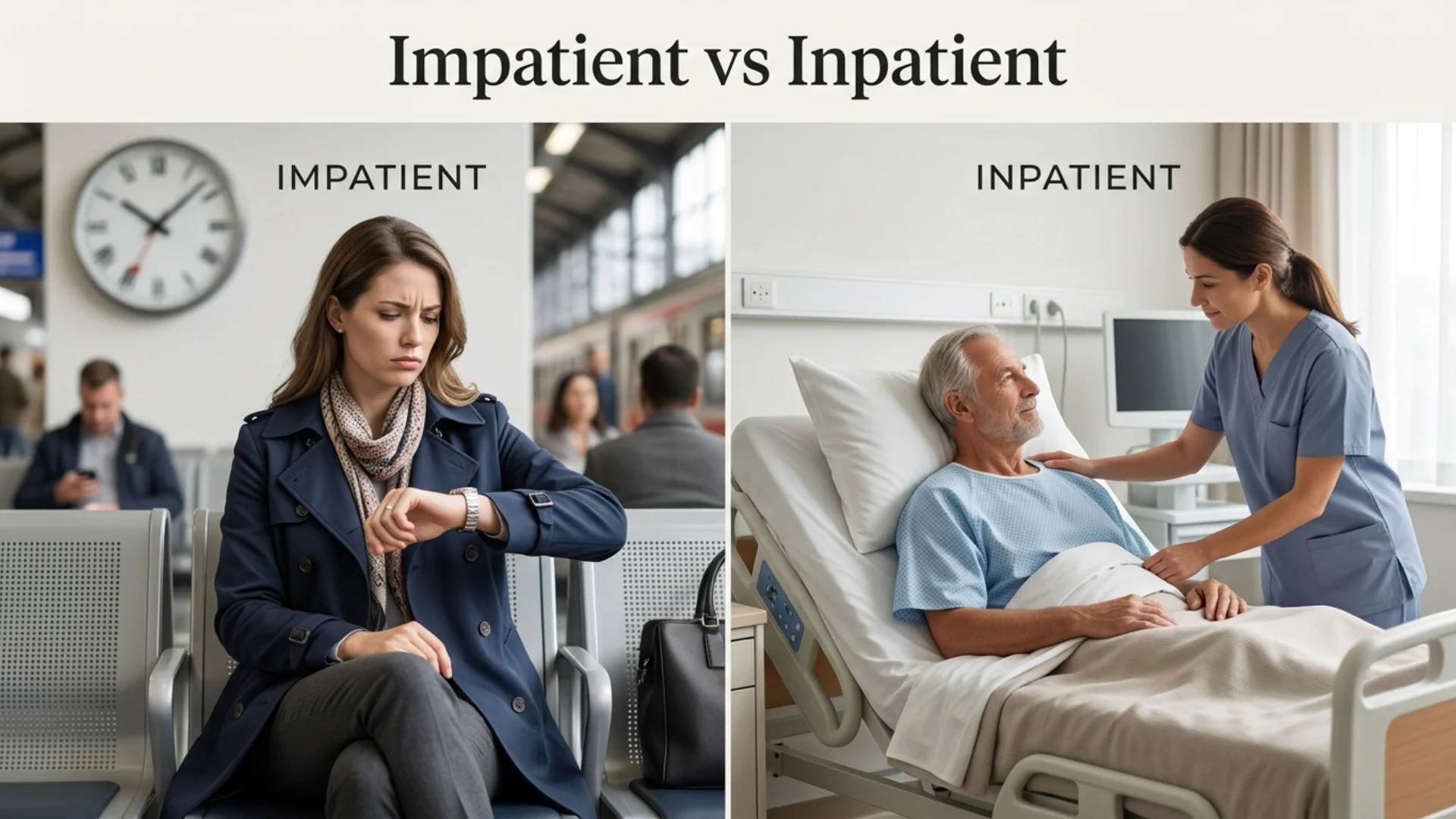
Impatient vs Inpatient: Meaning, Difference & Correct Usage
Impatient and inpatient are both correct English words, but they mean completely different things.
Use impatient when someone is unable or unwilling to wait calmly.
Use inpatient when talking about a person who has been admitted to a hospital or healthcare facility for treatment.
The easiest way to remember the difference is:
- Impatient = not patient
- Inpatient = admitted for medical care
Example:
The inpatient became impatient while waiting for the doctor.
Both words are correct in that sentence. One describes the person’s medical status, while the other describes the person’s mood.
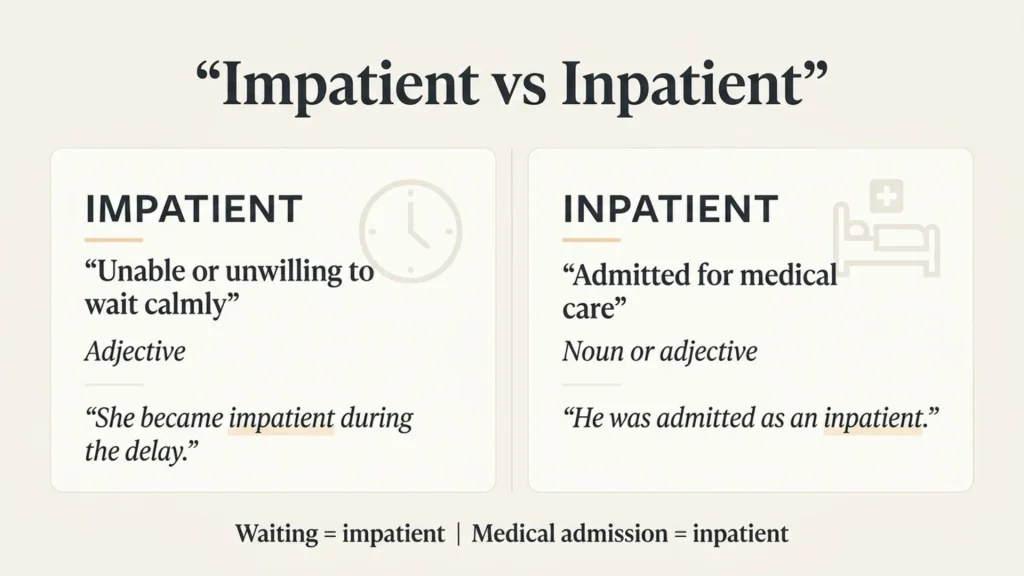
Impatient vs Inpatient: Quick Difference
| Word | Meaning | Part of Speech | Example |
|---|---|---|---|
| Impatient | Unable or unwilling to wait calmly | Adjective | She became impatient during the delay. |
| Inpatient | A person admitted for medical care | Noun or adjective | He was admitted as an inpatient. |
So if the sentence is about waiting, irritation, restlessness, or eagerness, use impatient.
If it is about hospital admission, treatment, healthcare, or a medical facility, use inpatient.
What Does Impatient Mean?
Impatient is an adjective meaning that someone does not want to wait calmly or becomes annoyed because something is taking too long.
Examples:
- She became impatient while waiting for the bus.
- The customer sounded impatient.
- He is impatient with slow service.
- The children grew impatient during the delay.
- I am impatient to hear the results.
In each example, the word describes a feeling, attitude, or behavior.
Impatient Can Also Mean Eager
Impatient does not always mean angry.
It can also describe strong eagerness for something to happen.
Example:
She was impatient to begin her new job.
Here, she is eager to start rather than necessarily irritated.
What Does Inpatient Mean?
Inpatient is mainly a medical term.
As a noun, an inpatient is a person who has been formally admitted to a hospital or similar healthcare facility for treatment.
Example:
The doctor checked on the inpatient.
It can also work as an adjective.
Examples:
- inpatient care
- inpatient treatment
- inpatient services
- inpatient unit
- inpatient facility
- inpatient rehabilitation
- inpatient admission
According to the Merriam-Webster definition of inpatient, an inpatient is a hospital patient who receives lodging and food while undergoing treatment.
That medical meaning has nothing to do with whether the person is patient or impatient emotionally.
Also check: Mother Tongue vs Native Language
Impatient or Inpatient: Which One Should You Use?
Ask one question:
Is the sentence about emotion or medical care?
If it is about frustration, waiting, or eagerness:
Use impatient.
If it is about an admitted medical patient:
Use inpatient.
Examples
Correct:
She was impatient while waiting for her order.
Incorrect:
She was inpatient while waiting for her order.
Correct:
The hospital admitted him as an inpatient.
Incorrect:
The hospital admitted him as an impatient.
The second mistake is particularly unfortunate because it sounds as though the hospital is officially admitting people based on how annoyed they are. Healthcare paperwork already has enough problems.
Why Are Impatient and Inpatient So Easy to Confuse?
The words look nearly identical:
impatient
inpatient
Only one letter changes near the beginning.
They also both contain the word patient, which itself has two different meanings.
Patient as an Adjective
Patient can mean able to wait calmly.
Example:
She is very patient with children.
The opposite is:
She is impatient with children.
Patient as a Noun
A patient can also mean someone receiving medical treatment.
Example:
The patient spoke with the doctor.
This second meaning is what appears inside inpatient.
That double meaning of patient is one major reason people confuse impatient and inpatient.
Patient vs Impatient
When patient describes personality or behavior, it means calm and willing to tolerate delay.
Impatient is its opposite.
Compare:
He remained patient while waiting.
He became impatient while waiting.
Patient
Able to wait without becoming annoyed.
Impatient
Unable or unwilling to wait calmly.
So:
patient → calm while waiting
impatient → frustrated or eager while waiting
Patience vs Impatience
Another common source of confusion is patience versus impatience.
These are nouns.
Patience
Patience is the ability to tolerate waiting, problems, or delays without becoming annoyed.
Example:
Learning a new language requires patience.
Impatience
Impatience is the feeling or condition of being impatient.
Example:
His impatience became obvious after an hour.
The relationship looks like this:
| Adjective | Noun |
|---|---|
| patient | patience |
| impatient | impatience |
So:
She is impatient.
but:
She showed impatience.
What Is the Difference Between Impatience and Impatient?
Impatient is an adjective.
Impatience is a noun.
Correct:
He is impatient.
Correct:
His impatience is obvious.
Incorrect:
His impatient is obvious.
The first describes the person. The second names the feeling or condition.
Inpatient vs Outpatient
The natural medical opposite of inpatient is outpatient.
Inpatient
A person receives care after being admitted to a hospital or healthcare facility.
Example:
She received inpatient treatment after surgery.
Outpatient
A person receives treatment without being admitted as an inpatient.
Example:
The procedure was performed on an outpatient basis.
The basic distinction is:
| Inpatient | Outpatient |
|---|---|
| Admitted for care | Not admitted as an inpatient |
| Inpatient treatment | Outpatient treatment |
| Inpatient unit | Outpatient clinic |
| Inpatient services | Outpatient services |
It is better not to reduce the difference to “inpatient always means staying overnight,” because actual medical admission rules can depend on the healthcare system, facility, treatment, and billing status.
Is It Inpatient or In-Patient?
Modern English normally writes inpatient as one word.
Preferred:
inpatient
Less common:
in-patient
You may still encounter in-patient in older writing or particular style conventions, but inpatient is the standard modern spelling.
The same pattern applies to:
outpatient
rather than:
out-patient
Is It Impatient or Unpatient?
Use impatient.
Unpatient is not the standard word for someone who cannot wait calmly.
Correct:
He is impatient.
Not standard:
He is unpatient.
The negative prefix changes before certain consonants in English.
The prefix in- often changes to im- before words beginning with p, b, or m.
Examples include:
- possible → impossible
- mature → immature
- patient → impatient
- balanced → imbalanced
So the standard opposite of patient is impatient.
Why Is It “Impatient” Instead of “Inpatient” for “Not Patient”?
This is where English looks as though it deliberately designed a trap.
The negative prefix in- can change form depending on the first sound of the following word.
Before p, b, and m, it commonly becomes im-.
That is why we have:
- impossible
- imperfect
- imbalanced
- immature
- impatient
So when you mean “not patient,” the correct form is:
impatient
Meanwhile, inpatient developed as a separate medical word.
How Do You Spell Impatient?
The correct spelling is:
i-m-p-a-t-i-e-n-t
impatient
Common misspellings include:
- inpacient
- impaitent
- impatiant
- impaient
- impationt
- impatinet
- impatint
- imatient
- impactient
- impatioent
The easiest memory trick is:
IM + PATIENT = IMPATIENT
If the meaning is “not patient,” remember the m.
How Do You Spell Inpatient?
The correct spelling is:
i-n-p-a-t-i-e-n-t
inpatient
Think:
IN + PATIENT = INPATIENT
The n is the clue that you are dealing with the medical word.
Examples:
- inpatient care
- inpatient treatment
- inpatient facility
- inpatient services
- inpatient rehabilitation
Impatient vs Inpatient Pronunciation
The two words can sound quite similar in fast speech, but they are not identical in careful pronunciation.
Impatient begins with an im- sound.
Inpatient begins with in-.
Because the rest of each word is nearly identical, listeners may rely heavily on context.
Compare:
The customer became impatient.
The emotional meaning is obvious.
The patient requires inpatient treatment.
The medical context makes inpatient clear.
Can Someone Be Both an Inpatient and Impatient?
Absolutely.
Example:
The inpatient became impatient after waiting two hours for an update.
Here:
inpatient = the person’s medical status
impatient = the person’s emotional state
Another example:
The impatient inpatient repeatedly asked when the doctor would arrive.
It sounds almost ridiculous, but it is grammatically correct.
Impatient Patient vs Inpatient Patient
These expressions mean different things.
Impatient Patient
An impatient patient is a medical patient who is annoyed, restless, or unwilling to wait.
Example:
The impatient patient kept checking the clock.
Inpatient
An inpatient is already a type of patient.
Therefore, saying inpatient patient may sometimes be understandable, especially in technical contexts, but it is often unnecessarily repetitive.
Usually:
The inpatient was transferred to another unit.
sounds cleaner than:
The inpatient patient was transferred to another unit.
Common Impatient Examples
Here are natural examples using impatient:
- I am impatient for the weekend to begin.
- She became impatient with the slow response.
- The audience grew impatient.
- He sounded impatient on the phone.
- The child was too impatient to wait.
- Investors became impatient with the delays.
- The customer gave an impatient sigh.
- She is impatient to see the final result.
- Don’t get impatient.
- They became increasingly impatient.
The common themes are:
- waiting
- annoyance
- eagerness
- frustration
- restlessness
Common Inpatient Examples
Here are natural examples using inpatient:
- She was admitted as an inpatient.
- The hospital provides inpatient care.
- He entered an inpatient rehabilitation program.
- The inpatient unit has twenty beds.
- The doctor recommended inpatient treatment.
- She works in an inpatient facility.
- The hospital expanded its inpatient services.
- The patient required inpatient monitoring.
- The inpatient was later discharged.
- The program offers both inpatient and outpatient treatment.
The common themes are:
- hospitals
- admission
- medical treatment
- healthcare facilities
- rehabilitation
- clinical services
Correct and Incorrect Examples
| Incorrect | Correct | Why |
|---|---|---|
| I became inpatient while waiting. | I became impatient while waiting. | The sentence describes frustration. |
| She was admitted as an impatient. | She was admitted as an inpatient. | The sentence describes medical status. |
| He needs impatient treatment. | He needs inpatient treatment. | Treatment is medical. |
| The customer looked inpatient. | The customer looked impatient. | It describes mood. |
| The impatient unit is upstairs. | The inpatient unit is upstairs. | It refers to a hospital unit. |
| She is unpatient with delays. | She is impatient with delays. | Impatient is the standard word. |
A Simple Memory Trick
Use these two associations:
IMpatient = “I’m tired of waiting”
Think:
IMpatient → I’m frustrated
This is not the literal etymology, but it is an easy spelling reminder.
INpatient = “IN medical care”
Think:
INpatient → IN a hospital or care facility
Again, the real definition depends on formal admission status, but the memory trick helps you choose the correct word.
Opposite of Impatient
The most direct opposite of impatient is:
patient
Example:
She is impatient.
Opposite:
She is patient.
Other words that may work depending on context include:
- calm
- tolerant
- composed
- forbearing
- understanding
- unhurried
However, these are not perfect substitutes in every sentence.
Opposite Word of Patient
If patient means willing to wait calmly, its opposite is usually:
impatient
Example:
He is a patient teacher.
Opposite:
He is an impatient teacher.
However, remember that patient can also be a noun meaning someone receiving medical care.
In that sense, it does not have impatient as its opposite.
That distinction matters.
Is Unpatient a Word?
You may occasionally encounter unpatient, but it is rare and not the standard modern word used to mean lacking patience.
For ordinary English, use:
impatient
Example:
She was impatient with the delay.
not:
She was unpatient with the delay.
Another Word for Inpatient
There is no perfect replacement in every medical context because inpatient describes a specific care status.
Depending on the sentence, possible alternatives may include:
- admitted patient
- hospitalized patient
- resident patient
But these expressions may not always mean exactly the same thing in every healthcare system.
When accuracy matters, especially in medical or insurance writing, inpatient is usually the safest term if that is the actual care status.
Other Words for Impatient
Depending on context, synonyms for impatient include:
- restless
- eager
- irritated
- annoyed
- anxious
- intolerant
- frustrated
- hurried
- restless
- edgy
These words are not identical in meaning.
For example:
eager can sound positive.
irritated emphasizes annoyance.
restless emphasizes difficulty remaining calm.
impatient can combine several of these ideas depending on the sentence.
Impatiently vs Impatient
Impatient is an adjective.
Example:
She was impatient.
Impatiently is an adverb.
Example:
She waited impatiently.
Compare:
The impatient customer checked the clock.
The customer checked the clock impatiently.
Both sentences express the same general idea, but the grammar is different.
Impatient Part of Speech
Impatient is an adjective.
It can appear:
Before a Noun
an impatient customer
an impatient child
an impatient driver
After a Linking Verb
She is impatient.
He became impatient.
They seemed impatient.
With “With”
She is impatient with delays.
With “For”
He is impatient for the results.
With an Infinitive
They are impatient to begin.
Inpatient Part of Speech
Inpatient can function as either a noun or an adjective.
Inpatient as a Noun
The inpatient spoke with the nurse.
Here, it refers to the person.
Inpatient as an Adjective
She received inpatient care.
Here, it modifies care.
Other examples include:
- inpatient unit
- inpatient program
- inpatient treatment
- inpatient services
- inpatient rehabilitation
Impatient vs Outpatient
These words are not opposites.
Impatient describes an emotional state.
Outpatient describes a medical care status.
Example:
The outpatient became impatient while waiting for test results.
Both words are correct.
The real medical pair is:
inpatient vs outpatient
The emotional pair is:
patient vs impatient
Keeping those two pairs separate makes the vocabulary much easier.
Inpatient vs Outpatient: Which Is Better?
Neither inpatient nor outpatient care is automatically “better.”
They serve different medical needs.
Inpatient care may be appropriate when someone requires admission, closer observation, intensive treatment, or services that cannot appropriately be provided on an outpatient basis.
Outpatient care may be suitable when admission is unnecessary.
The appropriate choice depends on factors such as:
- diagnosis
- treatment
- medical condition
- safety
- required monitoring
- healthcare provider recommendations
This is a medical decision rather than a grammar rule.
Common Writing Mistakes
Writing “Inpatient” When You Mean Annoyed
Incorrect:
He became inpatient after waiting an hour.
Correct:
He became impatient after waiting an hour.
Writing “Impatient” for Hospital Care
Incorrect:
The clinic offers impatient treatment.
Correct:
The clinic offers inpatient treatment.
Writing “Unpatient”
Less standard:
She is unpatient.
Standard:
She is impatient.
Confusing Patient and Patience
Incorrect:
Have patient.
Correct:
Have patience.
But:
Be patient.
is also correct because patient is the adjective.
Patient, Patients, Patience, Impatient & Inpatient
Here is the entire confusing family in one table:
| Word | Meaning | Example |
|---|---|---|
| patient | calm and willing to wait | Be patient. |
| patient | person receiving medical care | The patient arrived. |
| patients | more than one medical patient | The patients arrived. |
| patience | ability to wait calmly | Have patience. |
| impatient | unable or unwilling to wait calmly | She became impatient. |
| impatience | state of being impatient | His impatience was obvious. |
| inpatient | admitted medical patient / related care | She received inpatient care. |
| outpatient | person treated without inpatient admission / related care | He had outpatient treatment. |
Once these forms are separated, the whole mess becomes considerably less dramatic.
Frequently Asked Questions
What is the difference between impatient and inpatient?
Impatient means unable or unwilling to wait calmly. Inpatient refers to a person who has been admitted to a hospital or healthcare facility for treatment, or to care associated with such admission.
What is the difference between impatience and impatient?
Impatient is an adjective describing someone or something, while impatience is the noun naming the feeling or condition.
Example:
She is impatient.
Her impatience is obvious.
What qualifies a patient as an inpatient?
An inpatient is generally someone formally admitted to a hospital or healthcare facility for treatment. The exact admission criteria can vary by healthcare system and clinical situation, so simply being inside a hospital does not automatically make someone an inpatient.
What is the difference between inpatient and inpatient?
There is no difference because the two spellings in the question are identical.
This FAQ is likely the result of a typo. If the intended question is inpatient vs outpatient, an inpatient is admitted for care, while an outpatient receives care without being admitted as an inpatient.
Why would someone go to inpatient care?
A healthcare professional may recommend inpatient care when a person needs admission for closer monitoring, treatment, recovery, rehabilitation, or other care that is not appropriate to provide solely on an outpatient basis.
The specific medical reason depends on the patient and condition.
What’s better, inpatient or outpatient?
Neither is universally better. The appropriate level of care depends on a person’s medical needs, treatment plan, required monitoring, safety, and professional medical assessment.
Is it inpatient or impatient?
Both are correct words. Use impatient for a person who does not want to wait. Use inpatient for admitted medical care.
How do you spell impatient?
The correct spelling is impatient: I-M-P-A-T-I-E-N-T.
How do you spell inpatient?
The correct spelling is inpatient: I-N-P-A-T-I-E-N-T.
Is unpatient correct?
Impatient is the standard modern word meaning “not patient.” Unpatient is rare and should generally be avoided in ordinary writing.
What is the opposite of impatient?
The direct opposite of impatient is patient when patient means calm or willing to wait.
Is inpatient one word?
Yes. Inpatient is normally written as one word in modern English.
Final Answer: Impatient or Inpatient?
Use impatient when you mean:
- unable to wait calmly
- restless
- frustrated
- eager for something to happen
Use inpatient when you mean:
- a person admitted for medical treatment
- care provided to admitted patients
- an inpatient unit, service, program, or facility
The easiest rule is:
Waiting or frustration = impatient.
Medical admission = inpatient.
And yes, an inpatient can be impatient, because apparently English could not resist giving us one final opportunity to mix the words up.