Next Friday vs This Friday: Meaning, Dates & Correct Usage
Next Friday vs This Friday can be confusing because both phrases refer to a Friday in the future, but they do not always point to the same date.
Quick Answer
In normal conversation:
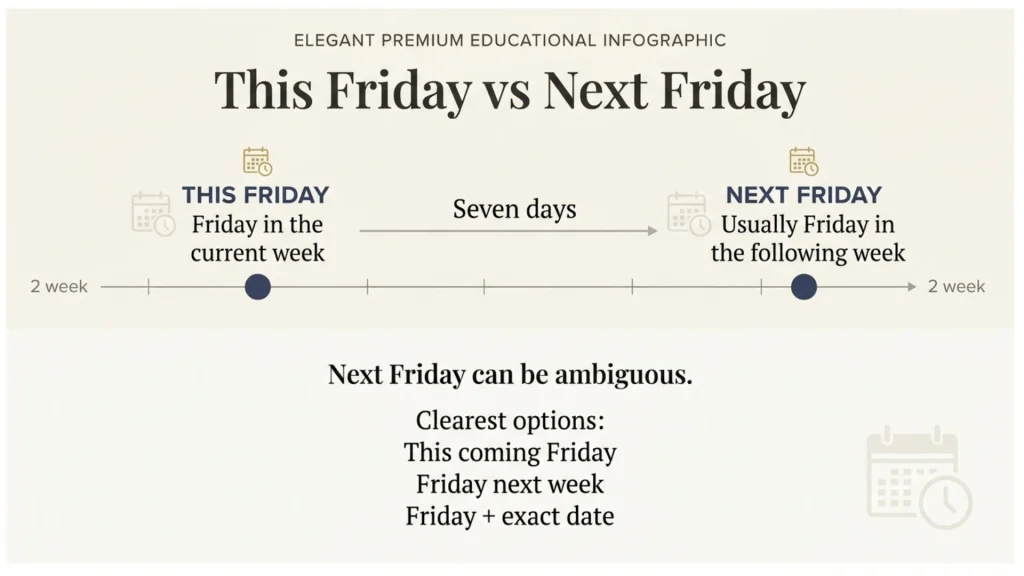
- This Friday usually means the Friday in the current week or the nearest upcoming Friday.
- Next Friday usually means the Friday in the following week.
- However, next Friday can be ambiguous because some speakers use it to mean the very next Friday on the calendar.
- If the exact day matters, use the actual date or say Friday next week.
For example, if today is Tuesday:
- This Friday = the Friday coming in three days
- Next Friday = usually the Friday one week after that
The safest wording is always:
“Friday, October 9”
instead of simply:
“next Friday.”
Next Friday vs This Friday at a Glance
| Phrase | Common Meaning | Clarity |
|---|---|---|
| This Friday | Friday in the current week | Usually clear |
| Next Friday | Often Friday of the following week | Can be ambiguous |
| This coming Friday | Nearest upcoming Friday | Clearer |
| Friday next week | Friday in the following week | Very clear |
| Friday + exact date | One specific calendar date | Clearest |
The problem is not that either phrase is grammatically wrong.
The problem is that different people sometimes interpret next Friday differently.
English apparently decided calendars were not confusing enough on their own.
What Does “This Friday” Mean?
This Friday normally refers to the Friday associated with the current week.
If today is Monday, Tuesday, Wednesday, or Thursday, most people understand this Friday as the Friday coming up within that same week.
Example:
We have a meeting this Friday.
If today is Tuesday, the speaker normally means the Friday three days later.
Other examples:
- The project is due this Friday.
- Are you free this Friday?
- We are having dinner this Friday.
- The office closes early this Friday.
- I’ll see you this Friday morning.
In each example, this Friday points toward the Friday that feels part of the speaker’s current week.
Also check: Impatient vs Inpatient
What Does “Next Friday” Mean?
Next Friday often means the Friday of the following week.
Suppose today is Tuesday.
Many speakers would understand:
I’ll see you this Friday.
as the upcoming Friday.
But:
I’ll see you next Friday.
as the Friday seven days after that.
However, this interpretation is not universal.
Some people use next Friday to mean simply the next occurrence of Friday.
That means two people can hear the same sentence and imagine two different dates. Current grammar discussions and usage guides consistently flag this ambiguity rather than treating one interpretation as universally mandatory.
Is Next Friday the Same as This Friday?
Usually, no.
When the two expressions are contrasted, they normally refer to different Fridays.
Example:
I can’t meet this Friday, but I’m free next Friday.
The contrast strongly suggests:
- this Friday = the earlier Friday
- next Friday = the Friday one week later
That is one of the clearest situations because the speaker explicitly mentions both.
But if someone simply says:
Let’s meet next Friday.
without any additional context, the intended date may be less obvious.
Why Is “Next Friday” Ambiguous?
The word next can be understood in two different ways.
Interpretation 1: The Next Friday on the Calendar
Some speakers think:
What is the next Friday that will occur?
Under this logic, next Friday means the nearest upcoming Friday.
This is similar to expressions such as:
- the next train
- the next appointment
- the next bus
The focus is on what comes next chronologically.
Interpretation 2: Friday of Next Week
Other speakers organize the phrase by calendar weeks.
Under this system:
- this Friday = Friday this week
- next Friday = Friday next week
This interpretation is extremely common and becomes especially natural when someone contrasts this week with next week.
Neither interpretation can safely be assumed in every conversation.
That is why exact dates are better for important plans.
This Friday vs Next Friday With an Example
Suppose today is Tuesday, October 6.
Under the common week-based interpretation:
| Phrase | Date |
|---|---|
| This Friday | October 9 |
| Next Friday | October 16 |
| Friday next week | October 16 |
| This coming Friday | October 9 |
Now imagine another speaker who uses next Friday to mean the nearest Friday.
That person might interpret:
See you next Friday.
as October 9 instead.
Same words. Different calendar.
This is why a simple confirmation such as:
Do you mean Friday, October 9 or Friday, October 16?
is often the smartest response.
When Is This Friday?
The answer depends on today’s date.
This Friday normally means the Friday belonging to the current week.
If today is:
Monday
This Friday is four days away.
Tuesday
This Friday is three days away.
Wednesday
This Friday is two days away.
Thursday
This Friday is tomorrow.
Friday
“This Friday” may mean today, depending on context.
Saturday or Sunday
The phrase becomes less predictable because some speakers think in calendar weeks while others think only about the nearest upcoming Friday.
After Friday has passed, this coming Friday is often clearer.
When Is Next Friday?
There is no perfectly universal conversational rule.
The safest practical interpretation is:
Next Friday usually means Friday of the following week.
But because some speakers use it for the nearest upcoming Friday, treat the expression as potentially ambiguous.
If you need precision, say:
- Friday next week
- this coming Friday
- Friday the 16th
- the Friday after this one
Those expressions reduce the chance of misunderstanding.
What Does “This Coming Friday” Mean?
This coming Friday generally emphasizes the nearest Friday that has not yet occurred.
Example:
I’ll finish the report this coming Friday.
Most listeners understand this as the Friday approaching next.
This phrase can be especially useful when next Friday might be misunderstood.
What Does “Friday Next Week” Mean?
Friday next week is one of the clearest ways to refer to the Friday in the following calendar week.
Example:
Our appointment is Friday next week.
That wording is usually less ambiguous than:
Our appointment is next Friday.
If the date matters professionally, however, adding the actual date is even better.
What Does “Coming Friday” Mean?
Coming Friday normally means the nearest upcoming Friday.
Example:
We’ll meet this coming Friday.
or:
We’ll meet coming Friday.
The second version is more common in some varieties of English than others.
In general American and British usage, this coming Friday sounds more natural than simply coming Friday.
Should I Say “This Friday” or “Next Friday”?
Use this Friday when you mean the Friday you consider part of the current week.
Example:
Let’s have lunch this Friday.
Use next Friday when context clearly establishes that you mean the Friday of the following week.
Example:
I’m busy this Friday, but next Friday works.
If context does not make the distinction obvious, use:
Friday next week.
Or give the date.
Is “Next Friday” Grammatically Correct?
Yes.
Next Friday is completely grammatical English.
The issue is interpretation, not grammar.
English regularly uses next with time expressions such as:
- next week
- next month
- next year
- next Monday
- next summer
The ambiguity appears because a named weekday can be understood either as the next occurrence of that weekday or as the weekday belonging to the next week.
For a dictionary-backed explanation of how next works with time expressions, see Cambridge Dictionary’s entry for “next”.
Do You Say “On Next Friday”?
Usually, no.
Natural:
I’ll see you next Friday.
Less natural in ordinary English:
I’ll see you on next Friday.
You normally use on with the weekday alone:
I’ll see you on Friday.
But you do not usually need it before:
- this Friday
- next Friday
- last Friday
So:
See you Friday.
See you this Friday.
See you next Friday.
are all natural constructions.
“On Friday” vs “This Friday”
Both are correct.
On Friday
I’ll call you on Friday.
This simply identifies Friday as the day.
This Friday
I’ll call you this Friday.
This emphasizes a particular Friday relative to the present time.
In everyday conversation, the meanings often overlap.
“Friday” vs “This Friday”
If the context is obvious, simply saying Friday may be enough.
Example:
Are you free Friday?
This usually means the nearest relevant Friday.
Adding this can make the time reference more explicit:
Are you free this Friday?
Both are natural.
Is “This Friday” Always the Closest Friday?
Not absolutely.
Most of the time, this Friday refers to the Friday nearest the speaker within the current week.
But expressions involving weekdays can become less clear near or after the day itself.
For example, on Saturday:
I’ll see you this Friday.
may briefly make someone wonder whether the speaker means:
- the Friday that just passed
- the Friday coming next
A clearer form is:
I’ll see you this coming Friday.
Even better:
I’ll see you Friday, October 9.
What If Today Is Friday?
If today is Friday, this Friday can naturally mean today.
Example:
The event is happening this Friday.
If the statement is made on Friday morning, listeners may reasonably understand that the event happens later that same day.
If you mean the Friday one week later, use:
next Friday
or:
Friday next week.
For important plans, include the exact date.
What If Today Is Saturday?
Saturday creates more ambiguity because Friday has just passed.
If someone says:
See you this Friday.
some listeners may mentally connect this Friday with the Friday that just ended.
Others may assume the speaker means the upcoming Friday.
Instead, use:
See you this coming Friday.
or:
See you Friday next week.
The exact date remains the safest option.
What If Today Is Sunday?
Sunday can also cause disagreement because people do not always mentally define the beginning of the week in the same way.
One person may consider the new week to have started already.
Another may think conversationally in terms of the workweek beginning Monday.
Rather than arguing with someone about where the invisible border between weeks lives, give the date.
What Date Is Next Friday?
To find the date of next Friday:
- Identify today’s date.
- Find the nearest Friday.
- Decide whether the speaker means that Friday or the Friday of the following week.
- If you are scheduling something important, confirm using the actual date.
If you are asking a person:
What’s next Friday’s date?
you may still need to clarify what they mean by next Friday.
A better question is:
What date is Friday next week?
What Is This Friday’s Date?
This Friday’s date means the calendar date attached to the Friday currently being discussed as this Friday.
For example, if today is Tuesday, October 6:
What is this Friday’s date?
would normally be answered:
October 9.
Because relative dates change constantly, articles and messages should avoid hard-coding them unless the content is intended to be temporary.
What Does “Friday Next Week” Mean?
Friday next week means the Friday belonging to the following week.
This phrase is particularly useful because it removes much of the ambiguity in next Friday.
Example:
I can’t meet this week. Let’s meet Friday next week.
The listener does not have to decide whether “next” modifies the occurrence of Friday or the calendar week.
What Does “Next Next Friday” Mean?
People sometimes say next next Friday informally to mean the Friday after next Friday.
It is understandable, but it is not especially elegant or precise.
Instead of:
I’ll see you next next Friday.
use:
I’ll see you the Friday after next.
or, even better:
I’ll see you Friday, October 23.
Exact dates continue their irritating habit of solving the entire problem.
This Friday vs Next Friday in Work Emails
Professional communication should favor clarity over conversational shorthand.
Avoid:
The report is due next Friday.
Better:
The report is due Friday next week.
Best:
The report is due Friday, October 16.
This becomes especially important with:
- deadlines
- interviews
- client meetings
- payroll dates
- contract dates
- project launches
- training sessions
No one wants to discover that two departments built their schedules around different interpretations of the same two words.
This Friday vs Next Friday for Appointments
Appointments should use an exact date and time.
Instead of:
Your appointment is next Friday.
write:
Your appointment is Friday, October 16, at 2:00 PM.
This is especially important for:
- medical appointments
- interviews
- reservations
- flights
- legal meetings
- exams
Relative time expressions are useful in casual speech but unnecessarily risky when timing matters.
This Friday vs Next Friday for Social Plans
For casual plans, context usually does most of the work.
Example:
Want to grab dinner this Friday?
If the conversation is happening during the week, the meaning is generally obvious.
But:
Let’s do it next Friday.
may still produce:
This coming Friday or the one after?
That clarification is normal because the phrase itself can genuinely be interpreted differently.
Closest Friday vs Next Friday
The closest Friday or nearest Friday is simply the Friday closest in the future.
That is not necessarily what every speaker means by next Friday.
For example, on Tuesday:
- closest Friday = three days away
- this Friday = usually three days away
- next Friday = often ten days away under the following-week interpretation
This is the source of much of the confusion.
“See You This Friday” Meaning
See you this Friday.
usually means:
I will see you on the upcoming Friday associated with this week.
It is generally clearer than:
See you next Friday.
when referring to the nearer Friday.
“See You Next Friday” Meaning
See you next Friday.
usually means the Friday of the following week, particularly if the upcoming Friday could instead be called this Friday.
But it can still mean the nearest Friday for some speakers.
For that reason, if someone sends you this message and the date matters, confirm it.
Is Friday Tomorrow?
This is simply a calendar question.
Friday is tomorrow only when today is Thursday.
If today is:
- Monday → Friday is four days away
- Tuesday → three days away
- Wednesday → two days away
- Thursday → tomorrow
- Friday → today
- Saturday → six days away
- Sunday → five days away
This kind of calculation is different from interpreting next Friday, because next-Friday usage also depends on how the speaker frames the week.
This Friday, Next Friday & Last Friday
These expressions create a useful timeline.
Last Friday
The Friday before the present reference point.
This Friday
Usually the Friday associated with the current week.
Next Friday
Usually the Friday associated with the following week, but potentially ambiguous.
Example:
I was busy last Friday, I’m free this Friday, and I’m traveling next Friday.
In this sentence, the three Fridays clearly form a sequence.
This Weekend vs Next Weekend
The same ambiguity appears with weekends.
This Weekend
Usually means the weekend associated with the current week.
Next Weekend
Usually means the weekend following this one.
But some speakers use next weekend for the nearest upcoming weekend.
Again, the safest wording is:
- this coming weekend
- the weekend after this one
- weekend of October 10
- exact dates
Should I Say This Saturday or Next Saturday?
Use this Saturday for the Saturday associated with the current week or the nearest upcoming Saturday.
Use next Saturday when context clearly means the Saturday of the following week.
Because next Saturday can still be interpreted as the nearest Saturday by some people, use the date when precision matters.
Should I Say This Monday or Next Monday?
The same basic rule applies.
- This Monday usually refers to the Monday associated with the current week.
- Next Monday often refers to the Monday in the following week.
However, if Monday has already passed, conversational interpretation can shift.
Instead of relying on assumptions, say:
Monday next week
or give the date.
Do I Say This Tuesday or Next Tuesday?
Use this Tuesday for the Tuesday treated as part of the current week.
Use next Tuesday for the Tuesday of the following week when that distinction is clear from context.
Again, an exact date is clearer for important schedules.
Which Is Correct: This Sunday or Next Sunday?
Both expressions are grammatically correct.
They simply refer to different time frames depending on context.
This Sunday generally refers to the Sunday associated with the current week or upcoming weekend.
Next Sunday often refers to the following Sunday.
However, because Sunday sits at the boundary between weeks in different calendar conventions, using the actual date is especially useful.
Common Mistakes With This Friday and Next Friday
Assuming Everyone Uses “Next Friday” the Same Way
They do not.
Some speakers mean the next occurrence of Friday.
Others mean Friday of next week.
Assuming Next Friday Is Always Seven Days Away
It is not.
If today is Tuesday and you mean Friday next week, it is ten days away.
If today is Friday, the following Friday is seven days away.
Using Relative Dates in Important Messages
Avoid vague phrases for:
- contracts
- travel
- appointments
- deadlines
- exams
- payments
- reservations
Use an exact date.
Adding “On” Unnecessarily
Natural:
I’ll see you next Friday.
Less natural:
I’ll see you on next Friday.
How to Avoid Confusion
Use these alternatives.
If You Mean the Nearest Friday
Say:
this Friday
or:
this coming Friday
If You Mean Friday of the Following Week
Say:
Friday next week
If Timing Really Matters
Say:
Friday, October 16
This eliminates interpretation completely.
Best Phrase for Each Situation
| Intended Meaning | Best Phrase |
|---|---|
| Nearest upcoming Friday | This Friday |
| Emphasize approaching Friday | This coming Friday |
| Friday in following week | Friday next week |
| Casual future reference | Next Friday |
| Important appointment | Exact date |
| Deadline | Exact date and time |
Frequently Asked Questions
Should I say this Saturday or next Saturday?
Say this Saturday for the Saturday associated with the current week or the nearest upcoming Saturday. Use next Saturday for the following week’s Saturday when context makes that clear. Use the exact date if confusion would matter.
Should I say this Monday or next Monday?
This Monday generally means Monday in the current time frame, while next Monday usually refers to the Monday of the following week. Because meaning can shift depending on when you speak, an exact date is safer.
Do I say this Tuesday or next Tuesday?
Both are correct. This Tuesday usually refers to the nearer/current-week Tuesday, while next Tuesday commonly refers to the following week’s Tuesday.
Which is correct: “this Sunday” or “next Sunday”?
Both are grammatically correct. The choice depends on which Sunday you mean. Sunday can be particularly confusing because different people treat it as either the beginning or end of the week.
Do you say next Friday or this Friday?
Use this Friday when referring to the upcoming/current-week Friday. Use next Friday when you mean the following week’s Friday and the context is clear. If the date matters, state the exact date.
Do you say next weekend or this weekend?
This weekend usually refers to the upcoming weekend associated with the current week. Next weekend often means the weekend after that, although some people use it for the nearest upcoming weekend.
What does next Friday mean?
It usually means the Friday of the following week, but some speakers use it to mean the very next Friday on the calendar. That is why the phrase can be ambiguous.
When is this Friday?
This Friday normally means the Friday associated with the current week. The exact calendar date depends on today’s date.
When is next Friday after this Friday?
If this Friday identifies the upcoming Friday, next Friday normally refers to the Friday seven days after it when the two phrases are contrasted.
What is the safest way to write a Friday date?
Use the weekday plus the exact date:
Friday, October 16
For appointments or deadlines, add the time as well.
Final Thoughts
The difference between Next Friday vs This Friday is simple in theory but less rigid in real conversation.
This Friday usually means the Friday associated with the current week.
Next Friday often means the Friday of the following week, but some speakers use it for the nearest upcoming Friday instead.
That makes next Friday grammatically correct but potentially ambiguous.
For casual plans, context is usually enough.
For deadlines, appointments, interviews, travel, or anything important, use:
Friday + exact date
A calendar date may be less conversational, but unlike English speakers, numbers rarely decide halfway through the conversation that they meant a different Friday.