Appreciate It vs Appreciated It: Meaning, Difference & Correct Usage
Appreciate it vs appreciated it comes down mainly to tense and time perspective.
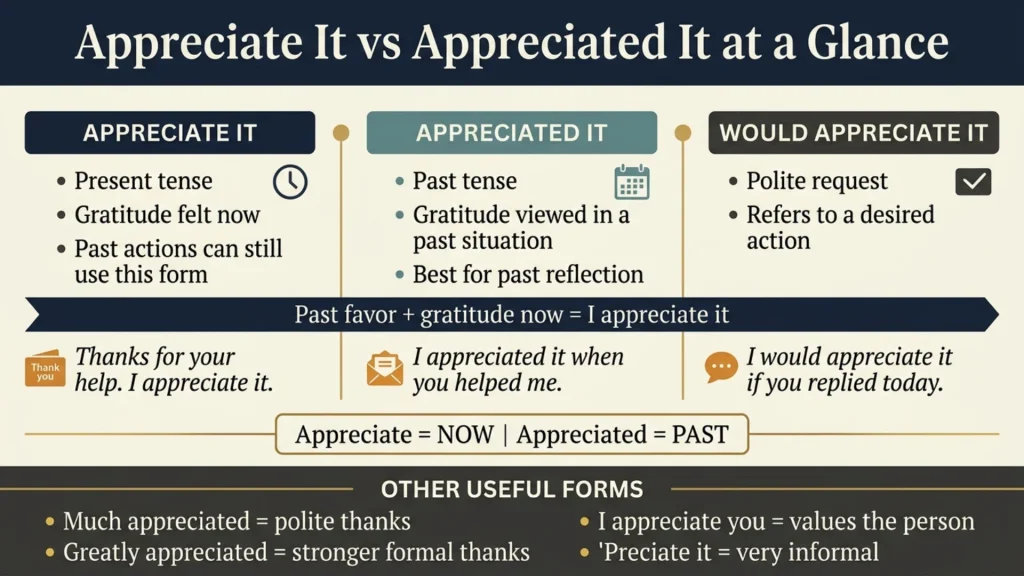
Use “I appreciate it” when you are expressing gratitude that you feel now, even if the helpful action already happened.
Use “I appreciated it” when you are talking about gratitude you felt in a past situation.
For example:
Thanks for helping me. I appreciate it.
means you are grateful now.
I really appreciated it when you helped me last week.
looks back at your gratitude as part of a past event.
Both are grammatically correct. The important question is not simply when did the other person help you? It is:
Are you expressing gratitude now, or describing your gratitude in the past?
Quick Answer: Appreciate It or Appreciated It?
| Phrase | Tense | Main Use | Example |
|---|---|---|---|
| I appreciate it | Present | Gratitude felt or expressed now | Thanks for your help. I appreciate it. |
| Appreciate it | Present, informal | Short casual thank-you | Got the file. Appreciate it. |
| I appreciated it | Past | Gratitude felt in a past situation | I appreciated it when you called yesterday. |
| I really appreciate it | Present | Stronger current gratitude | I really appreciate your support. |
| I really appreciated it | Past | Strong past gratitude | I really appreciated your help last week. |
| I would appreciate it | Conditional | Polite request | I would appreciate it if you replied today. |
| Much appreciated | Passive-style phrase | Polite thanks | Your help is much appreciated. |
The easiest memory rule is:
Appreciate = gratitude now
Appreciated = gratitude viewed in the past
Also check: That’s or Thats
What Does “Appreciate It” Mean?
“I appreciate it” means:
- I am grateful for it
- I value what you did
- I recognize your effort
- Thank you for doing that
The word it normally refers to an action, favor, kindness, help, message, gift, or other thing already understood from the conversation.
For example:
Thanks for staying late. I appreciate it.
Here, it refers to the person’s effort in staying late.
Another example:
Thanks for sending the report. I really appreciate it.
The speaker is expressing gratitude at the present moment.
The verb appreciate can mean to recognize the value or quality of something and can also be used to express gratitude, as shown in the Cambridge Dictionary definition of appreciate.
What Does “Appreciated It” Mean?
“Appreciated it” uses the simple past tense of appreciate.
It usually means:
I was grateful for it at that time.
Examples:
I appreciated it when you checked on me last week.
She appreciated it when her colleagues offered to help.
We appreciated it when the hotel gave us a late checkout.
In these sentences, the speaker is looking back at a completed situation.
Appreciate It vs Appreciated It: The Main Difference
The core difference is not gratitude itself.
Both phrases express gratitude.
The difference is the time frame.
Appreciate It
Present:
I appreciate it.
Meaning:
I am grateful now.
Appreciated It
Past:
I appreciated it.
Meaning:
I was grateful then.
That sounds simple, but one detail causes most confusion:
A past action does not automatically require “appreciated.”
A Past Favor Can Still Take “I Appreciate It”
Suppose someone helped you yesterday.
Today you say:
Thanks again for helping me yesterday. I really appreciate it.
This is completely natural.
The help happened yesterday, but your gratitude exists now.
So the timeline is:
Yesterday: help happened
Today: you are expressing gratitude
Therefore:
I appreciate it.
works perfectly.
Now compare:
When I was working on that project last year, I really appreciated your support.
Here, both the situation and the speaker’s perspective are placed in the past.
That makes:
appreciated
more natural.
Present Gratitude vs Past Gratitude
Compare these pairs.
Present
Thanks for driving me home. I appreciate it.
Past Reflection
I appreciated it when you drove me home during that difficult week.
Present
I really appreciate your honesty.
Past
I appreciated your honesty during our conversation yesterday.
Present
We appreciate everything you do for us.
Past
We appreciated everything you did for us during the project.
The verb tense changes the time perspective.
Is “Appreciate It” Grammatically Correct?
Yes.
The full sentence is:
I appreciate it.
In informal conversation, people often omit the subject:
Appreciate it.
This shortened form is common in:
- text messages
- casual conversations
- workplace chat
- quick replies
- social media
- informal emails
Example:
Sent you the document.
Thanks, appreciate it.
The understood meaning is:
Thanks, I appreciate it.
For formal writing, keeping I is usually clearer.
Is “Appreciated It” Grammatically Correct?
Yes.
There is nothing grammatically wrong with appreciated it.
Example:
I appreciated it when you came to visit.
The problem appears only when the tense does not match what the writer intends.
If someone helps you right now and you reply:
Thanks, I appreciated it.
the sentence may sound oddly detached because the past tense places your gratitude behind you.
Usually you would say:
Thanks, I appreciate it.
“I Appreciate It” Meaning
I appreciate it is a polite way to acknowledge:
- help
- effort
- kindness
- support
- patience
- advice
- cooperation
- understanding
Example:
Thank you for being flexible with the deadline. I appreciate it.
The phrase sounds warmer than a bare:
Thanks.
but is still natural in both professional and everyday English.
“I Appreciated It” Meaning
I appreciated it means the speaker valued or felt grateful for something in a past context.
Example:
I appreciated it when my manager gave me additional time.
It does not necessarily mean:
I no longer appreciate it.
Grammar does not magically delete gratitude at midnight.
The past tense simply frames the appreciation as part of an earlier situation.
“I Really Appreciate It” vs “I Really Appreciated It”
The word really adds emphasis but does not change the tense rule.
I Really Appreciate It
Present gratitude:
Thank you for helping me today. I really appreciate it.
I Really Appreciated It
Past gratitude:
I really appreciated it when you helped me during my first week.
Both communicate stronger appreciation.
“I Appreciate It” vs “I Appreciate That”
Both are correct, but it and that can point to different things.
Appreciate It
Often refers back to a favor or action:
Thanks for helping. I appreciate it.
Appreciate That
Often introduces or refers to a fact or situation:
I appreciate that you are busy.
This means:
I understand and recognize that you are busy.
It can also express gratitude:
You stayed late to help me, and I appreciate that.
Appreciate It vs Thank You
Both express gratitude, but their tone differs slightly.
Thank You
Direct expression of thanks:
Thank you for your help.
I Appreciate It
Emphasizes that you value the action:
I appreciate your help.
Together
Very natural:
Thank you. I really appreciate it.
Using both does not usually sound repetitive when the gratitude is genuine.
“Thanks, I Appreciate It” Correct Usage
Yes, this is completely natural:
Thanks, I appreciate it.
You can also write:
Thank you. I appreciate it.
Thanks so much. I really appreciate it.
Thank you for helping. I appreciate it.
In more formal business communication, the full phrase often sounds polished and respectful.
“I Would Appreciate It” Meaning
I would appreciate it usually introduces a polite request.
Example:
I would appreciate it if you could send the report by Friday.
This does not primarily mean you are already thankful.
It means:
I would be grateful if you did this.
The phrase makes requests sound softer and more professional.
“I Would Appreciate It If” vs “I Would Appreciate If”
The more standard construction is:
I would appreciate it if…
Example:
I would appreciate it if you could confirm the appointment.
The pronoun it is normally included in this pattern.
More natural:
I would appreciate it if you replied today.
Less standard:
I would appreciate if you replied today.
“I’d Appreciate It” Meaning
I’d appreciate it is simply the contracted form of:
I would appreciate it.
Example:
I’d appreciate it if you kept this confidential.
It is polite but slightly more conversational than the full:
I would appreciate it if…
“I Will Appreciate It” vs “I Would Appreciate It”
These forms are not always interchangeable.
I Would Appreciate It
Usually softer and more polite:
I would appreciate it if you could respond today.
I Will Appreciate It
Grammatically possible, but often sounds more direct:
I will appreciate any help you can provide.
In many polite requests, native speakers prefer:
I would appreciate…
because it sounds less demanding.
“I Appreciate It Greatly” vs “I Greatly Appreciate It”
Both are grammatical.
However:
I greatly appreciate it.
often sounds smoother and more formal.
Example:
I greatly appreciate your assistance.
You can also say:
I appreciate it greatly.
but it sounds slightly more emphatic or formal.
“I Would Appreciate It Greatly”
This is grammatical:
I would appreciate it greatly if you could respond soon.
But many speakers would choose the smoother:
I would greatly appreciate it if you could respond soon.
or:
I would really appreciate it if you could respond soon.
“Much Appreciated” Meaning
Much appreciated is a common shortened expression meaning:
Thank you. This is greatly appreciated.
Example:
Thanks for sending the document. Much appreciated.
It is concise and particularly common in:
- emails
- workplace chats
- business communication
- quick messages
Is “Much Appreciated” Correct?
Yes.
Examples:
Your assistance is much appreciated.
Thanks for sorting that out. Much appreciated.
Your quick response would be much appreciated.
The phrase can sound efficient and professional.
“It Is Much Appreciated”
This is also correct:
Your help is much appreciated.
Your patience is much appreciated.
It is much appreciated.
The structure uses appreciated as a past participle in a passive-style construction.
That is different from:
I appreciated it.
One uses appreciated as part of a passive construction; the other uses it as a simple past verb.
“Very Appreciated” vs “Much Appreciated”
Much appreciated is usually more idiomatic.
Natural:
Your help is much appreciated.
Natural:
Your help is greatly appreciated.
Less natural in many contexts:
Your help is very appreciated.
People may understand very appreciated, but standard English usually prefers:
- much appreciated
- greatly appreciated
- deeply appreciated
- truly appreciated
“Highly Appreciated” Correct Usage
Highly appreciated can be grammatical, especially when describing something valued highly.
However, for ordinary gratitude, these often sound more natural:
- greatly appreciated
- much appreciated
- sincerely appreciated
- deeply appreciated
Example:
Natural:
Your assistance is greatly appreciated.
Possible but more formal or less idiomatic:
Your assistance is highly appreciated.
“Well Appreciated” Meaning
Well appreciated exists but is less common for ordinary thank-you messages.
Instead of:
Your help was well appreciated.
most native speakers would prefer:
Your help was greatly appreciated.
or:
Your help was much appreciated.
“You Are Appreciated” Meaning
You are appreciated means:
People recognize your value and are grateful for you or what you do.
It focuses on the person rather than a specific action.
Example:
I hope you know that you are appreciated.
This can sound warm and supportive.
“Appreciate It” in Emails
In professional email, I appreciate it works well when thanking someone for something they have already done.
Example:
Thank you for sending the revised report. I appreciate it.
For a more formal tone:
I sincerely appreciate your assistance.
For a request:
I would appreciate it if you could provide the final figures by Thursday.
Better Ways to Say “I Appreciate It” in an Email
Depending on tone, you can use:
- Thank you for your help.
- I appreciate your assistance.
- Thank you for taking the time.
- I’m grateful for your support.
- Many thanks for your help.
- Thank you for your quick response.
- Your assistance is much appreciated.
- I sincerely appreciate your help.
- Thank you for handling this.
- I value your input.
Casual Ways to Say “Appreciate It”
For texts or casual conversations:
- Thanks!
- Thanks a lot.
- Much appreciated.
- Really appreciate it.
- Thanks, mate.
- Thanks for that.
- You’re a lifesaver.
- Cheers.
- Appreciate you.
- Thanks so much.
Tone and regional usage matter.
For example, cheers as thanks is especially common in British English.
Is “I Appreciate You” Grammatically Correct?
Yes.
I appreciate you is grammatically correct.
It means that you value the person, not merely one specific action.
Compare:
I appreciate it.
You value something the person did.
I appreciate you.
You value the person.
I appreciate your help.
You value their help.
“I appreciate you” can sound personal and warm, so it is common between:
- friends
- partners
- family members
- close colleagues
Appreciate You vs Appreciate It
Appreciate You
Person-focused:
I appreciate you being here for me.
or simply:
I appreciate you.
Appreciate It
Action-focused:
Thanks for staying. I appreciate it.
Both are correct.
Is “I Appreciate You Helping Me” Correct?
Yes.
Example:
I appreciate you helping me with the project.
You can also write more formally:
I appreciate your helping me with the project.
Both constructions exist, though ordinary modern conversation strongly favors:
I appreciate you helping me.
Appreciate vs Appreciated
The basic verb forms are:
| Form | Grammar | Example |
|---|---|---|
| appreciate | Base/present | I appreciate your help. |
| appreciates | Third-person present | She appreciates your help. |
| appreciated | Past | I appreciated your help. |
| appreciated | Past participle | Your help was appreciated. |
| appreciating | Present participle | He is appreciating the experience more now. |
So the difference between appreciate and appreciated is largely a normal present-versus-past tense distinction.
Common Spelling Mistakes
The correct spellings are:
appreciate
and:
appreciated
Because the word contains several vowels and consonants close together, misspellings are extremely common.
Incorrect: Appriciate
Correct:
appreciate
Incorrect: Apriciate
Correct:
appreciate
Incorrect: Appricate
Correct:
appreciate
Incorrect: Apprecaite
Correct:
appreciate
Incorrect: Apreciate
Correct:
appreciate
Incorrect: Appericate
Correct:
appreciate
Incorrect: Apprieciated
Correct:
appreciated
Incorrect: Appriciated
Correct:
appreciated
Incorrect: Appretiated
Correct:
appreciated
Incorrect: Appericated
Correct:
appreciated
Incorrect: Appreicated
Correct:
appreciated
A simple breakdown can help:
ap-pre-ci-ate
and:
ap-pre-ci-at-ed
How Do You Spell “Appreciate It”?
Correct:
appreciate it
Not:
- appriciate it
- apriciate it
- appricate it
- apreciate it
- appericate it
- apprecaite it
The correct full sentence is:
I appreciate it.
How Do You Spell “Appreciated”?
Correct:
A-P-P-R-E-C-I-A-T-E-D
A useful visual breakdown:
APPRECIATE + D = APPRECIATED
Because appreciate already ends in e, you simply add d:
appreciate → appreciated
What Does “’Preciate It” Mean?
‘Preciate it or preciate it is an informal spoken shortening of:
appreciate it
It may appear in:
- casual texting
- social media
- speech imitation
- informal dialogue
Example:
Preciate it, man.
This is understandable conversational English but is not the standard spelling for formal writing.
Use:
Appreciate it.
or:
I appreciate it.
in normal written English.
Appreciate It in Formal vs Informal English
Formal
I sincerely appreciate your assistance.
I would greatly appreciate your response.
Your cooperation is much appreciated.
Neutral
Thank you. I appreciate it.
I really appreciate your help.
Informal
Appreciate it!
Thanks, appreciate it.
Preciate it.
The grammar may stay similar while the tone changes.
Common Mistakes With Appreciate and Appreciated
Mistake 1: Using Past Tense for Current Gratitude
Awkward in an immediate thank-you:
Thanks for helping. I appreciated it.
Usually better:
Thanks for helping. I appreciate it.
Mistake 2: Thinking a Past Favor Requires Past Tense
Not necessarily.
Correct:
Thanks for what you did yesterday. I appreciate it.
The action is past. The gratitude is present.
Mistake 3: Forgetting “It” in a Polite Request
Less standard:
I would appreciate if you replied.
Better:
I would appreciate it if you replied.
Mistake 4: Saying “Be Appreciate”
Incorrect:
Your help will be appreciate.
Correct:
Your help will be appreciated.
Mistake 5: Using “Very Appreciated”
Awkward:
Your support is very appreciated.
Better:
Your support is much appreciated.
or:
Your support is greatly appreciated.
Appreciate It vs Appreciated It in Text Messages
Texting favors short forms.
Examples:
Thanks, appreciate it!
Really appreciate it ❤️
Appreciate you.
I really appreciated that yesterday.
All can work, but the same tense rules still apply.
Appreciate it sounds immediate.
Appreciated it looks backward.
Appreciate It vs Appreciated It in the Workplace
After Someone Sends a File
Natural:
Thanks for sending this. I appreciate it.
Reflecting on an Old Project
Natural:
I really appreciated your support during that project.
Requesting Something
Natural:
I’d appreciate it if you could send the figures by noon.
Formal Thank-You
Natural:
Your assistance is greatly appreciated.
Appreciate It vs Appreciated It: Timeline Rule
Use this simple timeline:
Past Action + Present Gratitude
You helped me yesterday. I appreciate it.
Past Action + Past Reflection
You helped me during college. I appreciated it at the time.
Present Help + Present Gratitude
You’re helping me now. I appreciate it.
Future Action + Polite Request
I’d appreciate it if you helped me tomorrow.
That one distinction solves almost the entire problem.
Frequently Asked Questions
Which is correct: “I really appreciated it” or “I really appreciate it”?
Both are correct.
Use “I really appreciate it” when expressing gratitude you feel now.
Use “I really appreciated it” when describing gratitude in a past situation.
What’s a better way to say “appreciate it”?
Alternatives include:
- Thank you.
- Thank you so much.
- I’m grateful.
- Much appreciated.
- Thanks for your help.
- I value your support.
- I’m thankful for your assistance.
- That means a lot to me.
Is it grammatically correct to say “I appreciate you”?
Yes. I appreciate you is grammatical and means you value the person. It is warmer and more personal than I appreciate it, which usually refers to an action or favor.
How do I say “I appreciate it” in an email?
A natural professional version is:
Thank you for your assistance. I really appreciate it.
For more formality:
I sincerely appreciate your help.
For a request:
I would appreciate it if you could respond by Friday.
Is it polite to say “I appreciate it”?
Yes. It is generally polite, warm, and suitable for both everyday and professional communication.
What is another way to say “I appreciate it very much”?
Natural alternatives include:
- I really appreciate it.
- I greatly appreciate it.
- Thank you very much.
- I’m truly grateful.
- Your help means a lot to me.
- Your assistance is much appreciated.
Is “much appreciated” grammatically correct?
Yes. It is a common and natural expression of thanks, especially in business emails and workplace messages.
Is “I appreciated it” rude?
No. It is not inherently rude. However, if someone has just helped you and you are thanking them now, I appreciate it usually sounds warmer and more immediate.
Can I say “I appreciate it” for something that happened yesterday?
Yes. If you are expressing your gratitude now, I appreciate it is completely natural even when the favor happened yesterday.
Is “appreciated it” past tense?
Yes. Appreciated is the simple past and past participle form of appreciate.
Final Thoughts
For Appreciate It vs Appreciated It, the grammar is simple once you focus on the speaker’s time perspective.
Use:
I appreciate it
when your gratitude is being expressed now.
Use:
I appreciated it
when you are looking back on gratitude in a past situation.
And remember the most important nuance:
A favor can happen in the past while your gratitude is still present.
So:
Thanks for helping me yesterday. I appreciate it.
is perfectly correct.
For polite future requests, use:
I would appreciate it if…
For concise professional thanks:
Much appreciated.
That is really the whole system. English merely surrounded it with fourteen misspellings, three tense forms, passive constructions, and enough email etiquette to make a two-word thank-you require an article.