
On Tuesday Morning or In Tuesday Morning: Which Is Correct?
On Tuesday morning or in Tuesday morning is a common preposition question, and the correct phrase in standard English is:
on Tuesday morning
Not:
in Tuesday morning
The reason is simple: English normally uses on with specific days and dates, including a day followed by a part of the day.
So we say:
- on Tuesday morning
- on Tuesday afternoon
- on Tuesday evening
- on Tuesday night
But when no specific day is mentioned, we usually use in with parts of the day:
- in the morning
- in the afternoon
- in the evening
That one change in context decides the preposition.
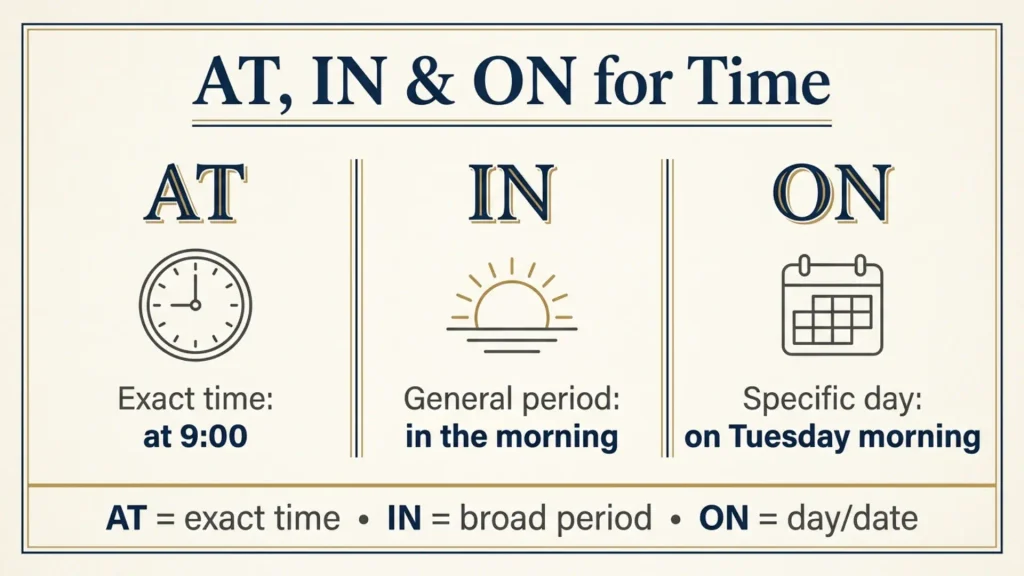
Quick Answer: On Tuesday Morning vs In Tuesday Morning
| Phrase | Correct? | Example |
|---|---|---|
| on Tuesday morning | Yes | We will meet on Tuesday morning. |
| in Tuesday morning | No in normal English | Incorrect for a specific Tuesday morning |
| in the morning | Yes | I exercise in the morning. |
| on Tuesday afternoon | Yes | The meeting is on Tuesday afternoon. |
| on Tuesday evening | Yes | She arrives on Tuesday evening. |
| on Tuesday night | Yes | We leave on Tuesday night. |
The easiest rule is:
Specific day + part of the day → ON
General part of the day → IN
Why Is “On Tuesday Morning” Correct?
The phrase Tuesday morning refers to a specific period connected to a particular day.
English normally uses on with:
- days of the week
- dates
- named days
- specific days combined with morning, afternoon, evening, or night
Examples:
- on Monday
- on Tuesday
- on Friday
- on 10 March
- on my birthday
- on Christmas Day
- on Tuesday morning
- on Friday evening
- on Saturday afternoon
The British Council’s guide to prepositions of time explains the broader rule: on is normally used with days and dates, while in is used with parts of the day and longer periods such as months and years.
Why Is “In Tuesday Morning” Incorrect?
In Tuesday morning sounds unnatural because in is not normally used directly before a named day.
We do not normally say:
- in Monday
- in Tuesday
- in Friday
- in Tuesday morning
- in Saturday afternoon
Instead, use:
- on Monday
- on Tuesday
- on Friday
- on Tuesday morning
- on Saturday afternoon
The presence of the weekday makes the time period specific, so English switches to on.
In the Morning vs On Tuesday Morning
This is the core difference.
In the Morning
Use in the morning when talking about morning generally.
Examples:
- I usually drink coffee in the morning.
- She studies in the morning.
- The roads are quieter in the morning.
There is no specific day.
On Tuesday Morning
Use on Tuesday morning when talking about the morning of Tuesday specifically.
Examples:
- I have an appointment on Tuesday morning.
- We will leave on Tuesday morning.
- She called me on Tuesday morning.
So:
general morning → in the morning
specific Tuesday morning → on Tuesday morning
On Tuesday or At Tuesday?
Use:
on Tuesday
Do not normally use:
at Tuesday
Examples:
Correct:
I’ll see you on Tuesday.
Incorrect:
I’ll see you at Tuesday.
The preposition at is normally used with precise clock times and certain fixed expressions.
Examples:
- at 8:00
- at noon
- at midnight
- at night
- at lunchtime
But days of the week normally take on.
On Tuesday Morning or At Tuesday Morning?
Use:
on Tuesday morning
Not:
at Tuesday morning
Correct:
The appointment is on Tuesday morning.
Incorrect:
The appointment is at Tuesday morning.
However, you can combine a day with a specific clock time:
The appointment is at 9:00 on Tuesday morning.
Here:
- at introduces the precise time
- on introduces the day and part of the day
English apparently decided one preposition per sentence was too merciful.
On Tuesday Morning at 9 or At 9 on Tuesday Morning?
Both can be grammatical.
At 9 on Tuesday Morning
The meeting starts at 9 on Tuesday morning.
This is very natural.
On Tuesday Morning at 9
The meeting is on Tuesday morning at 9.
Also correct.
The first version often sounds slightly smoother because the exact time appears close to the verb.
On Tuesday Afternoon
Use on Tuesday afternoon.
Examples:
- We will meet on Tuesday afternoon.
- She has class on Tuesday afternoon.
- The package should arrive on Tuesday afternoon.
Do not normally say:
in Tuesday afternoon
Without the weekday, however:
in the afternoon
is correct.
Compare:
I usually exercise in the afternoon.
I’m exercising on Tuesday afternoon.
On Tuesday Evening
Use:
on Tuesday evening
Examples:
- We had dinner on Tuesday evening.
- She arrives on Tuesday evening.
- The event begins on Tuesday evening.
Without a specific day:
in the evening
Examples:
- I read in the evening.
- He often works in the evening.
On Tuesday Night or At Tuesday Night?
The natural phrase is:
on Tuesday night
Examples:
- We arrived on Tuesday night.
- The storm began on Tuesday night.
- She works on Tuesday night.
Do not normally say:
at Tuesday night
However, English does use:
at night
when talking about nighttime generally.
Compare:
I sleep at night.
I worked on Tuesday night.
So:
general night → at night
specific Tuesday night → on Tuesday night
On Monday Morning or In Monday Morning?
Use:
on Monday morning
Correct:
- I’ll call you on Monday morning.
- We have a meeting on Monday morning.
- The office reopens on Monday morning.
Incorrect in normal usage:
- in Monday morning
- at Monday morning
On Wednesday Morning or In Wednesday Morning?
Use:
on Wednesday morning
Examples:
- She arrived on Wednesday morning.
- We will discuss it on Wednesday morning.
- The class starts on Wednesday morning.
The same rule applies to every weekday.
On Thursday Morning
Correct:
on Thursday morning
Examples:
- I have an exam on Thursday morning.
- We are leaving on Thursday morning.
- He called on Thursday morning.
On Friday Morning or In Friday Morning?
Use:
on Friday morning
Correct:
I will send the report on Friday morning.
Not:
I will send the report in Friday morning.
But this is correct:
I usually send reports in the morning.
Again, the difference is specific day versus general part of the day.
On Saturday Morning or In Saturday Morning?
Use:
on Saturday morning
Examples:
- We go shopping on Saturday morning.
- The train leaves on Saturday morning.
- She is working on Saturday morning.
Do not normally use:
in Saturday morning
On Sunday Morning or In Sunday Morning?
Use:
on Sunday morning
Examples:
- We met on Sunday morning.
- The church service is on Sunday morning.
- I’ll finish the work on Sunday morning.
Without Sunday:
I relax in the morning.
A Simple Weekly Pattern
Here is the full pattern:
- on Monday morning
- on Tuesday morning
- on Wednesday morning
- on Thursday morning
- on Friday morning
- on Saturday morning
- on Sunday morning
The weekday controls the preposition.
Why Do We Say “In the Morning” but “On Monday Morning”?
Because English moves from a broad time period to a specific day-based period.
Broad Time
Use in:
- in the morning
- in the afternoon
- in the evening
Specific Day
Use on:
- on Monday morning
- on Tuesday afternoon
- on Friday evening
- on Saturday night
The weekday makes the expression specific enough to follow the day rule.
At, In, and On for Time
A simple system helps.
Use “At” for Precise Times
Examples:
- at 6:00
- at 9:30
- at noon
- at midnight
- at lunchtime
- at night
Use “In” for Longer Periods and General Parts of the Day
Examples:
- in the morning
- in the afternoon
- in the evening
- in January
- in summer
- in 2026
- in the future
Use “On” for Days and Dates
Examples:
- on Tuesday
- on Friday
- on 14 October
- on my birthday
- on Tuesday morning
- on Friday night
This distinction is one of the most useful preposition rules to memorize.
On Tuesday Morning vs Tuesday Morning
Sometimes no preposition is needed.
For example:
I’ll see you Tuesday morning.
This is common, especially in American English.
You can also say:
I’ll see you on Tuesday morning.
Both are natural.
The version with on follows the full standard prepositional structure.
The version without on treats Tuesday morning directly as a time expression.
This Tuesday Morning
Normally, do not add on before time expressions beginning with this.
Natural:
I’ll see you this Tuesday morning.
Usually unnecessary:
I’ll see you on this Tuesday morning.
The second form is possible in special contexts, but it sounds heavier.
The same applies to:
- this morning
- this Tuesday
- this Friday
- this weekend
For another guide on interpreting weekday expressions, see Next Friday vs This Friday.
Next Tuesday Morning
Use:
next Tuesday morning
Normally, no on is needed.
Examples:
- I’ll call you next Tuesday morning.
- The appointment is next Tuesday morning.
- We leave next Tuesday morning.
You may occasionally hear on next Tuesday, but standard modern English usually prefers simply next Tuesday.
Last Tuesday Morning
Likewise:
last Tuesday morning
Examples:
- I saw him last Tuesday morning.
- The problem started last Tuesday morning.
Not usually:
on last Tuesday morning
Every Tuesday Morning
Use:
every Tuesday morning
Examples:
- I exercise every Tuesday morning.
- She attends class every Tuesday morning.
No on is required because every already introduces the time phrase.
On Tuesdays vs On Tuesday
These differ slightly.
On Tuesday
Usually means one particular Tuesday.
I’ll see you on Tuesday.
On Tuesdays
Usually means every Tuesday or Tuesdays in general.
I work from home on Tuesdays.
Compare:
The class starts on Tuesday morning.
One specific Tuesday.
The class meets on Tuesday mornings.
A repeated weekly schedule.
Tuesday Morning vs Tuesday Mornings
Tuesday Morning
One particular Tuesday morning:
I have a meeting Tuesday morning.
Tuesday Mornings
Repeated Tuesday mornings:
I exercise on Tuesday mornings.
Plural mornings signals repetition.
Is “Tuesday Morning” Capitalized?
Capitalize Tuesday because days of the week are proper nouns.
Do not normally capitalize morning.
Correct:
Tuesday morning
Not:
Tuesday Morning
unless the phrase appears in a title or heading whose capitalization style requires it.
Morning, Afternoon, Evening, and Night
The basic general forms are:
- in the morning
- in the afternoon
- in the evening
- at night
Specific-day forms are:
- on Tuesday morning
- on Tuesday afternoon
- on Tuesday evening
- on Tuesday night
Night is the odd one out in general expressions because standard English says at night, not normally in the night when referring to nighttime generally.
For more on the difference between nighttime and night time, see Nighttime vs Night Time.
“In the Night” vs “At Night”
These can both be correct but differ in meaning.
At Night
Means during nighttime generally.
I work at night.
In the Night
Often refers to something happening during a particular night.
I woke up twice in the night.
But with a named weekday:
I woke up several times on Tuesday night.
What About “Tuesday in the Morning”?
This construction is possible but less direct.
For example:
I’ll come Tuesday in the morning.
Some speakers and regional varieties may use it, but standard edited English strongly prefers:
I’ll come Tuesday morning.
or:
I’ll come on Tuesday morning.
Can I Say “During Tuesday Morning”?
Yes.
During Tuesday morning means at some point or throughout part of that morning.
Example:
The weather improved during Tuesday morning.
This sounds more formal than:
The weather improved on Tuesday morning.
Use during when you want to emphasize the period or duration.
Can I Say “By Tuesday Morning”?
Yes, but it means something different.
By Tuesday morning means no later than Tuesday morning.
Example:
Please finish the report by Tuesday morning.
Compare:
Finish the report on Tuesday morning.
This tells you when to do it.
Finish the report by Tuesday morning.
This gives you a deadline.
For another article involving time expressions and scheduling, see Timeslot vs Time Slot.
Before Tuesday Morning
This means earlier than Tuesday morning.
Example:
I need the documents before Tuesday morning.
Until Tuesday Morning
This means continuing up to Tuesday morning.
Example:
The office will remain closed until Tuesday morning.
From Tuesday Morning
This means beginning Tuesday morning.
Example:
The new timetable starts from Tuesday morning.
Depending on context, especially in American English, starting Tuesday morning may sound more natural.
Common Mistakes
Mistake 1: “In Tuesday Morning”
Incorrect:
I will see you in Tuesday morning.
Correct:
I will see you on Tuesday morning.
Mistake 2: “At Tuesday”
Incorrect:
The meeting is at Tuesday.
Correct:
The meeting is on Tuesday.
Mistake 3: “At Tuesday Morning”
Incorrect:
We leave at Tuesday morning.
Correct:
We leave on Tuesday morning.
Mistake 4: Using “On” With a General Morning
Less natural:
I exercise on the morning.
Correct:
I exercise in the morning.
Mistake 5: Saying “In Friday”
Incorrect:
I’ll finish it in Friday.
Correct:
I’ll finish it on Friday.
Mistake 6: Forgetting the Difference Between a Day and a Clock Time
Correct:
The meeting is on Tuesday at 10:00.
Here:
- Tuesday takes on
- 10:00 takes at
40 Correct Examples
- I will call you on Tuesday morning.
- We have class on Tuesday morning.
- She arrived on Tuesday morning.
- The package will come on Tuesday morning.
- I usually exercise in the morning.
- He reads the news in the morning.
- The meeting is on Tuesday.
- The meeting starts at 9:00.
- The meeting is at 9:00 on Tuesday morning.
- We leave on Monday morning.
- She works on Wednesday morning.
- I have an exam on Thursday morning.
- The report is due on Friday morning.
- We travel on Saturday morning.
- They visit us on Sunday morning.
- I’ll see you Tuesday morning.
- We will meet next Tuesday morning.
- I saw her last Tuesday morning.
- She exercises every Tuesday morning.
- I work from home on Tuesdays.
- The class meets on Tuesday mornings.
- We had dinner on Tuesday evening.
- She arrived on Tuesday afternoon.
- The storm began on Tuesday night.
- I normally relax in the evening.
- He works at night.
- I woke up twice in the night.
- Please finish it by Tuesday morning.
- The office is closed until Tuesday morning.
- The work begins Tuesday morning.
- The train leaves on Friday afternoon.
- She called on Sunday evening.
- The appointment is on Monday at 3:00.
- I study in the afternoon.
- We eat dinner in the evening.
- The event starts on Saturday night.
- I need the files before Tuesday morning.
- The weather changed during Tuesday morning.
- She will return this Tuesday morning.
- We will discuss it next Tuesday.
A Simple Memory Trick
Remember:
AT = exact time
IN = broad period
ON = day/date
Examples:
at 10:00
in the morning
on Tuesday
And when a day and part of the day appear together:
on Tuesday morning
The day rule wins.
Frequently Asked Questions
Is it on Monday morning or in Monday morning?
Use on Monday morning.
Example:
I’ll call you on Monday morning.
Do not normally say in Monday morning.
Which is correct: “on Tuesday” or “in Tuesday”?
On Tuesday is correct.
Example:
The meeting is on Tuesday.
Days of the week normally take on, not in.
Which is correct: “on Friday morning” or “in Friday morning”?
Use:
on Friday morning
Example:
The report will be ready on Friday morning.
Is it in or on Saturday morning?
Use:
on Saturday morning
Use in the morning only when no specific day is attached.
Is it on Tuesday morning or in Tuesday morning?
The standard phrase is:
on Tuesday morning
The weekday makes the time expression specific, so English uses on.
Is it correct to say “on Monday” or “at Monday”?
Use:
on Monday
Not:
at Monday
Use at with precise clock times, such as at 8:00.
Do we say on Saturday or at Saturday?
Say:
on Saturday
Example:
We are leaving on Saturday.
Do we say on Friday or in Friday?
Use:
on Friday
Not:
in Friday
Is it on or at Thursday?
Use:
on Thursday
Example:
The appointment is on Thursday.
Final Answer: On Tuesday Morning or In Tuesday Morning?
For on Tuesday morning or in Tuesday morning, the correct standard phrase is:
on Tuesday morning
Use on because Tuesday is a specific day.
Say:
I’ll see you on Tuesday morning.
Use in only when talking about morning generally:
I usually exercise in the morning.
Use at for precise times:
I’ll see you at 9:00 on Tuesday morning.
The easiest rule is:
AT = exact time
IN = general part of the day
ON = specific day or date
So whenever you combine a weekday with morning, afternoon, evening, or night, on is normally the preposition you need.