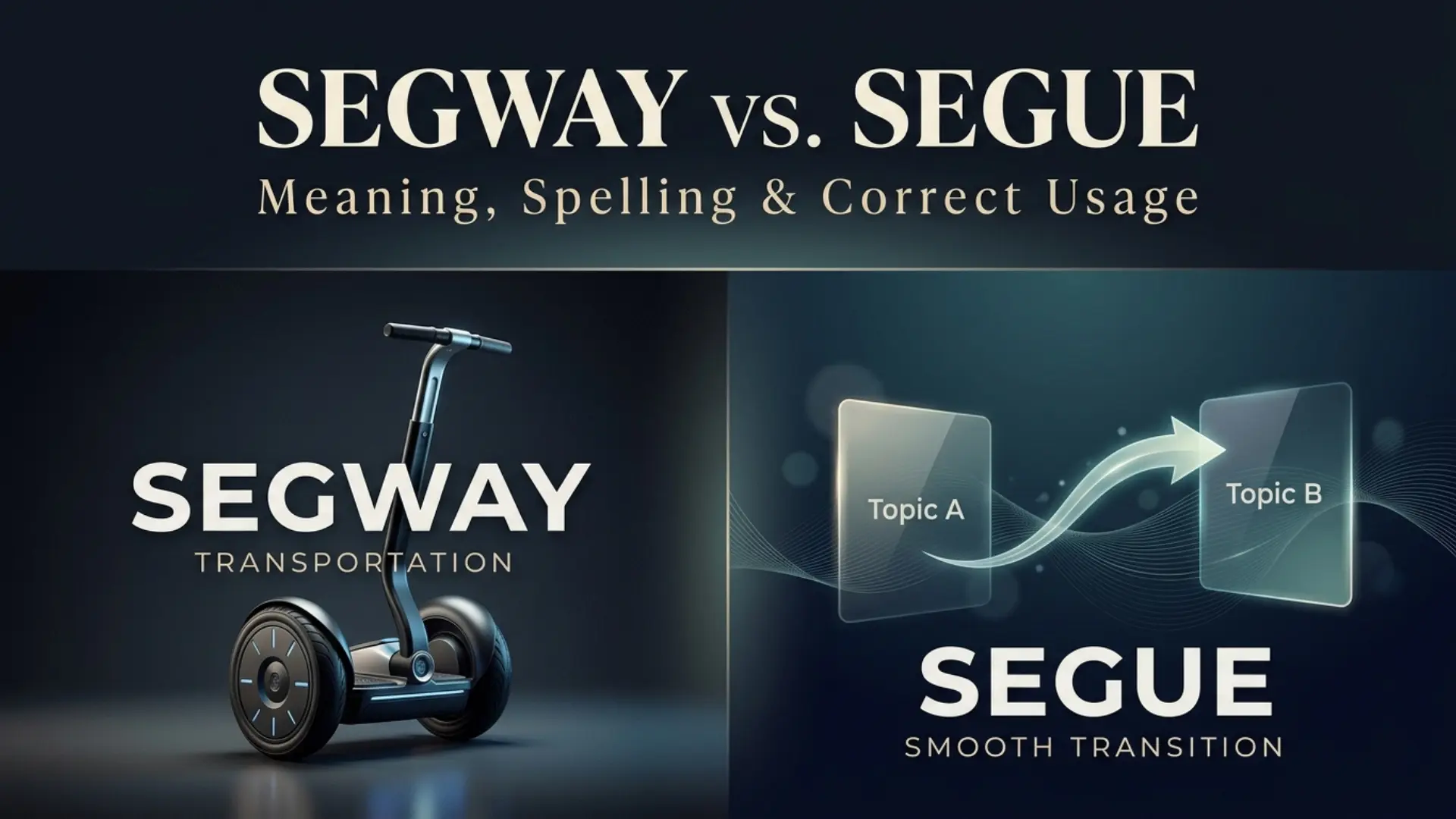
Segway vs. Segue: Meaning, Spelling & Correct Usage
Quick Answer: Use segue when you mean a smooth transition from one topic, idea, activity, scene, or piece of music to another.
Use Segway when referring to the transportation brand or one of its personal mobility devices.
So:
Let’s segue into the next topic. ✅
That was a smooth segue. ✅
They toured the city on a Segway. ✅
Let’s segway into the next topic. ❌
The confusing part is pronunciation:
segue and Segway are pronounced essentially the same way: SEG-way.
The spelling and meaning, however, are different.
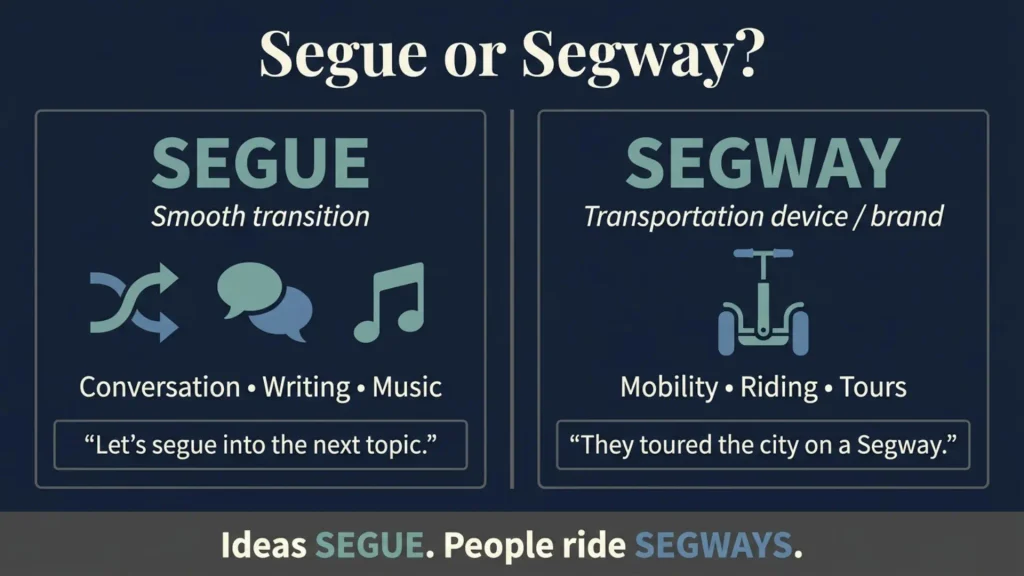
Segway vs. Segue at a Glance
| Word | Meaning | Part of Speech | Typical Use | Example |
|---|---|---|---|---|
| segue | smooth transition | noun or verb | speech, writing, music, stories | Let’s segue into the next topic. |
| Segway | transportation brand/device | proper noun | mobility, riding, tours | He rode a Segway downtown. |
The easiest memory rule is:
Segue = transition
Segway = transportation
What Does Segue Mean?
Segue means to move smoothly and without interruption from one thing to another.
It can describe movement between:
- conversation topics
- presentation sections
- paragraphs
- arguments
- scenes
- activities
- songs
- musical passages
- stories
- moods or situations
Example:
The discussion segued from marketing into customer retention.
The subject changed, but the transition felt natural rather than abrupt.
The Cambridge Dictionary definition of segue describes it as moving easily and without interruption from one subject, situation, story section, or piece of music to another.
Segue as a Verb
As a verb, segue means to transition smoothly.
Examples:
Let’s segue into the next section.
She segued from the introduction into the main argument.
The conversation segued naturally into politics.
The first song segued directly into the second.
A common structure is:
segue into + topic
Example:
We can now segue into the pricing discussion.
Another common structure is:
segue from + one thing + to/into + another
Example:
The host segued from sports to entertainment news.
Segue as a Noun
Segue can also be a noun meaning the transition itself.
Examples:
That was a smooth segue.
Her story created a natural segue into the next topic.
The final paragraph provides a useful segue into the conclusion.
That joke was a clever segue into the product announcement.
This noun-versus-verb distinction is similar to other English pairs where grammar determines how a word functions. GrammarRead’s Respond vs. Response guide explains another useful noun-and-verb distinction.
What Does Segway Mean?
Segway is associated with the well-known personal transportation brand and its mobility devices.
Example:
The tourists explored the city on Segways.
When you mean the branded device, Segway is normally capitalized.
It does not mean:
- transition
- topic change
- conversational bridge
- smooth movement between ideas
So:
That was a nice Segway into the next topic. ❌
should be:
That was a nice segue into the next topic. ✅
Is It Segway or Segue?
Ask one simple question:
Am I talking about a transition?
If yes:
segue
If you are talking about a transportation device:
Segway
Examples:
The presenter used a smooth segue.
We rented a Segway during the tour.
How Do You Spell Segway as in Transition?
The correct spelling is:
segue
Not:
segway
This is probably the single most common search behind the Segway vs. Segue confusion.
If your sentence means:
- change topic
- transition smoothly
- move into another point
- connect two sections
- move between songs
the spelling you need is:
segue
How Do You Spell Segue?
The spelling is:
S-E-G-U-E
It may look strange if you first learned the word by hearing it.
That is because its spelling comes from Italian rather than being designed around modern English phonetic spelling.
A simple memory trick:
SE-GUE
not:
SEG-WAY
when discussing transitions.
How Is Segue Pronounced?
Segue is pronounced approximately:
SEG-way
IPA:
/ˈseɡ.weɪ/
This is essentially the same pronunciation as Segway.
That identical pronunciation explains much of the confusion.
Someone can hear:
“Let’s segue into the next topic.”
and reasonably imagine that the word is spelled:
segway
until they see it written.
Why Is Segue Spelled Like That?
Segue entered English from Italian.
The Italian word segue means roughly:
it follows
or:
there follows
It comes from the Italian verb seguire, meaning to follow.
The word originally became familiar in musical contexts, where it indicated continuing directly into another passage without stopping.
That musical idea later broadened into everyday English.
Now we can:
- segue into another topic
- segue from one scene to another
- segue into a new section
- segue between ideas
- use a segue in conversation
The underlying idea remains the same:
one thing follows another smoothly.
Why Do People Write Segway Instead of Segue?
There are several reasons.
They Sound the Same
When spoken, there is no obvious spelling clue.
Segway Looks More Phonetic
If someone hears SEG-way, the spelling Segway looks intuitive.
Segue does not.
Segway Is a Familiar Brand
People may have seen the brand name before they ever encountered the transition word in writing.
Both Are Real Terms
Spellcheck may not always flag Segway because it is a legitimate proper name.
That makes this error especially easy to miss.
English has several spelling traps where a plausible-looking form competes with the intended word. GrammarRead’s Smooth vs. Smoothe covers another pair where appearance alone is not a reliable guide.
Segue in Conversation
In conversation, a segue is a smooth shift from one subject to another.
Example:
Speaking of travel, that gives me a good segue into our vacation plans.
The speaker uses the current topic to introduce the next one naturally.
Another example:
Her comment about work segued into a conversation about retirement.
This means the discussion moved naturally from work to retirement.
What Is a Segue in Conversation?
A segue in conversation is a natural bridge between two subjects.
Suppose two people are discussing exercise.
One person says:
“Speaking of running, did you hear that Daniel is training for a charity race?”
That sentence can act as a segue from:
exercise
to:
Daniel’s charity race
A good conversational segue prevents the subject change from feeling random.
Segue Into a Conversation
You can say:
segue into a conversation
when something naturally leads into a discussion.
Example:
The news story provided a natural segue into a conversation about privacy.
You can also say:
segue into the conversation
if referring to a specific discussion.
Example:
Her question gave me a way to segue into the conversation about salaries.
Segway Into a Conversation or Segue Into a Conversation?
Use:
segue into a conversation ✅
Not:
segway into a conversation ❌
unless someone is literally riding a Segway into a place where a conversation is happening, which would at least make the spelling mistake memorable.
For the normal language meaning:
segue
is correct.
Segway to Another Topic or Segue to Another Topic?
Use:
segue to another topic
or, more naturally:
segue into another topic
Examples:
Let’s segue into another topic.
The interviewer segued to a discussion of education.
She smoothly segued from politics into economics.
Not:
Let’s segway into another topic.
Segued Into or Segwayed Into?
If you mean transitioned smoothly, use:
segued into
Example:
The discussion segued into a debate about taxes.
Not:
The discussion segwayed into a debate about taxes.
The past tense of segue is:
segued
So:
segue → segued
Example:
The presentation segued smoothly into the Q&A.
Segueing or Segwaying?
For the transition verb, the standard -ing form is:
segueing
Example:
She is segueing into the next section.
If someone writes:
segwaying into another topic
they are normally confusing the transition word with the Segway brand.
The main verb forms are:
| Form | Example |
|---|---|
| segue | We segue into the next topic. |
| segues | She segues naturally between ideas. |
| segued | He segued into a new subject. |
| segueing | They are segueing into the final section. |
Is Segway a Verb?
When discussing transitions, no: the standard verb is segue.
People may occasionally use brand names informally as verbs, so someone could theoretically talk about Segwaying around a city, meaning riding a Segway.
But that is unrelated to:
segueing between topics
If you mean transition, always choose:
segue
What Does “Segway Into” Mean?
When people write segway into while discussing ideas, they almost always mean:
segue into
which means:
move smoothly into something else
Example:
The speaker segued into a discussion of future plans.
Meaning:
The speaker moved naturally from the previous subject to future plans.
Segway Meaning Transition
If you see segway being used to mean transition online, it is usually a misspelling of:
segue
Standard:
The paragraph provides a good segue into the next section.
Nonstandard for this meaning:
The paragraph provides a good segway into the next section.
Segway Meaning in Conversation
When someone writes:
“That was a great segway.”
during a conversation, the intended meaning is probably:
That was a great transition.
But the standard spelling is:
That was a great segue.
Does Segway Have a Slang Meaning?
There is no standard slang meaning of Segway that makes it the correct spelling for a conversational transition.
Online, people frequently use lowercase segway when they actually mean segue.
That is better understood as a spelling error or informal confusion than as a separate established slang definition.
If someone says:
“Nice segway.”
they almost certainly mean:
“Nice segue.”
What Does “Nice Segue” Mean?
Nice segue means:
That was a smooth or clever transition.
Example:
Person A:
“We’ve talked about the budget. Customer retention is another area affected by spending.”
Person B:
“Nice segue.”
Person B is complimenting the smooth connection between the two topics.
What Does “Good Segue” Mean?
A good segue is a transition that connects one subject to another naturally.
Example:
The statistic about employee turnover was a good segue into the discussion about workplace culture.
The transition feels logical because the two ideas are related.
What Does “Great Segue” Mean?
Great segue is simply a stronger compliment.
It means:
That was an especially smooth, clever, or natural transition.
It is commonly used in:
- meetings
- podcasts
- interviews
- presentations
- casual conversations
- panel discussions
What Does “Make a Segway” Mean?
If someone says:
make a segway
while discussing a transition, the intended phrase is:
make a segue
To make a segue means to create or use a smooth transition.
Example:
She made a clever segue from the sales figures into the marketing plan.
The more natural verb construction is often simply:
She segued from sales into marketing.
“A Segway Into Something” or “A Segue Into Something”?
Use:
a segue into something
Example:
That question gave us a natural segue into the next section.
Not:
a segway into something
unless you are referring literally to a transportation device.
Segue From vs Segue Into
Both structures are useful.
Segue From
Use when emphasizing where the transition begins.
The conversation segued from work to travel.
Segue Into
Use when emphasizing the new subject.
The conversation segued into travel.
From + Into
You can combine them:
The presentation segued from market trends into the company’s expansion plan.
How to Use Segue in Writing
Segue works well when discussing flow between sections.
Example:
The final sentence of the introduction provides a natural segue into the historical background.
You can also use the verb:
The article then segues into a discussion of pricing.
However, your actual writing does not need the word segue every time you create a transition.
Transition phrases can often perform the job directly.
Examples:
- however
- therefore
- meanwhile
- in contrast
- as a result
- in addition
- with that in mind
- turning to
- this leads to
- another factor is
How to Use Segue in a Presentation
A presentation often needs verbal bridges between slides or sections.
Useful examples:
“That brings us to our next point.”
“With that background in mind, let’s segue into the results.”
“This naturally leads us to the second issue.”
“Now let’s turn to customer feedback.”
A good segue makes the presentation feel structured without sounding scripted.
How to Use Segue in a Podcast
Podcasts depend heavily on conversational transitions.
Example:
“You mentioned working remotely, which is a perfect segue into my next question about productivity.”
Another:
“That story gives us a nice segue into today’s main topic.”
The word is especially useful for describing transitions between:
- interview questions
- stories
- segments
- advertisements
- themes
Segue in Music
Segue originally has a strong musical association.
In music, it refers to moving directly from one passage, composition, or section into another without an obvious break.
Example:
The first track segues into the second.
Another:
The band used an instrumental segue between the two songs.
This musical idea explains the modern conversational meaning.
One topic flows into another in the same way that one piece of music can flow into the next.
Segue in Film and Storytelling
The term can also describe smooth movement between:
- scenes
- storylines
- time periods
- narrative sections
Example:
The documentary segues from archival footage into modern interviews.
The transition connects two parts without feeling abrupt.
Synonyms for Segue
The best synonym depends on whether segue is being used as a noun or verb.
As a Verb
Possible alternatives include:
- transition
- shift
- move
- progress
- proceed
- flow
- pivot
- turn
Example:
Let’s segue into the next point.
could become:
Let’s move to the next point.
As a Noun
Possible alternatives include:
- transition
- bridge
- link
- connection
- shift
- passage
- progression
Example:
That was a good segue.
could become:
That was a good transition.
Not every synonym works equally well in every sentence.
For another case where related words overlap without being interchangeable, see GrammarRead’s Assume vs Presume vs Infer.
Is “Transition” a Synonym for Segue?
Yes.
Transition is the closest general synonym.
Compare:
That sentence creates a smooth segue into the next section.
That sentence creates a smooth transition into the next section.
Both are natural.
The difference is mostly style.
Segue often emphasizes smoothness and continuity.
Transition is broader and more neutral.
Segue vs Transition
A transition can be smooth, abrupt, gradual, or awkward.
A segue usually implies a relatively smooth continuation.
For example:
There was an abrupt transition between the two scenes.
sounds natural.
But:
There was an abrupt segue between the two scenes.
is possible but slightly tension-filled because segue itself suggests flow.
So:
Every segue is a transition, but not every transition is necessarily a smooth segue.
Segue vs Pivot
A pivot often suggests a more deliberate change in direction.
Example:
The interviewer pivoted from policy to the candidate’s personal history.
A segue emphasizes the smooth connection.
Example:
The interviewer used the candidate’s background as a segue into a discussion of education policy.
Segue vs Bridge
A bridge is something that connects two ideas or sections.
A segue is the transition itself.
Example:
That anecdote acts as a bridge between the introduction and the main argument.
or:
That anecdote creates a natural segue into the main argument.
Common Misspellings of Segue
Because the pronunciation is unexpected, several incorrect spellings appear online.
Segway
Correct only for the brand/device context.
Segue Way
Not the standard spelling.
Segue is one word.
Segueway
Incorrect for the transition word.
Sequeway
Incorrect.
Sague
Incorrect when you mean segue.
Segue Way Definition
People searching this phrase usually want the definition of:
segue
meaning a smooth transition.
If spelling is the source of confusion, GrammarRead’s Gauging Interest vs Gaging Interest covers another case where pronunciation can tempt writers toward the wrong-looking form.
Segueway Meaning
Segueway is not the standard word for a transition.
The correct word is:
segue
Example:
That was a smooth segue.
Not:
That was a smooth segueway.
“Segue Way” Meaning
Similarly:
segue way
is not the standard spelling.
You may be mentally combining:
segue
with:
way
because the word sounds like seg-way.
But the correct spelling remains:
segue
“Sague” Meaning
If sague appears in a search for transitions, it is most likely a misspelling of:
segue
English has enough spelling irregularities already. It did not need this one, but here we are.
Segwayed Into a Conversation
If the intended meaning is transitioned into a conversation, write:
segued into a conversation
Example:
The discussion about college segued into a conversation about careers.
Not:
segwayed into a conversation
Segwaying Into Another Topic
For a transition:
segueing into another topic
is the standard form.
Example:
She is segueing into the next topic.
The brand spelling does not become correct just because -ing is added.
Correct Segue Examples
- Let’s segue into the next topic.
- She used a smooth segue between the two sections.
- The discussion segued naturally into politics.
- The song segues into an instrumental passage.
- That question gives us a good segue into pricing.
- He segued from sports into business.
- The paragraph provides a clear segue into the conclusion.
- The host used the story as a segue to the next interview.
- Her comment created a natural conversational segue.
- The presentation segued smoothly from research to recommendations.
- This provides a useful segue into our final point.
- The podcast segues from news into listener questions.
- They are segueing into the second part of the program.
- He segued into the subject without making the change feel abrupt.
- That joke was a surprisingly effective segue.
Correct Segway Examples
- They rented a Segway during their city tour.
- He learned how to ride a Segway.
- The guide travelled through the park on a Segway.
- We saw a group of tourists using Segways.
- The Segway moved quietly along the path.
These examples concern the transportation device, not conversation or writing.
Common Segway vs. Segue Mistakes
Mistake 1: Let’s Segway Into the Next Topic
Incorrect:
Let’s segway into the next topic.
Correct:
Let’s segue into the next topic.
Mistake 2: That Was a Great Segway
If you mean transition:
That was a great segue.
Mistake 3: The Conversation Segwayed Into Politics
Correct:
The conversation segued into politics.
Mistake 4: A Nice Segueway
Correct:
a nice segue
Mistake 5: Segue Is Only a Verb
Incorrect assumption.
Segue can be both:
verb: The discussion segued into another topic.
noun: That was a smooth segue.
For another word-choice distinction where form and function matter, see Informational vs Informative.
Easy Trick to Remember Segway vs. Segue
Use this:
Segway has WAY-looking spelling and wheels.
Segue connects ideas.
Or ask:
Am I riding it or transitioning with it?
If you are riding it:
Segway
If you are transitioning:
segue
Another memory trick:
Segue = smooth
Both begin with:
Se-
Is Segue Formal or Informal?
Segue works in both formal and informal English.
Formal
This finding provides a natural segue into the second phase of the analysis.
Business
Let’s segue into the budget discussion.
Casual
That’s actually a good segue into something I wanted to ask you.
Academic
This argument provides a useful segue into the broader theoretical debate.
It is versatile rather than strongly formal or slangy.
Should Segway Be Capitalized?
When referring to the brand name, write:
Segway
with a capital S.
Example:
We rented a Segway.
When writers use lowercase segway to mean transition, capitalization is not the main problem.
The word itself is wrong for that meaning.
Use:
segue
Is Segue Capitalized?
Normally, no.
Use lowercase:
segue
unless it begins a sentence or appears in a title.
Example:
That was a smooth segue.
Why Spellcheck May Not Catch Segway
Spellcheck can recognize:
Segway
as a legitimate proper name.
So this sentence may not be flagged:
Let’s Segway into the next section.
The software sees a real word, even though it is the wrong word for the sentence.
This is a word-choice error rather than a simple nonexistent-word spelling error.
That is why context matters.
Segway vs. Segue in Professional Writing
In business emails, reports, presentations, articles, and professional communication, use:
segue
for transitions.
Examples:
This provides a natural segue into our recommendations.
I’ll segue into the final section.
The discussion segued from revenue to operating costs.
Using Segway instead may look careless because it changes the word from a transition term into a brand reference.
Segway vs. Segue in Academic Writing
Segue is acceptable in academic prose, but sometimes a more neutral transition phrase may be preferable.
For example:
This discussion provides a segue into the next issue.
is valid.
But depending on style, you might instead write:
This discussion leads to the next issue.
or:
The next section considers…
The best choice depends on tone.
Frequently Asked Questions
What is a Segway in conversation?
If someone says Segway in the context of changing topics, they probably mean segue. A segue in conversation is a smooth transition from one subject to another.
Is segue pronounced like Segway?
Yes. Segue is pronounced approximately SEG-way, essentially the same as Segway.
Why is segue spelled like that?
Segue comes from Italian, where segue means roughly “it follows.” English kept the Italian spelling even though the pronunciation is not obvious to many English readers.
What does “Segway” mean?
Segway is associated with the personal transportation brand and its mobility devices. It is not the standard word for a conversational or written transition.
What does the word “segue” mean?
Segue means a smooth, uninterrupted transition from one topic, activity, scene, situation, or piece of music to another. It can be a noun or a verb.
What does the phrase “make a segway” mean?
If you mean making a smooth transition, the correct phrase is make a segue. It means creating a natural connection from one subject or section to another.
What does “segway” mean in slang?
There is no standard slang meaning that makes segway the correct transition word. Online, lowercase segway is often simply a misspelling of segue.
What is a synonym for Segway?
If you mean the transition word, you actually want synonyms for segue, such as transition, shift, bridge, move, link, flow, or pivot, depending on context.
How do you pronounce the word “segue”?
It is pronounced approximately SEG-way: /ˈseɡ.weɪ/.
Is it “segue into” or “segway into”?
Use segue into when discussing a transition: Let’s segue into the next subject.
What is the past tense of segue?
The past tense is segued.
Example:
The conversation segued into another topic.
Is “segueway” a word?
Not as the standard word for a transition. Use segue.
Is it “nice Segway” or “nice segue”?
When complimenting a transition, use:
nice segue
Final Answer
The Segway vs. Segue distinction is simple once you separate pronunciation from meaning.
Use:
segue
for a smooth transition between ideas, topics, scenes, songs, or activities.
Use:
Segway
for the transportation brand or device.
So:
Let’s segue into the next topic. ✅
That was a nice segue. ✅
The conversation segued into politics. ✅
We toured the city on a Segway. ✅
The words sound almost identical, which is why Segway often gets mistakenly used for the transition meaning.
Remember:
Ideas segue.
People ride Segways.