Agreed vs. Agree: Meaning, Difference & Correct Usage
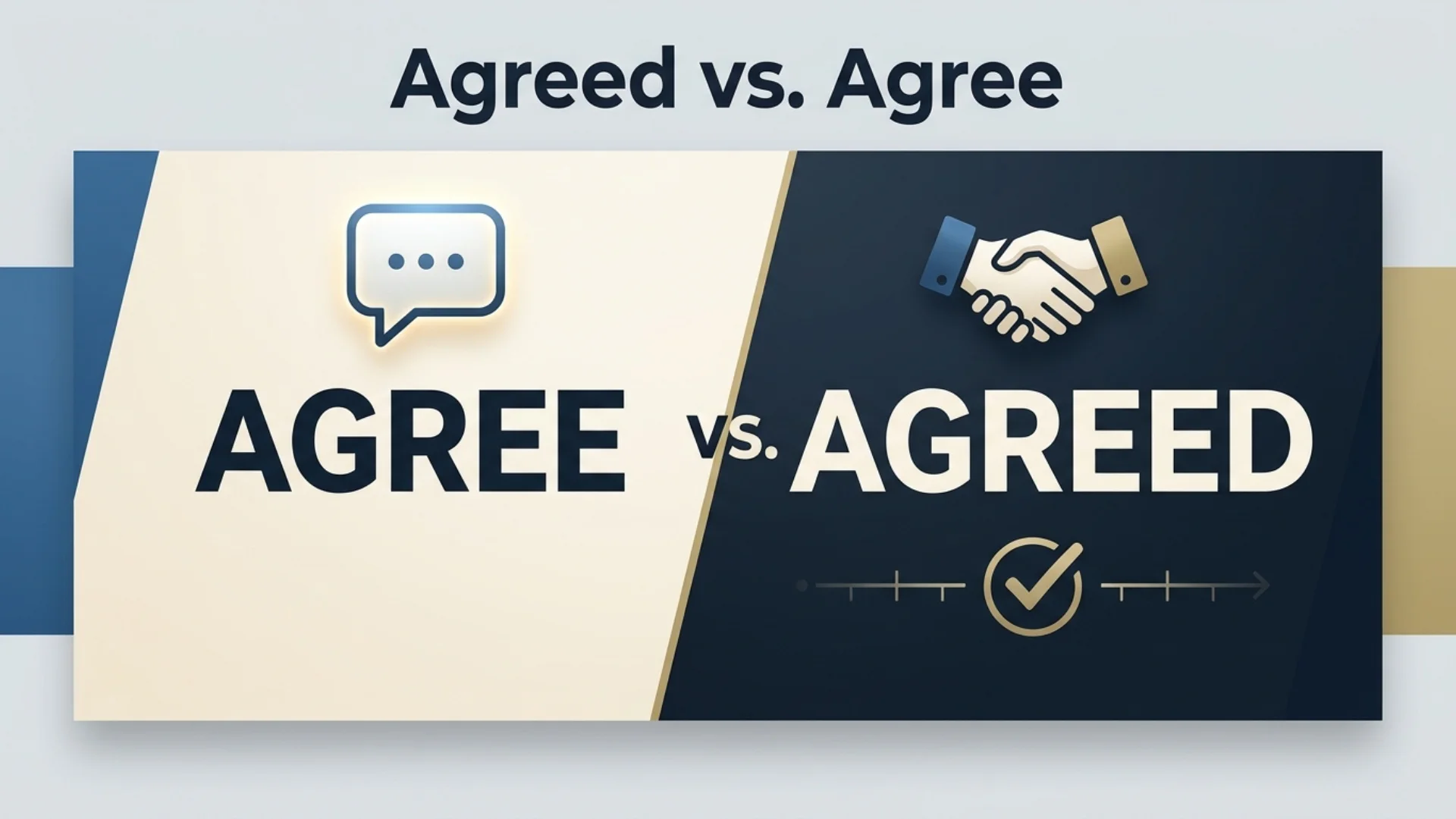
Agree and agreed come from the same verb, but they are not interchangeable.
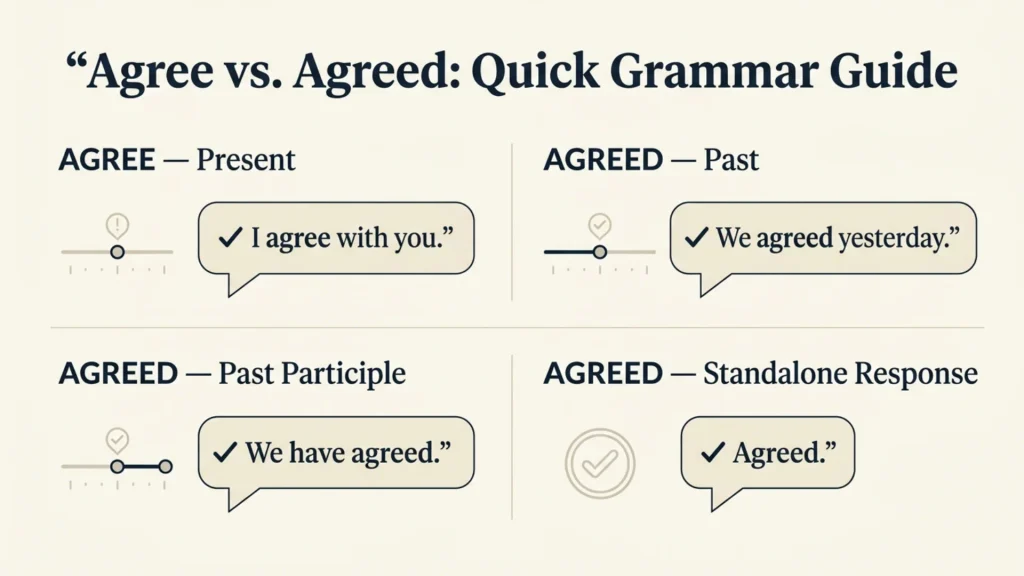
Use agree when you are talking about a present opinion, a general belief, or after words such as will, would, can, should, and did. Use agreed when the agreement happened in the past, when it is the past participle in a perfect tense, or when you are describing something that has already been accepted.
Compare:
- I agree with you. → I share your opinion now.
- I agreed with you yesterday. → I shared your opinion at that past time.
- We have agreed on the price. → The agreement has been reached.
- Agreed. → A short way to say “I agree” or “That is acceptable.”
That is the basic difference, but English gives agreed a few extra jobs that make the comparison more interesting.
Agreed vs. Agree at a Glance
| Form | Grammar Role | When to Use It | Example |
|---|---|---|---|
| Agree | Base verb / present verb | Present opinions, general statements | I agree with you. |
| Agrees | Third-person singular present | He, she, or it in the present | She agrees with me. |
| Agreed | Simple past | An agreement happened earlier | We agreed yesterday. |
| Agreed | Past participle | With have, has, or had | They have agreed. |
| Agreed | Modifier / adjective-like form | Something already accepted | The agreed price was $500. |
| Agreed! | Standalone response | To express acceptance | “Let’s leave at six.” “Agreed.” |
| Agreeing | Present participle | Continuous or participial structures | Everyone is agreeing for once. |
The fastest rule is:
Present or general opinion = agree
Past or completed agreement = agreed
But sentence structure can override that simple time rule, especially after auxiliary and modal verbs.
What Does Agree Mean?
Agree is a verb meaning to share the same opinion, accept a suggestion, reach the same decision, or correspond with something.
According to the Cambridge Dictionary definition of agree, the verb can describe having the same opinion, accepting an idea, deciding something together, or matching another statement or set of information.
Examples:
- I agree with your point.
- We agree about most things.
- They agree that the deadline is too short.
- I agree to the new conditions.
- The two reports agree on the main facts.
Is Agree a Verb?
Yes. Agree is a verb.
Its main forms are:
- Base form: agree
- Third-person singular: agrees
- Past tense: agreed
- Past participle: agreed
- Present participle: agreeing
Examples:
- I agree.
- She agrees.
- We agreed.
- They have agreed.
- Everyone is agreeing with the proposal.
Because agree is a regular verb, its simple past and past participle are both formed by adding -d.
What Does Agreed Mean?
Agreed is most commonly the simple past and past participle form of agree.
It can also be used as a short standalone response and as a modifier describing something that has already been settled.
Agreed as the Simple Past
Use agreed when the act of agreeing happened in the past.
- I agreed with Sarah yesterday.
- We agreed on the budget last week.
- They agreed to meet after work.
- He eventually agreed with my suggestion.
Agreed as the Past Participle
Use agreed after have, has, or had.
- We have agreed on the final price.
- She has agreed to help us.
- They had agreed before the meeting started.
- I have already agreed to the conditions.
In these sentences, agreed is not functioning as a simple past verb by itself. It is part of a perfect tense.
Agreed as a Standalone Response
Agreed! can be used by itself to show acceptance.
For example:
“Let’s finish this tomorrow.”
“Agreed.”
Here, Agreed means something similar to:
- I agree.
- That works for me.
- I accept.
- We have an agreement.
This short form is common in conversations, messages, meetings, and workplace communication.
Agree or Agreed: How Do You Choose?
Ask two questions:
- When does the agreement happen?
- What grammatical structure comes before the verb?
Use Agree for a Present Opinion
- I agree with you.
- I agree that this needs more work.
- We agree on the important points.
- They agree with the decision.
The agreement is true now.
Use Agreed for a Past Event
- I agreed with you yesterday.
- We agreed on Monday.
- They agreed after a long discussion.
- She agreed to the proposal last month.
The agreement took place earlier.
Use Agree After Modal Verbs
After will, would, can, could, should, may, might, and must, use the base form agree.
Correct:
- I would agree with that.
- We should agree on a deadline.
- They might agree to the offer.
- She could agree later.
- He will agree eventually.
Incorrect:
- I would agreed with that.
- We should agreed on a deadline.
- They might agreed.
The modal verb already carries the grammatical information, so the next verb stays in its base form.
“I Agree” or “I Agreed”?
Both are correct, but they describe different times.
I Agree
Use I agree when the opinion is current.
- I agree with your conclusion.
- I agree that we need more time.
- I agree with what you just said.
It means:
That is my opinion now.
I Agreed
Use I agreed when you are talking about a previous moment.
- I agreed with him during the meeting.
- I agreed to the deal yesterday.
- I agreed at first, but I later changed my mind.
It means:
I expressed or held that agreement in the past.
Compare Them Directly
“I agree with the plan.”
The speaker supports the plan now.
“I agreed with the plan.”
The speaker supported the plan at some previous time. The sentence does not necessarily tell us whether the speaker still supports it.
That distinction is important.
Also check: Next Friday vs This Friday
“I Agreed” Meaning
I agreed means that you accepted something, shared someone’s opinion, or reached the same decision at a past time.
Examples:
- I agreed to help him.
- I agreed with her explanation.
- I agreed on the price.
- I agreed that the proposal was reasonable.
The exact meaning depends on what follows agreed.
Agree With, Agree On, or Agree To?
A major part of using agree correctly is choosing the right preposition.
Agree With Someone
Use agree with when you share a person’s opinion.
- I agree with you.
- She agrees with her teacher.
- We agreed with the manager.
It can also be used with an idea, opinion, statement, or position.
- I agree with your argument.
- He does not agree with the proposal.
Agree On Something
Use agree on when two or more people reach the same decision about a subject or detail.
- We agreed on a price.
- They agreed on the meeting date.
- Have you agreed on a name?
- The teams agreed on the rules.
Think of agree on as reaching a shared decision about something.
Agree To Something
Use agree to when you accept a proposal, request, condition, arrangement, or plan.
- She agreed to the terms.
- I agreed to the change.
- They agreed to our request.
Agree to Do Something
Use agree + to-infinitive when someone accepts doing an action.
- He agreed to help.
- She agreed to wait.
- They agreed to meet tomorrow.
- I agreed to send the documents.
Do not write:
- He agreed helping.
- She agreed meet tomorrow.
Agreed On or Agreed Upon?
Both agreed on and agreed upon can be correct.
Agreed On
This is usually more natural in ordinary conversation.
- We agreed on the price.
- They agreed on a meeting place.
- Everyone agreed on the final version.
Agreed Upon
Agreed upon is slightly more formal and is common in business, legal, academic, and professional contexts.
- The parties agreed upon the conditions.
- We followed the procedure agreed upon earlier.
- The terms were agreed upon by both sides.
For everyday writing, agreed on is usually simpler.
For formal writing, either may work depending on the sentence.
Agreed Upon or Agreed-Upon?
The hyphen depends on where the phrase appears.
Agreed Upon After a Noun or Verb
Usually no hyphen is needed when it comes after the noun or works as part of a verb phrase.
- These are the terms we agreed upon.
- The price was agreed upon yesterday.
Agreed-Upon Before a Noun
Use a hyphen when agreed-upon works as a compound modifier directly before a noun.
- the agreed-upon price
- the agreed-upon deadline
- the agreed-upon rules
- the agreed-upon amount
Compare:
- We followed the agreed-upon schedule.
- We followed the schedule we agreed upon.
That position changes the punctuation.
Is “Agreed” Always Past Tense?
No.
This is one of the most useful distinctions to understand.
Consider:
We agreed on the price.
Here, agreed is simple past.
We have agreed on the price.
Here, agreed is a past participle.
The agreed price is $500.
Here, agreed modifies price and means the price that was accepted.
“Let’s use the blue design.” “Agreed.”
Here, agreed is a standalone conversational response.
Same spelling, different grammatical functions.
Can Agreed Be an Adjective?
It can function adjectivally or as a participial modifier.
Examples:
- the agreed price
- the agreed amount
- the agreed deadline
- the agreed terms
- the agreed procedure
In each example, agreed describes something that the relevant people have already accepted.
“The agreed amount was transferred.”
This means:
“The amount that everyone had accepted was transferred.”
Is “I Am Agreed” Correct?
Usually, I agree is the natural expression when stating your own opinion.
Natural:
- I agree with you.
- I completely agree.
- I agree with the decision.
Unnatural in ordinary modern English:
- I am agree.
- I am agreed with you.
However, we are agreed or are we agreed? can be correct when referring to a shared settled position.
Examples:
- We are agreed on the main issue.
- Are we all agreed?
- The committee is agreed on the next step.
So:
I agree = the normal way to state your opinion.
We are agreed = everyone has reached the same position.
Is “I Am Not Agree” Correct?
No.
I am not agree is incorrect because agree is a verb, not an adjective that normally follows am in this structure.
Correct:
- I do not agree.
- I don’t agree.
- I disagree.
Incorrect:
- I am not agree.
- I am disagree.
You can say:
- I am not in agreement with that proposal.
But in normal conversation, I don’t agree is much simpler.
“Do You Agree?” or “Are You Agree?”
Use:
Do you agree?
Not:
Are you agree?
Because agree is a main verb, ordinary present-tense questions use do/does.
Correct:
- Do you agree?
- Does she agree?
- Do they agree with us?
Incorrect:
- Are you agree?
- Is she agree?
- Are they agree?
You can, however, say:
Are we agreed?
That is a different structure meaning:
“Have we reached a shared decision?”
“Would You Agree?” Meaning and Usage
Would you agree? is a polite way to ask whether someone shares your opinion.
Examples:
- Would you agree that the proposal needs revision?
- Would you agree with this interpretation?
- Would you agree that customer service has improved?
Because would is a modal verb, it must be followed by the base form agree.
Correct:
- Would you agree?
Incorrect:
- Would you agreed?
“Did Agree” or “Did Agreed”?
Use did agree, never did agreed.
Correct:
- I did agree with you.
- She did agree to the proposal.
- They did agree on the final price.
Incorrect:
- I did agreed with you.
- She did agreed.
- They did agreed on it.
Why?
Did already carries the past tense. The main verb returns to its base form.
This rule applies to other verbs too:
- did go, not did went
- did see, not did saw
- did agree, not did agreed
“Strongly Agree” or “Strongly Agreed”?
Both can appear, but they serve different grammatical purposes.
Strongly Agree
Use this for your present opinion.
- I strongly agree with your conclusion.
- We strongly agree that changes are necessary.
- Most respondents strongly agree with the statement.
This is also the familiar wording used in surveys:
- Strongly disagree
- Disagree
- Neutral
- Agree
- Strongly agree
Strongly Agreed
This is possible when describing a past action.
- She strongly agreed with the recommendation.
- The members strongly agreed that action was necessary.
However, in many contexts strongly agreed sounds less natural than:
- agreed strongly
- agreed completely
- fully agreed
For a current opinion, strongly agree is almost always what people mean.
Is “Totally Agree” or “Totally Agreed” Correct?
If you are expressing your opinion now, use:
- I totally agree.
- Totally agree.
Totally agreed can describe past agreement, but it is less common as a standalone present response.
Examples:
Present:
- I totally agree with you.
Past:
- At the time, I totally agreed with her.
For most conversational responses, totally agree is the natural choice.
Is “Yes, Agreed” Correct?
Yes.
Yes, agreed can be used as a short conversational response meaning that you accept a suggestion or share the same view.
For example:
“Should we send it tomorrow?”
“Yes, agreed.”
More natural alternatives include:
- Yes, I agree.
- Agreed.
- Yes, that works for me.
- Absolutely.
In formal writing, I agree is often clearer.
What Does “Agreed” Mean in Slang or Texting?
In texts, chats, social media, and informal workplace messages, Agreed often functions as a quick response.
Example:
“Remote meetings are much easier for this.”
“Agreed.”
It means:
- I agree.
- Exactly.
- True.
- I think so too.
It is not really a new slang definition. It is simply a shortened conversational use of the existing word.
Can You Say “100% Agree”?
Yes, especially in informal writing.
Common forms include:
- I 100% agree.
- 100% agree.
- I agree 100%.
- I completely agree.
- I absolutely agree.
For formal writing, I completely agree or I strongly agree usually sounds more polished.
“100 agreed” without the percent sign is generally not standard English if you mean complete agreement.
How to Spell Agreed
The correct spelling is:
agreed
Not:
- agreeed
- agreede
- agreid
- aggreed
- agred
The spelling rule is simple.
Agree already ends in e, so add d:
agree + d = agreed
You do not add another full -ed after the final e.
Correct:
agree → agreed
Agreeance vs. Agreement
Agreement is the normal and widely used noun form of agree.
Examples:
- We reached an agreement.
- The agreement was signed.
- There is general agreement on the issue.
Agreeance does exist, but it is rare and usually sounds unnatural compared with agreement.
In almost every ordinary situation, choose agreement.
Natural:
- We are in agreement.
- They reached an agreement.
Awkward:
- We are in agreeance.
If you want standard modern English, agreement is the safer choice.
Common Mistakes With Agree and Agreed
Incorrect: Yesterday I agree with him.
Correct:
Yesterday I agreed with him.
The time marker yesterday requires past tense.
Incorrect: I am agree with you.
Correct:
I agree with you.
Agree is a verb.
Incorrect: I did agreed.
Correct:
I did agree.
After did, use the base form.
Incorrect: I will agreed.
Correct:
I will agree.
After a modal verb, use the base form.
Incorrect: We have agree.
Correct:
We have agreed.
A perfect tense needs the past participle.
Incorrect: She agree with me.
Correct:
She agrees with me.
Third-person singular present takes -s.
Incorrect: We agreed about a price yesterday.
Possible, but usually more natural:
We agreed on a price yesterday.
Incorrect: Are you agree?
Correct:
Do you agree?
30 Examples of Agree and Agreed in Sentences
Examples With Agree
- I agree with your suggestion.
- We agree on most issues.
- I agree that the deadline is unrealistic.
- Do you agree with me?
- They agree about the main problem.
- I completely agree.
- I strongly agree with that statement.
- Most experts agree on this point.
- We should agree on a time first.
- I would agree with that conclusion.
- She may agree after reading the report.
- They will probably agree to the proposal.
- I do agree that changes are necessary.
- You need to agree before we continue.
- I want to agree, but I need more information.
Examples With Agreed
- I agreed with you yesterday.
- She agreed to help us.
- We agreed on the final price.
- They agreed that the plan was risky.
- Everyone agreed during the meeting.
- He reluctantly agreed to the change.
- I had already agreed before you called.
- We have agreed on a new deadline.
- She has agreed to attend the event.
- They finally agreed after several hours.
- The agreed amount has been paid.
- Please follow the agreed procedure.
- We met at the agreed time.
- “Let’s continue tomorrow.” “Agreed.”
- Both sides agreed upon the basic conditions.
Agree vs. Agreed in Emails
The difference is especially useful in professional communication.
When Expressing Your Opinion Now
Use agree:
- I agree with your recommendation.
- I agree that Friday is the best option.
- I completely agree with the revised approach.
When Referring to an Earlier Decision
Use agreed:
- As agreed, I have attached the final document.
- As we agreed yesterday, the meeting will start at 10 a.m.
- We agreed to review the proposal next week.
When Referring to Something Settled
- Please send the agreed amount.
- We will follow the agreed schedule.
- The agreed deadline remains Friday.
Notice how the same word family can describe a current opinion, an earlier decision, or the result of that decision.
“As Agreed” Meaning
As agreed means as previously discussed, decided, or accepted.
It is especially common in business emails.
Examples:
- As agreed, I have sent the invoice.
- As agreed, the project will begin Monday.
- As agreed during our call, I have updated the document.
It is concise and professional when both sides genuinely made the arrangement earlier.
Better Ways to Say “I Agree”
Depending on tone, you can use:
- I completely agree.
- I absolutely agree.
- I strongly agree.
- That’s exactly right.
- I think you’re right.
- I share your view.
- I feel the same way.
- I have the same opinion.
- We’re on the same page.
- I couldn’t agree more.
- That makes sense to me.
- I support that idea.
- I concur.
- I am in agreement with that position.
- That works for me.
Choose according to formality. I concur sounds formal, while we’re on the same page is conversational.
Polite Ways to Say “I Agree”
For professional or respectful conversations:
- I agree with your assessment.
- I think you make a strong point.
- I share your perspective.
- I believe you’re right about that.
- I agree with your overall conclusion.
- That seems reasonable to me.
- I can see the logic in that.
- I think we’re aligned on this.
- I support that approach.
If you only partly agree, avoid pretending otherwise.
Try:
- I agree with you to some extent.
- I agree with the main point, although I see one issue differently.
- I understand your position and agree with most of it.
Quick Test: Agree or Agreed?
Choose the correct form.
1. I ___ with your opinion.
Answer: agree
The opinion is current.
2. We ___ on the price yesterday.
Answer: agreed
Yesterday places the action in the past.
3. They have ___ to the new conditions.
Answer: agreed
Have requires the past participle.
4. Would you ___ with that conclusion?
Answer: agree
After would, use the base form.
5. She did ___ with us eventually.
Answer: agree
After did, use the base form.
6. The ___ price was written in the contract.
Answer: agreed
It describes the price that had already been accepted.
7. “We’ll meet at nine.” “___.”
Answer: Agreed
It works as a standalone response.
8. He ___ with me last week.
Answer: agreed
Last week requires past tense.
FAQs About Agreed vs. Agree
Should I Use Agree or Agreed?
Use agree for a current opinion or after a modal or auxiliary construction requiring the base form. Use agreed for a past agreement, a past participle, something already settled, or the standalone response “Agreed.”
Is It Totally Agree or Totally Agreed?
If you are expressing your opinion now, say “I totally agree” or simply “Totally agree.” Use totally agreed when describing strong agreement that occurred in the past.
How Do I Say “I Agree” in a Polite Way?
You can say “I agree with your point,” “I share your view,” “That seems reasonable to me,” or “I think you make a strong point.” The best option depends on how formal the conversation is.
Is It Correct to Say “I Agree With You”?
Yes. I agree with you is completely correct and is one of the most natural ways to say that you share another person’s opinion.
What Is a Better Way to Say “Agree”?
Depending on context, alternatives include accept, concur, consent, approve, support, share the same view, be in agreement, and see eye to eye. These are not interchangeable in every sentence, so choose according to meaning.
Is “I Agree” Grammatically Correct?
Yes. I agree is a complete grammatical sentence. I is the subject and agree is the present-tense verb.
How Do You Use “I Agree” in a Sentence?
Examples include:
- I agree with your recommendation.
- I agree that we should wait.
- I agree with most of what you said.
- I agree completely.
Is “I Am Not Agree” Correct?
No. Say “I don’t agree” or “I do not agree.” Because agree is a verb, I am not agree is not the normal grammatical structure.
How Do I Say “Yes, I Agree”?
Natural alternatives include:
- Yes, I agree.
- Absolutely.
- I completely agree.
- Agreed.
- Exactly.
- That’s right.
- That works for me.
Can “Agreed” Be a Complete Response?
Yes. In conversation, Agreed. can stand alone as a short response meaning I agree or I accept that arrangement.
Is Agree the Present Tense of Agreed?
More precisely, agree is the base form and the present-tense form used with subjects such as I, you, we, and they. Agreed is the simple past and past participle.
What Is the Past Tense of Agree?
The past tense of agree is agreed.
- Today I agree.
- Yesterday I agreed.
What Is the Difference Between Agree and Agreement?
Agree is a verb.
Agreement is a noun.
Examples:
- We agree.
- We reached an agreement.
Final Answer: Agree or Agreed?
The difference between agree and agreed becomes simple once you look at the grammar around them.
Use agree when you mean:
- a current opinion
- a general belief
- the base verb after to
- a verb after will, would, should, can, could, may, or might
- a verb after do, does, or did
Use agreed when you mean:
- an agreement made in the past
- the past participle after have, has, or had
- something already accepted or settled
- the standalone response “Agreed.”
Remember the basic contrast:
I agree with you. → I share your opinion now.
I agreed with you. → I shared your opinion at a past time.
And if someone proposes a rule that somehow makes this more complicated than it needs to be?
Agreed: English has already done enough.