That’s Mean vs That Means: Meaning, Grammar & 50 Examples
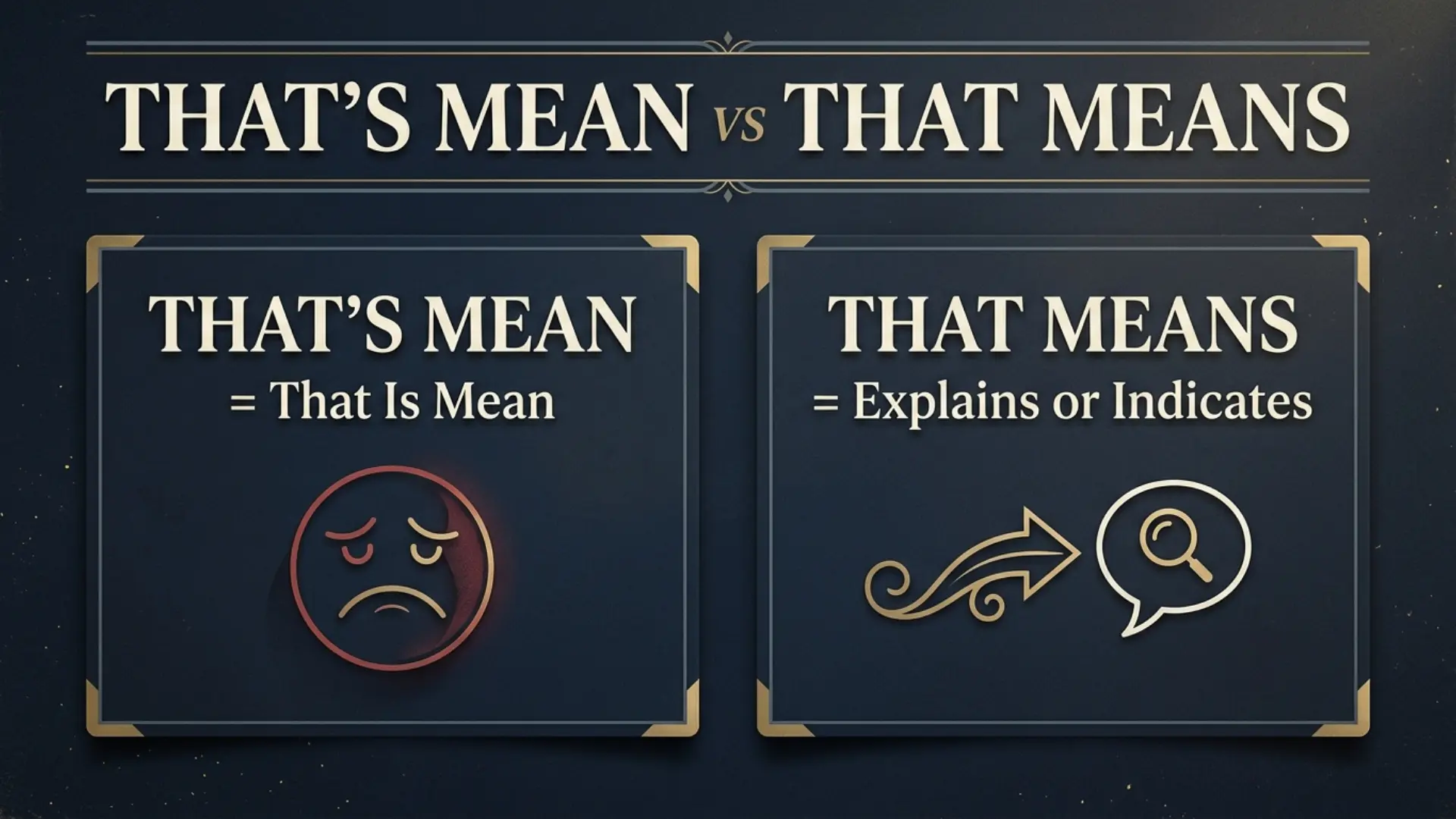
“That’s mean” and “that means” are both correct, but they mean completely different things.
Use that’s mean when you want to say that something is unkind, rude, unfair, or hurtful:
That’s mean. You shouldn’t laugh at him.
Here, that’s is the contraction of that is:
That is mean.
Use that means when you are explaining what something signifies, indicates, implies, or results in:
The store is closed. That means we have to come back tomorrow.
The easiest rule is:
- That’s mean = That is mean = unkind
- That means = explains what something means or leads to
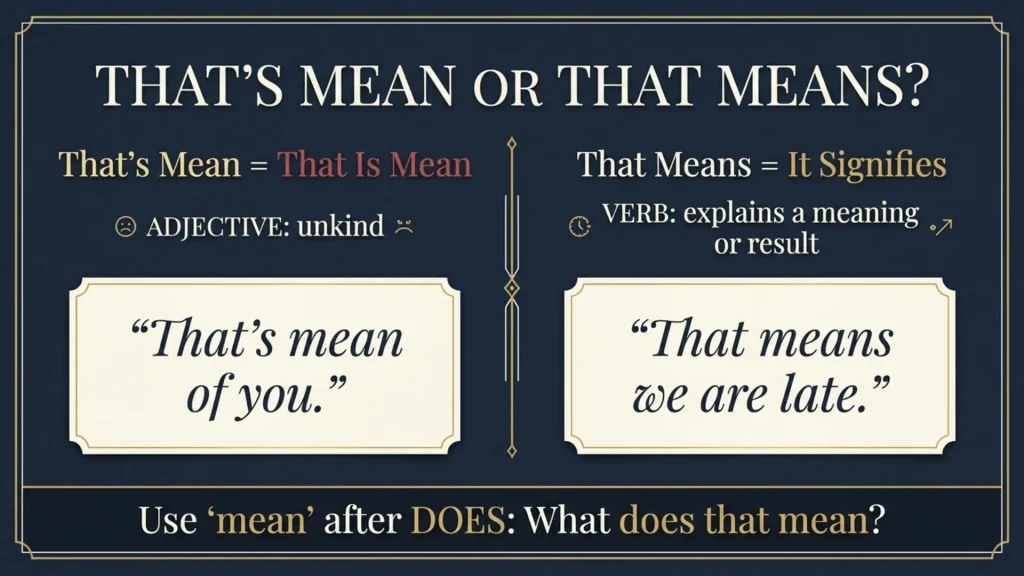
That’s Mean vs That Means: Quick Comparison
| Phrase | Grammar | Meaning | Example |
|---|---|---|---|
| That’s mean | that + is + adjective | That is unkind | That’s mean of you. |
| That means | subject + verb | That signifies or results in something | That means we are late. |
| Thats mean | Incorrect spelling | Missing apostrophe | Write that’s mean |
| That mean | Usually incorrect with singular “that” | Verb agreement error | Write that means |
| That’s means | Incorrect | Mixes two structures | Use that’s mean or that means |
What Does “That’s Mean” Mean?
That’s mean means:
That is unkind, rude, cruel, unfair, or hurtful.
The word mean is an adjective in this phrase.
Examples:
That’s mean. She was only trying to help.
That’s mean of you.
Making fun of someone’s accent is mean.
That’s a mean thing to say.
If you can expand that’s into that is, the structure becomes obvious:
That’s mean.
becomes:
That is mean.
What Does “That Means” Mean?
That means is used when you explain what something signifies, indicates, implies, or causes.
Examples:
The light is red. That means we should stop.
She passed the exam. That means she can graduate.
The shop is closed. That means we have to return tomorrow.
He hasn’t replied. That means he may be busy.
Here, means is a verb.
Cambridge Grammar explains that mean is used to explain what a word, phrase, situation, or result refers to, and it also uses means with a singular third-person subject. Cambridge Grammar on “mean”
Why Does “That Means” Use Means?
Because that is singular.
In the present simple, a third-person singular subject normally takes a verb ending in -s.
Compare:
I mean
You mean
We mean
They mean
but:
He means
She means
It means
That means
This means
So:
That means we are finished.
is correct.
Not:
That mean we are finished.
This is the same basic subject-verb agreement principle explained in GrammarRead’s People Do or People Does? guide.
Mean vs Means: The Basic Grammar Rule
Use mean with:
- I
- you
- we
- they
- plural subjects
- after auxiliary verbs such as do, does, did, will, can, may, might
Use means with a third-person singular subject in the present simple.
Examples With Mean
I mean what I said.
They mean the same thing.
What does that mean?
What do these words mean?
It will mean more work.
Examples With Means
That means something different.
It means the same thing.
This means we need more time.
The sign means “Stop.”
Her silence means she disagrees.
The “That Is” Test
A very easy way to choose between that’s mean and that means is to replace that’s with that is.
Example 1
That’s mean.
Replace it:
That is mean.
The sentence still works.
So that’s mean is correct.
Example 2
Suppose you want to say:
That means we need to leave.
Try replacing it with:
That is mean we need to leave.
That makes no grammatical sense.
Therefore you need:
That means we need to leave.
This tiny test saves a surprising amount of human suffering over one apostrophe.
“That Is Mean” vs “That Means”
These are both correct.
That Is Mean
Means:
That is unkind.
Example:
Ignoring her on purpose is mean.
That is mean.
That Means
Means:
That signifies or results in something.
Example:
We missed the final train.
That means we need a taxi.
The difference is grammatical:
- is = linking verb
- mean = adjective
versus:
- means = main verb
Is “That’s Mean” Correct?
Yes.
That’s mean is completely correct when that’s means that is and mean means unkind.
Examples:
That’s mean!
That’s really mean.
That’s mean of him.
That’s a mean thing to do.
That’s mean to say.
Is “Thats Mean” Correct?
No.
If you mean:
That is mean
you need an apostrophe:
That’s mean
Incorrect:
Thats mean.
Correct:
That’s mean.
The apostrophe replaces the missing i in is.
Is “That Means” Correct?
Yes.
Use that means when explaining what something indicates or results in.
Examples:
That means yes.
That means no.
That means we can go.
That means the answer is wrong.
That means you passed.
Is “That Mean” Correct?
Usually not when that is the singular subject in a normal present-tense statement.
Incorrect:
That mean we are late.
Correct:
That means we are late.
However, that mean can appear when another grammatical structure controls the verb.
For example:
Does that mean we are late?
Here, does carries the present-tense agreement, so the main verb returns to its base form:
mean
Not:
Does that means…
Does That Mean or Does That Means?
Use:
Does that mean…?
Not:
Does that means…?
Correct:
Does that mean we can leave?
Incorrect:
Does that means we can leave?
Why?
Because after does, use the base form of the verb:
does mean
not:
does means
Compare:
She means it.
but:
Does she mean it?
The same rule appears in many English grammar questions, including Anyone Has or Anyone Have?, where an auxiliary verb changes the form of the following verb.
What Does That Mean or What Does That Means?
Use:
What does that mean?
Not:
What does that means?
Correct:
What does that mean?
Incorrect:
What does that means?
Again, does already carries the -s needed for third-person singular agreement.
English does not need two grammatical workers doing the same shift.
What Is That Mean vs What Does That Mean?
Use:
What does that mean?
when asking for a meaning or explanation.
Example:
What does that word mean?
What does that sign mean?
What does that mean in simple terms?
The phrase:
What is that mean?
is normally incorrect if you intend to ask about meaning.
You may be combining:
What is that?
and:
What does that mean?
Use one complete structure.
What Is That Means?
What is that means? is not standard English when asking for meaning.
Instead say:
What does that mean?
Or:
What is the meaning of that?
Not:
What is that means?
Is That Mean or Does That Mean?
These are different structures.
Is That Mean?
This asks whether something is unkind.
Is that mean?
Example:
Is it mean to cancel at the last minute?
Does That Mean?
This asks about significance or implication.
Does that mean the meeting is canceled?
So:
- Is that mean? = Is that unkind?
- Does that mean…? = Does that signify or imply…?
That’s Mean vs That Is Mean
These mean the same thing.
That’s mean.
is simply the contracted form of:
That is mean.
Use the contraction in ordinary speech and informal writing.
Use the full form when you want extra emphasis:
That is mean.
“That’s Means” Is Incorrect
Do not write:
That’s means we are leaving.
Why?
Because that’s already contains the verb is.
Expanding it gives:
That is means we are leaving.
That structure is wrong.
Use:
That means we are leaving.
Or, with an adjective:
That’s mean.
What Does “Means That” Mean?
Means that introduces a result, implication, explanation, or interpretation.
Example:
The warning light is on, which means that something needs attention.
His contract expired, which means that he is no longer employed there.
The word that after means introduces the clause explaining the result.
You can sometimes omit it:
That means that we need to leave.
That means we need to leave.
Both are correct.
Means That or Mean That?
Both forms are possible depending on the subject.
Means That
Use with a third-person singular subject:
This means that we need help.
His absence means that the meeting will be delayed.
Mean That
Use with plural subjects:
These results mean that we need more research.
Or after auxiliary verbs:
Does that mean that we failed?
It may mean that she is busy.
The subject and sentence structure decide which form you need.
This Means That
This means that is a normal and useful English phrase.
Examples:
This means that the system is working.
This means that you qualify.
This means that something has changed.
You can often omit the second that:
This means you qualify.
Both versions are grammatical.
That Means That
Yes, that means that is also correct.
Example:
The road is flooded. That means that we need another route.
The two occurrences of that have different jobs.
The first that is the subject:
That means…
The second introduces the following clause:
…means that we need another route.
It may look repetitive, but grammar is not required to win a beauty contest.
Is It Correct to Say “That That”?
Yes, two consecutive uses of that can sometimes be grammatically correct.
Example:
I know that that answer is wrong.
The first that introduces the clause.
The second that modifies answer.
Another example:
She said that that was the best option.
However, if the sentence feels clumsy, you can often rewrite it.
“It’s Mean” vs “It Means”
These follow exactly the same distinction.
It’s Mean
It’s = it is
It’s mean to laugh at someone.
Meaning:
It is unkind.
It Means
It means something important.
Meaning:
It signifies something.
So:
- it’s mean = it is unkind
- it means = it signifies
“This Is Mean” vs “This Means”
This Is Mean
This is mean.
Means:
This is unkind.
This Means
This means we cannot continue.
Means:
This indicates that we cannot continue.
Another Word for “That Means”
Depending on context, you could use:
- that indicates
- that signifies
- that implies
- that suggests
- that shows
- that demonstrates
- that results in
- that tells us
- in other words
- therefore
- consequently
- so
Example:
The door is locked. That means nobody can enter.
Alternative:
The door is locked. Therefore, nobody can enter.
Synonyms for “That’s Mean”
Depending on tone:
- that’s unkind
- that’s rude
- that’s cruel
- that’s harsh
- that’s hurtful
- that’s unfair
- that’s nasty
- that’s insensitive
- that’s disrespectful
- that’s inconsiderate
Example:
That’s mean of you.
Alternative:
That’s unkind of you.
“By That Means” Meaning
The phrase by that means is different from that means.
By that means means:
by that method
or:
in that way
Example:
He gained access by that means.
Here, means is a noun meaning a method or way.
This is different from:
That means he gained access.
where means is a verb.
Means Can Also Be a Noun
One reason this word becomes confusing is that means can also be a noun.
Example:
The internet is a means of communication.
Here, means means:
method
Another example:
They had no means of escape.
Here it means:
method or way of escaping
This use is different from the verb:
That means something else.
What Does “Mean” Mean?
The word mean has several common uses.
Mean as a Verb: Signify
What does this word mean?
Mean as a Verb: Intend
I didn’t mean to hurt you.
Mean as an Adjective: Unkind
That was mean.
Mean as a Noun: Average
In mathematics:
The mean of 4, 6, and 8 is 6.
This is why context matters.
What Does “I Mean It” Mean?
I mean it means:
I am serious about what I am saying.
Example:
Please stop. I mean it.
The speaker is emphasizing sincerity or seriousness.
“When I Say It, I Really Mean It” Meaning
This means:
When I say something, I genuinely believe or intend it.
Example:
When I say I’m proud of you, I really mean it.
The speaker is emphasizing that the statement is sincere, not casual or empty.
“It Means a Lot” Meaning
It means a lot means something is emotionally important or valuable to someone.
Example:
Your support means a lot to me.
This does not mean the support has a dictionary definition.
Here, mean refers to emotional importance.
25 Examples of “That’s Mean”
- That’s mean.
- That’s really mean.
- That’s mean of you.
- That’s mean of him.
- That’s mean of her.
- That’s mean to say.
- That’s mean to laugh at him.
- That’s mean to ignore her.
- That’s mean to exclude someone.
- That’s mean to make fun of his accent.
- That’s mean. She was only trying to help.
- That’s mean. Give him another chance.
- That’s mean behavior.
- That’s mean and unnecessary.
- That’s mean, even as a joke.
- That’s mean to do to a friend.
- That’s mean if you know she is upset.
- That’s mean to say in front of everyone.
- That’s mean. You should apologize.
- That’s mean and disrespectful.
- That’s mean, not funny.
- That’s mean to someone who trusted you.
- That’s mean to deliberately embarrass him.
- That’s mean when you know the truth.
- That’s mean, and she deserves better.
25 Examples of “That Means”
- That means we are late.
- That means you passed.
- That means I was wrong.
- That means the shop is closed.
- That means we need more time.
- That means something has changed.
- That means you can enter.
- That means they already know.
- That means we should leave.
- That means the answer is correct.
- That means she agrees.
- That means he cannot attend.
- That means the plan worked.
- That means we have another option.
- That means tomorrow will be busy.
- That means the payment failed.
- That means your account is active.
- That means the road is blocked.
- That means nobody is home.
- That means the test is over.
- That means you have enough points.
- That means I need to call her.
- That means the deadline has changed.
- That means we can continue.
- That means the problem is solved.
Common Mistakes
Incorrect: Thats Mean
❌ Thats mean.
✅ That’s mean.
Reason: That’s is a contraction of that is, so it needs an apostrophe.
Incorrect: That Mean We Are Late
❌ That mean we are late.
✅ That means we are late.
Reason: That is singular, so the present-simple verb is means.
Incorrect: That’s Means
❌ That’s means we are late.
✅ That means we are late.
Incorrect: Does That Means?
❌ Does that means we can go?
✅ Does that mean we can go?
After does, use the base form.
Incorrect: What Is That Mean?
❌ What is that mean?
✅ What does that mean?
Incorrect: What Does That Means?
❌ What does that means?
✅ What does that mean?
For another common case where the auxiliary verb controls the following verb form, see Agreed vs Agree.
Simple Rule to Remember
Ask yourself what you are trying to say.
Are You Calling Something Unkind?
Use:
That’s mean.
Because:
That’s = that is.
Are You Explaining a Meaning or Result?
Use:
That means…
Example:
The gate is locked. That means we can’t enter.
Frequently Asked Questions
Which is correct: “means that” or “mean that”?
Both can be correct.
Use means that with a singular third-person subject:
This means that we need to leave.
Use mean that with plural subjects or after auxiliaries:
These results mean that we need to leave.
Does that mean that we need to leave?
What does “that’s mean” mean in English?
That’s mean means that is unkind, rude, unfair, or hurtful.
Example:
Laughing at her mistake is cruel. That’s mean.
Is it correct to say “that that”?
Yes, in some sentences.
Example:
I know that that answer is incorrect.
The two instances of that have different grammatical functions.
What is the difference between “mean” and “means”?
Mean is the base verb form.
I mean it.
They mean the same thing.
Means is normally the third-person singular present form:
It means something.
That means we should go.
When do you use means vs mean?
Use means with a singular third-person subject in the present simple.
Use mean with I, you, we, they, plural subjects, and after auxiliaries such as do, does, did, can, will, may, and might.
Which is correct: “it’s mean” or “it means”?
Both are correct but have different meanings.
It’s mean.
means:
It is unkind.
It means…
means:
It signifies or indicates…
Is it “mean” or “means”?
It depends on the subject and sentence structure.
I mean.
They mean.
He means.
It means.
Does it mean?
When I say it, I really mean it meaning?
It means the speaker is emphasizing that they are sincere and serious about what they are saying.
Example:
When I say I’ll help you, I really mean it.
What is the meaning of “it means”?
It means introduces the meaning, significance, implication, or result of something.
Example:
The green light is on. It means the device is working.
Final Answer
The difference between that’s mean vs that means is simple once you identify the grammar.
Use:
That’s mean
when you mean:
That is mean or unkind.
Use:
That means
when you are explaining what something signifies, indicates, implies, or results in.
Remember:
That’s = that is
and:
That + means = singular subject + verb
So:
That’s mean of you.
but:
That means we need to leave.
If you see does, return the verb to its base form:
Does that mean…?
not:
Does that means…?
One apostrophe and one s create two completely different structures. English apparently decided that was a reasonable user interface.