People Do or People Does? Correct Grammar, Examples & Rules
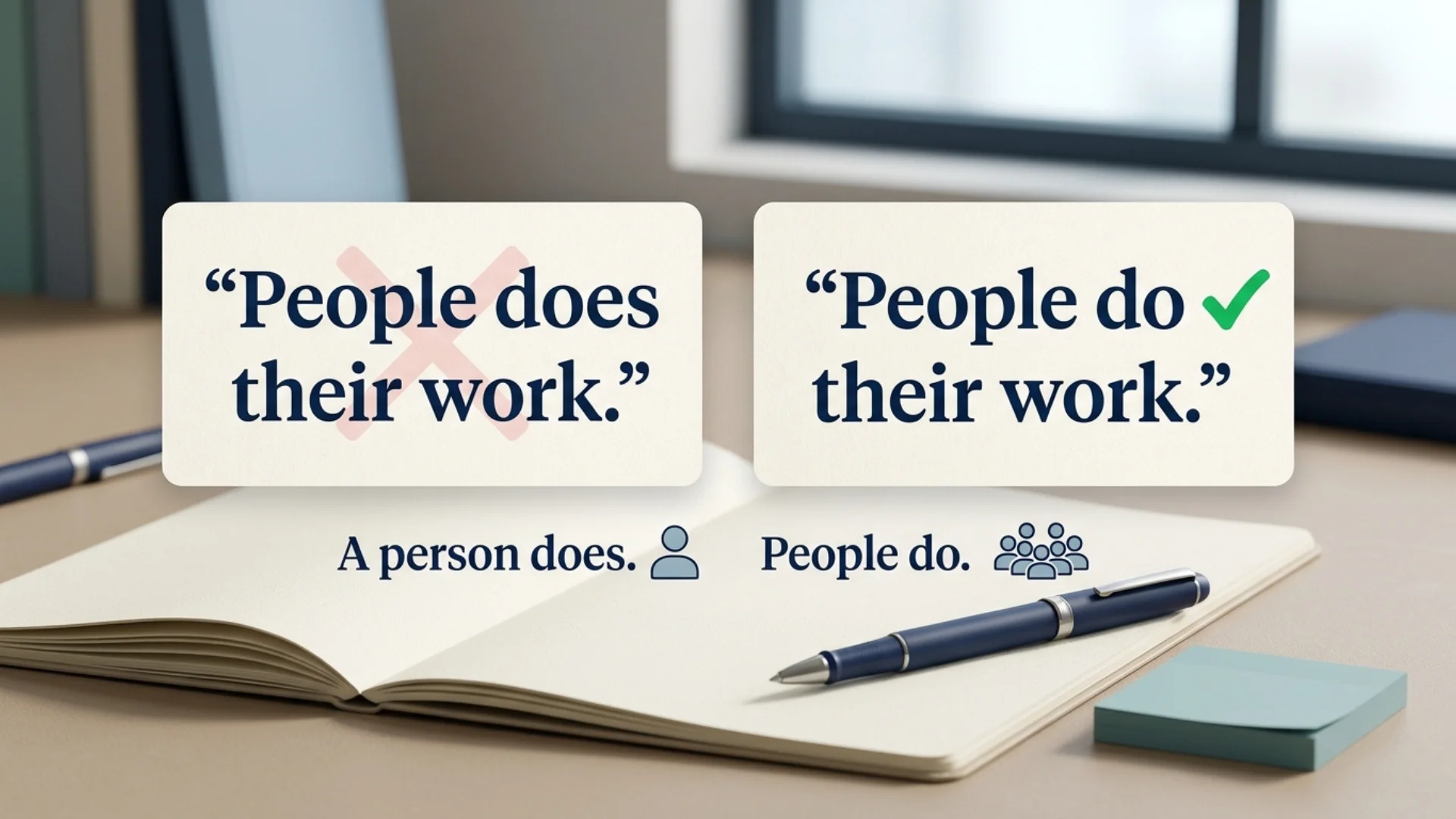
People do or people does? In normal English, people do is correct because people is usually a plural noun. Use does with a singular third-person subject such as he, she, it, or one person.
So we say People do make mistakes, Some people do agree, and Do people understand? We do not normally say people does. The main exception is the much rarer expression a people, meaning one nation or ethnic group, which can take a singular verb.

Quick Answer: People Do or People Does?
| Subject | Correct Form | Example |
|---|---|---|
| People | do | People do change over time. |
| A person | does | A person does need rest. |
| Some people | do | Some people do prefer tea. |
| Most people | do | Most people do understand. |
| Many people | do | Many people do work remotely. |
| Everybody | does | Everybody does make mistakes. |
| Anyone | does | Anyone does what they can. |
| A people | does | A people does preserve its traditions. |
The easiest memory trick is:
- People = they = do
- Person = he/she = does
Why “People Do” Is Correct
In everyday English, people is the usual plural of person. Because it is plural, it takes plural verb forms.
- People do their best.
- People are waiting outside.
- People have different opinions.
- People want clear answers.
The Cambridge Grammar guide to person, persons, and people explains that people is the normal form used for groups of human beings, while persons is much more formal and often legalistic.
Replace “People” With “They”
If you are unsure, replace people with they:
- People do care. → They do care.
- People do know the answer. → They do know the answer.
- People do want change. → They do want change.
Now test the incorrect form:
- People does care. → They does care.
The error becomes obvious immediately.
Also check: Was There or Were There?
Why “People Does” Is Usually Wrong
Does is the simple-present form used with a third-person singular subject:
- He does the work.
- She does the work.
- It does the job.
- One person does the work.
But people normally refers to more than one person:
- People do the work.
- People do understand.
- People do complain sometimes.
So people does creates a subject-verb agreement error in normal everyday English.
Do People or Does People?
In questions, use do people, not does people.
- Do people still use cash?
- Why do people do that?
- Where do people go for help?
- How do people learn languages?
- What do people want?
- Do people in your city use public transport?
The question pattern is:
Do + people + base verb?
For example:
- Do people like it?
- Do people know the rule?
- Do people work here?
After do, the main verb stays in its base form. So Do people likes it? is also incorrect.
People Don’t or People Does Not?
Use people don’t or people do not.
- People don’t always agree.
- People don’t know everything.
- People do not all think alike.
- People don’t usually notice that detail.
Do not use:
- People doesn’t agree.
- People does not agree.
Those forms use singular agreement with a plural subject.
Some People Do or Some People Does?
Some people do is correct.
The word some does not make people singular. The subject is still plural:
- Some people do prefer working at night.
- Some people do understand the rule immediately.
- Some people don’t like coffee.
Compare that with a singular noun:
- Somebody does know the answer.
Somebody is grammatically singular, while some people is plural.
Most People Do or Most People Does?
Most people do is correct.
- Most people do need enough sleep.
- Most people do understand simple examples.
- Most people don’t read every instruction carefully.
Most describes the plural noun people, so the verb remains plural.
Does Many People or Do Many People?
Do many people is correct because many people is plural.
- Do many people work from home?
- Do many people use this expression?
- Why do many people make this mistake?
Does many people is incorrect in standard English.
Everybody Does or Everybody Do?
Everybody does is the standard form because everybody is grammatically singular even though it refers to many individuals.
- Everybody does their part.
- Everybody does make mistakes.
- Everybody knows the answer.
This is one reason learners get confused: people refers to many individuals and is plural, while everybody also refers to many individuals but is grammatically singular.
| Expression | Grammar Number | Correct Verb |
|---|---|---|
| People | Plural | do |
| Everybody | Singular | does |
| Everyone | Singular | does |
| Someone | Singular | does |
| Anyone | Singular | does |
| Nobody | Singular | does |
Anyone Does or Anyone Do?
In a normal statement, anyone does follows singular agreement:
- Anyone does what they can in that situation.
However, that exact sentence pattern is less common than questions and conditional statements. More natural examples are:
- Does anyone know the answer?
- Does anyone need help?
- If anyone does call, let me know.
Because anyone is singular, the auxiliary is does.
Is Anyone or Does Anyone?
Both are correct, but they use different verbs and ask different kinds of questions.
- Is anyone here? → asks about a state or presence using be.
- Is anyone available? → asks about a condition.
- Does anyone know? → asks about an action or state expressed by another verb.
- Does anyone work here? → asks about an action or occupation.
Use is anyone when be is the main verb. Use does anyone when another present-tense verb follows.
Person Do or Person Does?
Person does is correct because person is singular.
- One person does the work.
- A person does what they think is right.
- Each person does one task.
Compare:
- One person does the job.
- Two people do the job.
Is People Singular or Plural?
In ordinary modern English, people is plural when it means more than one person.
- People are waiting.
- People have arrived.
- People do care.
It behaves like they, not like he, she, or it.
Can “People” Ever Be Singular?
Yes, but only in a different sense. A people can mean a nation, ethnic group, or cultural community considered as one group.
- A people is shaped by its history.
- A people does preserve traditions across generations.
This is a specialized use found more often in history, anthropology, politics, and cultural writing.
The plural of this meaning can be peoples:
- The indigenous peoples of the region have distinct languages.
- Different peoples do preserve different traditions.
So the everyday rule remains people do, but the phrase a people does can be grammatical when a people means one nation or cultural group.
2 People or 2 Persons?
In ordinary English, 2 people is the natural choice.
- Two people are waiting outside.
- We need two people for the job.
- Two people do the work faster.
Two persons is grammatically possible but sounds formal and is most common in legal, official, technical, or notice-style language.
- Maximum occupancy: 2 persons.
- Two persons were detained.
For normal conversation and general writing, use people.
3 People or 3 Persons?
Three people is normal everyday English. Three persons is possible in formal or legal contexts, but it is uncommon in ordinary conversation.
The same rule applies to larger numbers:
- 5 people
- 8 people
- 20 people
- 100 people
You may see 5 persons or 8 persons on signs, regulations, legal reports, or occupancy notices, but that does not make persons the normal conversational plural.
People Do in Statements, Questions, Negatives, and Emphasis
| Sentence Type | Correct Pattern | Example |
|---|---|---|
| Statement | People do | People do make mistakes. |
| Question | Do people | Do people understand? |
| Negative | People do not | People do not always agree. |
| Contraction | People don’t | People don’t know everything. |
| Emphasis | People do + verb | People do care about this. |
Why Is “Do” Sometimes Added for Emphasis?
In a positive statement, the simple present often does not need do:
- People care about this.
But do can add emphasis:
- People do care about this.
Both are correct. The second sentence stresses that the statement is true, often in response to doubt or disagreement.
Do and Does in the Simple Present
| Subject | Correct Form |
|---|---|
| I | do |
| You | do |
| We | do |
| They | do |
| People | do |
| He | does |
| She | does |
| It | does |
| A person | does |
| Everyone | does |
| Anyone | does |
Do and does are both present-tense forms of do. The difference is subject agreement, not meaning.
Common Mistakes With People, Do, and Does
| Incorrect | Correct | Reason |
|---|---|---|
| People does care. | People do care. | People is plural. |
| Does people know? | Do people know? | Plural questions use do. |
| People doesn’t agree. | People don’t agree. | Plural negative uses don’t. |
| Some people does this. | Some people do this. | Some people is plural. |
| Most people does this. | Most people do this. | Most people is plural. |
| Does many people know? | Do many people know? | Many people is plural. |
| Everybody do it. | Everybody does it. | Everybody is singular. |
| A person do this. | A person does this. | Person is singular. |
Past and Future Forms Are Easier
The do/does distinction disappears in the simple past:
- One person did the work.
- People did the work.
- Did people understand?
It also disappears after will:
- One person will do the work.
- People will do the work.
The present simple is where the singular does versus plural do contrast matters most.
Easy Rule to Remember
Use this shortcut:
- Ask whether the subject means one person or more than one.
- If it is people, mentally replace it with they.
- If they do sounds correct, use people do.
- If the subject is a person, everyone, anyone, somebody, or another singular form, use does.
Practice: Choose Do or Does
- People ___ change their minds.
- A person ___ need enough sleep.
- ___ people understand this rule?
- Everybody ___ their best.
- Some people ___ prefer silence.
- ___ anyone know the answer?
- Most people ___ use their phones every day.
- One person ___ all the cooking.
- ___ many people work here?
- A people ___ sometimes preserve traditions for centuries.
Answers
- do
- does
- Do
- does
- do
- Does
- do
- does
- Do
- does
Frequently Asked Questions
Which is correct, “do people” or “does people”?
Do people is correct in normal English because people is plural. For example: Do people know about this?
Do we use do or does for people?
Use do with people: People do their work. Use does with a singular subject such as a person, he, she, or it.
Which is correct: “some people do” or “some people does”?
Some people do is correct. People remains plural even when preceded by some.
Is people a singular or plural?
People is normally plural when it means multiple human beings. The specialized phrase a people, meaning a nation or ethnic group, can be singular.
Can people be used as singular?
Yes, in the expression a people, where it means one nation, ethnic group, or cultural community. In everyday references to multiple individuals, people is plural.
Is it correct to say “3 people” or “3 persons”?
Three people is the normal choice in everyday English. Three persons is grammatical but more formal and often appears in legal or official contexts.
Is it 5 people or 5 persons?
Use 5 people in ordinary writing and speech. 5 persons is mainly formal, legal, or administrative.
Which is correct, 2 people or 2 people?
If the intended comparison is 2 people or 2 persons, 2 people is the normal everyday form. 2 persons is acceptable in formal or legal contexts.
Is it “8 people” or “8 persons”?
8 people is natural in everyday English. 8 persons may appear on occupancy signs, regulations, legal documents, or formal reports.
Final Rule to Remember
For people do or people does, use people do in ordinary English because people is plural. The matching patterns are do people, people don’t, some people do, most people do, and many people do.
Use does with singular subjects such as a person, everyone, everybody, and anyone. The rare phrase a people, meaning one nation or cultural group, can also take a singular verb.