Disloyal vs Unloyal: Which Is Correct? Meaning & Examples
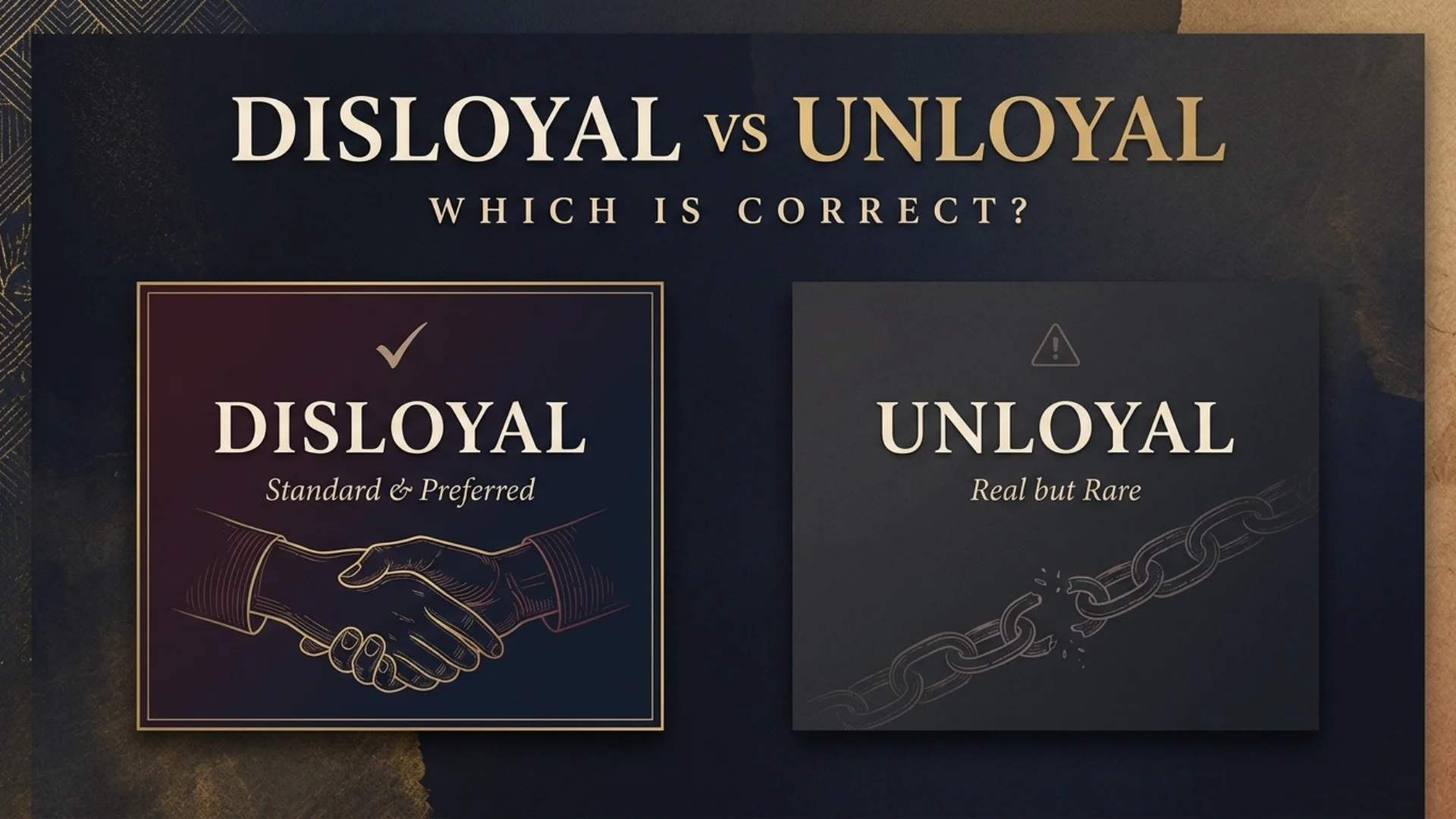
Quick Answer: Use disloyal in normal modern English.
Unloyal is a real but uncommon word meaning “not loyal.” It has appeared in published English, but it sounds unusual to many speakers and is rarely the best choice in formal, academic, professional, or everyday writing.
So:
He was disloyal to his friend. ✅
She showed disloyal behavior. ✅
He was unloyal to his friend. Understandable, but uncommon.
The safest rule is:
loyal → disloyal
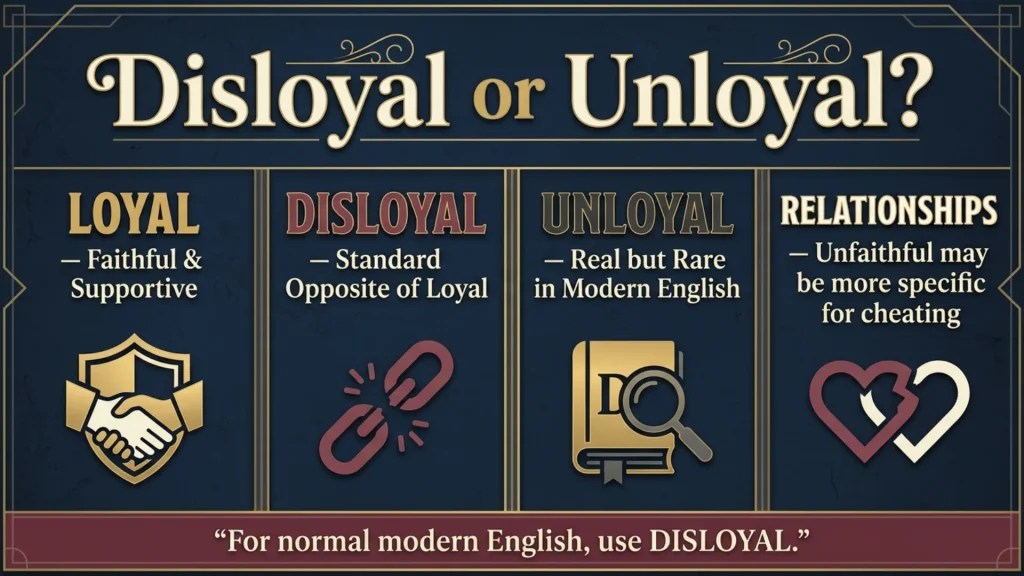
Disloyal vs Unloyal at a Glance
| Word | Meaning | Modern Usage | Recommended? |
|---|---|---|---|
| loyal | faithful, supportive, devoted | Very common | Yes |
| disloyal | lacking loyalty or faithfulness | Standard and common | Yes |
| unloyal | not loyal | Rare and unusual | Usually avoid |
| disloyalty | lack of loyalty | Standard noun | Yes |
| unloyalty | state of being unloyal | Very rare | Usually avoid |
Both disloyal and unloyal can express the idea of lacking loyalty.
The practical difference is usage, not a reliable rule that gives the two words completely separate meanings.
Which Is Correct: Unloyal or Disloyal?
Disloyal is the standard choice.
Use it in:
- everyday conversation
- essays
- professional writing
- journalism
- business communication
- relationship discussions
- academic writing
- formal documents
Example:
The employee was disloyal to the company.
You may occasionally encounter:
The employee was unloyal to the company.
That sentence can be understood, and unloyal has historical usage, but it sounds much less natural in current English.
When there is no special reason to choose the rare form, use:
disloyal
What Does Disloyal Mean?
Disloyal is an adjective meaning not loyal, lacking loyalty, or failing to show the faithfulness, allegiance, support, or devotion that is expected.
The Merriam-Webster definition of disloyal describes it as lacking loyalty or showing an absence of allegiance, devotion, obligation, faith, or support.
Examples:
He was disloyal to his closest friend.
The politician was accused of being disloyal to the party.
Sharing private information was a disloyal act.
Customers considered the decision disloyal to the company’s original values.
She felt that her partner had been disloyal.
Is Disloyal a Real Word?
Yes.
Disloyal is a standard English adjective with centuries of recorded use.
Its related forms include:
- disloyal
- disloyally
- disloyalty
Examples:
His disloyalty damaged the friendship.
He behaved disloyally toward his colleagues.
The word is not slang, a recent invention, or an informal spelling.
What Does Unloyal Mean?
Unloyal means:
not loyal
It is formed logically from:
un- + loyal
The problem is not that readers cannot understand it.
The problem is that English overwhelmingly established disloyal as the usual negative form.
Compare:
unhappy
unfair
unclear
but:
dishonest
disobedient
disloyal
English does not use one negative prefix mechanically for every adjective.
Is Unloyal a Word?
Yes, unloyal is a word, but it is rare.
It has appeared in published English and can be found in dictionary and historical-word resources.
So it is too strong to say:
“Unloyal is not a word.”
A more accurate statement is:
Unloyal exists, but disloyal is the established and far more natural word in modern standard English.
For normal writing:
Use disloyal.
Is Unloyal Grammatically Correct?
It can function grammatically as an adjective.
Example:
He seemed unloyal to the organization.
The sentence structure itself is grammatical.
However, lexical acceptability and grammar are not exactly the same thing.
A sentence can have perfectly valid grammar while containing a word choice that sounds unusual.
For example:
He seemed disloyal to the organization.
is much more idiomatic.
This distinction between technically possible forms and preferred modern usage also appears in other English word pairs. GrammarRead’s Linchpin vs Lynchpin explains another case where actual usage matters more than simply declaring one imaginable form impossible.
Disloyal or Unloyal: The Main Difference
The key difference is:
Disloyal = standard
Unloyal = rare
It is tempting to create a sharper semantic distinction, such as:
disloyal = actively betraying someone
unloyal = merely lacking loyalty
But modern English does not consistently enforce that distinction.
Disloyal itself can simply mean a lack of complete faithfulness or allegiance.
Examples:
He was disloyal because he refused to support the group.
That does not necessarily describe dramatic betrayal.
Likewise:
She was disloyal to the cause.
The exact seriousness depends on context.
Therefore, do not treat active vs passive betrayal as a fixed grammar rule.
Why Do We Say Disloyal Instead of Unloyal?
English negative prefixes are not completely predictable.
The prefix un- often creates a direct negative:
happy → unhappy
known → unknown
fair → unfair
But dis- appears in many established negatives and opposites:
honest → dishonest
obedient → disobedient
respectful → disrespectful
loyal → disloyal
English vocabulary develops through history and convention, not just mathematical prefix rules.
That is why a theoretically understandable word may remain rare while another form becomes standard.
For another example of a word pair shaped by established usage rather than neat spelling logic, see Smooth vs Smoothe.
The Origin of Disloyal
Disloyal has a long history in English.
It entered Middle English through Anglo-French forms related to desloial, combining a negative prefix with a word related to loyal.
The important practical point is that disloyal has been established for centuries.
That historical head start helps explain why modern English speakers naturally choose:
disloyal
rather than:
unloyal
Loyal vs Disloyal
The basic contrast is straightforward:
Loyal
Faithful, supportive, committed, or dependable.
She remained loyal to her friends.
Disloyal
Failing to show the expected loyalty.
She was disloyal to her friends.
Compare:
a loyal employee
a disloyal employee
a loyal supporter
a disloyal supporter
a loyal friend
a disloyal friend
Is the Opposite of Loyal Disloyal or Unloyal?
The normal opposite of loyal is:
disloyal
Other possible antonyms or near-antonyms include:
- unfaithful
- faithless
- treacherous
- traitorous
- false
- unreliable
- untrue
But they do not all have exactly the same strength or context.
For a simple direct opposite:
loyal ↔ disloyal
is the safest pair.
Disloyal Meaning in a Relationship
In a relationship, disloyal usually means failing to show the commitment, honesty, faithfulness, or support expected between partners.
Possible examples include:
- cheating
- secretly pursuing another romantic interest
- betraying a partner’s confidence
- deliberately undermining the relationship
- lying about important commitments
- taking another person’s side in a serious breach of trust, depending on context
Example:
She considered his secret messages to his ex disloyal.
Another:
He felt that discussing their private problems publicly was disloyal.
The exact boundary depends on the expectations of the relationship.
Disloyal vs Unfaithful
These words overlap, but unfaithful can be more specific in romantic contexts.
Disloyal
Broad.
It can describe behavior involving:
- friends
- employers
- teams
- countries
- political causes
- families
- romantic partners
Unfaithful
Can also mean generally lacking faithfulness, but it is especially common when describing romantic or sexual infidelity.
Example:
He was disloyal to his business partner.
Natural.
He was unfaithful to his wife.
Often implies romantic or sexual betrayal.
Can You Be Loyal and Unfaithful?
This depends on what kind of loyalty you mean.
A person may consider themselves supportive, protective, or committed in some parts of a relationship while still being sexually or romantically unfaithful.
But the act of infidelity itself would normally be considered a form of disloyal behavior within a relationship that expects exclusivity.
So it is possible for someone to display loyalty in some areas while acting disloyally in another.
Language does not magically resolve messy human contradictions. Regrettably, humans kept those.
Disloyal to or Disloyal With?
Use:
disloyal to
Examples:
She was disloyal to her friend.
He was disloyal to the company.
They were disloyal to the leader.
The soldier was accused of being disloyal to his country.
Usually avoid:
disloyal with
when identifying the person, group, or cause that did not receive loyalty.
Disloyal Person Meaning
A disloyal person is someone who fails to remain faithful, supportive, committed, or trustworthy toward a person, group, organization, belief, or cause that expects loyalty.
The severity varies.
A disloyal person might:
- break a confidence
- abandon an ally
- betray a partner
- turn against a team
- secretly work against an employer
- support an opposing side
Context determines whether the behavior is mildly disappointing or a serious betrayal.
What Is Another Word for a Disloyal Person?
Depending on context:
Betrayer
Someone who betrays trust.
Traitor
A much stronger word, often describing serious betrayal of a person, cause, organization, or country.
Turncoat
Someone who abandons one side and joins the opposing side.
Defector
Someone who leaves one organization, country, or political side for another.
Double-crosser
Someone who deceives or betrays another person after appearing cooperative.
Backstabber
Informal term for someone who secretly betrays another person.
Do not use these as exact replacements in every sentence.
Calling someone a traitor is much stronger than merely calling them disloyal.
Another Word for Unloyal
Because unloyal is uncommon, better alternatives include:
- disloyal
- unfaithful
- faithless
- unreliable
- untrue
- treacherous
- traitorous
- perfidious
- false
- disaffected
The best synonym depends on what actually happened.
A Fancy Word for Disloyal
A more formal or literary adjective is:
perfidious
It describes serious unfaithfulness or betrayal.
Example:
His perfidious behavior destroyed their trust.
Another formal option is:
treacherous
Example:
They condemned his treacherous actions.
You may also encounter:
recreant
but it is literary or archaic and is not a normal everyday replacement.
What Is a Fancy Word for Cheater?
It depends on the type of cheating.
Romantic or Marital Context
adulterer can describe a person who commits adultery.
philanderer traditionally describes a man who repeatedly has casual sexual relationships, especially while being unfaithful.
General Deception
Use:
- deceiver
- fraud
- trickster
- swindler
- cheat
Betrayal
Use:
- betrayer
- double-crosser
- backstabber
Do not replace cheater with adulterer unless the context actually involves adultery.
What Is a Deeper Word for Loyal?
More expressive alternatives include:
- faithful
- devoted
- steadfast
- unwavering
- staunch
- true
- dependable
- committed
- constant
- trustworthy
Examples:
She remained steadfast in her support.
He was a devoted friend.
They were unwavering in their loyalty.
She remained faithful to the cause.
Disloyal vs Treacherous
Treacherous is stronger.
Someone can be disloyal without committing an extreme betrayal.
Treacherous suggests readiness to betray trust or actively deceptive betrayal.
Compare:
His refusal to support the team seemed disloyal.
versus:
He secretly gave confidential information to their competitor, a treacherous act.
Disloyal vs Traitorous
Traitorous is also stronger than disloyal.
It often implies conduct resembling betrayal of:
- a country
- government
- cause
- organization
- leader
Example:
The general was accused of traitorous conduct.
Do not use traitorous for every minor act of disloyalty unless deliberately using dramatic language.
Disloyal vs Faithless
Faithless can describe someone who fails to remain faithful to a promise, relationship, duty, or allegiance.
It often has a literary tone.
Example:
The king punished his faithless adviser.
In everyday English:
disloyal adviser
may sound more natural.
Disloyal vs Untrustworthy
These are related but different.
Disloyal concerns loyalty.
Untrustworthy concerns whether someone can be trusted generally.
A person can be unreliable or dishonest without the situation specifically involving loyalty.
Example:
He lies constantly, so he is untrustworthy.
That does not necessarily mean he has betrayed a particular person or cause.
Is Unloyal Used in American English?
It occasionally appears, but disloyal is the natural standard choice in American English.
Prefer:
He was disloyal to his team.
Rather than:
He was unloyal to his team.
The same recommendation applies to professional American writing.
Is Unloyal Used in British English?
You may encounter unloyal in British sources too, particularly historical material, but disloyal remains the normal standard form.
This is not a major US-versus-UK spelling split like:
color / colour
Both major varieties strongly favor:
disloyal
Unloyal in Spanish
If you want to translate the idea of disloyal into Spanish, a common adjective is:
desleal
Example concept:
a disloyal friend → un amigo desleal
In romantic contexts, infiel may be more appropriate when you specifically mean unfaithful or cheating on a partner.
The best translation depends on context.
Disloyal in Friendship
A disloyal friend may:
- reveal private information
- speak against you behind your back
- deliberately sabotage you
- abandon you when loyalty was reasonably expected
- side with someone harming you
- betray an agreement or confidence
Example:
Sharing her friend’s private messages was disloyal.
Not every disagreement is disloyalty.
A loyal friend can disagree with you honestly.
Loyalty does not require blind agreement.
Disloyal in the Workplace
At work, disloyal may describe behavior perceived as working against an employer, team, or colleague.
Examples:
The manager accused him of being disloyal to the company.
She considered the secret disclosure of internal plans disloyal.
However, disagreement, resigning, changing jobs, or reporting wrongdoing is not automatically disloyal.
Whether the label is fair depends on the circumstances.
Disloyal in Politics
Political language frequently uses disloyal to describe someone perceived as failing to support:
- a party
- leader
- country
- institution
- political cause
Because it is a judgment-heavy word, it can be used rhetorically.
Example:
Critics accused the senator of being disloyal to the party.
That sentence reports the accusation without automatically proving that the person actually acted wrongly.
Disloyal in Relationships vs Cheating
These terms are not identical.
Disloyalty is broader.
Cheating usually refers to violating agreed romantic or sexual boundaries.
So:
Cheating can be disloyal.
But:
Not every act of disloyalty is romantic cheating.
For example, publicly revealing something your partner shared in confidence may be disloyal even if no infidelity occurred.
Does Disloyal Always Mean Betrayal?
Not necessarily.
It can describe severe betrayal, but it can also refer more broadly to a lack of expected faithfulness or support.
This is why it is misleading to define:
disloyal = active betrayal only
The context tells you how serious the behavior is.
Does Unloyal Mean “Not Actively Loyal”?
Some people try to distinguish the words this way:
unloyal = simply not loyal
disloyal = actively betraying
That can be a useful invented distinction in a particular discussion, but it is not a dependable standard dictionary rule.
If you need to express passive lack of commitment, clearer words are often:
- uncommitted
- indifferent
- detached
- neutral
- unreliable
- unsupportive
Those words communicate the intended nuance without relying on a rare form.
Why Does Unloyal Sound Wrong?
Mostly because readers are accustomed to:
disloyal
English speakers learn word combinations through repeated exposure.
The same principle explains why one spelling or word form can become standard even when another form looks logically possible.
For a similar distinction between a standard form and a tempting alternative, see GrammarRead’s Hassle vs Hastle.
Loyal, Disloyal, Unfaithful and Treacherous
| Word | Basic Sense | Strength |
|---|---|---|
| loyal | faithful and supportive | Positive |
| disloyal | lacking expected loyalty | General negative |
| unfaithful | not faithful, especially common in relationships | Moderate to strong |
| treacherous | dangerously deceptive or betraying trust | Strong |
| traitorous | resembling serious betrayal or treason | Very strong |
| perfidious | deliberately unfaithful or treacherous | Formal/literary |
Choosing the strongest-looking synonym is not automatically better writing.
Use the word that matches the actual situation.
Correct Examples With Disloyal
- He was disloyal to his closest friend.
- She felt that the company had been disloyal to its employees.
- His actions were clearly disloyal.
- They accused the officer of being disloyal to the organization.
- Sharing confidential information was a disloyal act.
- She would never be disloyal to her family.
- He remained loyal even when others became disloyal.
- The character betrays his allies and is eventually exposed as disloyal.
- Customers viewed the policy change as disloyal to the brand’s original mission.
- I would feel disloyal if I revealed what she told me privately.
- His disloyal behavior damaged their relationship.
- The leader removed several officials he considered disloyal.
- A disagreement does not automatically make someone disloyal.
- She interpreted his secrecy as disloyalty.
- The team expected loyalty and strongly criticized disloyal conduct.
Examples With Unloyal
These examples are understandable, but disloyal would normally be preferred:
He felt unloyal to his former employer.
The group considered him unloyal.
She worried that leaving would seem unloyal.
Standard modern alternatives:
He felt disloyal to his former employer.
The group considered him disloyal.
She worried that leaving would seem disloyal.
Common Mistakes
Mistake 1: Saying Unloyal Is Completely Invented
Too strong:
Unloyal is not a word.
Better:
Unloyal exists, but it is rare. Disloyal is the standard choice.
Mistake 2: Treating the Words as Equally Common
They are not.
Disloyal is overwhelmingly more natural in modern English.
Mistake 3: Inventing a Fixed Active/Passive Rule
Do not assume:
disloyal = active betrayal
and:
unloyal = passive lack of support
without context.
That is not a reliable standard distinction.
Mistake 4: Using Disloyal With the Wrong Preposition
Prefer:
disloyal to someone
Not normally:
disloyal with someone
Mistake 5: Using Traitor for Every Disloyal Person
Traitor is often much stronger.
Someone can be disloyal without deserving the label traitor.
Easy Rule to Remember
Remember this pair:
LOYAL → DISLOYAL
Not because unloyal is impossible, but because disloyal is the established modern form.
If you are writing:
- an essay
- an email
- a report
- a relationship message
- a caption
- an article
- a social post
- a school assignment
choose:
disloyal
Which Word Should You Use in Quotes or Captions?
If you are writing a quote, caption, post, or short message about loyalty, disloyal will normally sound more polished.
Examples:
Loyalty means little when actions are disloyal.
A disloyal friend can teach you the value of trustworthy people.
Trust is difficult to rebuild after disloyal behavior.
If you intentionally use unloyal because it fits a song title, quotation, character voice, or source text, keep the original wording.
Otherwise, prefer disloyal.
Frequently Asked Questions
Which is correct, unloyal or disloyal?
Disloyal is the standard and preferred word in modern English. Unloyal exists but is rare and often sounds unnatural.
What is the meaning of unloyal?
Unloyal means not loyal. It is understandable and historically attested, but modern English normally uses disloyal instead.
What is being disloyal?
Being disloyal means failing to show the loyalty, support, faithfulness, allegiance, or commitment that someone or something reasonably expects.
Is “unloyal” a word?
Yes, but it is uncommon. For ordinary modern writing, choose disloyal.
Is disloyal a real word?
Yes. Disloyal is a standard English adjective meaning lacking loyalty or faithfulness.
What is another word for “unloyal”?
The best replacement is usually disloyal. Depending on context, you could also use unfaithful, faithless, treacherous, unreliable, untrue, or traitorous.
What is a fancy word for cheater?
It depends on context. Adulterer is specific to adultery, philanderer can describe a habitually unfaithful man, and deceiver works for broader dishonesty. Perfidious is a formal adjective for serious unfaithfulness or betrayal.
What is a deeper word for loyal?
Strong alternatives include steadfast, faithful, devoted, unwavering, staunch, true, and committed.
What is another word for a disloyal person?
Possible words include betrayer, traitor, turncoat, defector, double-crosser, and backstabber, but these vary significantly in strength and context.
Is unloyal the opposite of loyal?
It can logically mean the opposite of loyal, but the established standard opposite in modern English is disloyal.
Is it disloyal or unloyal in a relationship?
Use disloyal. If the issue specifically involves romantic or sexual cheating, unfaithful may be more precise.
Can you be loyal and unfaithful?
A person can behave loyally in some areas while being unfaithful in another, but infidelity itself is normally considered disloyal behavior in an exclusive relationship.
What is unloyal in Spanish?
Desleal is a common translation for disloyal/unloyal. In a romantic context, infiel may be more appropriate for “unfaithful.”
Is disloyal formal or informal?
Disloyal works in both formal and informal English. It is natural in everyday speech, journalism, business writing, academic prose, and formal documents.
Final Answer
The Disloyal vs Unloyal question has a simple practical answer:
Use disloyal.
Disloyal is the established modern adjective for someone or something that lacks expected loyalty, faithfulness, allegiance, support, or commitment.
Unloyal is not imaginary. It has been used in English and can mean “not loyal,” but it is rare enough to sound awkward to many modern readers.
So write:
a disloyal friend
a disloyal partner
a disloyal employee
disloyal behavior
disloyal to the team
rather than defaulting to unloyal.
And do not invent a strict rule that disloyal always means active betrayal while unloyal means passive indifference. Standard English does not consistently divide the words that way.
The easiest rule remains:
loyal → disloyal