Afterward vs. Afterwards: Which Is Correct?
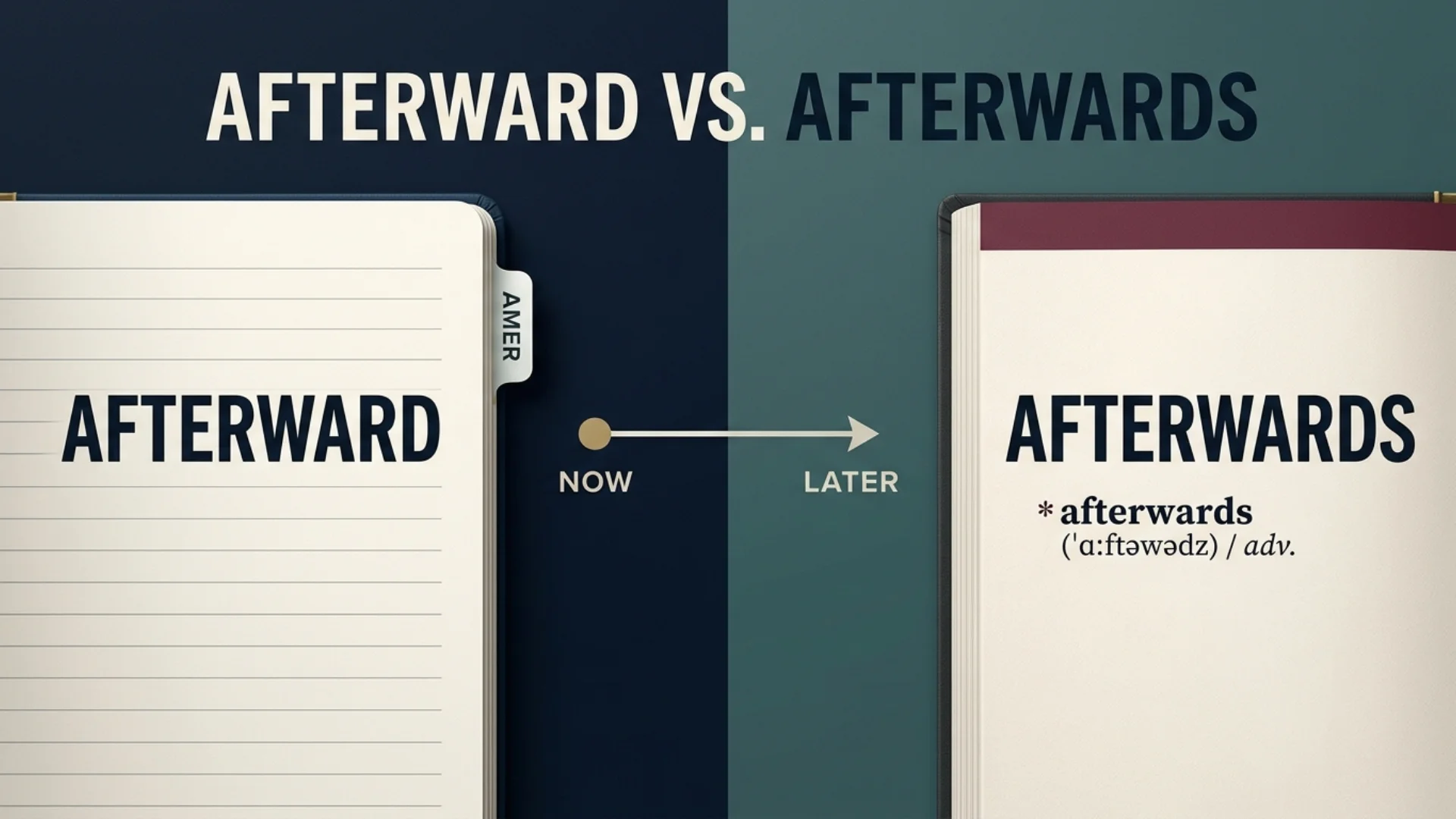
Afterward vs. Afterwards is easier than it looks: both words are correct, both are adverbs, and both mean “later” or “after that.” The main difference is regional preference.
Afterward is generally preferred in American English, while afterwards is especially common in British English. Oxford labels afterwards as especially British and notes that North American English usually uses afterward. Oxford Learner’s Dictionaries
So these two sentences mean the same thing:
- We went home afterward.
- We went home afterwards.
The extra s does not change the meaning. English merely decided that one tiny letter should consume an unreasonable amount of everyone’s afternoon.
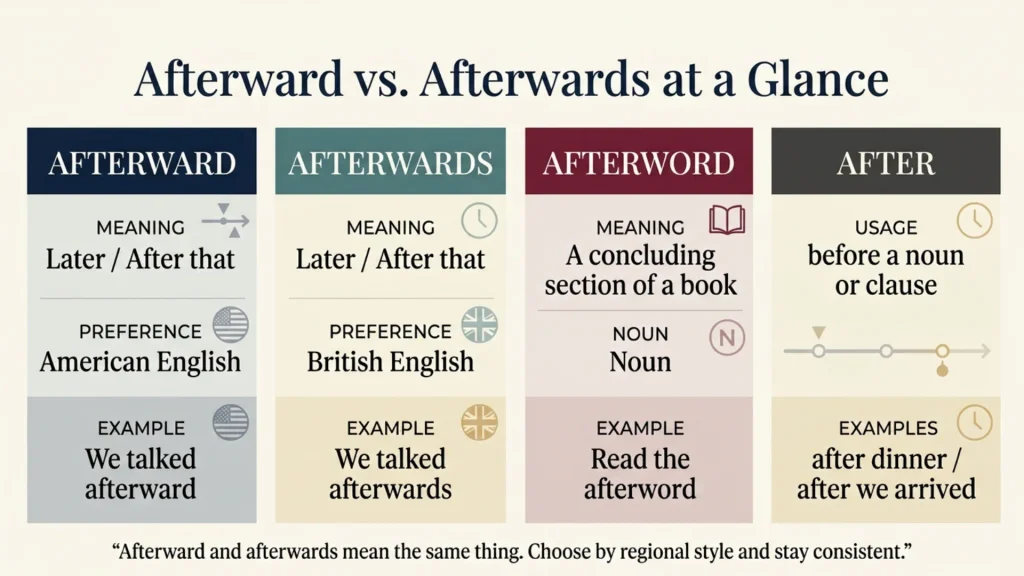
Quick Answer: Afterward vs. Afterwards
| Word | Correct? | Meaning | Common Usage |
|---|---|---|---|
| afterward | Yes | Later; after that | Preferred in American English |
| afterwards | Yes | Later; after that | Especially common in British English |
| afterword | Yes, but different word | Closing section of a book | Noun |
| afterwords | Possible only as plural of afterword | Multiple closing sections/afterwords | Rare noun |
| after words | Different phrase | Following some spoken/written words | Two separate words |
The easiest rule is:
US English → afterward
UK English → afterwards
If you are not following a regional style guide, either is grammatically correct.
What Does Afterward Mean?
Afterward is an adverb meaning:
- later
- at a later time
- after something already mentioned
- subsequently
- after that
Examples:
- We finished dinner and went for a walk afterward.
- She apologized afterward.
- I did not understand the problem until afterward.
- He called me shortly afterward.
- The meeting ended, and we discussed the results afterward.
It tells the reader when another action took place.
What Does Afterwards Mean?
Afterwards has the same basic meaning as afterward.
Examples:
- We finished dinner and went for a walk afterwards.
- She apologized afterwards.
- They stayed for coffee afterwards.
- Shortly afterwards, he left.
- We talked about the decision afterwards.
Cambridge Grammar explains that afterwards means later than an event already mentioned and distinguishes it from after, which can function as a preposition or conjunction before nouns and clauses. Cambridge Dictionary
Cambridge Grammar: After and Afterwards
Afterward and Afterwards: Is There Any Difference in Meaning?
No meaningful semantic difference exists between them.
Compare:
I spoke to the manager afterward.
I spoke to the manager afterwards.
Both mean that the conversation happened later, following an earlier event.
The final s does not make afterwards:
- plural
- more formal
- more emphatic
- more correct
- more recent
It is primarily a regional spelling and usage preference.
Afterward vs. Afterwards in American English
American English normally favors afterward.
Examples:
- We can discuss that afterward.
- She went directly home afterward.
- The company issued a statement shortly afterward.
- He realized his mistake afterward.
Oxford’s American dictionary lists afterward as its main form while also recognizing afterwards. Oxford Learner’s Dictionaries
So using afterwards in an American sentence is not some linguistic felony. It is simply less typical.
Afterwards vs. Afterward in British English
British English commonly favors afterwards.
Examples:
- Shall we go for dinner afterwards?
- She telephoned me afterwards.
- They spoke privately afterwards.
- Shortly afterwards, the train arrived.
Oxford marks afterwards as especially British and notes that North American English usually prefers afterward. Oxford Learner’s Dictionaries
Again, this is preference rather than a rigid correctness rule.
What About Canadian English?
Canadian English combines British and American influences, so usage can be less tidy than the simple US-versus-UK rule.
You may encounter both:
- afterward
- afterwards
For professional Canadian writing, the best approach is to follow:
- the organization’s house style,
- its chosen dictionary,
- and whichever form is already used consistently in the document.
Do not assume that every Canadian publication follows the exact same rule.
Afterward or Afterwards in AP Style
If you follow Associated Press-style editorial conventions, use:
afterward
not:
afterwards
Several university editorial guides based on AP style explicitly give the rule as “afterward, not afterwards.” UAMS News
Example:
AP-style:
The senator spoke to reporters afterward.
Not the preferred AP form:
The senator spoke to reporters afterwards.
This is a style rule, not proof that afterwards is grammatically incorrect.
Is Afterward More Formal Than Afterwards?
No.
Neither word is inherently more formal.
Both work in:
- conversation
- essays
- business writing
- academic writing
- journalism
- fiction
- emails
The major distinction is geographical and editorial.
American formal writing often uses afterward because that is the regional convention.
British formal writing can naturally use afterwards.
After vs. Afterwards
After and afterwards are related, but they cannot always be swapped.
Use After Before a Noun
- after lunch
- after school
- after the meeting
- after work
- after dinner
Example:
We went home after dinner.
You cannot normally write:
We went home afterwards dinner.
That sentence has committed enough crimes already.
Use After Before a Clause
After can also function as a conjunction:
- after I arrived
- after she called
- after the meeting ended
- after we finished eating
Example:
I called him after I got home.
Use Afterwards Independently as an Adverb
Afterwards does not need an object.
We had dinner and went home afterwards.
Cambridge specifically distinguishes these functions: after works before noun phrases and clauses, while afterwards functions as an adverb meaning later. Cambridge Dictionary
After That vs. Afterwards
After that and afterwards can often express the same sequence.
Compare:
- We ate dinner. After that, we went home.
- We ate dinner and went home afterwards.
Both are correct.
Use After That When You Want Stronger Sequence
After that can make the order of events especially explicit.
First we visited the museum. After that, we had lunch.
Use Afterwards for Smoother Prose
We visited the museum and had lunch afterwards.
Neither is universally better.
Afterward vs. Afterword
This is a much more important distinction because the meanings actually change.
Afterward
Afterward = later.
We talked afterward.
Afterword
Afterword = a concluding section or commentary appearing near the end of a book.
The author wrote an afterword explaining how the novel was created.
A useful example:
I read the afterword, and afterward I returned the book.
One tiny letter separates “later” from “the thing at the end of a book.” Naturally, English saw no possible usability issue here.
Afterwords vs. Afterwards
Afterwards is an adverb meaning later.
Afterwords is not an alternative spelling of it.
Technically, afterwords can serve as the plural of the noun afterword, although that plural is not something most people need every Tuesday.
Examples:
Correct: We went home afterwards.
Correct but unusual: The anthology contains several afterwords by different contributors.
Incorrect for time: We went home afterwords.
Afterword or Afterward?
Use this memory trick:
WORD → think of words in a book.
So:
- afterword = book section
- afterward = later in time
Examples:
The publisher added an afterword.
We celebrated afterward.
Afterwords or Afterwards?
If you mean later, the correct choice is:
afterwards
If you mean more than one concluding book section:
afterwords
For almost every everyday sentence involving time, afterwords is simply the wrong word.
When Can I Use Afterward?
Use afterward whenever you want to say that something happened later than an event already mentioned.
At the End of a Sentence
We went for coffee afterward.
At the Beginning
Afterward, we went for coffee.
In the Middle
We ate dinner and afterward went for a walk.
With Time Modifiers
Common combinations include:
- shortly afterward
- soon afterward
- immediately afterward
- right afterward
- not long afterward
- years afterward
Examples:
The announcement came shortly afterward.
He regretted the decision immediately afterward.
How to Use Afterwards in a Sentence
Here are natural examples:
- We went shopping afterwards.
- She felt much better afterwards.
- They met for drinks afterwards.
- We can discuss it afterwards.
- The children stayed behind afterwards.
- Shortly afterwards, the weather changed.
- He apologized immediately afterwards.
- Years afterwards, they met again.
- She finished the presentation and answered questions afterwards.
- I did not discover the error until afterwards.
Can a Sentence Start With Afterwards?
Yes.
Examples:
Afterwards, we went to dinner.
Afterwards, she realized what had happened.
Afterwards, the group returned to the hotel.
Starting with afterwards is grammatically fine.
The same applies to afterward:
Afterward, we discussed the results.
Is There a Comma After Afterwards?
Not automatically.
The punctuation depends on where afterwards appears and how the sentence is structured.
At the Beginning of a Sentence
A comma is often useful:
Afterwards, we went home.
However, with a very short introductory adverb, some styles may omit the comma if there is no risk of confusion.
At the End
Usually no comma is needed:
We went home afterwards.
In the Middle
Punctuation depends on sentence structure:
We had lunch and afterwards visited the museum.
There is no rule that says afterwards must always have a comma after it.
Can You Say “And Afterwards”?
Yes.
Examples:
We finished the film, and afterwards we went for dinner.
He completed university and afterwards moved to London.
She called the client and afterwards sent an email.
In polished prose, you may sometimes prefer:
We finished the film and went for dinner afterwards.
Both structures are possible.
Shortly Afterward vs. Shortly Afterwards
Both are correct.
American English
Shortly afterward, the meeting ended.
British English
Shortly afterwards, the meeting ended.
The regional preference remains the same.
The same applies to:
- soon afterward / soon afterwards
- immediately afterward / immediately afterwards
- years afterward / years afterwards
- not long afterward / not long afterwards
Is It Afterwards or Afterward?
Both.
Use this practical rule:
Choose Afterward If:
- your audience is primarily American
- you follow AP-style conventions
- your organization specifies American English
- you want the usual US form
Choose Afterwards If:
- your audience is primarily British
- your publication prefers British English
- the rest of your document follows British conventions
Either Works If:
- no regional style has been specified
- you simply need the meaning “later”
- consistency matters more than dialect
Afterward and Afterwards With Other -ward/-wards Words
English contains several similar pairs:
- toward / towards
- backward / backwards
- upward / upwards
- downward / downwards
- afterward / afterwards
Regional preferences often follow similar patterns, with American English tending to favor many -ward forms and British English more readily using -wards forms.
However, do not assume every pair behaves identically in every grammatical context.
For example, forward has uses where forwards would not simply replace it.
So the pattern is helpful, not magical.
Common Mistakes
Assuming Afterwards Is Wrong
Wrong idea:
Afterwards is incorrect English.
Better:
Afterwards is standard English and especially common in British usage.
Assuming Afterward Is Only American
American English strongly favors afterward, but British readers still understand it, and usage is not governed by an international grammar police force.
Writing Afterwords When You Mean Later
Incorrect:
We spoke afterwords.
Correct:
We spoke afterwards.
Confusing Afterword With Afterward
Book section:
Read the afterword.
Later:
We talked afterward.
Using Afterwards Before a Noun
Incorrect:
afterwards dinner
Correct:
after dinner
Or:
We had dinner and left afterwards.
Alternatives to Afterward and Afterwards
Depending on context, you can use:
- later
- later on
- after that
- subsequently
- thereafter
- then
- next
- following that
- at a later time
- eventually
Later
The simplest alternative:
We discussed it later.
Subsequently
More formal:
The company subsequently changed its policy.
Thereafter
Formal and often used in historical, legal, or chronological writing:
He moved to Paris and lived there thereafter.
Oxford describes thereafter as a formal adverb meaning after the time or event mentioned. Oxford Learner’s Dictionaries
After That
Very natural for explaining sequences:
We ate lunch. After that, we returned to work.
What Is a Fancy Way to Say Later?
For more formal writing, consider:
- subsequently
- thereafter
- at a later stage
- at a later point
- in due course
- at a subsequent time
But do not replace a perfectly good later with a twelve-dollar phrase merely because the sentence owns a tie.
Often, simple English is better.
How Do You Say “After” in a More Formal Way?
Possible alternatives depend on grammar.
Instead of:
after the meeting
you might use:
- following the meeting
- subsequent to the meeting
- upon completion of the meeting
But after the meeting is usually clearer.
For plain professional writing, replacing simple after with legalistic language often makes the sentence worse rather than smarter.
Afterward vs. Afterwards in Formal Writing
Both forms can be used formally.
The better question is:
Which variety of English does the document follow?
US Document
Use:
afterward
UK Document
Use:
afterwards
International Document
Choose either form and remain consistent.
Do not switch randomly between:
afterward
and:
afterwards
unless you are quoting another source.
Examples Side by Side
| American-leaning form | British-leaning form |
|---|---|
| We left afterward. | We left afterwards. |
| She called afterward. | She called afterwards. |
| Shortly afterward, it rained. | Shortly afterwards, it rained. |
| What happened afterward? | What happened afterwards? |
| We talked about it afterward. | We talked about it afterwards. |
| He apologized afterward. | He apologized afterwards. |
| They met again years afterward. | They met again years afterwards. |
Every pair communicates essentially the same time relationship.
A Simple Memory Trick
Remember:
American English
afterward
Think of the shorter form without s.
British English
afterwards
The -wards ending is more characteristic of British usage in this pair.
And:
Afterword
Contains word, so think:
words at the end of a book
That handles three annoyingly similar forms with one reasonably functional human memory.
Related Grammar Choices
Similar-looking options often create confusion even when the underlying rule is fairly simple.
For subject-verb agreement, see People Do or People Does?.
For choosing singular or plural verb forms in existential constructions, see Was There or Were There?.
Frequently Asked Questions
When Can I Use Afterward?
Use afterward when you mean later or after an event already mentioned.
Example:
We finished the meeting and talked afterward.
It is particularly natural in American English.
Which Is Correct in AP Style: Afterward or Afterwards?
Afterward is the preferred AP-style form. Editorial guides that follow AP explicitly use “afterward, not afterwards.” UAMS News
Is There a Comma After the Word Afterwards?
Not always. At the beginning of a sentence, a comma is often used:
Afterwards, we went home.
At the end:
We went home afterwards.
No comma is normally required.
What Can I Say Instead of Afterwards?
Good alternatives include:
- later
- after that
- subsequently
- thereafter
- then
- later on
- following that
Choose according to tone and sentence structure.
Should I Use Afterward or Afterwards?
Use afterward for most American English and afterwards for typical British English. Both are grammatically correct.
How Do You Say “Later” in a Fancy Way?
More formal alternatives include:
- subsequently
- thereafter
- in due course
- at a later stage
- at a subsequent time
In most writing, however, later is perfectly good.
What Can I Say Instead of “Talk to You Soon”?
Natural alternatives include:
- Speak to you soon.
- Talk again soon.
- Catch up with you soon.
- Speak later.
- Until next time.
- Looking forward to speaking again.
What Is Another Word for Goodbye?
Depending on tone:
- farewell
- bye
- take care
- see you
- until next time
- so long
- see you later
Farewell is usually more formal or dramatic than everyday goodbye.
How Do You Say After in a Fancy Way?
Depending on context, you can use:
- following
- subsequent to
- thereafter
- following that
- upon completion of
But after is usually clearer and more natural.
Is Afterwords the Same as Afterwards?
No.
Afterwards means later.
Afterwords can only be the plural of afterword, the concluding section of a book.
What Is the Difference Between Afterward and Afterword?
Afterward is an adverb meaning later.
Afterword is a noun referring to a concluding section in a book.
Can I Use Afterwards in American English?
Yes. It is understood and grammatically valid, but afterward is more typical in American usage. Oxford’s American dictionary recognizes both forms. Oxford Learner’s Dictionaries
Final Answer
For Afterward vs. Afterwards, there is no difference in basic meaning.
Both mean:
later or after that.
The practical distinction is regional:
- American English: usually afterward
- British English: usually afterwards
- AP style: afterward
- Meaning: the same
- Part of speech: both are adverbs
Do not confuse either one with afterword, which is a concluding section of a book, or afterwords, its uncommon plural.
If you have no required regional or editorial style, choose either afterward or afterwards and use it consistently.