Linchpin vs. Lynchpin: Correct Spelling, Meaning & Examples
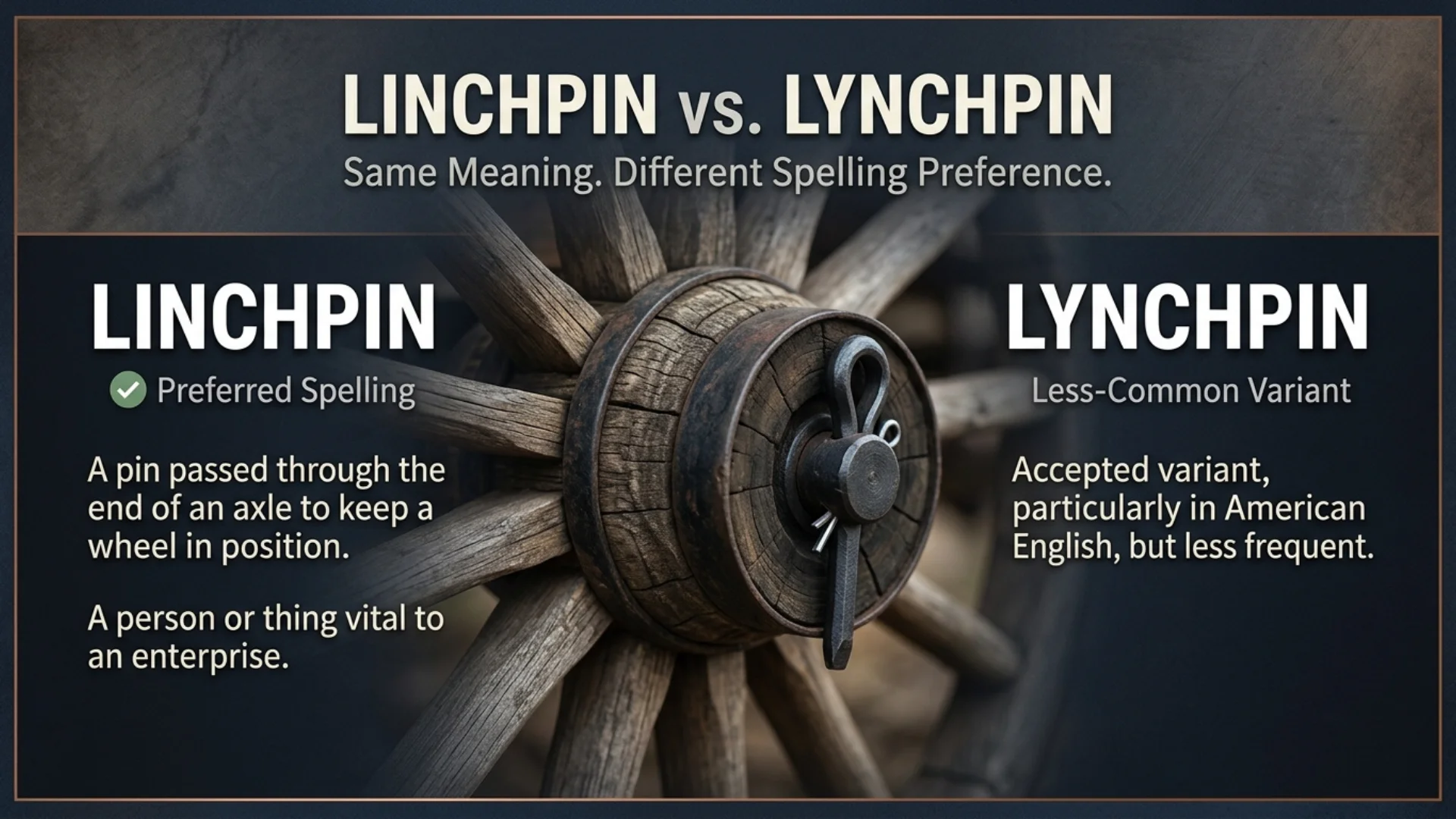
Quick Answer: Linchpin is the standard and preferred spelling in modern English. Lynchpin is a recognized but less common variant with the same meaning and pronunciation. Both can describe a literal pin that keeps a wheel on an axle or, more commonly, an essential person or thing that holds a larger system together.
For professional writing, academic work, business communication, and general everyday English, linchpin is the safest spelling to use.
Linchpin vs. Lynchpin at a Glance
| Feature | Linchpin | Lynchpin |
|---|---|---|
| Meaning | Essential person or thing; originally a locking pin | Same |
| Part of speech | Noun | Noun |
| Pronunciation | LINCH-pin | LINCH-pin |
| Modern status | Standard and preferred | Accepted, less common variant |
| Professional writing | Recommended | Usually better avoided |
| Literal mechanical meaning | Yes | Same |
| Figurative meaning | Yes | Same |
| Related to the verb “lynch”? | No | No |
The important point is that linchpin and lynchpin do not have different definitions.
The difference is mainly one of spelling preference and frequency.
Is It Linchpin or Lynchpin?
Use linchpin in normal modern writing.
Lynchpin exists and is recognized as a variant, but it is considerably less common.
For example:
Preferred:
Communication is the linchpin of a successful team.
Accepted variant:
Communication is the lynchpin of a successful team.
Both sentences mean the same thing, but the first spelling is the better choice for polished contemporary English.
Merriam-Webster lists linchpin as the main form and identifies lynchpin as a less common variant. Merriam-Webster’s linchpin definition
What Is a Linchpin?
A linchpin is a person or thing that is essential to a larger group, system, organization, plan, or process.
If the linchpin disappears, the rest may stop functioning properly.
Examples:
- She is the linchpin of the marketing team.
- Trust is the linchpin of their relationship.
- The new software is the linchpin of the company’s automation strategy.
- This agreement became the linchpin of the negotiations.
- Reliable transportation is the linchpin of the local economy.
The word can refer to a person, object, idea, policy, process, or almost anything else that performs an essential supporting role.
Linchpin Meaning
Linchpin has two main meanings.
Literal Meaning
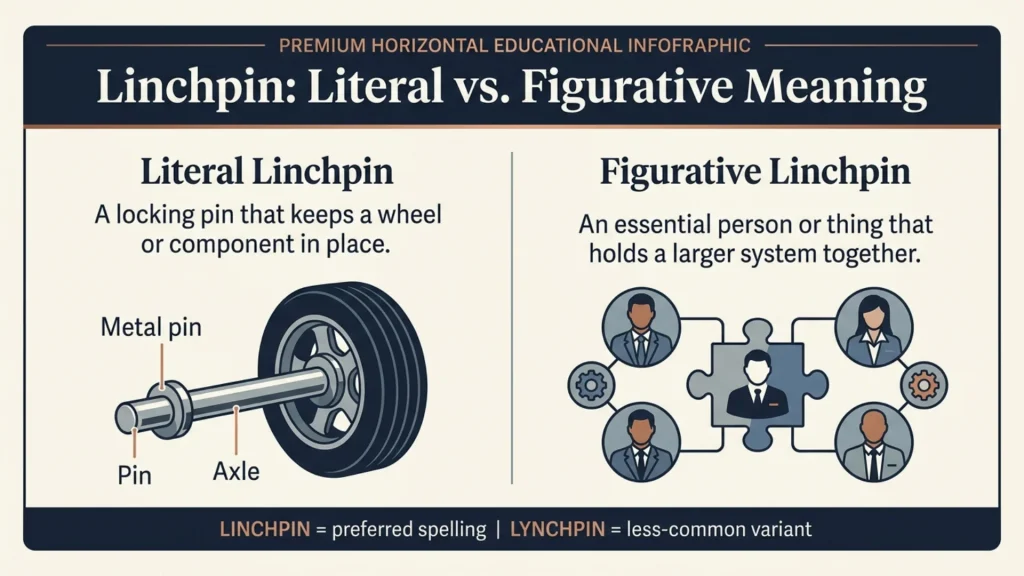
Originally, a linchpin is a locking pin inserted through the end of an axle or shaft.
Its job is to prevent a wheel or another component from sliding off.
A tiny pin can therefore determine whether the entire wheel assembly stays together.
That physical function explains the modern metaphor.
Figurative Meaning
Today, linchpin is very commonly used to mean:
a person or thing that is essential to the success, stability, or operation of something larger.
For example:
Maria is the linchpin of the department.
This does not mean Maria is a metal pin hiding beneath a wagon. It means the department depends heavily on her.
English occasionally manages to make an old piece of hardware useful in a corporate meeting. Miracles happen.
What Does Lynchpin Mean?
Lynchpin means the same thing as linchpin.
It can refer to:
- an essential person
- a crucial component
- a central idea
- an important part of a plan
- a literal locking pin
The main difference is that lynchpin is a less common spelling.
Examples:
- He became the lynchpin of the operation.
- The funding agreement was the lynchpin of the project.
These sentences are understandable and the spelling is recognized, but linchpin would normally be preferred.
Linchpin Definition
A simple definition of linchpin is:
A person or thing that holds other parts together or is essential to the functioning of a larger system.
It can also literally mean a pin used to keep a wheel or mechanical component in position.
Think of it as:
small component → major importance
That physical idea eventually became the metaphorical meaning used today.
Where Does the Word Linchpin Come From?
The history of linchpin has nothing to do with the modern verb lynch.
The word developed from Middle English forms connected to an older word for a pin or axle-related fastening.
Merriam-Webster traces it through Middle English lynspin, from an Old English word lynis, combined with pin.
The physical object was used to hold a wheel securely on an axle.
Because removing the pin could cause the wheel to come off, people eventually began using the word figuratively for something equally essential.
By the early twentieth century, the metaphorical use of linchpin for an indispensable person or element had become established.
Is Linchpin Related to the Word Lynch?
No.
Linchpin is not derived from the verb “lynch.”
The similarity in modern spelling between lynchpin and lynch can make people assume the two words are historically connected, but their origins are separate.
This distinction also helps explain why linchpin is usually preferable today.
It reflects the standard spelling and avoids creating an unnecessary visual association with an unrelated and violent word.
Is “Lynchpin” Wrong?
Not completely.
Calling lynchpin an outright nonexistent word would be inaccurate.
Major dictionaries recognize it as a variant spelling.
The better distinction is:
Linchpin = standard, preferred spelling
Lynchpin = recognized, less common variant
So in ordinary writing, there is rarely a good reason to choose the less common version.
Is Linchpin Derogatory?
No. Linchpin is not generally considered derogatory.
Calling someone a linchpin is normally positive.
It suggests that the person is:
- essential
- dependable
- central
- influential
- important to the success of a group
- difficult to replace
For example:
Sofia is the linchpin of our customer support team.
That is usually a compliment.
The standard word linchpin is also etymologically unrelated to lynching.
The alternative spelling lynchpin may visually remind some readers of the unrelated verb lynch, which provides another practical reason to prefer linchpin.
What Does a Linchpin Look Like?
A literal linchpin is typically a small metal pin used to secure a mechanical component.
Traditionally, it was placed through the end of an axle to prevent a wheel from sliding off.
Modern mechanical linchpins may have:
- a metal shaft
- a ring or loop
- a retaining clip
- a curved locking element
- a hole through which another securing piece passes
The exact design varies by equipment.
Linchpins or similar retaining pins can be found on agricultural equipment, trailers, carts, machinery, and other mechanical assemblies.
The object is usually simple.
Its importance is not.
That is precisely why it became such an effective metaphor.
Linchpin as a Metaphor
The metaphorical meaning follows directly from the mechanical one.
Imagine a wagon.
The linchpin is tiny compared with the wheel, axle, frame, and cargo.
Yet if that small component fails, the wheel may come off and the entire system can stop working.
So when we say:
She is the linchpin of the organization.
we mean:
The organization depends heavily on her contribution.
Other examples:
- Education is the linchpin of the reform plan.
- Customer trust is the linchpin of the brand.
- The goalkeeper became the linchpin of the defense.
- Accurate data is the linchpin of the research project.
- That supplier is the linchpin of the entire production chain.
Lynch Pin or Linchpin?
In modern English, write linchpin as one word.
Preferred:
linchpin
Less-common variant:
lynchpin
Avoid treating lynch pin as the normal modern spelling.
Historical texts may contain forms such as linch-pin or other older spelling variations because English spelling has changed considerably over the centuries.
For normal contemporary writing, use:
linchpin
Linchpin in a Sentence
Here are natural examples using the preferred spelling.
Workplace
- Rachel is the linchpin of our operations team.
- Good communication is the linchpin of remote collaboration.
- The finance department became the linchpin of the restructuring plan.
Business
- Customer retention is the linchpin of the company’s growth strategy.
- The new product could become the linchpin of the brand’s recovery.
- Reliable suppliers are the linchpin of the manufacturing process.
Technology
- Encryption is a linchpin of modern digital security.
- The central database is the linchpin of the platform.
- Reliable authentication became the linchpin of the new system.
Education
- Reading comprehension is a linchpin of academic success.
- Teacher training is the linchpin of the reform program.
Relationships
- Trust is the linchpin of a healthy relationship.
- Honest communication became the linchpin of their reconciliation.
Lynchpin in a Sentence
Because lynchpin is an accepted spelling variant, sentences such as these are grammatically understandable:
- He was the lynchpin of the campaign.
- Funding became the lynchpin of the project.
- The agreement was the lynchpin holding the partnership together.
However, replacing lynchpin with linchpin would make each sentence conform to the preferred modern spelling.
Linchpin Person Meaning
Calling someone a linchpin person means that person performs an especially important role in a group or system.
A linchpin employee might:
- possess important knowledge
- coordinate several teams
- solve difficult problems
- maintain crucial relationships
- connect different departments
- make decisions others depend on
For example:
Without Daniel coordinating the logistics, the project would struggle. He is the linchpin of the team.
The idea is not necessarily that nobody else is talented.
It means one person’s contribution currently connects or supports several important parts.
Who Is a Linchpin Person?
A linchpin person is someone whose work, knowledge, relationships, or decisions are unusually important to the functioning of a larger group.
Examples could include:
- a project manager connecting several departments
- an engineer maintaining a critical system
- an administrator who understands a complicated process
- a team leader who coordinates multiple specialists
- a family member who keeps communication flowing
- a player whose role connects the rest of a sports team
Calling somebody a linchpin normally emphasizes their importance to the whole system.
Can a Person Be a Lynchpin?
Yes.
Because lynchpin is a recognized spelling variant of linchpin, a person can technically be described as a lynchpin.
For example:
She is the lynchpin of the team.
However, the preferred spelling is:
She is the linchpin of the team.
The meaning is identical.
Linchpin vs. Cornerstone
Linchpin and cornerstone both describe something important, but the images behind them differ.
A linchpin holds important parts together.
A cornerstone provides a fundamental base or foundation.
Compare:
Trust is the linchpin connecting the partnership.
Education is a cornerstone of economic development.
In some figurative contexts, either word could work, but they emphasize different relationships.
Linchpin vs. Keystone
A keystone is the central stone at the top of an arch that helps lock the structure together.
A linchpin is originally a pin that keeps a wheel attached to an axle.
Both therefore became metaphors for an essential element.
For example:
- Public trust is the linchpin of the system.
- Public trust is a keystone of the system.
The meanings overlap strongly, though the underlying physical metaphors differ.
Linchpin vs. Fulcrum
A fulcrum is the support or pivot point on which a lever turns.
Figuratively, it can describe the central point around which something operates or changes.
A linchpin, by contrast, emphasizes something that holds components together or keeps the larger system functioning.
Synonyms for Linchpin
Depending on context, useful synonyms include:
- cornerstone
- keystone
- mainstay
- backbone
- foundation
- core
- heart
- anchor
- pillar
- key element
- crucial component
- central figure
- essential person
- pivotal element
They are not perfect substitutes in every sentence.
For example:
She is the backbone of the team
sounds natural.
She is the foundation of the team
also works, but emphasizes support more than connection.
She is the linchpin of the team
suggests her role helps hold several parts together.
Is It Lychpin?
No.
Lychpin is a misspelling.
Correct:
linchpin
Recognized variant:
lynchpin
Incorrect:
lychpin
The missing n creates a spelling that is not the standard word.
Is It Lincpin?
No.
Lincpin is another common typing or spelling error.
Use:
linchpin
The correct first part is linch-, followed by pin.
Is It Linhcpin?
No.
Linhcpin is simply a transposition error caused by switching the letters c and h.
Correct spelling:
linchpin
Breaking the word into two visual pieces can help:
linch + pin
Is It Linchipin?
No.
Linchipin adds an unnecessary vowel.
The correct spelling is:
linchpin
There are only two syllables:
LINCH-pin
Is It Lynchpiun?
No.
Lynchpiun is a typographical error.
If you are using the preferred spelling:
linchpin
If you intentionally use the recognized alternative:
lynchpin
Neither spelling contains piun.
How Do You Pronounce Linchpin?
Linchpin is pronounced approximately:
LINCH-pin
The stress falls on the first syllable.
Lynchpin is normally pronounced the same way.
So the distinction is visible in spelling rather than pronunciation.
Linchpin Plural
The plural of linchpin is:
linchpins
Examples:
- These suppliers are the linchpins of the distribution network.
- Several experienced employees became linchpins of the organization.
- Small businesses can serve as linchpins of local communities.
If using the variant spelling, the plural would be:
lynchpins
But linchpins remains the preferred form.
Common Mistakes With Linchpin and Lynchpin
Mistake 1: Assuming Lynchpin Has a Different Meaning
It does not.
Both spellings refer to the same concept.
Mistake 2: Saying Lynchpin Is Completely Invalid
That goes too far.
It is recognized as a less-common variant.
Mistake 3: Assuming Linchpin Comes From Lynching
It does not.
The word has a much older mechanical history.
Mistake 4: Writing Lynch Pin as Two Words
Modern English normally uses linchpin as one word.
Mistake 5: Using Random Misspellings
Forms such as:
- lychpin
- lincpin
- linhcpin
- linchipin
- lynchpiun
are spelling errors, not additional variants.
Linchpin in Formal and Professional Writing
For professional documents, use linchpin.
Examples:
The security framework is the linchpin of the compliance program.
Customer data is the linchpin of the personalization strategy.
The agreement could become the linchpin of the merger.
This spelling is suitable for:
- reports
- emails
- essays
- academic writing
- presentations
- journalism
- business documents
- proposals
- professional websites
If you are already checking commonly confused English forms, GrammarRead’s guide to People Do or People Does? covers another frequent grammar choice.
Should You Avoid Lynchpin in Professional Writing?
Usually, yes, simply because linchpin is the dominant standard spelling.
Using lynchpin may cause some readers to think:
- it is a typo
- it is an outdated spelling
- the writer confused it with lynch
That does not make the variant grammatically meaningless.
It simply means there is little practical benefit in choosing it when the preferred version is clear and widely recognized.
American vs. British English
Both linchpin and lynchpin have appeared in different varieties of English.
The important point is that linchpin is preferred across modern English generally, including American and British usage.
The variant lynchpin may appear somewhat more often in British writing than in American writing, but it still does not replace linchpin as the safest standard choice.
So you do not need separate spellings for American and British audiences.
Use:
linchpin
What Is the Linchpin Theory?
There is no single universal academic theory called “the linchpin theory.”
The phrase appears in different fields with different meanings.
One well-known modern use comes from business and career discussions inspired by Seth Godin’s book Linchpin, where a “linchpin” is an unusually valuable person who contributes creativity, initiative, judgment, and work that is difficult to replace.
The term also appears in specialized academic and analytical frameworks where a linchpin means a central assumption, person, relationship, or variable upon which other parts depend.
So if you encounter “linchpin theory,” check the field or author rather than assuming it refers to one standardized theory.
Linchpin in Business
Business writing frequently uses linchpin metaphorically.
Examples:
- Customer loyalty is the linchpin of the subscription model.
- The operations manager is the linchpin connecting production and delivery.
- Cash flow remains the linchpin of the expansion strategy.
- Reliable data became the linchpin of the company’s forecasting process.
The word works especially well when several components depend on one central factor.
Linchpin in Technology
Technology writers may use linchpin for essential systems or components.
Examples:
- Identity management is the linchpin of the security architecture.
- The API became the linchpin connecting the company’s services.
- Database reliability is the linchpin of the platform.
Again, the idea is dependency.
If the linchpin fails, several connected parts may be affected.
Linchpin in Politics and Policy
In policy writing, linchpin can describe an agreement, institution, proposal, country, policy, or strategic relationship that plays a central role.
For example:
The funding mechanism became the linchpin of the reform package.
This simply means the rest of the plan depends heavily on that mechanism.
The word itself does not imply approval or criticism.
Linchpin in Sports
A player can be described as the linchpin of a team when their performance connects or supports several aspects of the team’s success.
Examples:
- The midfielder is the linchpin of their attacking system.
- Their captain became the linchpin of the defense.
- She is the linchpin connecting defense and attack.
This usage emphasizes function rather than merely saying someone is the best player.
Easy Trick to Remember Linchpin
Remember the physical origin:
LINCH + PIN
The word ends with pin because it originally names a real pin.
Then remember:
Linchpin = the thing that keeps everything together.
If you are choosing between:
linchpin or lynchpin
use:
linchpin
for standard modern writing.
For another guide where a tiny grammatical choice changes the correct form, see Was There or Were There?.
Frequently Asked Questions
Is it okay to say “lynchpin”?
Yes. Lynchpin is a recognized variant spelling, so it is not meaningless or automatically incorrect. However, linchpin is the standard and preferred modern spelling.
What does “lynchpin” mean?
Lynchpin means the same as linchpin: an essential person or thing that holds a larger system together. It can also refer literally to a locking pin used on an axle or shaft.
Is linchpin derogatory?
No. Linchpin is normally neutral or complimentary when used about a person. It means that someone plays an essential role. The word’s historical origin is unrelated to the verb lynch.
What does a linchpin look like?
A literal linchpin is usually a small metal securing pin inserted through an axle, shaft, hitch, or mechanical assembly to prevent another component from sliding free.
Is it linchpin or lynchpin?
Linchpin is the preferred modern spelling. Lynchpin is a recognized but less common variant.
Can a person be a lynchpin?
Yes. A person can metaphorically be the linchpin or lynchpin of a team, company, project, or system when other important functions depend heavily on them. The spelling linchpin is preferred.
What’s another word for lynchpin?
Depending on context, synonyms include cornerstone, keystone, mainstay, backbone, pillar, anchor, core, key element, and essential component.
What is the lynchpin theory?
There is no single universal “lynchpin theory.” In business discussions it can refer to the idea, popularized by Seth Godin, of becoming an unusually valuable and hard-to-replace contributor. Other fields use linchpin independently for central assumptions or factors.
Who is a linchpin person?
A linchpin person is someone whose skills, knowledge, relationships, or decisions are central to a group’s success. Removing that person would significantly affect how the wider system functions.
Is lynch pin two words?
In standard modern writing, use linchpin as one word. Older or variant forms may appear historically, but the closed compound is the normal spelling today.
What is the plural of linchpin?
The plural is linchpins.
Example:
Experienced coordinators are the linchpins of the program.
Final Answer
The Linchpin vs. Lynchpin question has a simple practical answer:
Use linchpin.
It is the standard and preferred modern spelling.
Lynchpin is a recognized less-common variant, not a completely different word and not a separate meaning.
A linchpin can literally be a small pin that keeps a wheel or component secured. Figuratively, it is an essential person, idea, or component that helps hold a larger system together.
The word is not derived from the verb lynch, and calling someone a linchpin is normally a compliment rather than a derogatory description.
When writing an essay, business email, article, report, or professional document, linchpin is the cleanest choice.