Due To or Do To? Correct Usage, Examples & Grammar Rules
“Due to” and “do to” sound exactly the same, which is why so many writers mix them up. The short answer: when you mean “because of,” the correct spelling is always due to. “Do to” is a misspelling in that context — but the words “do” and “to” can correctly appear side by side in sentences like “What did she do to fix it?” In this guide, you will learn the grammar behind both, see 20+ correct examples, study common mistakes with fixes, try practice exercises, and pick up formal alternatives for professional writing.
Quick Answer: Due To or Do To?
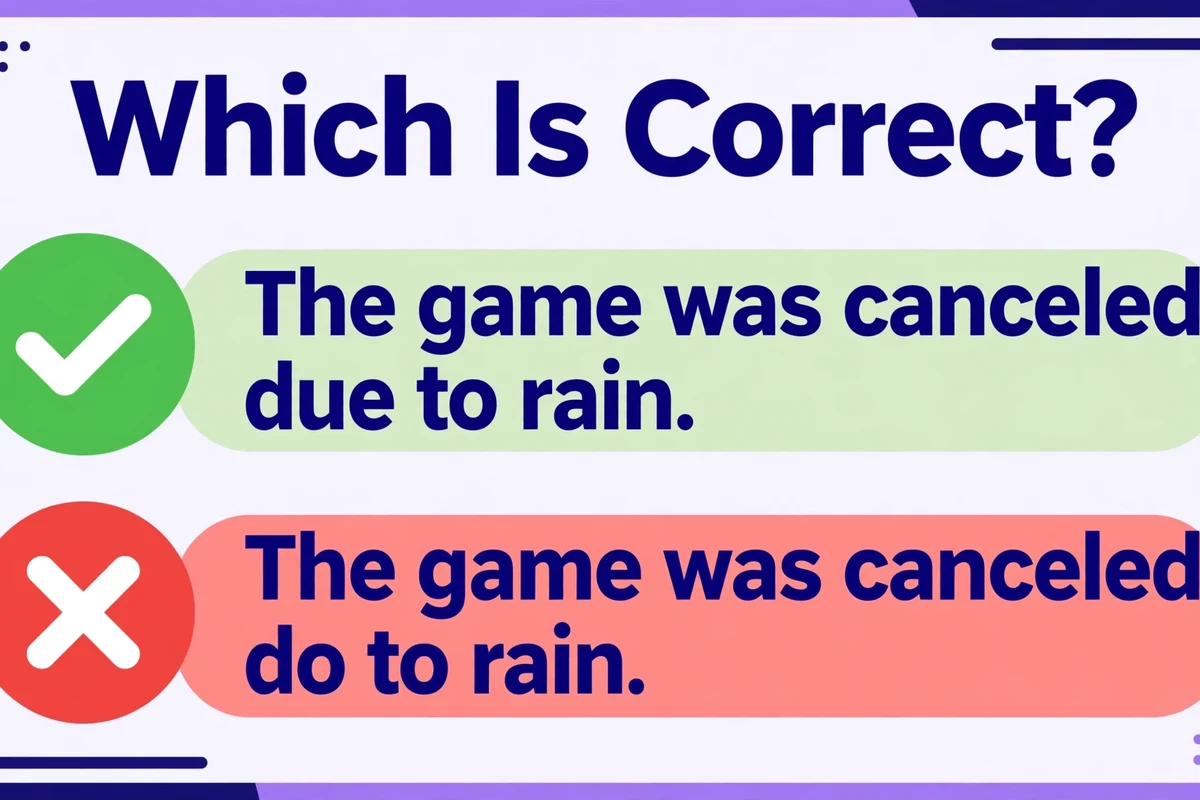
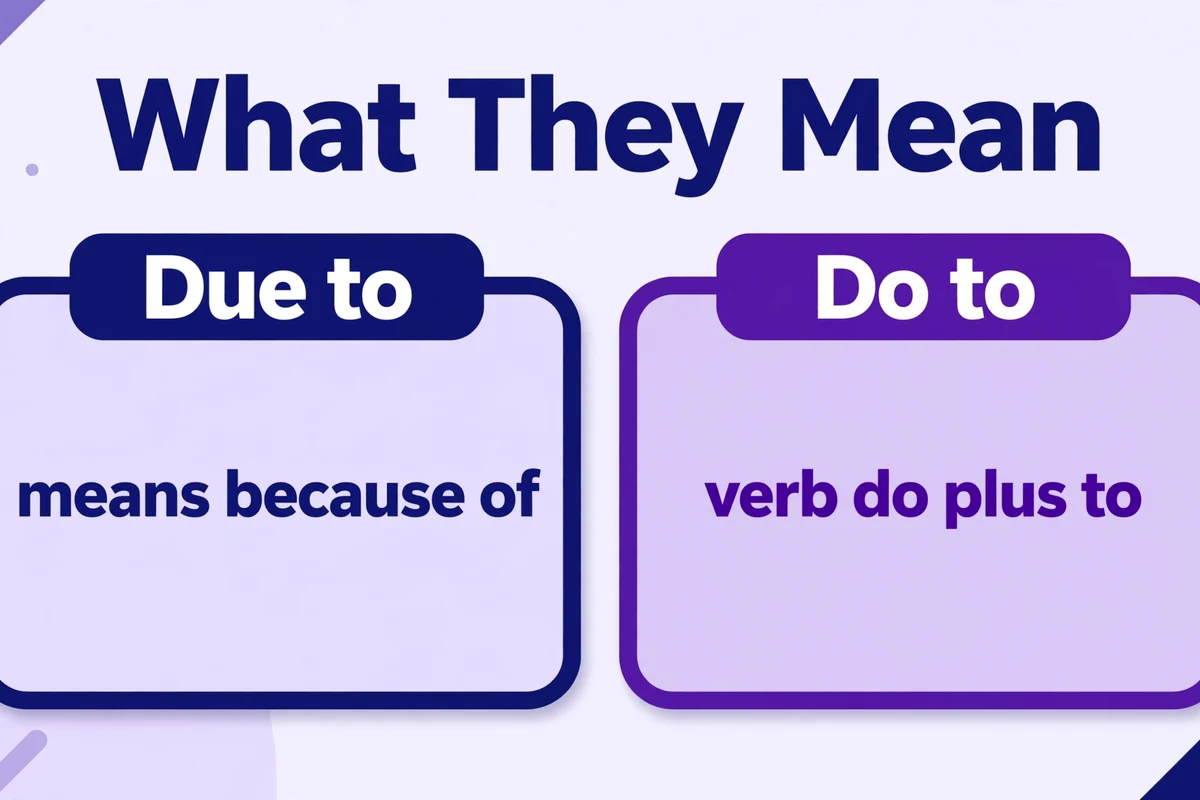
Use “due to” when you mean “because of” or “as a result of.”
- Correct: The flight was delayed due to fog.
- Incorrect: The flight was delayed do to fog.
“Do to” is only correct when “do” (the verb, meaning “perform”) happens to sit next to “to” (as in an infinitive), as in “What can we do to help?” Here, “do to” is not a phrase at all — it is just two separate words that land next to each other.
What Does “Due To” Mean?
“Due to” is a compound preposition meaning “because of,” “as a result of,” or “caused by.” Merriam-Webster defines it exactly this way and notes that it has been recognized as standard English for decades.
The word “due” itself is an adjective meaning “owed” or “expected” (as in “The payment is due” or “She is due for a promotion”). When combined with the preposition “to,” it forms the fixed expression “due to,” which introduces the cause or reason for something:
- The match was canceled due to rain. (= because of rain)
- Her success is due to years of practice. (= caused by years of practice)
What About “Do To”?
“Do” is a verb meaning “to perform an action,” and it is also one of English’s main auxiliary verbs (“Do you like coffee?”). “To” is a preposition or the particle used to form infinitives (“to go,” “to help”).
“Do to” is never a set phrase. It is only correct when the verb “do” is directly followed by an infinitive beginning with “to”:
- What did they do to solve the problem? (“do” + “to solve”)
- Tell me what I can do to help. (“do” + “to help”)
- She didn’t know what to do to calm the baby. (“to do” + “to calm”)
If you cannot split the sentence into “do” + “to + verb,” then “do to” is wrong and you need “due to.”
Comparison Table: Due To vs Do To
| Form | Meaning / Function | Correct Example | Usage Context |
|---|---|---|---|
| due to | Prepositional phrase meaning “because of” | The event was postponed due to bad weather. | Showing cause or reason; the safe choice |
| do to | Verb “do” + infinitive “to” (not a phrase) | What did you do to fix the sink? | Only when “do” is followed by a “to”-infinitive |
| due to the fact that | Wordy version of “because” | Due to the fact that it rained, we stayed in. | Grammatical but wordy — prefer “because” |
20 Correct Examples of “Due To”
Study these examples across everyday, academic, and professional contexts:
- The game was postponed due to heavy rain.
- She missed the bus due to oversleeping.
- Due to staff shortages, the store closes early on Sundays.
- The road is closed due to construction.
- He was tired due to lack of sleep.
- Due to popular demand, the show added a second date.
- The company’s profits fell due to rising costs.
- She got the job due to her excellent references.
- Due to the holiday, our office will be closed on Monday.
- The flight was delayed due to technical issues.
- His absence was due to a family emergency.
- Due to unexpected traffic, I arrived ten minutes late.
- The project succeeded due to careful planning.
- Many species are endangered due to habitat loss.
- Due to low enrollment, the class was canceled.
- Please accept my apology for the delay, which was due to an error on our end. (business email)
- Due to recent policy changes, all visitors must sign in at reception. (workplace notice)
- The experiment failed due to contaminated samples. (academic writing)
- Due to inflation, prices have risen sharply this year. (formal report)
- Her promotion was due to consistent high performance. (professional review)
Correct “Do To” Constructions
Remember, these work only because “do” is a verb followed by an infinitive:
- What will you do to prepare for the exam?
- There is nothing more we can do to help.
- He didn’t know what to do to impress the interviewers.
- What did she do to deserve such praise?
Incorrect vs Correct: Common Mistakes
| Incorrect | Correct | Explanation |
|---|---|---|
| Do to the storm, school is closed. | Due to the storm, school is closed. | Meaning “because of” — always “due to.” |
| He was late do to traffic. | He was late due to traffic. | Same homophone error; “due” not “do.” |
| Do to the fact that it’s late, let’s go. | Due to the fact that it’s late, let’s go. (Better: Because it’s late, let’s go.) | “Do to the fact” is never right; “due to the fact” is grammatical but wordy. |
| Will this do or due? | Will this do? | Here “do” is the verb meaning “suffice” — “due” makes no sense. |
| She did her do diligence. | She did her due diligence. | “Due diligence” (careful research) uses “due,” not “do.” |
| We’ll just have to make due. | We’ll just have to make do. | “Make do” (manage with what you have) uses “do,” not “due.” |
| Is it do to work or due to work? | It is “due to work” (e.g., “I’m tired due to work”). | “Because of work” → “due to.” |
Grammar Rules & Exceptions
1. The traditional “attributable to” rule
Traditional grammarians argue that “due to” means “attributable to,” so it should modify a noun, not a verb:
- Traditional: His tardiness was due to traffic. (“due to traffic” = “attributable to traffic” — modifies the noun “tardiness.”)
- Traditional objection: Due to traffic, he was late. (Here it modifies the verb “was late.”)
However, this is a style preference, not a hard rule. Merriam-Webster’s usage note states that the objection dates back to 18th-century disagreements, that “due to” is as grammatically sound as “owing to,” and that “there is no solid reason to avoid due to.” In everyday and most professional writing, starting a sentence with “due to” is completely standard. Only in the most formal or traditional publications might an editor prefer “owing to” or “because of” in that position.
2. “Due to the fact that” is wordy
“Due to the fact that” is always replaceable with the shorter, stronger “because”:
- Wordy: Due to the fact that the server crashed, we lost data.
- Better: Because the server crashed, we lost data.
3. Do vs due vs to vs too
These four are a classic confusion cluster. Keep them straight:
- Do — verb: perform an action (“I will do my homework.”).
- Due — adjective: owed or expected (“The rent is due”); used in “due to” = because of.
- To — preposition or infinitive marker (“Go to school,” “to learn”).
- Too — adverb: “also” or “excessively” (“Me too,” “too fast”). It is never part of “due to.”
For more commonly confused pairs, see our guides to Segway vs Segue and Gluing vs Glueing.
4. American vs British English
There is no meaningful difference between American and British English on this point: “due to” is correct in both, and “do to” (for “because of”) is wrong in both. British style guides tend to be slightly stricter about the traditional noun-modifier rule, but the Merriam-Webster position above reflects mainstream modern usage everywhere.
Using “Due To” in Real-World Writing
Professional emails
- “The delivery is delayed due to supply chain disruptions. We expect arrival by Friday.”
- “Due to your feedback, we have revised the proposal.”
Formal reports and academic writing
- “Enrollment declined due to demographic shifts in the region.”
- In very formal writing, consider “owing to,” “on account of,” or “as a result of” for variety.
Everyday messages
- “Can’t make it tonight due to a headache — rain check?”
Casual or formal, the spelling never changes: it is always “due to” when you mean “because of.”
Easy Memory Technique: The Substitution Test
When you are unsure, try this two-second test:
- Replace the phrase with “because of”. If the sentence still makes sense, write due to.
“The picnic was canceled ___ rain” → “because of rain” works → “due to rain” ✓ - Ask whether someone is doing something. If the sentence is about performing an action followed by “to + verb,” write do to.
“What did you ___ ___ stop the leak?” → “What did you do to stop the leak?” ✓
Bonus check for formal writing: replace “due to” with “attributable to.” If it fits (“His success is attributable to hard work”), your “due to” is unassailable even by strict traditionalists.
Practice Exercises
Choose “due to” or “do to” for each sentence:
- The meeting was canceled ___ the snowstorm.
- What did you ___ ___ fix the leaking pipe?
- She was exhausted ___ working two jobs.
- Tell me what I can ___ ___ help you move.
- ___ the fact that prices rose, our budget is tight. (Also name the more concise rewrite.)
- His promotion was ___ years of consistent results.
- What will they ___ ___ reduce the noise?
Answer Key
- due to — “because of the snowstorm.”
- do to — verb “do” + infinitive “to fix.”
- due to — “because of working two jobs.”
- do to — verb “do” + infinitive “to help.”
- Due to — grammatically correct; more concise rewrite: “Because prices rose, our budget is tight.”
- due to — passes the “attributable to” test: “attributable to years of consistent results.”
- do to — verb “do” + infinitive “to reduce.”
Frequently Asked Questions
How do you use “due to” in a sentence?
Place “due to” where “because of” would fit: “The game was postponed due to rain.” It can open a sentence (“Due to rain, the game was postponed”) or sit in the middle. It is always followed by a noun or noun phrase, never by a full clause — use “because” before a clause (“because it rained,” not “due to it rained”).
Is it “do to work” or “due to work”?
“Due to work” is correct when you mean “because of work” (“I’m tired due to work”). “Do to work” is only correct in a verb + infinitive construction, which is rare with “work” — for example, “What did you do to work up an appetite?”
When should I use “do” vs “due”?
Use do when you mean “perform” (“I will do it”) or as an auxiliary (“Do you agree?”). Use due when you mean “owed/expected” (“The bill is due”) or in the phrase “due to” meaning “because of.” They are homophones, which is why the spelling gets mixed up — similar to other confusing pairs like sustain vs substain.
Is it “due to it” or “do to it”?
“Due to it” is not standard — “due to” should be followed by a specific noun (“due to the delay,” “due to illness”), not a vague pronoun. Rewrite with “because of it” instead. “Do to it” is only correct as verb + infinitive, e.g., “What did you do to it?” (meaning “what did you do to this thing?”).
What is a more formal way to say “due to”?
Formal alternatives include owing to, on account of, as a result of, attributable to, by reason of, and in view of. “Owing to” is the traditional formal substitute when “due to” modifies a verb. For positive causes, “thanks to” works well (“Thanks to your help, we finished early”).
Can “due to” start a sentence?
Yes. “Due to the storm, schools are closed” is standard modern English, used by reputable writers for decades (per Merriam-Webster). Only the strictest traditional style guides object, preferring “Owing to the storm…” or “Because of the storm…” in that position.
Related Articles
- Segway vs. Segue: Meaning, Spelling & Correct Usage
- Gluing vs Glueing: Which Spelling Is Correct?
- Disloyal vs Unloyal: Which Is Correct?
- Entwined vs Intertwined: Meaning, Difference & Examples
- Soo vs So: Meaning, Difference & Correct Usage
Conclusion
The rule is simple: if you mean “because of,” write due to — always. “Do to” is a misspelling in that context, and it is only correct when the verb “do” happens to sit next to an infinitive (“What can we do to help?”). Run the substitution test whenever you hesitate, prefer “because” over “due to the fact that,” and reach for “owing to” or “as a result of” when you want a formal tone. Master this one distinction and a whole family of homophone errors disappears with it.
Grammar references: Merriam-Webster’s entry for “due to” (preposition: “as a result of : because of,” with usage note on its standard status); Collins Dictionary’s “because of” entry (lists “due to” as a synonym); LanguageTool’s guide on “due to the fact” wordiness and alternatives.