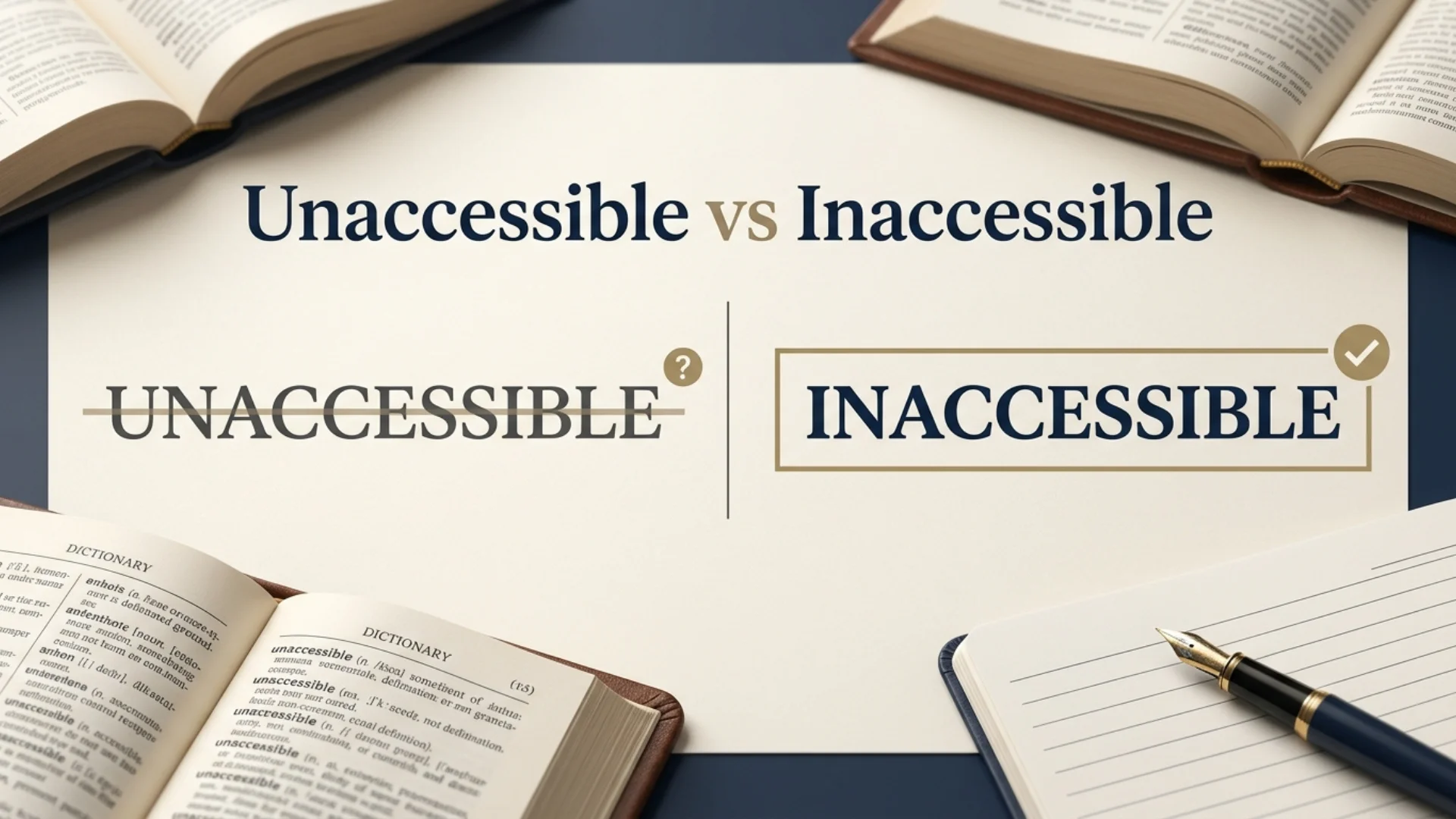
Unaccessible vs Inaccessible: Meaning, Difference & Correct Use
If you are choosing between unaccessible vs inaccessible, use inaccessible in standard modern English.
Inaccessible is the established adjective for something that is difficult or impossible to reach, enter, obtain, use, contact, or understand. Unaccessible has appeared historically and can still be found occasionally, but it is rare and generally avoided in formal, academic, professional, and everyday writing.
Here is the simplest answer:
| Word | Standard English? | Meaning | Recommended? |
|---|---|---|---|
| Inaccessible | Yes | Difficult or impossible to reach, use, obtain, enter, contact, or understand | Yes |
| Unaccessible | Rare/nonstandard in modern usage | Usually intended to mean the same as inaccessible | Usually no |
So, if you are wondering whether to write inaccessible or unaccessible, choose inaccessible.
What Does Inaccessible Mean?
Inaccessible is an adjective meaning that something cannot be reached easily, entered, obtained, used, contacted, or understood.
The exact meaning depends on the context.
According to the Cambridge Dictionary definition of inaccessible, the word can describe something that is difficult or impossible to reach, difficult to obtain or use, or difficult to understand.
Examples
- The mountain village became inaccessible after the landslide.
- The website was temporarily inaccessible.
- Several files were inaccessible without administrator permission.
- The research paper was almost inaccessible to beginners.
- The manager remained inaccessible throughout the day.
- The upper floor is inaccessible to wheelchair users.
In each example, the basic idea is the same: access is difficult or impossible.
Also check: What Happen or What Happened
Is Unaccessible a Word?
Unaccessible has existed in English and can occasionally be found in older writing or rare modern usage.
However, it is not the normal choice in present-day standard English.
Writers sometimes form unaccessible naturally because English frequently uses the prefix un- to create opposites:
- available → unavailable
- clear → unclear
- reachable → unreachable
- suitable → unsuitable
This makes unaccessible look logical.
The problem is that English does not build every negative adjective with un-. The established negative form of accessible is inaccessible.
For modern writing, using inaccessible avoids unnecessary doubt.
Better
The road is inaccessible during winter.
Avoid in standard writing
The road is unaccessible during winter.
The second sentence will probably still be understood, but inaccessible is the conventional form.
Unaccessible vs Inaccessible: What Is the Difference?
In most cases, there is no useful difference in intended meaning.
Someone writing unaccessible usually means exactly what another writer means by inaccessible.
The real difference is usage and acceptance.
Inaccessible
- Standard modern English
- Widely recognized
- Appropriate in formal writing
- Appropriate in academic writing
- Appropriate in technical writing
- Appropriate in everyday English
- Used for physical, digital, social, financial, and abstract situations
Unaccessible
- Rare
- Historically attested
- Sometimes used informally
- Often treated as nonstandard
- May look like a spelling mistake
- Usually unnecessary because inaccessible already performs the same function
That is why inaccessible is the safer and more natural choice.
Why Is It Inaccessible Instead of Unaccessible?
Both in- and un- can express negation in English, but English word formation is not perfectly predictable.
The prefix in- can mean “not.”
Examples include:
- accurate → inaccurate
- active → inactive
- complete → incomplete
- direct → indirect
- visible → invisible
- accessible → inaccessible
English vocabulary developed through multiple language influences, especially Germanic and Latin-based forms. As a result, speakers cannot always create the correct negative form simply by attaching whichever prefix seems logical.
That is why we say:
- inaccessible
- not normally unaccessible
Learning the established word is more reliable than trying to calculate the prefix every time. English, naturally, declined to make this tidy for anyone.
Inaccessible Meaning in Different Contexts
The word inaccessible is broader than simply “hard to reach.”
It can describe places, websites, information, people, services, ideas, and many other things.
Inaccessible Area Meaning
An inaccessible area is a place that is extremely difficult or impossible to reach.
Examples:
- The rescue team entered an inaccessible area of the mountains.
- Parts of the forest remain inaccessible by road.
- Flooding made several villages inaccessible.
An area may be inaccessible because of:
- mountains
- damaged roads
- weather
- flooding
- security restrictions
- distance
- dangerous terrain
- lack of transportation
Inaccessible Website or File Meaning
In technology, inaccessible means something cannot currently be opened, reached, or used.
Examples:
- The server error made the website inaccessible.
- The folder is inaccessible without the correct permissions.
- My account became inaccessible after the password reset failed.
- The database is temporarily inaccessible.
In technical writing, inaccessible is preferable to unaccessible.
Inaccessible Information Meaning
Information is inaccessible when people cannot obtain, use, locate, or understand it easily.
Examples:
- The records remained inaccessible to the public.
- The information is stored in an inaccessible database.
- The report is technically accurate but inaccessible to non-specialists.
Notice that inaccessible information can be inaccessible for two different reasons:
- You cannot obtain it.
- You can obtain it, but it is too difficult to understand.
Context tells you which meaning is intended.
Inaccessible Person Meaning
Calling a person inaccessible usually means they are difficult to contact, approach, or communicate with.
It can describe practical availability:
- The director was inaccessible during the conference.
It can also describe social behavior:
- He seemed distant and inaccessible.
In the second sense, the person may seem emotionally distant, unfriendly, reserved, or difficult to approach.
However, inaccessible and unapproachable are not always identical.
Someone may be inaccessible simply because they are unavailable, while someone who is unapproachable may actively seem intimidating or unfriendly.
Inaccessible Meaning: Difficult to Understand
Inaccessible can also describe language, writing, ideas, art, or academic material that is difficult for people to understand or appreciate.
Examples:
- The textbook is inaccessible to beginners.
- His explanation was unnecessarily inaccessible.
- The novel may feel inaccessible to younger readers.
- Highly technical terminology can make research inaccessible to the public.
Here, no physical access is involved.
The meaning is closer to:
- difficult to understand
- obscure
- highly technical
- complicated
- hard to follow
Not Accessible vs Inaccessible
Not accessible and inaccessible can often express the same basic idea.
Not accessible
This is a phrase.
Example:
The building is not accessible after 10 p.m.
Inaccessible
This is a single adjective.
Example:
The building is inaccessible after 10 p.m.
Both are grammatically correct.
However, they can sometimes carry slightly different emphasis.
Not accessible may simply describe the absence of access.
Inaccessible often sounds stronger and may suggest that access is especially difficult or impossible.
Compare:
- The archive is not accessible to visitors today.
- The archive is inaccessible because the entrance collapsed.
The first may describe a rule or temporary condition.
The second strongly suggests that access cannot realistically happen.
Inaccessible Pronunciation
Inaccessible is commonly pronounced approximately as:
in-uk-SES-uh-bul
The stressed syllable is SES.
A simplified pronunciation guide:
in-uhk-SES-uh-buhl
Because accents vary, the exact vowel sounds may differ slightly between British and American English.
Inaccessible Synonyms
The best synonym depends on what kind of access you mean.
For a place
- unreachable
- remote
- isolated
- impassable
- out of reach
- difficult to reach
For information or resources
- unavailable
- unobtainable
- restricted
- withheld
- out of reach
For writing or ideas
- difficult
- obscure
- complicated
- abstruse
- hard to understand
- incomprehensible
For a person
- unavailable
- distant
- aloof
- unapproachable
- hard to reach
Do not replace inaccessible mechanically. The correct synonym depends on the sentence.
Unaccessible or Inaccessible Synonym Choices
If you are trying to avoid repeating inaccessible, first identify the intended meaning.
Physical access
Instead of:
The cave is inaccessible.
You might write:
- The cave is unreachable.
- The cave is difficult to enter.
- The cave cannot be reached safely.
Digital access
Instead of:
The website is inaccessible.
You might write:
- The website is unavailable.
- The website cannot be reached.
- The website is offline.
Understanding
Instead of:
The book is inaccessible.
You might write:
- The book is difficult to understand.
- The book is overly technical.
- The book is hard to follow.
People
Instead of:
The manager is inaccessible.
You might write:
- The manager is difficult to contact.
- The manager is unavailable.
- The manager is hard to approach.
Examples of Inaccessible in Sentences
Here are examples covering the most common meanings.
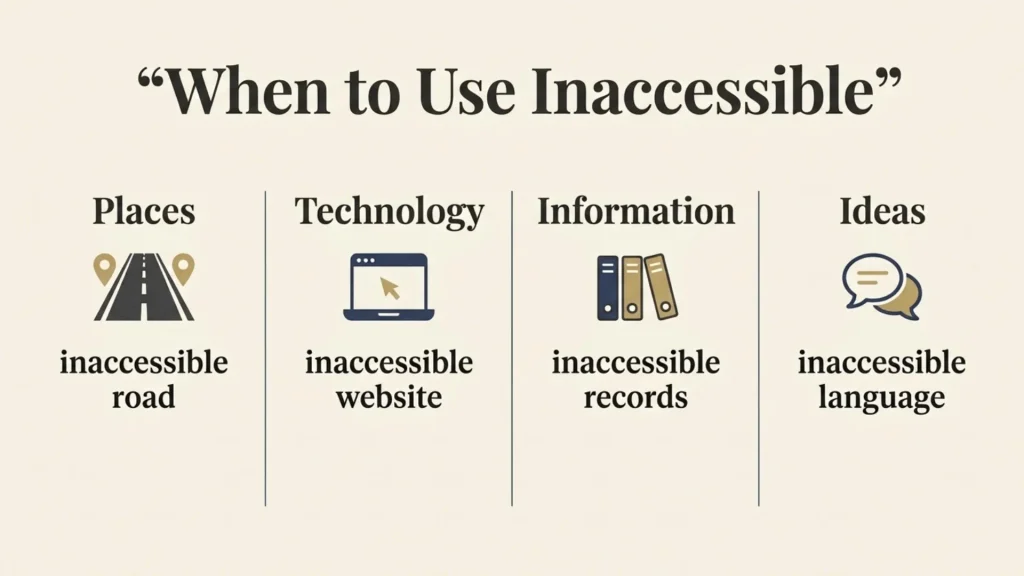
Places
- Heavy snow made the road inaccessible.
- The ruins are located in an inaccessible part of the valley.
- Several homes became inaccessible by car.
Technology
- The website was inaccessible for two hours.
- Some files remain inaccessible without authorization.
- The system became inaccessible during maintenance.
Information
- Important records were inaccessible to researchers.
- The database is inaccessible outside the company network.
- Medical information should not become inaccessible to patients.
Language and ideas
- The article is too technical and inaccessible to general readers.
- Legal terminology can make contracts feel inaccessible.
- The lecturer made a simple topic unnecessarily inaccessible.
People
- The executive remained inaccessible to reporters.
- She seemed emotionally inaccessible after the argument.
Common Mistakes With Inaccessible
Mistake 1: Writing “unaccessible” in formal English
Less natural:
The website is unaccessible.
Better:
The website is inaccessible.
Mistake 2: Confusing inaccessible with unavailable
A service can be unavailable because it is temporarily not offered.
Something is often inaccessible because you cannot reach, enter, open, use, or understand it.
Example:
The doctor is unavailable this afternoon.
The clinic is inaccessible because the road is flooded.
Mistake 3: Assuming inaccessible only refers to places
It can also describe:
- websites
- files
- services
- people
- information
- language
- art
- ideas
- education
- technology
Mistake 4: Confusing inaccessible with unapproachable
An inaccessible person may simply be difficult to reach.
An unapproachable person usually appears unfriendly, intimidating, or difficult to speak to.
Is It Inapproachable or Unapproachable?
The standard word is unapproachable.
This is a useful reminder that English does not use one negative prefix for every adjective.
We say:
- accessible → inaccessible
- approachable → unapproachable
- available → unavailable
- accurate → inaccurate
So although unaccessible may look reasonable because unapproachable is correct, English convention prefers inaccessible.
How Do You Say “Not Accessible”?
Several expressions can mean not accessible, depending on context:
- inaccessible
- unavailable
- unreachable
- restricted
- out of reach
- closed
- blocked
- unobtainable
- difficult to access
- impossible to reach
Examples
The mountain road is inaccessible.
The website is unavailable.
The manager is unreachable.
The documents are restricted.
The shelf is out of reach.
Choosing the most precise word makes the sentence clearer.
Inaccessible or Unaccessible: Which Is Correct?
For standard modern English, inaccessible is the correct and preferred choice.
Use:
- inaccessible area
- inaccessible website
- inaccessible information
- inaccessible building
- inaccessible file
- inaccessible person
- inaccessible language
- inaccessible location
Avoid using unaccessible unless you are discussing the word itself, quoting historical material, or analyzing unusual language usage.
Frequently Asked Questions
Is “unaccessible” a word?
Yes, unaccessible has appeared historically and is still occasionally used, but it is rare and generally not preferred in modern standard English. Use inaccessible in normal writing.
What does it mean if someone is inaccessible?
An inaccessible person may be difficult to contact, meet, approach, or communicate with. Depending on context, it can also suggest that the person seems emotionally distant.
Is it inapproachable or unapproachable?
Unapproachable is the standard word. It describes someone or something that is difficult to approach.
How do you say “not accessible”?
The most direct single-word equivalent is often inaccessible. Depending on context, you could also use unavailable, unreachable, restricted, or out of reach.
Do we say inaccessible or unaccessible?
Use inaccessible. It is the established form in standard modern English.
What is another way to say “inaccessible”?
Possible synonyms include unreachable, unavailable, remote, restricted, unobtainable, unapproachable, or difficult to understand. The best option depends on context.
What are some synonyms for “not accessible”?
Common choices include inaccessible, unavailable, unreachable, restricted, blocked, closed, unobtainable, and out of reach.
What’s a better word for “accessible”?
It depends on the intended meaning. Possible alternatives include available, reachable, approachable, understandable, usable, convenient, and open.
What’s a stronger word for “unable”?
Depending on the sentence, stronger or more precise alternatives may include incapable, powerless, prevented, prohibited, impossible, or unequipped. Unable describes a person or thing lacking the ability to do something, while inaccessible describes something that cannot easily be reached, used, or understood.
Final Answer: Unaccessible vs Inaccessible
The difference between unaccessible vs inaccessible is mainly a matter of standard usage.
Inaccessible is the established modern adjective and means difficult or impossible to reach, enter, obtain, use, contact, or understand.
Unaccessible has existed and may occasionally appear, but it is rare and unnecessary in normal modern writing.
For academic, professional, technical, and everyday English, remember this simple rule:
Use “inaccessible.”