In the Street vs On the Street: Which Is Correct?
You are writing an email and you stop. Is it in the street or on the street? Both phrases are correct English, but they do not mean the same thing — and picking the wrong one can change your sentence from a simple address into a traffic warning. Here is the short answer: on the street is the standard choice for location and addresses in American English, while in the street means physically inside the roadway, where cars drive. British English is the exception: there, in the street also works for general location.
In the Street vs On the Street: The Quick Answer
| On the Street | In the Street | |
|---|---|---|
| Core meaning | On the surface, or along the street | Inside the roadway itself |
| Addresses | Always — "I live on Maple Street" | Never for addresses (US) |
| American English | Default for location | Only for the physical roadway |
| British English | Also used | Also standard for general location |
| Typical feeling | Neutral, everyday | Physical, sometimes dangerous |
Think of it the way dictionaries treat the two prepositions: on is about a surface, in is about being enclosed within a space. A street is both a surface you live along and a space cars move through — which picture you mean decides the preposition. For the full dictionary treatment, see the Cambridge Dictionary entry for "on".
What Does "On the Street" Mean?
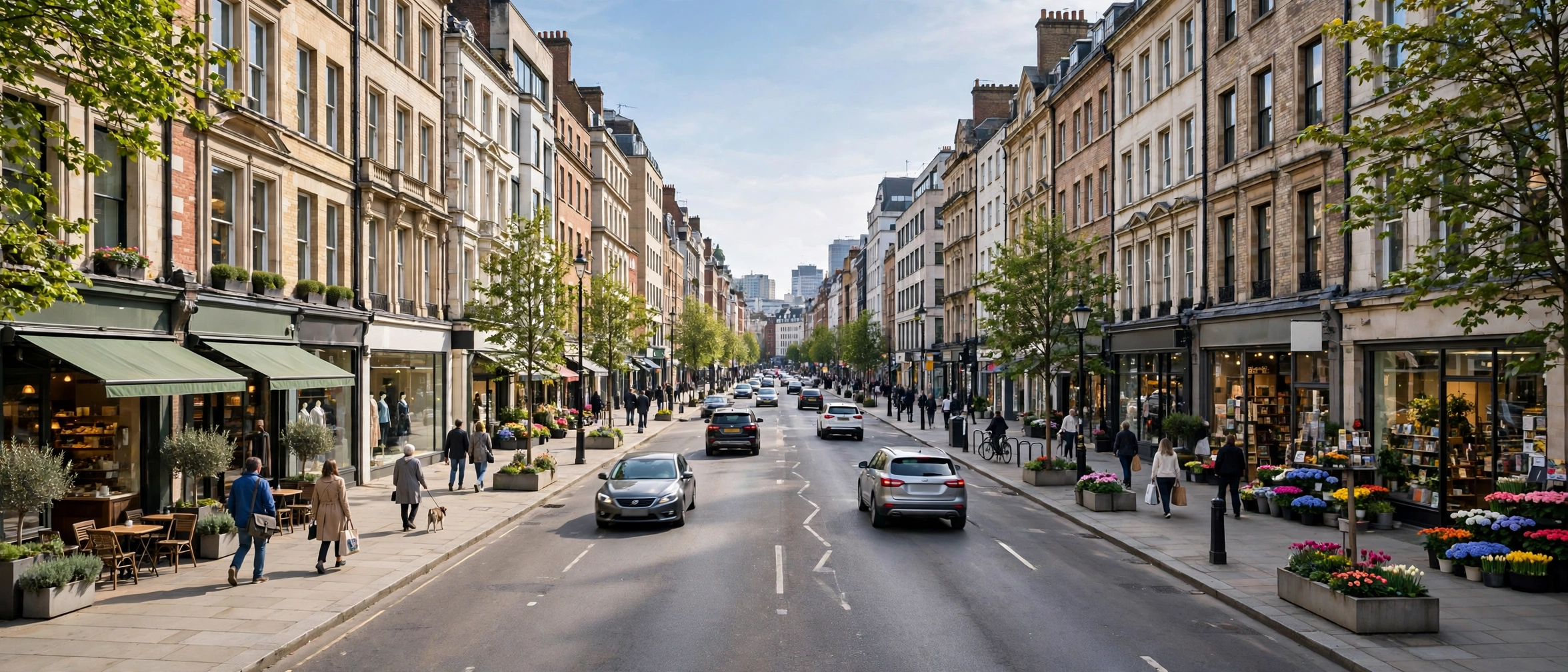
On the street treats the street as a surface or a line of addresses. You live on a street the way a picture hangs on a wall: you are positioned along it, not inside it.
- "She lives on Maple Street." (address)
- "There is a great coffee shop on Fifth Avenue." (location along the street)
- "I saw him walking on the street yesterday." (moving along the street area, sidewalks included)
- "The new store is opening on the main street." (position along the road)
This is the default in American English for nearly every location context: addresses, directions, shops, offices, and everyday activity near a street. If you are giving an address, on is the only choice — "I live in Oak Street" is not standard in American English, and it sounds wrong to most British speakers too when a street name is given.
What Does "In the Street" Mean?
In the street puts someone or something physically inside the roadway — the part of the street where vehicles travel, between the curbs, not on the sidewalk.
- "Do not play in the street — it is dangerous!" (the classic parental warning)
- "A ball rolled in the street and a car braked sharply." (the ball is in the traffic lanes)
- "The cyclist swerved in the street." (the cyclist is in the roadway)
- "There was a wallet lying in the street." (on the road surface, in the roadway)
In American English, this phrase carries a hint of risk: the person or thing is among the traffic. That is why a news report says a pedestrian was struck "in the street" — the preposition itself tells you the person was in the road. Saying "on the street" there would soften the meaning and sound wrong.

British vs American English: Where the Rule Splits
This is one of the most consistent regional preposition differences in English. American English keeps the two phrases apart: on for location, in for the roadway. British English uses in the street for both jobs. "There were hundreds of people in the street cheering" and "She met him in the street one afternoon" are completely natural in British English, with no suggestion that anyone is standing in traffic.
Two practical consequences follow. First, do not "correct" a British writer’s "in the street" to "on the street" — in their variety it is already correct. Second, if you write for an international or mixed audience, "on the street" is the safer neutral choice for location, since American usage dominates most global publishing. This is the same kind of trap as other commonly confused pairs: just as swap vs swop trips writers up on spelling variants, in vs on trips them up on prepositions — and in both cases the standard form is the safe choice.
"On the Road" or "In the Road"?
The same surface-versus-space logic applies to road, with one extra twist: on the road is also an idiom for traveling.
- On the road = on the road’s surface, or traveling. "There was heavy traffic on the road this morning." "The band is on the road again." (touring)
- In the road = physically standing or lying within the roadway, in the way. "Get out of the road!" "A tree branch fell in the road last night."
For normal driving and travel, on the road is always the phrase. "In the road" is reserved for something or someone actually in the roadway — and it often carries a complaint, as in "You are standing in the road!" British speakers use "in the road" this way more freely; Americans more often say "in the street" or simply "in the way."
"In" or "On" a Highway?
Always on the highway. A highway is treated as a surface and a route, exactly like a street or road: "There was a serious accident on the highway," "We drove on Interstate 95 for three hours." "In the highway" is not correct for location or travel. The only time "in" appears near "highway" is in different constructions, such as "in the highway system" or "in the Highway Trust Fund," where "highway" modifies another noun — never for being on the road itself.
Vehicles: "In" or "On" the Car? On or In a Bus?
Vehicles follow their own version of the same rule, and it is the part other guides leave out. The test is simple: can you stand up and walk around inside it?
| Vehicle | Preposition | Example |
|---|---|---|
| Car, taxi, van, truck cab | in | "She is waiting in the car." |
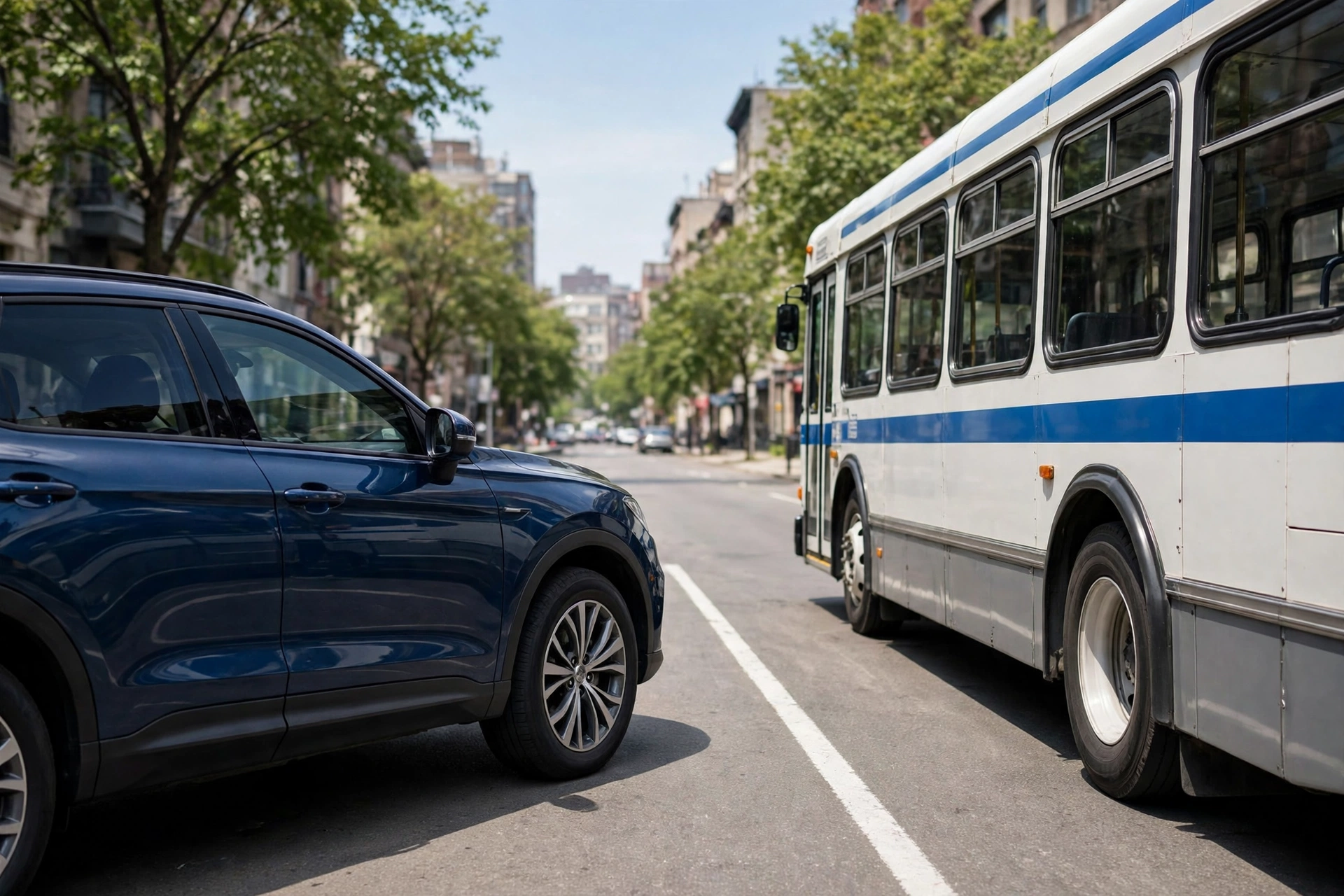
| Bus, train, plane, ship, ferry | on | "I met him on the bus." |
| Bicycle, motorcycle, horse | on | "He arrived on his bike." |
Small enclosed vehicles take in because you sit inside them: in a car, in a taxi. Large vehicles take on because you board them and can stand and move around: on a bus, on a train, on a plane. Bikes and motorcycles take on because you sit on top of them, not inside them. So the answers are fixed: in the car and on the bus — "on the car" only works if someone is literally sitting on its roof, and "in the bus" sounds wrong to most native speakers.
One related point: for the general means of travel, use by — "by car," "by bus," "by train." Use in or on only when you name a specific vehicle or describe being inside it. If verb forms ever trip you up the way prepositions do, felt vs feel and to fast or too fast cover two more common traps.
"At the Street" or "In the Street"?
"At the street" on its own is not standard for location. At is for a specific point, so it pairs with a point noun: "at the street corner," "at the end of the street," "at the bus stop." If you mean the general area, use on the street (American default) or in the street (roadway, or British location). "Meet me at the street" sounds unfinished; "Meet me at the corner of the street" is complete.
Idioms That Always Use "On"
Several fixed expressions lock in on, and none of them accept "in":
- On the street / on the streets — homeless or living rough: "After losing his job, he ended up on the streets."
- The man on the street — the average, ordinary person: "Ask the man on the street and most people agree."
- On the road — traveling or touring, as above.
- Hit the streets — to go out publicly or be released: "The new album hits the streets on Friday."
Note the plural too: "on the streets" suggests street life in general, while "in the streets" appears when crowds fill the roadway itself, as in "celebrations in the streets." The preposition still follows the same rule — surface and area versus inside the roadway.
Common Mistakes With In and On
| Incorrect | Correct | Why |
|---|---|---|
| I live in Oak Street. | I live on Oak Street. | Addresses always take "on." |
| He was hit on the street. | He was hit in the street. | Being hit means he was in the roadway. |
| There was an accident in the highway. | There was an accident on the highway. | Highways always take "on." |
| She is on the car. | She is in the car. | Cars are enclosed; you sit in them. |
| I met him in the bus. | I met him on the bus. | Buses are large vehicles; you ride on them. |
| He ended up in the street. (homelessness) | He ended up on the street. | The idiom is fixed with "on." |
| Meet me at the street. | Meet me at the street corner. | "At" needs a specific point. |
One more consistency rule, the same one that applies to pairs like due to or do to and smooth vs smoothe: do not mix regional standards in the same document. If your audience is American, use "on the street" for location throughout; if it is British, "in the street" for location is fine throughout. Mixing them looks careless even to readers who cannot explain why.
How to Remember the Difference
On = surface. In = inside. Picture "on" as resting on a pavement, a route, a row of addresses. Picture "in" as standing between the curbs with traffic around you. Then ask one question: could the sentence end with "among the traffic"? If yes, use "in the street." If you are giving an address or describing the general area, use "on the street." And for vehicles, ask: can I stand up inside it? If yes, "on"; if you only sit inside it, "in." For subject-verb agreement troubles of the same kind, see here is or here are and if he was vs if he were.
FAQs About In the Street vs On the Street
Which is correct, on the street or in the street?
Both are correct, but they mean different things. In American English, "on the street" is for location and addresses, and "in the street" means physically inside the roadway. In British English, "in the street" also covers general location, so both can be correct there for the same sentence.
"at the street" or "in the street"?
"In the street" is the real phrase; "at the street" on its own is not standard. Use "at" only with a specific point, such as "at the street corner" or "at the end of the street." For the general area, choose "on the street" (American default) or "in the street" (roadway, or British location).
Do you walk on the street or in the street?
Normally you walk on the street — along the sidewalk or the street area. You walk in the street only when you are walking in the roadway itself, where cars drive, for example because there is no sidewalk or you have stepped off the curb. In American English, "walking in the street" often implies unsafe behavior.
"on the road" or "in the road"?
Use on the road for traveling along a road or for anything on its surface: "There was heavy traffic on the road." Use in the road only for something physically within the roadway, often in the way: "Get out of the road!" "On the road" is also the idiom for traveling, as in "The band is on the road."
Is "on the road" grammatically correct?
Yes. "On the road" is fully grammatical and is the standard phrase for travel and for things on a road’s surface. "In the road" is also grammatical, but it means something different — being inside the roadway — so it is not a substitute for "on the road."
"in" or "on" a highway?
Always on the highway: "There was an accident on the highway," "We drove on the highway for hours." "In the highway" is not correct for location or travel. "In" appears only in different constructions, such as "in the highway system," where it does not describe being on the road.
"in" or "on the car"?
In the car. A car is a small enclosed vehicle you sit inside, so the preposition is "in": "She is waiting in the car." "On the car" would mean physically on top of it, such as a cat sitting on the car’s roof.
Walking on the road or in the road?
Walking on the road means walking along it, on its surface — the normal phrase for travel on foot. Walking in the road means walking in the roadway itself, in the path of traffic, and it often carries a warning tone: "Do not walk in the road." If there is a sidewalk, "on the road" (or "on the sidewalk") is the natural choice.
On or in a bus?
On a bus. Buses are large vehicles you board and can stand and walk around in, so the standard phrase is "on the bus": "I met him on the bus." "In the bus" is not the standard form and sounds wrong to most native speakers. The same rule gives "on a train," "on a plane," and "on a ship," versus "in a car" and "in a taxi."
Conclusion
In the street vs on the street is one of the simplest confusions in English once you see the picture behind it. On is the surface: addresses, locations, and everyday life along a street, plus roads and highways, which always take "on." In is the space inside: the roadway itself, where cars drive and where the danger lives — and, in British English, general street location too. Vehicles follow the same logic in miniature: sit inside it and you are in it; board it and walk around and you are on it. Ask "surface or space?" and the right preposition almost always answers itself.