Cocoon vs Cacoon: Which Spelling Is Correct?
Quick Answer: Cocoon vs cacoon: cocoon is the correct spelling. Cacoon is a common misspelling of cocoon. A cocoon is the protective silky covering made by some insect larvae, especially caterpillars, while they transform into adult insects. It can also describe a safe, comfortable place or a state of being protected from the outside world.
If you have seen “cacoon” in a message, essay, or social media post, you may wonder whether it is an accepted variant. It is not. The standard English spelling is “cocoon,” and “cacoon” is an error that appears mainly because the word’s pronunciation can make the second vowel sound unclear.
This guide explains why “cocoon” is correct, what it means, how to pronounce it, and how to use it in sentences. It also covers common mistakes, related words, and the figurative uses that make “cocoon” a useful word in everyday writing.
Cocoon vs Cacoon: What’s the Difference?
The difference between cocoon and cacoon is spelling. “Cocoon” is the only standard spelling in modern English dictionaries. “Cacoon” does not appear as a headword in major dictionaries and should not be used in formal or informal writing.
The confusion is understandable because the word is pronounced with a reduced vowel sound in the second syllable. Some writers hear the word as “ca-COON” and spell it with an “a.” The correct spelling uses a double “o” in both syllables: c-o-c-o-o-n.
| Feature | Cocoon | Cacoon |
|---|---|---|
| Spelling status | Correct, standard spelling | Misspelling, not a standard word |
| Dictionary entry | Listed in Merriam-Webster, Cambridge, and Oxford | Not listed as a headword |
| Meaning | A protective covering or safe place | No meaning as a spelling of cocoon (it is also the name of a tropical bean) |
| Pronunciation | kuh-KOON | Would be pronounced similarly, but is not standard |
| Plural | Cocoons | Not applicable |
| Use in writing | Correct in all contexts | Should be corrected |
The rule is simple: if you mean the silky case made by a caterpillar, or the figurative sense of a safe place, spell it “cocoon.”
What Does Cocoon Mean?
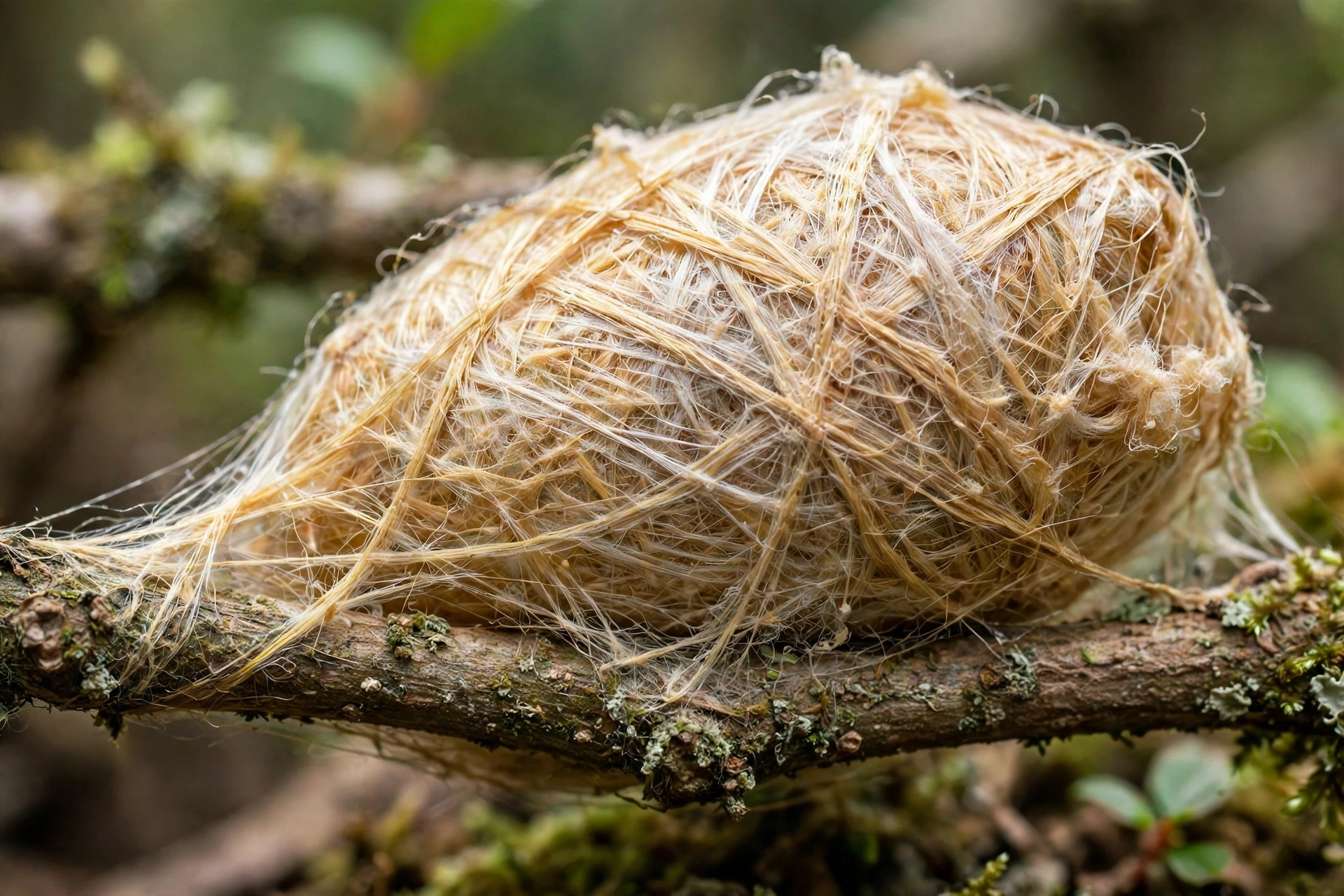
A cocoon is a protective covering made by the larvae of certain insects, especially moth caterpillars, during the pupal stage of metamorphosis. The larva spins silk around itself and remains inside while its body changes into an adult insect.
According to Merriam-Webster, a cocoon is “a covering usually of silk which is spun or constructed by an insect larva usually as a place for pupation.” The Cambridge Dictionary entry for cocoon gives a similar definition, describing the silky covering made by a caterpillar to protect it while it changes into an adult insect.
Cocoon Definition in Everyday Language
The cocoon definition also includes a figurative meaning. A cocoon can describe a place or situation that protects a person from unpleasant experiences or the outside world.
For example:
- The caterpillar spun a cocoon on the branch.
- She stayed in her cocoon of blankets on a cold morning.
- The small village was a cocoon, far from the noise of the city.
In these examples, the literal meaning refers to an insect’s covering, while the figurative meaning refers to comfort, safety, or isolation.
Cocoon in Science and Nature
In science, a cocoon is part of the life cycle of holometabolous insects — insects that undergo complete metamorphosis. The caterpillar stage ends when the larva forms a cocoon. Inside, it becomes a pupa and then emerges as an adult moth or butterfly.
The silk used to make a cocoon comes from the larva itself. Silkworms, the larvae of the silk moth, produce the silk that has been used in textile production for thousands of years.
A cocoon is a protective case that helps the insect survive while it changes form. This scientific use is the origin of the figurative meaning: just as a cocoon protects a caterpillar, a “cocoon” in everyday language can protect a person from difficulty.
Is Cacoon a Word?
No, cacoon is not a standard English word. It is a common misspelling of cocoon. Major dictionaries do not list “cacoon” as a headword, and it has no separate definition.
The error usually comes from the word’s pronunciation. The second syllable of “cocoon” is stressed, while the first syllable is unstressed and contains a reduced vowel. A writer who spells the word by sound may write “cacoon” instead of “cocoon.”
Spelling checkers will usually flag “cacoon” as an error and suggest “cocoon.” If you see “cacoon” in your writing, correct it to “cocoon” in every context.
One reason the error survives is that “cacoon” is also the name of a tropical bean or seed, so a spellchecker does not always flag it. But as a spelling of the insect’s silk case, “cacoon” is still wrong: the correct spelling is always “cocoon.”
Why Do People Spell It “Cacoon”?
Several factors contribute to the misspelling:
- Pronunciation: The unstressed first vowel sounds like “uh,” which some writers hear as “a.”
- Unfamiliarity: “Cocoon” is not an everyday word for many people, so they guess its spelling.
- Typing errors: The double “o” in the second syllable can be mistyped or misremembered.
- Similar words: Words such as “cacao” and “cannon” may influence the spelling by association.
None of these reasons makes “cacoon” correct. The standard spelling remains “cocoon.”
How to Pronounce Cocoon
The standard American pronunciation of cocoon is kuh-KOON, with the stress on the second syllable. The first syllable uses a reduced vowel, often written as “uh,” while the second syllable uses a long “oo” sound.
In British English, the pronunciation is similar: kuh-KOON. The spelling does not change between American and British English.
A useful memory aid is to think of the word as “co-COON.” The second part sounds like “coon,” the informal word for a raccoon, although the two words are unrelated. The double “o” appears in both syllables, which helps you remember the spelling: co-coon.
Cocoon vs Chrysalis: What’s the Difference?
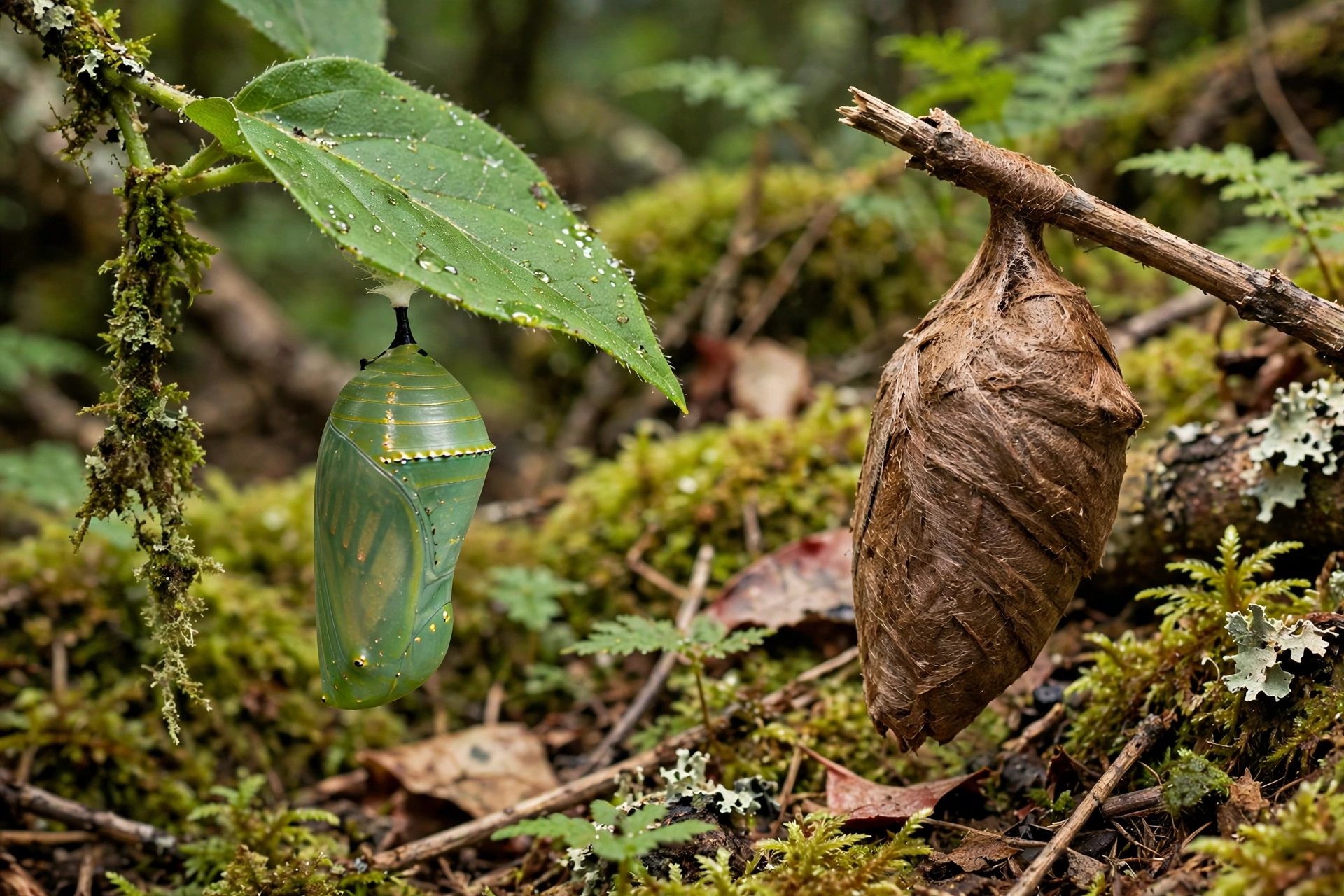
“Cocoon” and “chrysalis” are related but not identical. A chrysalis is the pupa itself — the hard outer case of a butterfly during metamorphosis. A cocoon is the silky covering that some larvae spin around the pupa.
Not all butterflies make cocoons. Moths usually spin cocoons, while butterflies usually form a chrysalis without a silky outer covering. In everyday language, people sometimes use “cocoon” for both, but in scientific writing the distinction matters.
| Feature | Cocoon | Chrysalis |
|---|---|---|
| What it is | A silky covering spun by a larva | The pupa itself, often with a hard outer case |
| Made by | Mainly moth larvae and some other insects | Mainly butterfly pupae |
| Material | Silk | A hardened outer layer |
| Common use | General and figurative | Mostly scientific |
For most writing, “cocoon” is the word you need. Use “chrysalis” when you are writing scientifically about a butterfly pupa.
Figurative Uses of Cocoon
The figurative use of “cocoon” is common in writing about comfort, safety, and personal growth. A person can “cocoon” themselves from stress, or “emerge from a cocoon” after a period of change.
Cocoon as a Safe Place
Writers often use “cocoon” to describe a home, room, or situation that feels safe and comfortable.
For example:
“After a long week, she retreated to her cocoon of books and tea.”
This sentence does not describe an insect. It uses the image of a protective covering to suggest comfort and privacy.
Cocoon as a Verb
“Cocoon” can also be used as a verb, meaning to wrap or protect someone or something as if in a cocoon.
- She cocooned the baby in a soft blanket.
- He cocooned himself in his work to avoid the news.
- The town was cocooned by fog.
The verb form follows regular English patterns: cocoon, cocooned, cocooning.
Emerge From a Cocoon
The phrase “emerge from a cocoon” describes a transformation or a return to the world after a period of withdrawal.
For example:
“After months of study, she emerged from her cocoon ready for the exam.”
This figurative use is especially common in writing about personal growth, recovery, and new beginnings.
How to Use Cocoon in Sentences
The following examples show “cocoon” in literal and figurative contexts.
Literal Examples
- The caterpillar spun a cocoon under the leaf.
- Silkworms produce silk to build their cocoons.
- The cocoon hung from the branch for several weeks.
- Scientists studied the structure of the cocoon.
Figurative Examples
- He lived in a cocoon of privilege, unaware of the problems outside.
- The hotel room was a warm cocoon after the cold journey.
- She wrapped herself in a cocoon of silence.
Each example uses “cocoon” as a noun. The verb examples above show the same word in a different grammatical role.
Common Mistakes to Avoid
Most errors involving “cocoon” are spelling errors, but a few are errors of meaning.
1. Spelling It “Cacoon”
This is the most common mistake. Remember the double “o” in both parts of the word: co-coon.
2. Confusing Cocoon With Chrysalis
A cocoon is a silky covering. A chrysalis is the pupa itself. They are related, but they are not the same thing.
3. Using “Cocoon” for Every Insect Covering
Not all insects make cocoons. Some pupae are exposed, and some are buried in soil. Use “cocoon” only when a silky covering is present.
4. Overusing the Figurative Meaning
The figurative use of “cocoon” is effective, but it can become a cliché if it appears too often. In formal writing, use it sparingly and only when the image adds meaning.
5. Misspelling the Plural
The plural of cocoon is “cocoons.” It follows the regular English pattern of adding “-s” without changing the spelling.
Cocoon Synonyms and Related Words
Several words can describe a similar idea, but they are not exact substitutes for “cocoon.”
| Word | Best used when | Example |
|---|---|---|
| Chrysalis | Describing a butterfly pupa scientifically | The chrysalis hung from the twig. |
| Pupa | Referring to the life stage itself | The pupa remained inside the cocoon. |
| Shell | Describing a hard outer covering | The shell protected the seed. |
| Sanctuary | Describing a safe place for people | The library was her sanctuary. |
| Haven | Describing a place of safety or rest | The cabin was a haven from the storm. |
| Retreat | Describing a place to withdraw | She went to a mountain retreat. |
These words share the idea of protection, but only “cocoon” carries the specific image of a silky insect covering and the transformation that happens inside it.
Frequently Asked Questions
1. Which is correct: cocoon or cacoon?
Cocoon is correct. Cacoon is a common misspelling and is not listed as a standard word in major dictionaries.
2. What does cocoon mean?
A cocoon is the protective silky covering made by some insect larvae, especially caterpillars, while they transform into adult insects. It can also describe a safe, comfortable place or a state of being protected from the outside world.
3. Is cacoon a word?
No, cacoon is not a standard English word. It is a misspelling of cocoon.
4. How do you pronounce cocoon?
Cocoon is pronounced “kuh-KOON,” with the stress on the second syllable. The first vowel is a reduced “uh” sound, and the second syllable has a long “oo” sound.
5. What is the difference between a cocoon and a chrysalis?
A cocoon is a silky covering spun by a larva around the pupa. A chrysalis is the pupa itself, often with a hard outer case, and is most often associated with butterflies. Moths usually spin cocoons, while butterflies usually form a chrysalis.
6. What is the plural of cocoon?
The plural of cocoon is “cocoons.” Add “-s” without changing the spelling.
7. Can cocoon be used as a verb?
Yes. As a verb, “cocoon” means to wrap or protect someone or something as if in a cocoon. For example, “She cocooned the baby in a soft blanket.”
8. What does “emerge from a cocoon” mean?
It means to come out of a period of withdrawal, protection, or transformation and return to the world, often changed or ready for something new.
9. Is cocoon spelled the same in British and American English?
Yes. “Cocoon” is spelled the same in both British and American English.
10. What is a cocoon in nature?
In nature, a cocoon is the silk case that protects a larva while it undergoes metamorphosis into an adult insect, such as a moth.
11. Can cocoon describe a person or place?
Yes. Figuratively, a cocoon can describe a safe, comfortable place or a protective situation, such as “a cocoon of blankets” or “a cocoon of silence.”
12. Why do people spell cocoon as cacoon?
People often spell it “cacoon” because the first vowel is unstressed and sounds like “uh,” which they hear as “a.” The correct spelling uses a double “o” in both syllables: co-coon.
Final Thoughts: Which Spelling Should You Choose?
Cocoon is the only correct spelling. Cacoon is a misspelling, not an accepted variant.
Remember the word as co-coon, with a double “o” in each part. The image of a caterpillar wrapped in silk can help you remember both the spelling and the meaning.
Whether you are writing about nature, personal growth, or a comfortable place, “cocoon” is the spelling to use — that is the answer to the cocoon vs cacoon question.