Gases or Gasses: Correct Plural, Meaning & Examples
Quick Answer: Use gases as the standard plural of gas. For example: “Oxygen and nitrogen are gases.” The spelling gasses is also recorded by some major dictionaries as an alternative plural, but it is much less common and is usually best avoided in scientific, academic, and professional writing. Gasses is also commonly used as the third-person singular form of the verb gas: “The machine gasses the chamber.”
So the practical rule for Gases or Gasses is simple: if you mean more than one gas, choose gases. If you are using the verb to gas, gasses may be the form you need.
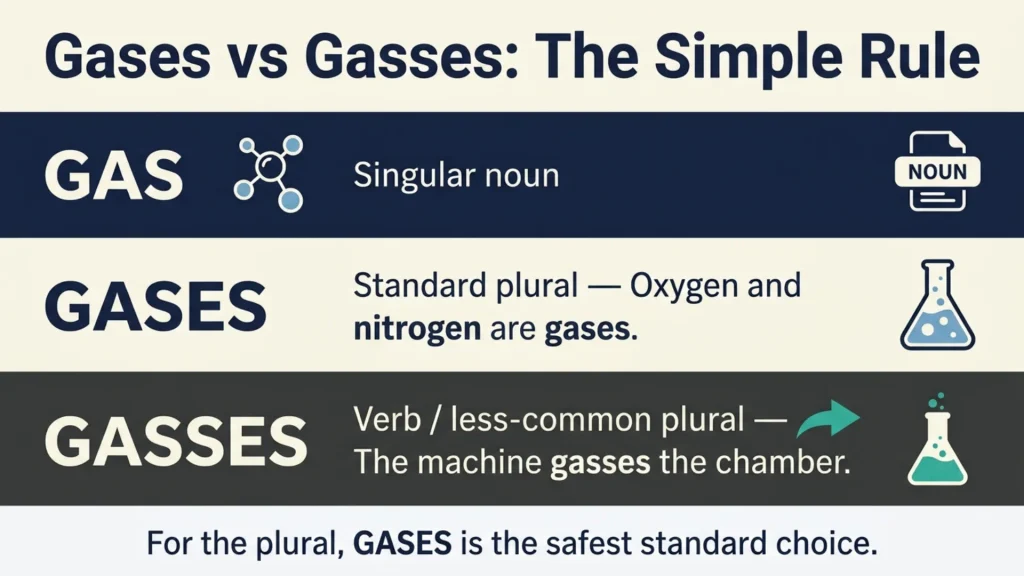
Gases or Gasses at a Glance
| Form | Grammar | Meaning | Best Use |
|---|---|---|---|
| gases | Plural noun | More than one gas | Standard and preferred plural |
| gasses | Alternative plural noun | More than one gas | Accepted by some dictionaries, but uncommon |
| gasses | Verb | Supplies, exposes to, emits, or treats with gas | Normal verb form in many contexts |
The safest everyday spelling is gas → gases. That is the form you should expect in textbooks, science writing, journalism, business documents, and most edited English.
What Is the Plural of Gas?
The standard plural of gas is gases.
- Oxygen and nitrogen are gases.
- Scientists measured several atmospheric gases.
- Some gases are colorless and odorless.
- Greenhouse gases affect Earth’s energy balance.
The spelling is g-a-s-e-s, not g-a-s-s-e-s, for the normal preferred plural in modern edited English.
Is “Gasses” Also a Plural of Gas?
Yes, with an important qualification.
Some major dictionaries recognize gasses as an alternative plural of gas. The Cambridge Dictionary entry for gas, for example, records the plural as gases or gasses.
That does not mean the two spellings are equally common or equally advisable in every context. In modern scientific, academic, technical, journalistic, and general professional writing, gases is overwhelmingly the safer choice.
The atmosphere contains several gases. is the better standard form. You may encounter The atmosphere contains several gasses., but the first version is much more conventional.
What Does “Gasses” Mean?
Gasses is also a verb form. It is the third-person singular present form of the verb gas.
- The technician gasses the chamber before testing.
- The system gasses the container automatically.
- The worker gasses up the vehicle before the trip.
Depending on context, the verb gas can mean to supply something with gas, expose something to gas, poison with gas, emit gas, or fuel a vehicle. In informal American English, gas someone up can also mean to praise or encourage someone excessively.
Gases vs Gasses: The Main Difference
The easiest distinction is:
Gases = usually a plural noun
Gasses = commonly a verb, and sometimes an alternative plural noun
The laboratory stores several gases. Here, gases is a plural noun.
The technician gasses the chamber. Here, gasses is a verb.
How Do You Spell Gases?
The normal plural spelling is G-A-S-E-S.
A useful memory trick is: One gas, two gases.
If you are talking about oxygen, nitrogen, helium, methane, carbon dioxide, or other substances in the gaseous state, gases is normally the spelling you want.
How Do You Spell Gas?
The singular noun is gas.
- Helium is a gas.
- The stove uses natural gas.
- We need to stop for gas.
In American English, gas can also be an informal short form of gasoline.
Why Is the Plural “Gases” Instead of “Gasses”?
English spelling is not governed by one universal rule that can be applied mechanically to every word. For the noun gas, the conventional modern plural is formed by adding -es: gas + es = gases.
- bus → buses
- class → classes
- box → boxes
- gas → gases
The extra consonant in gasses survives in other inflected uses and as an accepted variant in some dictionaries, but gases became the dominant noun plural.
English spelling contains many cases where historical usage matters more than a single neat formula. GrammarRead’s Combating vs Combatting guide covers another pair where variant forms can both exist without being equally preferred.
Gasses as a Verb: Why the S Is Doubled
When gas is used as a verb, doubled-s forms are standard:
- gas → gasses
- gas → gassed
- gas → gassing
Examples:
- She gasses up the car every Monday.
- The room was gassed.
- They are gassing the system before inspection.
This creates the useful contrast: gases = standard plural noun; gasses = common verb form.
Gases or Gasses in American English
In American English, use gases for the normal plural noun.
- greenhouse gases
- noble gases
- toxic gases
- industrial gases
- exhaust gases
Although dictionaries may recognize gasses as an alternative plural, it is not the best default for U.S. academic, scientific, or professional writing. As a verb, however, gasses is completely normal.
Gases or Gasses in British English
British English also strongly favors gases as the ordinary plural. You may find gasses in British corpora and historical or technical texts, but that does not make it the preferred spelling for general modern writing.
If you are writing a school assignment, university paper, scientific report, professional document, or general web article, choose gases unless a specific house style tells you otherwise.
Greenhouse Gases or Greenhouse Gasses?
Use greenhouse gases. This is the standard phrase in scientific, environmental, governmental, and educational writing.
Examples of greenhouse gases include carbon dioxide, methane, nitrous oxide, water vapor, and fluorinated gases.
Although greenhouse gasses can be found in real-world texts and some dictionaries accept gasses as a plural, greenhouse gases is by far the better spelling for polished writing.
Noble Gases or Noble Gasses?
Use noble gases. Examples include helium, neon, argon, krypton, and xenon. In chemistry and physics, gases is the standard plural form.
Toxic Gases or Toxic Gasses?
The normal spelling is toxic gases.
Example: The detector can identify several toxic gases.
Exhaust Gases or Exhaust Gasses?
Prefer exhaust gases.
Example: The system reduces harmful exhaust gases.
The variant exhaust gasses occurs in some writing, but the single-s plural remains the cleaner standard choice.
Are Gases and Gasses Pronounced Differently?
Usually, no meaningful pronunciation distinction is made in ordinary speech. Both are generally pronounced like GAS-iz. That is one reason the spelling causes confusion: speech does not reliably tell you which written form is intended.
Gas, Gases, Gasses, Gassed, and Gassing
| Word | Role | Example |
|---|---|---|
| gas | Singular noun / base verb | Helium is a gas. |
| gases | Standard plural noun | These gases are harmless. |
| gasses | Verb / alternative plural | The machine gasses the container. |
| gassed | Past-tense verb | The chamber was gassed. |
| gassing | -ing verb form | They are gassing the chamber. |
Gases or Gasses Examples
Correct Examples With Gases
- Oxygen and nitrogen are common atmospheric gases.
- The scientists tested several gases.
- Greenhouse gases can trap heat in the atmosphere.
- The cylinders contain compressed gases.
- Some gases are highly reactive.
- The detector measures toxic gases.
- Different gases behave differently under pressure.
- The students learned about noble gases.
Correct Examples With Gasses as a Verb
- The technician gasses the chamber before each test.
- The system gasses the container automatically.
- He gasses up the car before a long drive.
- The operator carefully gasses the enclosure.
Accepted but Less Preferred Plural Use
You may occasionally see The chamber contains several gasses. Some dictionaries accept that spelling, but The chamber contains several gases. is the better modern default.
Common Mistakes With Gases and Gasses
Mistake 1: Assuming Gasses Is Always Wrong
It is not. Gasses is a real verb form, and some dictionaries also list it as a plural noun variant.
Mistake 2: Using Gasses as the Default Scientific Plural
Avoid The atmosphere contains many gasses. Prefer The atmosphere contains many gases.
Mistake 3: Writing Gases for the Normal Verb Form
For the verb, doubled-s forms are standard: The technician gasses the chamber.
Mistake 4: Assuming US and UK English Have Opposite Rules
They do not. Gases is the normal plural on both sides of the Atlantic.
Mistake 5: Trusting Spellcheck Alone
Spellcheck may accept both words because both can be legitimate. It cannot always decide whether your sentence needs a noun or a verb.
This is similar to other spelling pairs where context matters. GrammarRead’s Smooth vs Smoothe and Linchpin vs Lynchpin guides show why dictionary status and actual usage both matter.
Why “Gases” Is the Best Default
If you remember only one spelling rule from this article, use gas → gases.
- It matches standard scientific usage.
- It is immediately recognized internationally.
- It avoids confusion with the verb gasses.
- It works naturally in American and British English.
- It is the expected choice in most edited writing.
If a dictionary, quotation, historical source, or specific house style uses gasses as the plural, that spelling is not automatically wrong. It is simply much less useful as the default.
Plural Rules: Why English Is Not Always Predictable
Many English plurals ending in an s-like sound take -es: bus → buses, class → classes, box → boxes, church → churches, gas → gases.
English also contains irregular and historically established plural patterns. For example, compound nouns do not always put the plural ending where learners expect. GrammarRead’s Passerbyers vs Passersby vs Passerby explains a plural where the internal structure of the word matters more than simply adding an ending at the very end.
Five Examples of Gases
- Oxygen — essential for human respiration.
- Nitrogen — the largest component of Earth’s atmosphere by volume.
- Carbon dioxide — produced by respiration and combustion, among other processes.
- Helium — a noble gas used in scientific and industrial applications.
- Methane — a hydrocarbon gas and an important greenhouse gas.
In this scientific context, the spelling is firmly gases.
Does “Gas” Include Farts?
In everyday language, yes: intestinal gas is gas in the digestive tract, and passing it through the rectum is called flatulence or flatus.
That does not change the grammar rule. If you are talking about different intestinal gases, the normal plural spelling is still gases.
Why Can Intestinal Gas Smell Bad?
Most intestinal gas is not strongly odorous. Unpleasant odor can come from small amounts of sulfur-containing compounds produced during digestion. Food, gut bacteria, and digestive conditions can all influence how much gas a person produces and how it smells.
A suddenly persistent change in gas together with symptoms such as significant abdominal pain, diarrhea, constipation, blood in the stool, vomiting, or unexplained weight loss is a health issue rather than a spelling issue and is worth discussing with a healthcare professional.
Can a Fart Be Deadly?
There is no credible standard medical record of an ordinary individual fart being the “deadliest fart ever.” Normal human flatulence disperses into the surrounding air and is not treated as a lethal exposure in everyday circumstances.
Dangerous concentrations of gases such as hydrogen sulfide can occur in industrial, sewage, manure-pit, or other confined-space environments, but that is a completely different situation from ordinary human flatulence.
Does Fart Smell Stay in Clothes?
Odor can temporarily linger in fabric, especially in poorly ventilated spaces or if clothing absorbs other odor-producing substances. There is no universal fixed duration because fabric type, airflow, humidity, and the compounds involved all affect how quickly the smell dissipates.
Why Can a Fart Feel “Big”?
A larger release of intestinal gas can result from swallowed air, carbonated drinks, bacterial fermentation of food, or gas accumulating before being released. The perceived size or loudness of a fart does not provide a reliable measurement of how much gas was present.
Easy Trick to Remember Gases vs Gasses
More than one gas? → GASES
Someone or something doing the action of gassing? → GASSES
Examples: These gases are dangerous. / The machine gasses the chamber.
Frequently Asked Questions
What is the plural form of “gas”?
The standard plural is gases. Some dictionaries also recognize gasses as an alternative plural, but gases is much more common and is the best choice for scientific and professional writing.
What are 5 examples of gases?
Five examples are oxygen, nitrogen, carbon dioxide, helium, and methane.
What does the word “gasses” mean?
Gasses commonly functions as the third-person singular verb form of gas, as in “The machine gasses the chamber.” Some dictionaries also record it as an alternative plural of gas.
Is fart considered a gas?
A fart is the release of intestinal gas, technically called flatus, through the rectum. It contains a mixture of gases generated or introduced during digestion.
What is an unhealthy fart smell?
There is no single smell that automatically means something is unhealthy. Sulfur compounds can make flatulence smell like rotten eggs. Persistent major changes accompanied by pain, diarrhea, constipation, bleeding, vomiting, or unexplained weight loss deserve medical attention.
What was the deadliest fart ever?
There is no credible documented “deadliest fart” record for ordinary human flatulence. Reports about dangerous gas deaths generally involve concentrated toxic gases in confined or industrial environments, not a normal fart.
What’s the smelliest fart ever?
There is no objective, scientifically recognized world record for the “smelliest fart.” Odor perception is subjective, and flatulence odor varies with sulfur compounds, diet, gut bacteria, and digestion.
Does fart smell stay in clothes?
It can linger temporarily, particularly in enclosed spaces or absorbent fabrics, but the duration varies. Ventilation and washing remove lingering odor.
Why was my fart so big?
A large-feeling release may come from accumulated intestinal gas, swallowed air, carbonated drinks, or bacterial fermentation of food. Occasional variation is normal.
Is it gases or gasses in American English?
Use gases as the standard American English plural. Gasses is a normal verb form and is also listed as an alternative plural by some dictionaries.
Is it gases or gasses in UK English?
Gases is also the preferred general plural in British English. The variant gasses occurs, but gases is the safest modern default.
Is it greenhouse gases or gasses?
Use greenhouse gases. That is the standard form in scientific and environmental writing.
How do you spell gases?
For the normal plural of gas, spell it g-a-s-e-s.
Final Answer
The Gases or Gasses question has a simple practical answer with one useful nuance.
Gases is the standard and preferred plural of gas: One gas → two gases.
Gasses is most commonly encountered as a verb: The machine gasses the chamber.
Some respected dictionaries also accept gasses as an alternative plural noun, so it is too strong to claim that the spelling can never be plural. However, gases is the clearer choice for science, school, professional writing, greenhouse gases, noble gases, toxic gases, and ordinary modern English.
When in doubt, use gases for the plural and reserve gasses for the verb.