Drove vs Driven: Difference, Grammar Rules & Examples
Quick Answer: Drove is the simple past tense of drive, while driven is the past participle.
Use drove for a completed past action:
I drove to work yesterday.
Use driven with have, has, or had:
I have driven this route before.
Also use driven in passive constructions:
The car was driven by Sarah.
The basic verb forms are:
drive → drove → driven
So:
I drove ✅
I have driven ✅
I have drove ❌
I driven yesterday ❌
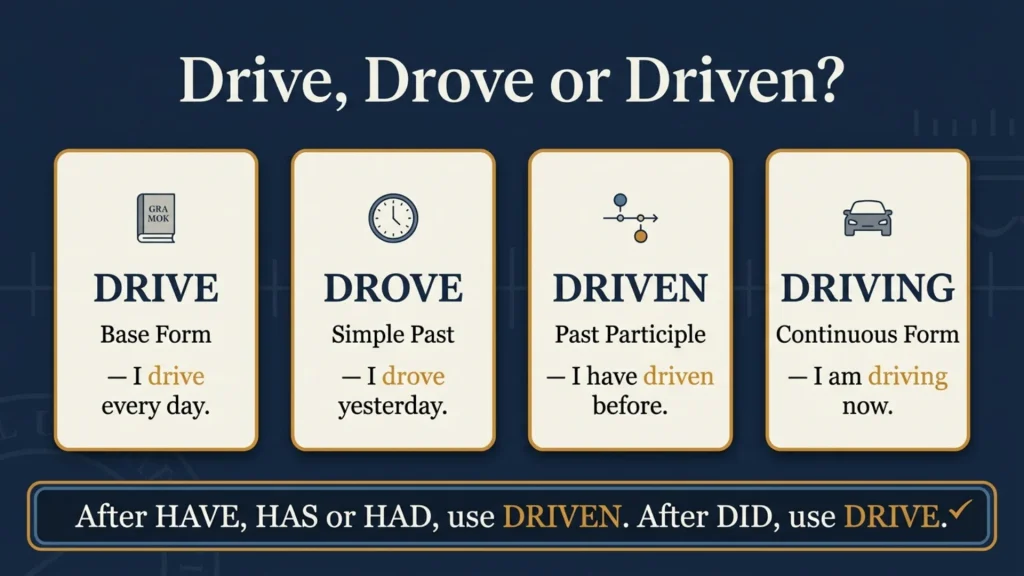
Drove vs Driven at a Glance
| Form | Grammar | Main Use | Example |
|---|---|---|---|
| drive | Base form | Present, infinitives, after did/modals | I drive every day. |
| drove | Simple past | Completed past action | I drove yesterday. |
| driven | Past participle | Perfect tenses and passive voice | I have driven before. |
| driving | -ing form | Continuous tenses | I am driving now. |
The easiest rule to remember is:
Drove = simple past
Driven = past participle
What Is the Difference Between Drove and Driven?
Both words come from the verb drive, but they perform different grammatical jobs.
Drove works as the simple past tense.
Example:
She drove home after work.
The action happened and finished in the past.
Driven is the past participle.
Example:
She has driven home many times.
Here, driven works with the helping verb has.
Another example:
The vehicle was driven carefully.
Here, driven forms part of a passive construction.
The difference is therefore not primarily about meaning. It is about verb form and sentence structure.
The Forms of Drive
Drive is an irregular verb.
Regular verbs usually form the past by adding -ed:
walk → walked
play → played
But drive changes internally:
drive → drove → driven
According to the Cambridge Dictionary entry for drive, drove is the past tense and driven is the past participle.
The four forms you will use most often are:
- drive
- drove
- driven
- driving
What Does Drove Mean?
Drove is the simple past tense of drive.
Use it when an action happened in the past and is presented as complete.
Examples:
I drove to the store yesterday.
She drove the children to school.
We drove through the mountains.
He drove home after midnight.
They drove for six hours.
Notice that drove does not need have, has, or had.
The normal structure is:
subject + drove
Example:
Michael drove the car.
Is Drove a Word?
Yes.
Drove is a standard English word and the correct simple past form of drive.
Examples:
I drove home.
He drove carefully.
We drove across Texas.
It can also exist as a noun with a different meaning, as in a drove of animals, meaning a group moving together.
But in the phrase I drove, it is the past tense of the verb drive.
What Does Driven Mean?
Driven is the past participle of drive.
It appears most often with helping verbs such as:
- have
- has
- had
- will have
- would have
- could have
- should have
- was
- were
- been
Examples:
I have driven that car before.
She has driven across the country.
They had driven for three hours before stopping.
The vehicle was driven by a professional.
Unlike drove, driven normally does not serve as the ordinary standalone simple past.
Incorrect:
I driven home yesterday.
Correct:
I drove home yesterday.
Driven Meaning
As a verb form, driven means that something has been driven, moved, forced, motivated, or caused by the action expressed by drive.
Examples:
I have driven this road before.
The nail was driven into the wall.
The machine is driven by an electric motor.
The decision was driven by cost concerns.
The exact meaning depends on the sense of drive being used.
Driven Can Also Be an Adjective
This is an important point that simple grammar guides sometimes miss.
Driven can also function as an adjective.
Example:
She is a highly driven entrepreneur.
Here, driven means strongly motivated or determined.
Other examples:
He is extremely driven.
They hired a driven young manager.
The company has a data-driven strategy.
In these examples, driven is not simply describing someone operating a vehicle.
So the claim that “driven can never appear without have, has, or had” is too simplistic.
As a verb participle, it commonly works with an auxiliary.
As an adjective, it can describe a person, system, decision, or process.
Drive, Drove and Driven
A simple three-form table makes the pattern easier to remember.
| Verb Form | Name | Example |
|---|---|---|
| drive | base form | I drive to work. |
| drove | simple past | I drove yesterday. |
| driven | past participle | I have driven there. |
Think:
Today I drive.
Yesterday I drove.
I have driven before.
I Haven’t Driven or Drove?
Correct:
I haven’t driven.
Incorrect:
I haven’t drove.
Why?
Because have/has + not still forms the present perfect, which requires the past participle.
The pattern is:
have + driven
Therefore:
I have driven.
I haven’t driven.
She has driven.
She hasn’t driven.
I Have Never Driven or Drove?
Correct:
I have never driven.
Incorrect:
I have never drove.
Example:
I have never driven a manual car.
The helping verb have requires the past participle driven.
Compare:
I drove a manual car yesterday.
Here, there is no have, and the sentence describes a completed past event, so drove is correct.
Have You Ever Drove or Driven?
Correct:
Have you ever driven…?
Incorrect:
Have you ever drove…?
Examples:
Have you ever driven in snow?
Have you ever driven across the country?
Have you ever driven a motorcycle?
The structure is:
have + past participle
Therefore:
have driven
not:
have drove
Has Driven or Has Drove?
Use:
has driven
Example:
She has driven this route many times.
Not:
She has drove this route many times.
The same rule applies to:
have driven
has driven
had driven
Had Driven or Had Drove?
Correct:
had driven
Incorrect:
had drove
Example:
We had driven for four hours before we stopped.
The past perfect structure is:
had + past participle
Since the past participle of drive is driven, the correct form is:
had driven
I Would Have Driven or Drove?
Correct:
I would have driven.
Incorrect:
I would have drove.
Example:
I would have driven you home if I had known you needed a ride.
The structure is:
would + have + past participle
So:
would have driven
The same applies to:
could have driven
should have driven
might have driven
must have driven
Should Have Drove or Should Have Driven?
Use:
should have driven
Example:
You should have driven more carefully.
Not:
You should have drove more carefully.
The helping structure should have must be followed by the past participle.
Could Have Drove or Could Have Driven?
Correct:
could have driven
Example:
We could have driven there instead.
Incorrect:
We could have drove there instead.
Would Have Drove or Would Have Driven?
Correct:
would have driven
Example:
She would have driven to work, but her car would not start.
The word would does not make drove correct after have.
Once have appears in this construction, use:
driven
Did You Drive or Drove?
Correct:
Did you drive…?
Incorrect:
Did you drove…?
Example:
Did you drive to work yesterday?
Why?
Because did already marks the sentence as past tense.
The main verb returns to its base form:
did + drive
Not:
did + drove
Compare:
You drove to work.
Did you drive to work?
This same principle appears in many English verb questions. GrammarRead’s guide to What Happen or What Happened? explains another common past-tense pattern.
Didn’t Drive or Didn’t Drove?
Use:
didn’t drive
Not:
didn’t drove
Examples:
I didn’t drive yesterday.
She didn’t drive to work.
They didn’t drive very far.
Because didn’t already contains the past-tense auxiliary did, the main verb remains:
drive
Do You Drive or Drove?
In a present-tense question, use:
Do you drive?
Example:
Do you drive to work every day?
In a past-tense statement:
You drove yesterday.
In a past-tense question:
Did you drive yesterday?
These three patterns are worth memorizing together.
Was Driving vs Drove
Both can describe the past, but they emphasize different things.
Drove
Drove is the simple past.
Example:
I drove home at 6 p.m.
It presents the drive as a completed event.
Was Driving
Was driving is the past continuous.
Example:
I was driving home when you called.
It describes an action that was in progress at a particular moment.
Compare:
I drove home after work.
The trip is presented as a complete action.
I was driving home when the storm started.
The driving was already in progress when another event occurred.
For another tense and agreement comparison, see Was There or Were There?.
Have Driven Meaning
Have driven is the present perfect form of drive.
It can express:
Life Experience
I have driven in France before.
An Action With Present Relevance
I have driven 300 miles today.
An Action During an Unfinished Time Period
We have driven a lot this week.
The precise interpretation depends on context, but grammatically the pattern remains:
have + driven
Have Driven vs Drove
Compare:
I drove to London last year.
This describes a completed event at a specified past time.
I have driven to London several times.
This describes experience without focusing on one specific finished past time.
A useful clue is that simple past often appears with finished-time expressions such as:
- yesterday
- last night
- last year
- two hours ago
- in 2025
Example:
I drove there yesterday.
Present perfect normally does not combine with a finished time such as yesterday in standard usage.
Drove vs Driven With Yesterday
Use:
drove
Example:
I drove to the office yesterday.
Not:
I have driven to the office yesterday.
Not:
I driven to the office yesterday.
The finished past-time expression yesterday naturally calls for the simple past.
Drove vs Driven With “Before”
Both forms may appear with before, depending on structure.
I drove this road before the bridge was built.
Here, drove describes a specific completed past action.
I have driven this road before.
Here, driven is part of the present perfect and describes past experience.
So before alone does not determine the verb form.
The complete sentence structure does.
Drove vs Driven in the Present Perfect
The present perfect uses:
have/has + driven
Examples:
I have driven this car.
He has driven this car.
They have driven all night.
Incorrect:
I have drove this car.
He has drove this car.
Drove vs Driven in the Past Perfect
The past perfect uses:
had + driven
Example:
She had driven home before the rain started.
It often shows that one past action happened before another past event.
Sequence:
She drove home → rain started
Sentence:
She had driven home before the rain started.
Drove vs Driven in the Future Perfect
Use:
will have driven
Example:
By noon, we will have driven 400 miles.
The future perfect describes something that will be completed before a future point.
Drove vs Driven in Passive Voice
Passive voice requires the past participle:
driven
Example:
Maria drove the car.
This is active voice.
Passive:
The car was driven by Maria.
Not:
The car was drove by Maria.
Other examples:
The bus was driven carefully.
The cars were driven onto the ferry.
The vehicle has been driven only 5,000 miles.
Was Drove or Was Driven?
Correct:
was driven
Incorrect in standard passive grammar:
was drove
Example:
The truck was driven by an experienced driver.
The passive pattern is:
be + past participle
Therefore:
was + driven
Were Drove or Were Driven?
Use:
were driven
Example:
The cars were driven to the dealership.
Not:
The cars were drove to the dealership.
Driven by Meaning
The phrase driven by often means:
caused, motivated, powered, or influenced by something
Examples:
She is driven by ambition.
The economy was driven by consumer spending.
The pump is driven by an electric motor.
The decision was driven by cost.
Here, the meaning extends beyond operating a car.
What Does “Driven” Mean When Describing a Person?
A driven person is highly motivated and determined to achieve something.
Example:
She is ambitious and driven.
Similar words include:
- motivated
- determined
- ambitious
- focused
- goal-oriented
This adjective meaning is common in professional and career contexts.
Drove Meaning Beyond Cars
The verb drive has several meanings, so drove can describe more than vehicle operation.
Forced Something Forward
The wind drove the rain against the windows.
Caused Someone to Act
The pressure drove him to resign.
Hit Something Forcefully
She drove the nail into the wood.
Caused Progress
Strong demand drove prices higher.
The grammatical rule does not change.
In each example, drove is the simple past.
Driven Meaning Beyond Cars
Driven can carry the same broader meanings as a past participle.
Examples:
Prices have been driven higher by demand.
He was driven to frustration by the noise.
The nail had been driven deep into the wood.
Growth was driven by exports.
Drove or Drived?
Use:
drove
Not:
drived
Standard modern English forms the simple past irregularly:
drive → drove
So:
I drove home. ✅
I drived home. ❌
Drived may appear in nonstandard speech or writing, but it is not the standard past-tense form for ordinary edited English.
Is Drived a Word?
You may find drived recorded as a nonstandard form in some word databases, but standard modern English uses:
drove for the simple past
and:
driven for the past participle.
For school, professional, academic, and general standard writing, avoid drived.
Droven or Driven?
Use:
driven
Not:
droven
in normal modern English.
Correct:
I have driven there before.
Incorrect in modern standard English:
I have droven there before.
Historically, droven existed as an older past-participle form, but modern English uses driven.
So if you’re searching for a current droven definition, the useful modern answer is that it is an obsolete historical form, not the form you should use today.
Drive, Drove, Driven, Driving
| Form | Function | Example |
|---|---|---|
| drive | base/present | I drive every day. |
| drives | third-person present | She drives every day. |
| drove | simple past | She drove yesterday. |
| driven | past participle | She has driven before. |
| driving | present participle | She is driving now. |
This complete pattern prevents several common mistakes at once.
Driven Pronunciation
Driven is pronounced approximately:
DRIV-uhn
IPA:
/ˈdrɪv.ən/
The first vowel sounds like the vowel in sit, not the long vowel in drive.
Compare:
drive → rhymes roughly with five
drove → rhymes roughly with rove
driven → begins like driv- in driven
Drove Pronunciation
Drove is pronounced approximately:
drohv
IPA:
/droʊv/ in standard American pronunciation.
It rhymes with words such as:
- grove
- stove
- cove
Why Drive Is an Irregular Verb
A regular verb normally forms its past tense by adding -ed:
walk → walked
talk → talked
play → played
Drive does not follow this pattern.
Instead:
drive → drove → driven
That makes it an irregular verb.
Similar irregular patterns include:
write → wrote → written
ride → rode → ridden
speak → spoke → spoken
break → broke → broken
Recognizing these patterns is more useful than trying to create forms such as drived or droven by analogy.
Drove vs Driven and Ride vs Ridden
The patterns are similar:
drive → drove → driven
ride → rode → ridden
So:
I drove the car.
I have driven the car.
and:
I rode the bike.
I have ridden the bike.
The simple past and past participle are different forms.
Drove vs Driven in Questions
Questions depend on the auxiliary verb.
With Did
Use the base form:
Did you drive?
With Have
Use the past participle:
Have you driven?
With Has
Use:
Has she driven?
With Had
Use:
Had they driven?
With Would Have
Use:
Would you have driven?
The verb form follows the grammar construction, not simply the fact that the sentence refers to the past.
Drove vs Driven in Negative Sentences
Simple Past Negative
I didn’t drive.
Not:
I didn’t drove.
Present Perfect Negative
I haven’t driven.
Not:
I haven’t drove.
Past Perfect Negative
I hadn’t driven.
Not:
I hadn’t drove.
Modal Perfect Negative
I wouldn’t have driven.
Not:
I wouldn’t have drove.
Common Drove vs Driven Mistakes
Mistake 1: I Have Drove
Incorrect:
I have drove there before.
Correct:
I have driven there before.
Mistake 2: I Driven Yesterday
Incorrect:
I driven to work yesterday.
Correct:
I drove to work yesterday.
Mistake 3: Did You Drove?
Incorrect:
Did you drove home?
Correct:
Did you drive home?
Mistake 4: She Had Drove
Incorrect:
She had drove for three hours.
Correct:
She had driven for three hours.
Mistake 5: The Car Was Drove
Incorrect:
The car was drove by John.
Correct:
The car was driven by John.
Mistake 6: I Drived Home
Incorrect:
I drived home.
Correct:
I drove home.
Mistake 7: I Have Droven
Incorrect in modern standard English:
I have droven home.
Correct:
I have driven home.
For another common auxiliary-verb trap, see GrammarRead’s Anyone Has or Anyone Have?.
Drove vs Driven: 20 Correct Examples
- I drove to work yesterday.
- She drove the children to school.
- We drove through the night.
- He drove across the bridge.
- They drove home after dinner.
- I have driven this route before.
- She has driven that car many times.
- We had driven for hours before stopping.
- They have driven across Canada.
- He will have driven 500 miles by tomorrow.
- The car was driven carefully.
- The buses were driven to the depot.
- Have you ever driven in snow?
- I haven’t driven since Monday.
- She should have driven more slowly.
- I would have driven you home.
- Did you drive yesterday?
- I didn’t drive last night.
- She is a highly driven person.
- The decision was driven by rising costs.
Drove vs Driven: Quick Correction Table
| Incorrect | Correct |
|---|---|
| I have drove there. | I have driven there. |
| She has drove home. | She has driven home. |
| We had drove all night. | We had driven all night. |
| Have you ever drove there? | Have you ever driven there? |
| I would have drove. | I would have driven. |
| You should have drove. | You should have driven. |
| The car was drove by Sam. | The car was driven by Sam. |
| I driven home yesterday. | I drove home yesterday. |
| Did you drove here? | Did you drive here? |
| I didn’t drove. | I didn’t drive. |
| I drived home. | I drove home. |
| I have droven home. | I have driven home. |
Easy Trick to Remember Drove vs Driven
Remember:
Yesterday = drove
Have/has/had = driven
Examples:
Yesterday, I drove.
I have driven before.
Then add one extra rule:
Did = drive
Example:
Did you drive?
So the three memory patterns are:
I drove.
I have driven.
Did you drive?
Those three sentences solve most drove vs driven mistakes.
Drove vs Driven in Formal and Informal English
The grammar rule does not change with formality.
Casual:
I drove there last night.
Professional:
I drove to the client meeting yesterday.
Formal:
The vehicle was driven to the inspection facility.
You may hear nonstandard forms such as have drove in some dialects or casual speech, but edited standard English uses have driven.
Is Driven Grammatically Correct?
Yes.
Driven is a standard English past participle and adjective.
Correct examples include:
I have driven there before.
The car was driven carefully.
She is a driven professional.
The question is not whether driven is grammatical. The question is whether the sentence structure requires a past participle.
Is Drove Grammatically Correct?
Yes.
Drove is the standard simple past form of drive.
Example:
I drove home yesterday.
It becomes incorrect when placed in a structure requiring the past participle.
Incorrect:
I have drove home.
Correct:
I have driven home.
Frequently Asked Questions
Is it “I have never driven” or “I have never drove”?
Use I have never driven. The helping verb have requires the past participle driven.
Should have drove or should have driven?
Use should have driven. The construction should have is followed by a past participle.
Is “drove” a proper word?
Yes. Drove is the standard simple past form of drive.
What is the difference between drive and driven?
Drive is the base form, while driven is the past participle. Compare I drive every day with I have driven this route before.
What’s the difference between drove and driven?
Drove is the simple past. Driven is the past participle used in perfect tenses, passive constructions, and some adjective uses.
Was driving vs. drove?
Was driving is past continuous and describes an action in progress. Drove is simple past and presents the action as a completed event.
What does “drove” mean?
As a verb, drove is the simple past of drive. It can mean operated a vehicle, caused movement, forced something, or caused a result depending on context.
Which is correct: “did you drive” or “drove”?
Use Did you drive? After did, the main verb returns to its base form.
Is “driven” grammatically correct?
Yes. Driven is the standard past participle of drive and can also function as an adjective.
Have you ever drove or driven?
Use Have you ever driven?
Had driven or had drove?
Use had driven.
Would have driven or drove?
Use would have driven.
Drove or drived?
Use drove as the standard simple past.
Droven or driven?
Use driven in modern standard English. Droven is an obsolete historical form.
Final Answer
The difference between Drove vs Driven comes down to one grammar rule:
Drove is the simple past.
Driven is the past participle.
Use:
I drove home yesterday.
Use:
I have driven home many times.
Use:
She had driven there before.
Use:
The vehicle was driven by James.
And remember that after did, you need the base form:
Did you drive?
not:
Did you drove?
The complete pattern is:
drive → drove → driven
If you remember “Yesterday I drove, but I have driven”, you will get the distinction right in almost every everyday sentence.