Was There or Were There? Grammar Rules, Examples & Easy Guide
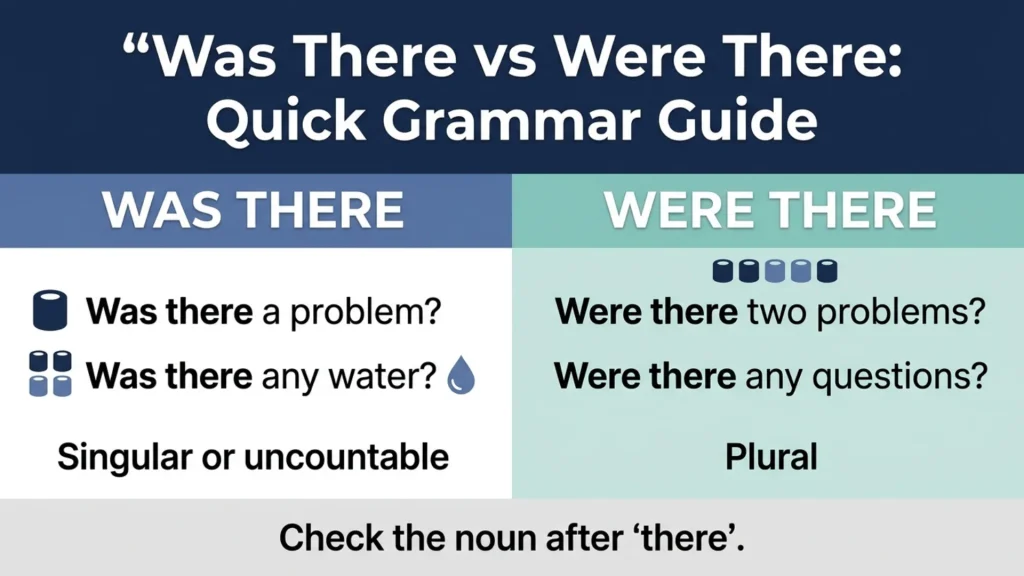
Was there or were there? Both are correct, but the choice depends on the noun that follows. Use was there with a singular noun or an uncountable noun, and use were there with a plural noun.
For example, Was there a problem? is correct because problem is singular. Were there any problems? is correct because problems is plural. The word there does not decide the verb. The noun that comes after the verb does.
Quick Answer: Was There or Were There?
| Use | Correct Form | Example |
|---|---|---|
| One person or thing | Was there | Was there a mistake? |
| Uncountable noun | Was there | Was there any water? |
| More than one | Were there | Were there two mistakes? |
| Plural noun with any | Were there | Were there any questions? |
| Singular past statement | There was | There was a delay. |
| Plural past statement | There were | There were several delays. |
The simplest rule is:
- Singular or uncountable noun → was there
- Plural noun → were there
Was There or Were There: The Main Grammar Rule
Was and were are past-tense forms of the verb be. In a sentence beginning with there, the noun that follows the verb usually controls whether the verb is singular or plural.
Compare these two questions:
- Was there a student outside?
- Were there students outside?
In the first sentence, a student is singular, so was is correct. In the second, students is plural, so were is correct.
The same pattern appears in statements:
- There was a student outside.
- There were students outside.
The British Council’s guide to there is and there are shows the same singular-versus-plural pattern and demonstrates its past-tense forms with there was and there were.
Also check: People Do or People Does?
When to Use “Was There”
Use was there when you are asking about one person, one thing, one event, or an uncountable amount in the past.
With a Singular Countable Noun
- Was there a message for me?
- Was there a problem with the order?
- Was there a meeting yesterday?
- Was there a car outside?
- Was there a reason for the delay?
- Was there a mistake in the report?
- Was there a guest in the room?
- Was there a doctor available?
With an Uncountable Noun
Uncountable nouns normally take singular agreement in this structure.
- Was there any water left?
- Was there enough time?
- Was there any information about the flight?
- Was there much traffic this morning?
- Was there any furniture in the apartment?
- Was there enough food for everyone?
- Was there any evidence?
- Was there any noise outside?
Words such as water, information, traffic, furniture, and evidence are grammatically uncountable, so was there is normally the standard choice.
When to Use “Were There”
Use were there when the noun that follows is plural.
- Were there any messages for me?
- Were there problems with the order?
- Were there meetings yesterday?
- Were there cars outside?
- Were there reasons for the delay?
- Were there mistakes in the report?
- Were there guests in the room?
- Were there doctors available?
With Numbers and Quantities
If the noun refers to more than one item, use were there.
- Were there two people waiting?
- Were there three chairs in the room?
- Were there ten applications?
- Were there several complaints?
- Were there many students absent?
- Were there enough seats?
Was There Any or Were There Any?
The word any does not determine whether you should use was or were. Look at the noun after any.
| Noun Type | Correct Form | Example |
|---|---|---|
| Uncountable | Was there any | Was there any milk? |
| Singular idea | Was there any | Was there any chance of success? |
| Plural | Were there any | Were there any mistakes? |
| Plural | Were there any | Were there any people waiting? |
So both phrases are correct:
- Was there any money left?
- Were there any coins left?
Money is uncountable, while coins is plural.
Was There Two or Were There Two?
In standard written English, were there two is correct because the noun phrase refers to more than one.
- Correct: Were there two people in the car?
- Standard correction: Were there two problems?
- Nonstandard or informal: Was there two people in the car?
You may hear was there two in casual speech in some dialects, but formal and edited English normally uses plural agreement: were there two.
There Was or There Were
The same rule applies when the sentence is a statement instead of a question.
| Singular / Uncountable | Plural |
|---|---|
| There was a problem. | There were problems. |
| There was a student outside. | There were students outside. |
| There was some traffic. | There were several cars. |
| There was enough food. | There were enough meals. |
| There was one option. | There were three options. |
There Was and There Were Examples
- There was a strange sound downstairs.
- There was some rain in the afternoon.
- There was only one seat available.
- There was a long queue outside.
- There were several sounds downstairs.
- There were heavy clouds over the city.
- There were only two seats available.
- There were long queues outside.
Which Is Correct: “There Was Only” or “There Were Only”?
Both can be correct. The noun after only determines the verb.
- There was only one ticket left.
- There were only two tickets left.
- There was only a little time remaining.
- There were only a few minutes remaining.
The presence of only changes the emphasis, not the agreement rule.
“I Was There” or “I Were There”?
For a normal statement about the past, I was there is correct.
- I was there yesterday.
- I was there when the meeting started.
- I was there for the whole event.
I were there is not correct as an ordinary past-tense statement. However, were can appear with I in hypothetical or contrary-to-fact constructions:
- If I were there, I could help.
- I wish I were there with you.
- If I were the manager, I would change the policy.
That is the subjunctive use of were. It is a different grammar pattern from the ordinary past tense.
He Was or He Were?
For ordinary past-tense statements, use he was.
- He was at work yesterday.
- He was tired after the trip.
- He was there when it happened.
Use he were mainly in hypothetical or contrary-to-fact constructions:
- If he were here, he would know what to do.
- I wish he were more careful.
It Was or It Were?
In a normal past-tense sentence, it was is correct.
- It was cold yesterday.
- It was a difficult test.
- It was on the table.
It were is possible in formal hypothetical structures:
- If it were possible, we would leave earlier.
- I wish it were easier.
Was and Were in the Past Tense
Was and were are forms of be in the simple past.
| Subject | Past Form | Example |
|---|---|---|
| I | was | I was ready. |
| He / She / It | was | She was ready. |
| You | were | You were ready. |
| We | were | We were ready. |
| They | were | They were ready. |
With existential there, the sentence works differently because the noun comes after the verb:
- There was a problem.
- There were problems.
This is why learners sometimes hesitate. The noun controlling the agreement appears later than it does in an ordinary sentence.
Negative Forms: There Wasn’t and There Weren’t
The negative forms follow the same singular-versus-plural rule.
- There wasn’t a problem.
- There wasn’t any water.
- There weren’t any problems.
- There weren’t enough chairs.
Questions work the same way:
- Wasn’t there a meeting today?
- Weren’t there two meetings today?
Common Mistakes With Was There and Were There
| Incorrect | Correct | Why |
|---|---|---|
| Were there a problem? | Was there a problem? | Problem is singular |
| Was there two people? | Were there two people? | Two people is plural |
| Were there any water? | Was there any water? | Water is uncountable |
| Was there any mistakes? | Were there any mistakes? | Mistakes is plural |
| There was many reasons. | There were many reasons. | Reasons is plural |
| I were there yesterday. | I was there yesterday. | Ordinary past with I uses was |
How to Teach the Use of Was and Were
A simple teaching method is to separate ordinary subject agreement from there was / there were constructions.
Step 1: Teach the Basic Pronoun Pattern
- I was
- He was
- She was
- It was
- You were
- We were
- They were
Step 2: Move to There Was and There Were
Give learners one singular and one plural model:
- There was a book.
- There were three books.
Step 3: Turn Statements Into Questions
- There was a book. → Was there a book?
- There were three books. → Were there three books?
Step 4: Add Uncountable Nouns
- There was some milk.
- Was there any milk?
Step 5: Add “Any” With Plurals
- There were some questions.
- Were there any questions?
This sequence helps learners see that any is not the deciding factor. Noun number is.
Easy Decision Guide
Use this three-step check whenever you are unsure:
- Find the noun after there.
- Decide whether it is singular, plural, or uncountable.
- Use was for singular/uncountable and were for plural.
Examples:
- ___ there a reason? → reason = singular → Was there a reason?
- ___ there reasons? → reasons = plural → Were there reasons?
- ___ there any information? → information = uncountable → Was there any information?
- ___ there any documents? → documents = plural → Were there any documents?
Practice: Choose Was or Were
- ___ there a message for me?
- ___ there any people outside?
- ___ there enough time?
- ___ there three copies available?
- ___ there any traffic this morning?
- ___ there several errors in the file?
- ___ there a reason for the change?
- ___ there any questions after the presentation?
Answers
- Was
- Were
- Was
- Were
- Was
- Were
- Was
- Were
Alternatives to “There Was” and “There Were”
Sometimes a more direct sentence sounds stronger, especially in formal writing.
| Original | Possible Rewrite |
|---|---|
| There was a problem with the system. | The system had a problem. |
| There were several errors in the report. | The report contained several errors. |
| There was a loud noise outside. | A loud noise came from outside. |
| There were many people at the event. | Many people attended the event. |
There was and there were are not bad English. Rewriting simply helps when you want a more direct or active sentence.
Frequently Asked Questions
Which is correct, there were or there was?
Both are correct. Use there was with a singular or uncountable noun and there were with a plural noun: There was a problem, but There were several problems.
Was there two or were there two?
Were there two is the standard form because two introduces a plural noun phrase. For example: Were there two people waiting?
How do you use “was” and “were” with “there”?
Use was when the following noun is singular or uncountable, and use were when it is plural: Was there a delay? versus Were there delays?
Is “was there” grammatically correct?
Yes. Was there is correct with a singular or uncountable noun, as in Was there a problem? or Was there any milk?
Is it “I was there” or “I were there”?
I was there is correct for an ordinary past statement. I were is used mainly in hypothetical or subjunctive expressions such as If I were there.
What can I say instead of “there was”?
Rewrite the sentence around the real noun or action. For example, There was a problem with the server can become The server had a problem.
What is a better way to say “there were”?
Use a direct subject when it improves clarity. There were many students in the hall can become Many students filled the hall.
When should I use were instead of was?
Use were with you, we, they, and plural nouns in the ordinary past tense. Also use were in standard hypothetical subjunctive constructions such as If I were you.
Which is correct: “there was only” or “there were only”?
Both can be correct. Use there was only before a singular or uncountable noun and there were only before a plural noun: There was only one chair, but There were only two chairs.
Final Rule to Remember
For was there or were there, ignore the word there and look at the noun that follows. Use was there for one thing or an uncountable noun, and use were there for more than one.
If you remember just four examples, make them these:
- Was there a problem?
- Were there problems?
- Was there any water?
- Were there any bottles?