Resignate or Resonate: Meaning, Difference & Correct Usage
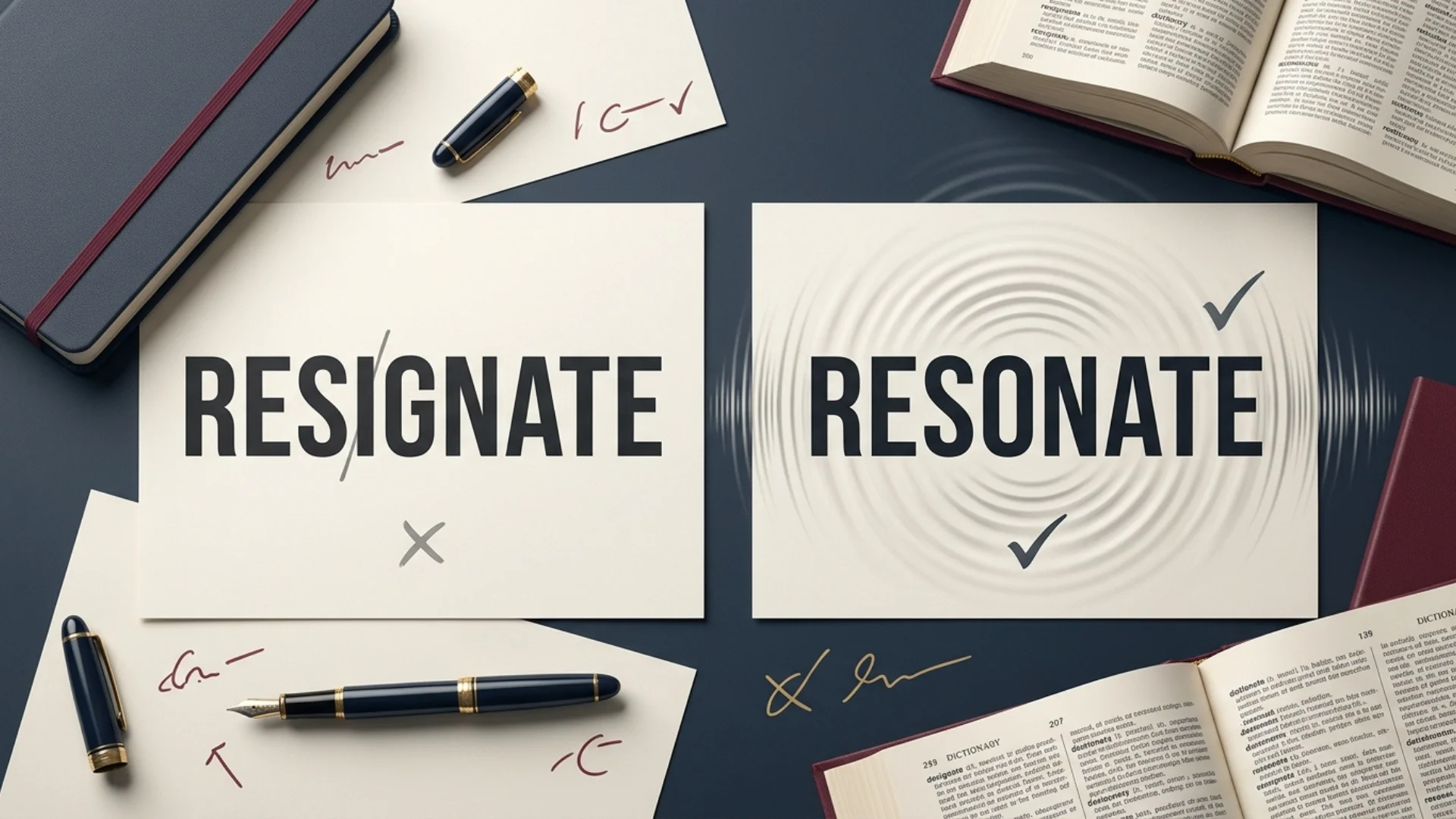
Resignate or resonate? In standard modern English, resonate is the word you normally want.
Resonate means to produce or carry a deep sound, or more commonly in figurative use, to create a strong emotional or intellectual response.
For example:
Her story really resonated with me.
By contrast, resignate is not the standard word for this meaning. When people write resignate, they usually mean resonate.
Quick Answer: Resignate or Resonate?
| Word | Standard English? | Meaning |
|---|---|---|
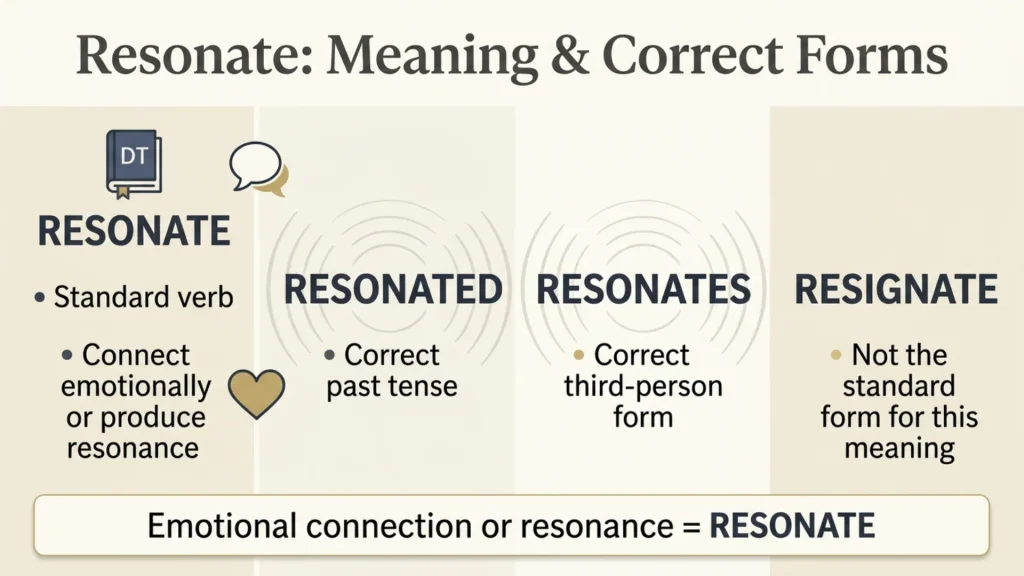
| Resonate | Yes | To echo, vibrate, or create a strong emotional/intellectual response |
| Resignate | Not standard for this meaning | Usually a mistaken form of resonate |
| Resonated | Yes | Past tense of resonate |
| Resonates | Yes | Third-person singular form |
| Resonating | Yes | Present participle |
| Resignated | Nonstandard | Usually intended as resonated |
If you mean that an idea, story, message, feeling, or experience connected strongly with someone, write:
resonate
not:
resignate
What Does Resonate Mean?
Resonate has both a literal and a figurative meaning.
Literal Meaning
It can describe sound that vibrates, echoes, or produces resonance.
Example:
The bell resonated through the hall.
Another example:
Her voice resonated across the auditorium.
Figurative Meaning
It can also describe something that creates a strong emotional, personal, or intellectual response.
Example:
His message resonated with the audience.
This means the message felt meaningful or relevant to them.
Merriam-Webster records both the sound-related meaning and the personal/emotional meaning of resonate. (merriam-webster.com)
What Does Resonate Mean in Feelings?
When resonate is used with feelings, it means that something connects with you deeply.
Example:
That quote really resonated with me.
This does not mean the quote made a physical sound.
It means the quote:
- felt personally meaningful
- matched your experience
- triggered a strong emotional response
- reflected something you already believed or felt
That figurative use is extremely common in everyday English.
Also check: Wish You vs Wishing You
What Does “This Resonates With Me” Mean?
The phrase:
This resonates with me.
means:
This feels meaningful or personally relevant to me.
It can be used when talking about:
- advice
- personal stories
- beliefs
- values
- music
- books
- speeches
- social issues
- experiences
Example:
Her description of changing careers really resonated with me.
The speaker identifies strongly with what was said.
Is Resignate a Word?
For the meaning most people intend, resignate is not the standard modern English word.
If you are trying to say that something emotionally connected with someone, the correct word is:
resonate
Not:
resignate
So:
The message resignated with me. ❌
should be:
The message resonated with me. ✅
Some online sources may contain resignate because of misspelling, informal usage, or confusion with words such as resign, resignation, and designate.
That does not make it the standard choice.
Why Do People Say Resignate?
The confusion is understandable.
English already contains words such as:
- resign
- resignation
- designate
- designation
- assign
- assignation
So resignate looks as though it ought to fit an existing pattern.
It does not.
The standard family for the meaning in question is:
- resonate
- resonates
- resonated
- resonating
- resonance
- resonant
Resignate vs Resonate
The practical difference is simple.
Resonate
Standard verb.
Example:
The speech resonated with young voters.
Resignate
Usually a mistaken or nonstandard substitute for resonate.
Example:
The speech resignated with young voters. ❌
Use:
The speech resonated with young voters. ✅
Resignate Meaning
People searching for a resignate meaning are usually looking for the meaning of resonate.
The intended meaning is normally:
to connect emotionally, create a strong response, or have a meaningful effect
Example:
The movie resignated with me. ❌
Correct:
The movie resonated with me. ✅
Resignated Definition
Resignated is not the standard past tense when you mean “made a strong emotional connection.”
The correct form is:
resonated
Example:
His words resonated with me for years.
Not:
His words resignated with me for years.
Resignates or Resonates?
Use:
resonates
Example:
The message resonates with younger readers.
Not:
The message resignates with younger readers.
The full verb pattern is:
| Tense / Form | Correct Form |
|---|---|
| Base | resonate |
| Third person | resonates |
| Past | resonated |
| -ing form | resonating |
Is It Resonate or Resignate?
Use resonate.
Correct:
That idea resonates with me.
Incorrect in standard English:
That idea resignates with me.
The confusion usually comes from sound or spelling similarity rather than meaning.
Resonate vs Resign
Resonate and resign are completely different verbs.
Resonate
Means to echo, reverberate, or create a strong emotional/intellectual response.
Her message resonated with me.
Resign
Means to formally leave a job, office, or position.
She resigned from the company.
The noun related to resign is:
resignation
The noun related to resonate is:
resonance
Resonance vs Resignation
These words are also unrelated.
Resonance
Can refer to:
- sound vibration
- echo-like quality
- emotional significance
- strong personal connection
Example:
The speech had emotional resonance.
Resignation
Can mean:
- the act of leaving a job or position
- acceptance of something unpleasant
Example:
He submitted his resignation.
This similarity in spelling helps explain why some writers accidentally invent resignate.
Resonant vs Resonate
These are related but belong to different parts of speech.
Resonate
Verb.
The idea resonates with people.
Resonant
Adjective.
The speech had a resonant message.
It can also describe a rich or echoing sound.
Resonance vs Resonate
Resonate
Verb.
The story resonates with readers.
Resonance
Noun.
The story has emotional resonance.
The distinction is similar to:
- perform / performance
- exist / existence
- resonate / resonance
How to Use Resonate Correctly
With “With”
The most common figurative structure is:
resonate with + person/group
Examples:
The message resonated with me.
The campaign resonates with younger audiences.
Her experience resonated with many parents.
With Sound
Use resonate when describing vibration or rich sound.
The guitar resonated throughout the room.
With Ideas
The argument resonated with readers.
With Emotions
Her story resonated deeply with me.
Is It Correct to Say “I Resonate With You”?
It can be understood, but it is not always the most natural phrasing.
More natural options include:
What you said resonates with me.
Your experience resonates with me.
I relate to what you’re saying.
I feel the same way.
I resonate with you is used, especially in informal or spiritual/personal-development language, but standard everyday English often sounds more natural when the idea, message, or experience is the thing that resonates.
“I Hope This Resonates With You” Meaning
The phrase:
I hope this resonates with you.
means:
I hope this feels meaningful, relevant, or emotionally true to you.
It is commonly used in:
- personal writing
- social media
- speeches
- coaching
- marketing
- newsletters
- reflective writing
It does not necessarily mean the listener agrees completely.
It means the speaker hopes the message connects.
Resonate With or Resonate To?
Both constructions can exist, but they are used differently.
Resonate With
Most common for emotional or intellectual connection.
The story resonated with me.
Resonate To
Can occur in more literal resonance contexts.
The material resonates to certain frequencies.
For normal figurative writing, resonate with is the safer choice.
Resonate in Emotional Writing
Examples:
Her honesty resonated with me.
The song resonates with people who have experienced loss.
His story resonated deeply with the audience.
That idea still resonates with me today.
The message resonated because it felt authentic.
Resonate in Professional Writing
Examples:
The campaign message resonated with customers.
The new branding did not resonate with our target audience.
The proposal resonated with senior leadership.
The product positioning resonates with younger consumers.
The company’s values resonate with employees.
Resonate in Marketing
Marketing writers commonly use resonate to describe whether a message or campaign feels relevant to an audience.
Examples:
The headline should resonate with first-time buyers.
The campaign resonated with its intended audience.
The message failed to resonate with customers.
However, the word can become vague if overused.
Instead of:
Our message needs to resonate.
a more precise sentence might be:
Our message needs to address the customer’s main concern.
Use resonate where emotional or conceptual connection is genuinely what you mean.
Resonate in Music and Sound
The original sound-related meaning remains important.
Examples:
The piano notes resonated through the hall.
His voice resonated in the empty room.
The metal chamber caused the sound to resonate.
In these examples, resonate refers to vibration or sound rather than emotional connection.
Resonate Synonyms
The best synonym depends on context.
Emotional or Personal Meaning
Possible alternatives include:
- connect
- relate
- strike a chord
- appeal
- move
- affect
- speak to
- feel meaningful
- hit home
- ring true
Sound Meaning
Possible alternatives include:
- echo
- reverberate
- ring
- resound
- vibrate
Merriam-Webster lists echo and reverberate among related terms for the sound-related sense.
Another Way to Say “Resonate With Me”
Instead of:
That resonates with me.
you could say:
- That really speaks to me.
- I relate to that.
- That feels meaningful to me.
- That really hits home.
- That reflects my experience.
- That rings true for me.
- I connect with that idea.
- That makes sense to me.
- I strongly identify with that.
- That struck a chord with me.
The best alternative depends on tone.
Resonate vs Relate
These words overlap but are not identical.
Relate
Often means you understand something because of your own similar experience.
I can relate to her situation.
Resonate
Suggests something creates a deeper emotional or intellectual response.
Her message resonated with me.
You can relate to a situation without necessarily finding it emotionally powerful.
Resonate vs Reverberate
Both words can describe sound.
Resonate
Often emphasizes vibration, richness, or a continuing effect.
Reverberate
Often emphasizes repeated echoes or consequences spreading outward.
Example:
The bell resonated in the hall.
The explosion reverberated through the valley.
In figurative writing, resonate is much more common for emotional connection.
Resonate vs Echo
Echo
Can mean a sound repeats or an idea repeats another idea.
His comments echoed earlier concerns.
Resonate
Usually suggests impact or connection.
His comments resonated with frustrated employees.
The first focuses on similarity or repetition.
The second focuses on response.
Resonate vs Connect
Connect is broader.
The story connected with readers.
Resonate often sounds stronger or more emotional.
The story resonated with readers.
Both can work.
Correct and Incorrect Examples
| Incorrect | Correct |
|---|---|
| The story resignated with me. | The story resonated with me. |
| Her message resignates deeply. | Her message resonates deeply. |
| The speech resignated with voters. | The speech resonated with voters. |
| That idea will resignate. | That idea will resonate. |
| His words have resignated for years. | His words have resonated for years. |
| The song resonates with me. | The song resonates with me. |
Common Misspellings of Resonate
Writers may produce:
- resignate
- resegnate
- resinate
- resonante
- ressonate
- resonat
- resignates
- resignated
The correct spelling is:
resonate
Past tense:
resonated
Third person:
resonates
Resinate or Resonate?
This is another common confusion.
Use:
resonate
when you mean:
- echo
- reverberate
- connect emotionally
- have personal significance
Resinate is not the standard spelling for that meaning.
Example:
That message really resonated with me.
ReseGnate or Resonate?
If you see spellings such as resegnate, the intended word is almost certainly:
resonate
Correct:
The idea resonates.
Not:
The idea resegnates.
Resignator Meaning
Resignator is not a normal derivative of resonate.
If you mean someone who resigns, English normally uses phrases such as:
- person who resigned
- departing employee
- resigning official
If you mean something that creates resonance, words such as resonator may be relevant depending on context.
A resonator is something that resonates or enhances resonance.
Resignator vs Resonator
These two should not be confused.
Resonator
A recognized word related to resonance.
It can describe a physical object or system designed to resonate.
Resignator
Not the standard equivalent of resonator.
If your intended meaning involves sound vibration, the relevant word is usually:
resonator
Reasonation vs Resonance
Another nearby spelling people search for is reasonation.
If you mean the effect of resonating, the noun is:
resonance
Example:
The music created a powerful resonance.
If you mean reasoning, use words such as:
- reasoning
- rationale
- argument
- thought process
Do not substitute reasonation for resonance.
Why Does Resonate Mean Emotional Connection?
The figurative meaning developed naturally from the physical idea of resonance.
A sound can resonate physically by vibrating or continuing to ring.
An idea can metaphorically “resonate” when it continues to affect someone’s thoughts or emotions.
That is why sentences such as:
Her words resonated with me.
feel natural even though no actual sound vibration is involved.
Does Resonate Mean Agree?
Not exactly.
If something resonates with you, you may agree with it, but the word emphasizes connection or impact, not simple agreement.
Example:
His story resonated with me, even though I disagreed with his conclusion.
That sentence is perfectly possible.
You can connect with someone’s experience without agreeing with everything they say.
Does Resonate Mean Relatable?
Sometimes, but not exactly.
Relatable means easy to identify with.
Resonate suggests that something has a strong effect or connection.
Compare:
The character is relatable.
The character’s story resonated with viewers.
The first describes the character.
The second describes the audience’s response.
Can a Person Resonate?
Yes, but context matters.
Natural:
Her ideas resonate with me.
Also possible:
She resonates with younger audiences.
This means her personality, message, work, or public image connects strongly with those audiences.
However, saying:
I resonate you.
is not standard English.
Use:
I relate to you.
or:
What you said resonates with me.
Can an Idea Resonate?
Yes.
This is one of the most common figurative uses.
Examples:
The idea resonated with employees.
Her argument resonates with many readers.
The proposal did not resonate with voters.
Can Music Resonate?
Yes, in both senses.
Literal:
The note resonated through the room.
Figurative:
The song resonated with listeners.
English, because apparently one meaning per word would have made life too peaceful.
Frequently Asked Questions
What does resonate mean?
Resonate means to produce or carry resonance, or figuratively, to create a strong emotional or intellectual connection.
What does resonate mean in feelings?
It means something affects you deeply, feels personally relevant, or reflects your emotions or experience.
What does the word resignate mean?
In normal modern English, people using resignate usually mean resonate. For emotional impact or connection, use resonate.
Which is correct: “resinate” or “resonate”?
Use resonate when you mean to echo, vibrate, or create emotional impact.
Is it resonate or resignate?
The standard word is resonate.
Is it correct to say “I resonate with you”?
It is understandable and occurs in informal usage, but “what you said resonates with me” or “I relate to you” is often more natural in standard English.
How do you use resonate correctly?
A common pattern is:
something + resonates with + someone
Example:
Her message resonates with me.
What is another way to say resonate?
Depending on context: connect, strike a chord, appeal, echo, reverberate, hit home, ring true, or speak to.
What does “I hope this resonates with you” mean?
It means:
I hope this message feels meaningful, relevant, or emotionally true to you.
Is “resignated” correct?
Not when you mean the past tense of resonate. Use:
resonated
Is “resignates” correct?
Not for the meaning of emotional connection or resonance. Use:
resonates
What is the noun form of resonate?
The main noun is:
resonance
Example:
The story has emotional resonance.
Final Answer: Resignate or Resonate?
For standard modern English, use:
resonate
Use it when something:
- echoes or vibrates
- has emotional impact
- feels personally meaningful
- connects strongly with an audience
- “strikes a chord”
Examples:
Her words resonated with me.
The campaign resonates with younger customers.
The sound resonated through the room.
When you see resignate, resignated, or resignates being used for those meanings, the intended standard forms are almost always:
- resonate
- resonated
- resonates
So the easiest rule is:
Connection, echo, or emotional impact = resonate.