What Happen or What Happened? Meaning, Grammar & Correct Usage
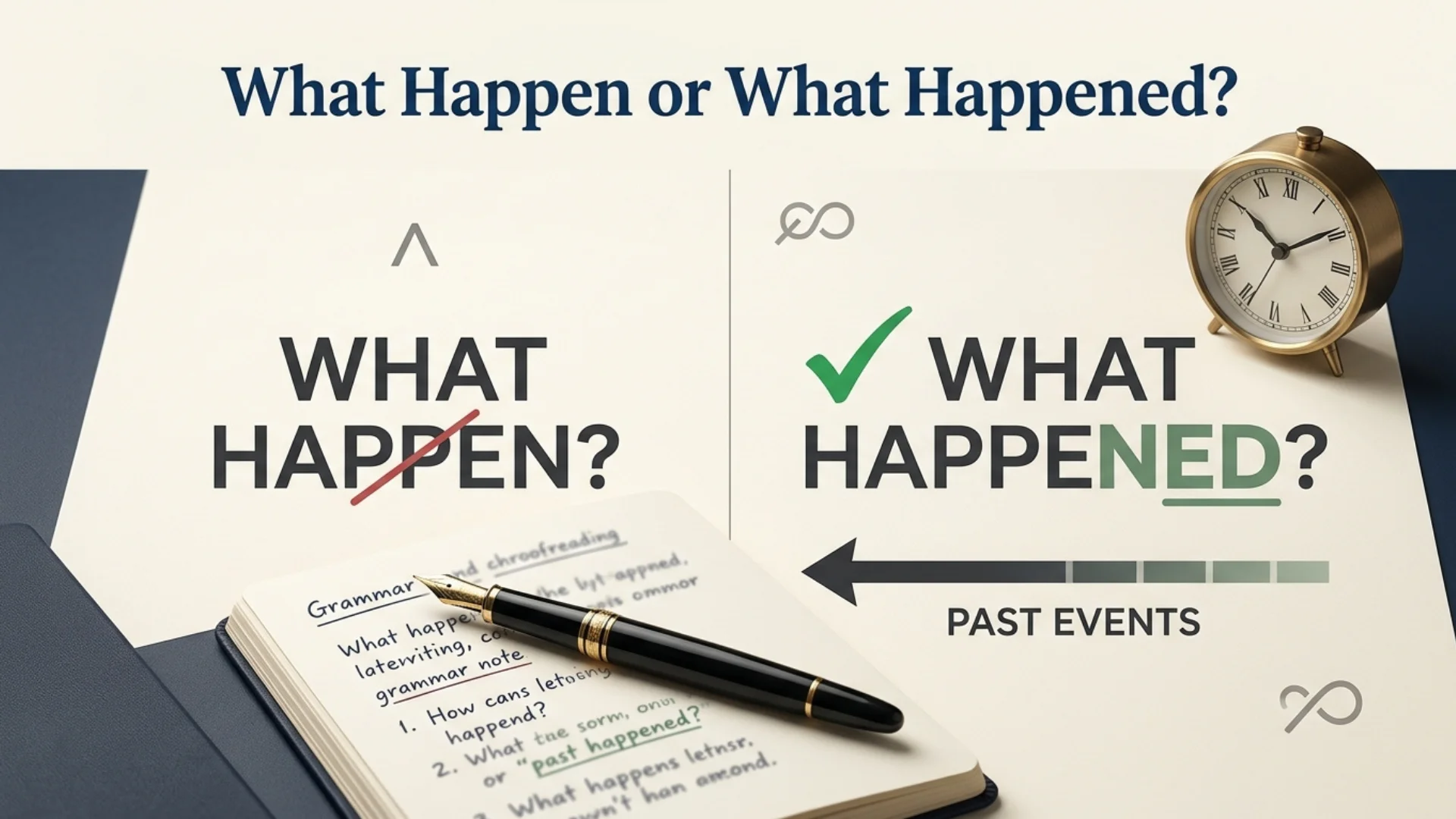
If you are choosing between “what happen” or “what happened,” the normal correct question about a past event is:
What happened?
What happen? is generally incorrect as a complete question in standard English.
The confusion becomes easier once you separate the verb forms:
- happen = base form
- happens = present tense with a third-person singular subject
- happened = simple past and past participle
- happening = present participle
So:
What happened yesterday? ✅
What happen yesterday? ❌
What happens every Friday? ✅
What will happen tomorrow? ✅
What is happening now? ✅
The base form happen is perfectly correct in many sentences. It simply cannot replace happened when you are directly asking about a completed past event.
Quick Answer: What Happen or What Happened?
| Phrase | Correct? | When to Use It |
|---|---|---|
| What happened? | Yes | Asking about a past event |
| What happen? | Usually no | Incorrect as a standalone standard question |
| What happens? | Yes | General, repeated, or usual situations |
| What is happening? | Yes | Something occurring now |
| What will happen? | Yes | Asking about the future |
| What did happen? | Yes | Emphatic past question |
| What has happened? | Yes | Past event connected to the present |
| What had happened? | Yes | Event completed before another past event |
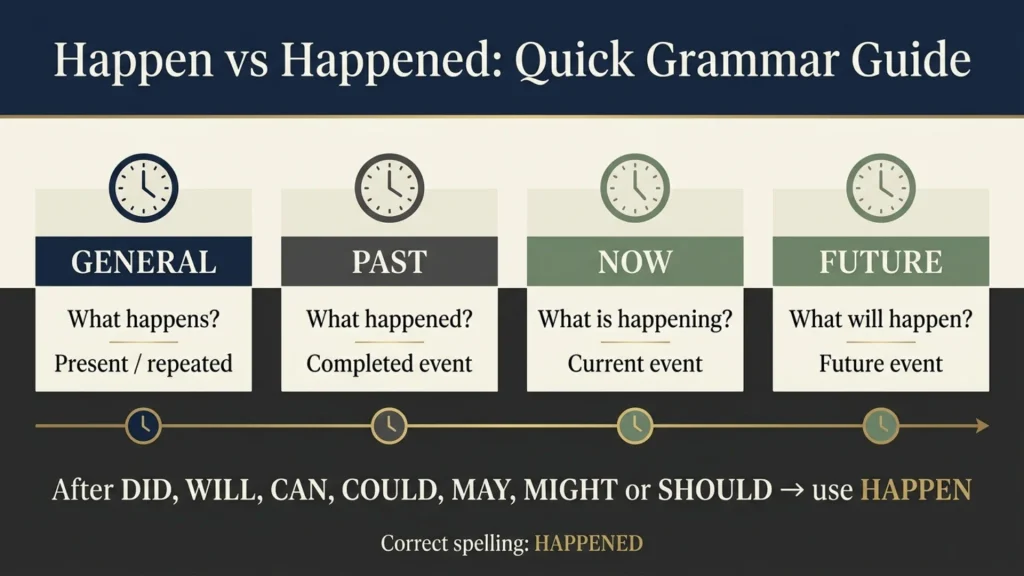
The quickest rule is:
Past event = What happened?
General situation = What happens?
Right now = What is happening?
Future = What will happen?
What Does Happen Mean?
Happen is a verb meaning to occur, take place, or come into existence as an event or situation.
Examples:
- Accidents happen.
- Mistakes happen.
- What will happen next?
- It could happen again.
- When does that happen?
- Something strange may happen tonight.
Cambridge Dictionary lists happened as the past simple and past participle of happen. Cambridge Dictionary: happen and happened
What Does Happened Mean?
Happened is the past-tense form of happen.
Use it for an event that has already taken place.
Examples:
- Something happened yesterday.
- The accident happened at noon.
- What happened at the meeting?
- I don’t know what happened.
- That happened years ago.
- Nothing happened after I left.
So if someone asks about something that already occurred, what happened? is the natural form.
Why Is “What Happened?” Correct?
In What happened?, the event itself is what the speaker is asking about.
Compare:
Something happened.
Replace something with what:
What happened?
You do not normally need did because happened already carries the past tense.
That is why this is correct:
What happened last night?
And this is not:
What happen last night?
Why Is “What Happen?” Usually Wrong?
The problem with what happen? is not the word happen itself.
The problem is that the sentence lacks the verb form needed for the intended tense.
For a present-tense general question, English normally requires:
What happens?
For a past event:
What happened?
For the future:
What will happen?
For an emphatic past question:
What did happen?
Notice that the base form happen becomes correct once another verb carries the tense:
What will happen?
What might happen?
What can happen?
What did happen?
So a rule such as “never say what happen” is too simplistic. The base form is correct after certain auxiliary and modal verbs.
Happen vs Happened
The basic difference is tense.
Happen
Use happen as the base or present form.
Examples:
- Strange things happen.
- Accidents happen.
- It may happen.
- It could happen.
- What will happen?
Happened
Use happened for the past.
Examples:
- Something happened.
- It happened yesterday.
- What happened?
- Nobody knows what happened.
| Time | Correct Form | Example |
|---|---|---|
| General/present | happen/happens | These things happen. |
| Past | happened | Something happened. |
| Present continuous | happening | Something is happening. |
| Present perfect | has/have happened | Something has happened. |
| Past perfect | had happened | Something had happened. |
| Future | will happen | Something will happen. |
If verb forms are the part that keeps causing trouble, the same principle of matching grammatical form to context appears in People Do or People Does?.
Happen or Happened: Which Should You Use?
Look at the time of the event.
Use Happen for General or Possible Events
- Mistakes happen.
- These things happen.
- What could happen?
- What might happen?
- When does that happen?
- I hope it doesn’t happen again.
Use Happened for Past Events
- The meeting happened yesterday.
- Something happened to my laptop.
- What happened after you left?
- Nobody explained what happened.
The choice is mostly about tense, not style.
What Happens vs What Happened
Both are correct, but they refer to different time relationships.
What Happens?
What happens? normally asks about:
- regular events
- repeated situations
- general results
- typical consequences
Examples:
What happens when you press this button?
What happens if the payment fails?
What happens every Monday?
What Happened?
What happened? asks about a completed past event.
Examples:
What happened when you pressed the button?
What happened after the payment failed?
What happened on Monday?
Compare:
What happens when the alarm sounds?
General procedure.
What happened when the alarm sounded?
Specific past event.
What Is Happening vs What Happened
These phrases distinguish the present from the past.
What Is Happening?
Use what is happening? for something occurring now.
Example:
Why is everyone running? What is happening?
What Happened?
Use what happened? after the event occurred.
Example:
Everyone suddenly ran outside. What happened?
This is similar to other English expressions where a small grammatical change alters the time or status being described. The distinction is explored from another angle in “In Process” vs “In Progress”.
What’s Happened vs What Happened
Both are correct, but what’s happened? normally means:
What has happened?
The apostrophe in what’s represents what has in this context.
What Happened?
Simple past:
What happened last night?
The speaker is asking about a past event.
What’s Happened?
Present perfect:
What’s happened to the lights?
The speaker notices a present result and wants to know what caused it.
Compare:
What happened to your car yesterday?
versus:
What’s happened to your car? It looks damaged.
The first focuses on a past event. The second often connects the past event to the situation visible now.
What Has Happened vs What Happened
This is one of the most useful distinctions to understand.
What Happened?
Use the simple past when the event belongs to a finished past context.
What happened yesterday?
What happened at the party?
What Has Happened?
Use the present perfect when the event matters to the present situation or when the time period is not presented as finished.
What has happened to my files?
What has happened since I left?
You normally would not say:
What has happened yesterday? ❌
With a clearly finished time such as yesterday, simple past is usually required:
What happened yesterday? ✅
What Had Happened
What had happened? uses the past perfect.
It refers to something that happened before another past event or point in time.
Example:
When I arrived, everyone looked upset. I asked what had happened.
Timeline:
- Something happened.
- Everyone became upset.
- I arrived.
- I asked about the earlier event.
The past perfect helps show which past event came first.
What Did Happen?
What did happen? is grammatical.
But it normally adds emphasis.
Neutral:
What happened?
Emphatic:
What did happen?
Example:
You keep telling me what didn’t happen, but what did happen?
The important grammar rule is:
After did, use the base form.
Correct:
What did happen?
Incorrect:
What did happened?
The past tense is already carried by did.
What Just Happened or What Did Just Happen?
The normal form is:
What just happened?
Example:
The screen suddenly went black. What just happened?
What did just happen? can also be grammatical when the speaker deliberately adds emphasis, but it is far less neutral.
Example:
Wait. What did just happen in that final scene?
In most ordinary situations, choose:
What just happened?
How Did That Happen or How Did That Happened?
Correct:
How did that happen?
Incorrect:
How did that happened?
Again, did carries the past tense, so the main verb returns to the base form:
did + happen
not:
did + happened
The same pattern appears in:
Why did it happen?
When did it happen?
Where did it happen?
How did this happen?
When Did This Happen?
When did this happen? is correct.
Do not write:
When did this happened? ❌
or:
When was this happened? ❌
Correct examples:
- When did this happen?
- When did the accident happen?
- When did that happen?
- Do you know when this happened?
“When Was This Happened?” Is Usually Incorrect
The verb happen is normally intransitive, meaning it does not take a direct object and is not ordinarily used in the passive voice.
So:
When was this happened? ❌
should normally be:
When did this happen? ✅
Similarly:
The accident was happened yesterday. ❌
Use:
The accident happened yesterday. ✅
“This Is Happened” vs “This Happened”
Use:
This happened.
Not:
This is happened.
If something is occurring now, use:
This is happening.
Compare:
This happened yesterday.
This is happening right now.
This has happened before.
Each sentence has a different tense and meaning.
What Is Happened?
As a normal direct question, what is happened? is incorrect.
Use one of these depending on the meaning:
What happened?
Past.
What is happening?
Now.
What has happened?
Past event with present relevance.
English has enough verb forms already. Combining the wrong ones does not unlock a secret bonus tense.
What Have Happened?
As a standalone question meaning “what event has occurred?”, the standard form is usually:
What has happened?
Not:
What have happened?
However, have happened is correct with a plural subject:
Several accidents have happened here.
What changes have happened since last year?
The helping verb agrees with the actual subject.
Past Tense of Happen
The past tense of happen is:
happened
The verb is regular:
happen → happened
Examples:
Present: Accidents happen.
Past: An accident happened.
Perfect: An accident has happened.
How Do You Spell Happened?
The correct spelling is:
H-A-P-P-E-N-E-D
The most common spelling errors include:
- happend ❌
- hapened ❌
- happenned ❌
- happaned ❌
- happned ❌
- happended ❌
- happened ✅
A useful way to remember it is:
happen + ed = happened
The base word happen already contains the double p.
For another common spelling trap, see Hassle vs Hastle.
Happened or Happend?
Correct:
happened
Incorrect:
happend
The final e from happen is still present before the d in the past-tense spelling.
Think:
happen + ed
not:
happen + d
Hapened or Happened?
Correct:
happened
The word keeps the double p from happen.
So:
hapened ❌
happened ✅
Happenned or Happened?
Only one n appears before -ed:
happened ✅
not:
happenned ❌
The spelling pattern is:
h a p p e n e d
Is Happened a Verb?
Yes.
Happened is the simple past and past participle form of the verb happen.
Examples:
It happened suddenly.
Something has happened.
Nothing had happened before that.
Is Happened a Word?
Yes.
Happened is a standard English word.
It is the past form of happen.
There is no need to replace it with occurred merely to sound more formal unless the context actually benefits from that word.
Happened Meaning
Happened generally means:
- occurred
- took place
- came about
- became a reality
- was experienced as an event
Example:
Something unexpected happened.
Meaning:
Something unexpected occurred.
Something Happened Meaning
Something happened means an event occurred, although the speaker may not yet explain what the event was.
Example:
Something happened at work today.
The phrase suggests that an event occurred and that further explanation may follow.
It can be neutral, positive, negative, or mysterious depending on context.
What Happened to Someone or Something?
The structure:
What happened to + person/thing?
asks what event affected that person or object.
Examples:
- What happened to Sarah?
- What happened to your phone?
- What happened to the building?
- What happened to my order?
- What happened to the lights?
It often implies that the speaker expected a different situation or has noticed that something changed.
What Happened at, to, and with
The preposition changes the focus.
What Happened At…?
Asks about an event at a place or occasion.
What happened at the meeting?
What Happened To…?
Asks what affected a person or thing.
What happened to your laptop?
What Happened With…?
Can ask about the result or status of a situation.
What happened with the job interview?
In many contexts, what happened with is conversational, while a more specific question can be clearer:
How did the interview go?
What Happened Here?
What happened here? asks about a past event whose result is visible or relevant at the current location.
Example:
There is broken glass everywhere. What happened here?
Even though the evidence is visible now, the event itself occurred in the past, so happened is correct.
What Usually Happens?
Use happens for a usual or repeated event.
Correct:
What usually happens after the interview?
Incorrect:
What usually happen after the interview?
The subject what takes the third-person singular present form happens in this construction.
Compare:
What usually happens?
General pattern.
What happened?
Specific past event.
When Does That Happen?
When does that happen? asks when something normally or generally occurs.
Because does already marks the present tense, the main verb is the base form:
does + happen
Correct:
When does that happen?
Incorrect:
When does that happens?
This is the same auxiliary-verb principle that gives us:
did + happen
rather than:
did + happened
What Will Happen?
What will happen? is the natural future question.
Because modal verbs such as will take the base form:
will + happen
Examples:
- What will happen tomorrow?
- What will happen if we lose?
- What will happen next?
- Nobody knows what will happen.
This is one situation where the words what + happen can appear in the same question, but will must come between them.
What Could Happen?
The same rule works after other modal verbs:
- What could happen?
- What might happen?
- What may happen?
- What should happen?
- What can happen?
The modal verb provides the grammatical structure, and happen remains in its base form.
Happen in a Sentence
Here are natural examples using happen:
- Mistakes happen.
- Accidents can happen anywhere.
- What will happen next?
- I hope this doesn’t happen again.
- Strange things sometimes happen.
- When does that usually happen?
- Anything could happen.
- What should happen after approval?
- It may happen sooner than expected.
- Don’t let it happen again.
Happened in a Sentence
Examples using happened:
- Something happened yesterday.
- The accident happened at night.
- What happened to your phone?
- Nothing happened after we left.
- It happened very quickly.
- Nobody knew what happened.
- The same thing happened last year.
- What happened during the meeting?
- Everything happened exactly as planned.
- I still don’t understand how it happened.
What Happened in Questions
Here are common everyday uses:
What happened yesterday?
What happened at school?
What happened after I left?
What happened to him?
What happened to your car?
What happened between you two?
Can you explain what happened?
Do you remember what happened?
The expression works naturally in both conversation and formal writing.
Explain What Happened
Explain what happened means to describe the events that occurred.
Example:
Please explain what happened during the incident.
Notice that this is no longer a direct question.
Direct question:
What happened?
Embedded clause:
Please explain what happened.
The word order remains what happened, not what did happen, unless emphasis is specifically intended.
Describe What Happened
Describe what happened asks someone to provide details about an event.
Example:
Describe what happened before the alarm sounded.
The focus is often on:
- sequence
- actions
- people involved
- time
- location
- result
Another Word for “What Happened?”
Depending on context, you can ask:
- What occurred?
- What took place?
- What went on?
- What happened here?
- What caused this?
- What went wrong?
- What changed?
- How did this happen?
- What was the problem?
- What took place next?
These are not perfect synonyms in every sentence.
For example, what went wrong? assumes a problem, while what happened? is neutral.
“What Occurred?” vs “What Happened?”
Both can ask about a past event.
What happened? is much more common and conversational.
What occurred? sounds more formal.
Compare:
What happened after the meeting?
Can you describe what occurred during the incident?
The second version fits formal reports, investigations, or technical writing more naturally.
What Happened in Formal Writing
There is nothing grammatically informal about what happened.
It can appear naturally in:
- reports
- interviews
- investigations
- academic discussions
- workplace communication
- journalism
- everyday speech
More formal alternatives may include:
what occurred
what took place
but they are stylistic choices, not corrections.
Common Mistakes With Happen and Happened
| Incorrect | Correct | Reason |
|---|---|---|
| What happen yesterday? | What happened yesterday? | Past tense needed |
| What did happened? | What did happen? | Use base verb after did |
| How did this happened? | How did this happen? | Did carries past tense |
| When was this happened? | When did this happen? | Happen is not normally passive |
| This is happened. | This happened. | Incorrect auxiliary |
| What is happened? | What happened? / What is happening? | Choose correct tense |
| What usually happen? | What usually happens? | Present agreement |
| When does it happens? | When does it happen? | Base verb after does |
| What will happened? | What will happen? | Base verb after will |
| It happend. | It happened. | Incorrect spelling |
| It hapened. | It happened. | Missing second p |
| It happenned. | It happened. | Extra n |
Easy Rule to Remember
Use this four-part shortcut:
Yesterday → What happened?
Usually → What happens?
Right now → What is happening?
Tomorrow → What will happen?
That one pattern solves most of the confusion around happen vs happened.
Frequently Asked Questions
Which Is Correct, Happen or Happened?
Both are correct words.
Use happen as the base form or for appropriate present/future constructions:
It may happen.
Use happened for the past:
It happened yesterday.
If the question is what happen or what happened?, use what happened? for a past event.
What’s Happened or What Happens?
Both are correct, but they mean different things.
What’s happened? usually means what has happened? and asks about something that has already occurred but is relevant now.
What happens? asks about a general, repeated, or usual situation.
What Happens and What Happened?
What happens? is present tense and usually describes general or repeated situations.
What happened? is past tense and asks about a completed event.
Example:
What happens when the machine overheats?
versus:
What happened when the machine overheated yesterday?
Is “What Happen” or “What Happened” the Correct Grammar?
For a standalone question about a past event, What happened? is correct.
What happen? is not standard grammar in that context.
However, happen is correct after auxiliaries and modal verbs:
What did happen?
What will happen?
What might happen?
What Just Happened or What Did Just Happen?
What just happened? is the normal neutral form.
What did just happen? can be grammatical when used emphatically, especially to express surprise or disbelief, but it is less common.
What Does “What Happened” Mean?
What happened? asks which event occurred or asks someone to explain a past situation.
For example:
I heard a loud crash. What happened?
The speaker wants to know what event caused the situation.
Is “How Did That Happened?” Correct?
No.
Use:
How did that happen?
After did, use the base form happen.
What Is the Past Tense of Happen?
The past tense of happen is happened.
How Do You Spell Happened?
The correct spelling is:
happened
It contains two p’s, one n, and ends in -ed.
Final Answer
For What Happen or What Happened, the normal correct question about a past event is:
What happened?
Use what happens? for something general or repeated.
Use what is happening? for something taking place now.
Use what will happen? for the future.
Use what has happened? when a past event has a present connection.
And use what did happen? only when you deliberately want emphasis.
The underlying rule is straightforward:
happen = base form
happens = present
happened = past
happening = ongoing
Once you know which word is carrying the tense, the entire happened happen what happens what happened search-result jungle becomes considerably less mysterious.