Complete vs. Completed: Meaning, Difference & Correct Usage
Complete vs. completed can be confusing because both words describe something reaching an end, but they do not always play the same grammatical role.
The simplest difference is this:
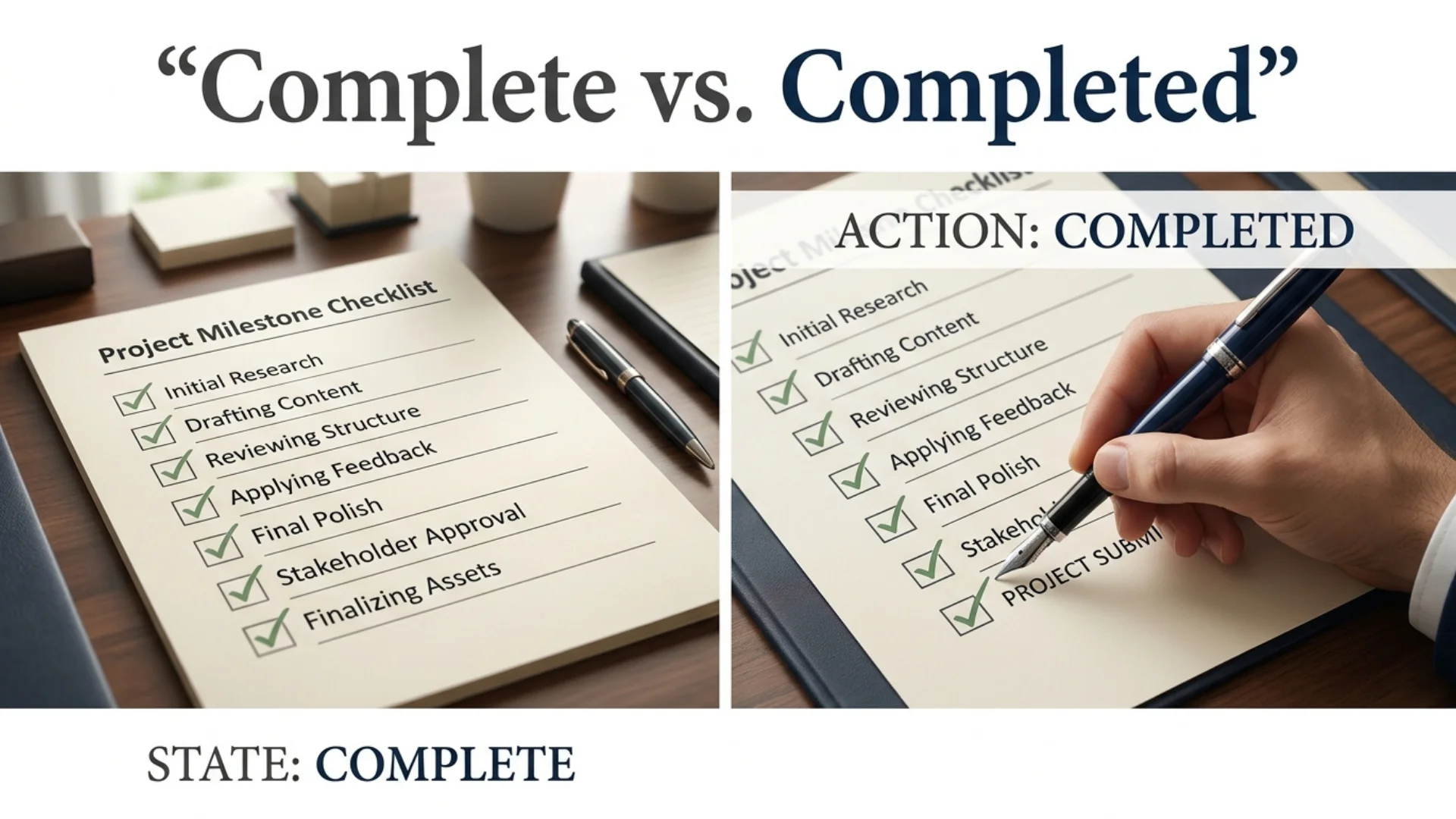
- Complete often describes a state: “The work is complete.”
- Completed often describes a finished action: “I completed the work.”
- Complete can also be a verb: “Please complete the form.”
- Completed is the past tense and past participle of the verb complete.
So both words are correct. The right choice depends on whether you are describing what something is like now or what action happened.

Quick Answer: Complete vs. Completed
| Word | Main Use | Meaning | Example |
|---|---|---|---|
| Complete | Adjective | Finished, whole, containing everything required | The report is complete. |
| Complete | Verb | To finish something | Please complete the report. |
| Completed | Past-tense verb | Finished something in the past | She completed the report. |
| Completed | Past participle | Used with has, have, had, was, were, been | The report has been completed. |
| Completed | Adjective/modifier | Something that has already been finished | Submit the completed report. |
The most useful rule is:
Complete = state or action to finish.
Completed = an action that has already been finished.
What Does Complete Mean?
Complete can function as both an adjective and a verb.
That is one reason people hesitate when choosing between complete or completed.
Complete as an Adjective
As an adjective, complete means finished, whole, or containing everything necessary.
Examples:
- The project is complete.
- Your application is complete.
- The list is complete.
- The installation is almost complete.
- My work here is complete.
- The collection is now complete.
In these sentences, complete describes the condition or state of something.
You are not focusing on the action of finishing it.
You are simply saying that it is finished or whole.
Complete as a Verb
As a verb, complete means to finish something or bring it to an end.
Examples:
- Please complete the application.
- I need to complete this assignment.
- We will complete the project tomorrow.
- You must complete all required fields.
- She wants to complete the course this year.
Here, complete describes an action.
It answers the question:
What needs to be done?
Also check: Its Self or Itself
What Does Completed Mean?
Completed is the simple past and past participle form of the verb complete.
It tells us that the action of finishing something has already happened.
Examples:
- I completed the assignment yesterday.
- She completed the form.
- We completed the project on Friday.
- They have completed the training.
- The building was completed in 2024.
The word completed often focuses more strongly on the action or process that reached its end.
Complete vs. Completed: The Main Difference
The clearest distinction is state vs. action.
Complete Often Describes a State
Consider:
The project is complete.
Here, complete is an adjective.
The sentence tells us about the project’s current condition.
The project is finished.
Completed Often Describes an Action
Now consider:
The team completed the project.
Here, completed is a past-tense verb.
The sentence tells us what the team did.
Compare:
| Sentence | Focus |
|---|---|
| The project is complete. | Current state |
| The team completed the project. | Past action |
| The project was completed yesterday. | Action/process |
| The project has been completed. | Finished action with present relevance |
This state-versus-action distinction solves most complete versus completed problems.
“It Is Complete” vs. “It Is Completed”
Both structures can be grammatical, but they usually emphasize different things.
It Is Complete
It is complete describes the current condition.
Example:
The report is complete.
Meaning:
The report is finished and contains everything needed.
This is often the most natural choice for a simple status update.
It Is Completed
It is completed can describe something as having been finished, but in many everyday contexts it sounds less natural than it is complete.
For example:
The report is completed.
This may sound like passive verbal wording, especially if the action or process is important.
English speakers may instead prefer:
- The report is complete.
- The report has been completed.
- The report was completed.
Which version works best depends on the time and intended emphasis.
Is Complete or Is Completed: Which Is Correct?
Both can be correct.
Use is complete when describing a state:
- The task is complete.
- The report is complete.
- The repair is complete.
- The setup is complete.
Use a completed construction when emphasizing the action:
- The task has been completed.
- The report was completed yesterday.
- The repair was completed by the technician.
For ordinary status updates, is complete is often simpler and more natural.
“This Is Complete” vs. “This Is Completed”
This is complete is usually the more natural way to say that something is now finished.
Example:
This is complete and ready for review.
This is completed may be possible in specialized contexts, but it often sounds awkward when there is no reason to emphasize the finishing action.
More natural alternatives include:
- This is complete.
- This has been completed.
- This was completed yesterday.
“It’s Complete” vs. “It’s Completed”
The same distinction applies.
It’s Complete
Means:
It is finished.
Example:
The installation is finished now.
It’s complete.
It’s Completed
Can mean:
It is being regarded as a completed item/process.
But in ordinary conversation, speakers often prefer:
It has been completed.
rather than:
It is completed.
Complete or Completed in a Status Update
In business, project management, software, construction, and workplace communication, both forms are common.
Use Complete for Status
- Testing is complete.
- The migration is complete.
- The report is complete.
- Phase one is complete.
- The audit is complete.
These sentences answer:
What is its current status?
Use Completed for Activity
- We completed testing.
- The team completed the migration.
- I completed the report.
- Phase one was completed yesterday.
- The audit has been completed.
These answer:
What happened?
“Work Is Complete” vs. “Work Was Completed”
Both are correct, but the emphasis differs.
Work Is Complete
Focuses on the current state.
Example:
The electrical work is complete.
This simply means the work is finished.
Work Was Completed
Focuses on the event.
Example:
The electrical work was completed on Monday.
This tells us when the work reached completion.
“Work Complete” vs. “Work Completed”
You may see both forms in short labels, dashboards, reports, or project-tracking systems.
Examples:
- Work complete
- Work completed
- Installation complete
- Installation completed
- Task complete
- Task completed
In full sentences, it is usually clearer to write:
The work is complete.
or:
The work has been completed.
Short interface labels can omit helper verbs because they are not full sentences.
“Already Complete” vs. “Already Completed”
Both expressions work, but grammar changes around them.
Already Complete
Here complete is an adjective.
Example:
The form is already complete.
Meaning:
The form is already in a finished state.
Already Completed
Here completed describes a finished action.
Example:
I already completed the form.
or:
The form has already been completed.
“Been Completed” Meaning
Been completed appears in perfect passive constructions.
Examples:
- The task has been completed.
- All repairs have been completed.
- The application had been completed before the deadline.
- The work will have been completed by Friday.
The structure emphasizes the completed action rather than who performed it.
“Has Completed” vs. “Has Been Completed”
These two constructions are different.
Has Completed
The subject performed the action.
Example:
Sarah has completed the training.
Sarah did the completing.
Has Been Completed
The subject received the action.
Example:
The training has been completed.
The sentence focuses on the training, not the person who finished it.
Complete in the Past Tense
The past tense of complete is completed.
Present:
I complete the report every Friday.
Past:
I completed the report yesterday.
Future:
I will complete the report tomorrow.
Present perfect:
I have completed the report.
Past perfect:
I had completed the report before the meeting.
Past Form of Complete
The verb forms are:
| Form | Word |
|---|---|
| Base form | complete |
| Third-person singular | completes |
| Present participle | completing |
| Simple past | completed |
| Past participle | completed |
Examples:
- I complete the task.
- She completes the task.
- I am completing the task.
- I completed the task.
- I have completed the task.
Is Complete a Verb?
Yes.
Complete can be both an adjective and a verb.
Adjective
The assignment is complete.
Verb
Please complete the assignment.
The grammatical role depends on how the word is used in the sentence.
Is Completing a Verb?
Yes.
Completing is the present participle and gerund form of complete.
Examples:
She is completing the assignment.
Here, completing is part of the present progressive verb phrase.
Completing the assignment took two hours.
Here, completing functions as a gerund.
“I Completed” vs. “I Have Completed”
Both are correct, but tense differs.
I Completed
Simple past.
Example:
I completed the training yesterday.
A specific finished time is mentioned.
I Have Completed
Present perfect.
Example:
I have completed the training.
The action happened before now, and the result matters now.
“I Completed It” Is Correct
Yes.
I completed it is a normal and grammatically correct sentence.
Example:
Did you finish the assignment?
Yes, I completed it yesterday.
You could also simply say:
Yes, I did.
“I Am Completed” Is Usually Wrong
When talking about yourself finishing a task, do not normally say:
I am completed.
That sounds as though someone has finished creating or assembling you, which is an unexpectedly dramatic update for an office email.
Instead, say:
- I am finished.
- I have finished.
- I have completed it.
- I am done.
- My work is complete.
“Once Completed” Meaning
Once completed means after something has been finished.
Example:
Once completed, the form should be submitted to HR.
The implied meaning is:
Once the form has been completed…
This construction is common in instructions and professional writing.
Complete vs. Completed Before a Noun
Both words can appear before nouns, but they do not necessarily mean the same thing.
A Complete Report
A complete report contains everything required.
Example:
Please send me a complete report.
The emphasis is completeness or wholeness.
A Completed Report
A completed report is a report that someone has finished preparing.
Example:
Please send the completed report by Friday.
The emphasis is that the action of completing it has finished.
The distinction becomes even clearer with lists.
Complete List
A complete list contains every required item.
Completed List
A completed list is one that someone has finished compiling or filling out.
A completed list could theoretically still be incomplete if the person forgot something.
English has apparently decided one word was not enough trouble.
Complete vs. Completed Form
Consider these sentences:
Please complete the form.
Complete is a verb telling someone what action to perform.
Please submit the completed form.
Completed describes a form that has already been filled out.
The form is complete.
Complete describes the form’s current state.
The form has been completed.
Completed appears in a passive construction emphasizing the finished action.
All four sentences are correct.
Complete vs. Finished
Complete and finished overlap, but they are not perfect substitutes in every context.
Complete
Can emphasize wholeness or having all required parts.
Example:
The collection is complete.
This means nothing required is missing.
Finished
Usually emphasizes that an activity has ended.
Example:
I am finished with the report.
This means you have stopped working on it because the task is done.
Completed vs. Finished
Both can describe an action reaching an end.
Examples:
- I completed the assignment.
- I finished the assignment.
Both are correct.
Completed can sound slightly more formal or process-oriented.
Finished is extremely common in everyday speech.
Compare:
The construction project was completed in June.
I finished my lunch.
Technically both verbs relate to reaching an end, but their natural contexts differ.
Complete vs. Done
Done is another common alternative.
Formal or Neutral
The task is complete.
Conversational
The task is done.
Action
I completed the task.
All three may describe essentially the same final outcome, but tone and grammatical structure differ.
Completeness vs. Completion
These nouns are related but not identical.
Completeness
Completeness refers to the quality or state of having everything required.
Example:
We checked the report for accuracy and completeness.
Completion
Completion refers to the act or point of finishing something.
Example:
Payment is due upon completion of the project.
So:
completeness = how complete something is
completion = the act or event of finishing
Is “Fully Completed” Correct?
Yes, fully completed can be grammatically correct.
Examples:
- The installation has been fully completed.
- All required stages were fully completed.
However, completed already implies that something has been finished.
In many sentences, fully adds little.
Instead of:
The work is fully completed.
You can usually write:
The work is complete.
or:
The work has been completed.
Use fully completed only when you genuinely need to emphasize that every stage or requirement has been finished.
Is “100% Complete” Correct?
Yes.
100% complete is common in:
- progress reports
- dashboards
- project tracking
- software installations
- construction updates
Example:
The migration is 100% complete.
Here complete is an adjective describing the state or progress level.
You could also say:
The migration has been completed.
But 100% completed is less natural in many ordinary status statements than 100% complete.
“Completed By” Meaning
Completed by can have two common meanings depending on context.
Identifying the Person
The report was completed by Sarah.
Sarah performed the action.
Giving a Deadline
You may also see:
The report must be completed by Friday.
Here by Friday gives the deadline.
Context makes the meaning clear.
“Completed In” Meaning
Completed in may describe duration or time.
Duration
The project was completed in six months.
The work took six months.
Year or Period
The building was completed in 2019.
The completion happened during that year.
Common Mistakes With Complete and Completed
Mistake 1: Using Present Form for a Past Action
Incorrect:
She complete the task yesterday.
Correct:
She completed the task yesterday.
A finished past action requires the past form.
Mistake 2: Saying “Has Complete”
Incorrect:
She has complete the task.
Correct:
She has completed the task.
After has, have, or had, use the past participle.
Mistake 3: Saying “The Project Completed”
In ordinary usage, this is usually wrong if you mean that someone finished the project.
Incorrect:
The project completed yesterday.
Better:
The project was completed yesterday.
or:
The project is complete.
Mistake 4: Assuming “Is Complete” Is Wrong
It is completely correct.
The project is complete uses complete as an adjective.
You do not need to change it to “is completed.”
Mistake 5: Confusing a Complete Form With a Completed Form
A complete form has all necessary information.
A completed form has been filled out or finished.
Often both descriptions can apply, but they emphasize different things.
Complete vs. Completed in Professional Writing
Professional communication often benefits from choosing the form that conveys the exact information needed.
For Status Updates
Use:
- The project is complete.
- Testing is complete.
- The migration is complete.
- The review is complete.
For Activity Reports
Use:
- We completed the project.
- The team completed testing.
- The migration was completed successfully.
- The review has been completed.
For Instructions
Use:
- Complete the attached form.
- Complete all mandatory fields.
- Please complete the assessment by Friday.
For Finished Documents
Use:
- Send the completed application.
- Attach the completed checklist.
- Submit the completed report.
Better Ways to Say Completed
The best alternative depends on context.
Possible synonyms include:
- finished
- finalized
- concluded
- accomplished
- executed
- fulfilled
- carried out
- performed
- achieved
- done
- closed
- resolved
- delivered
Do not replace completed mechanically.
For example:
The project was finalized can suggest final approval or preparation.
The issue was resolved means the problem was solved.
The task was accomplished emphasizes achievement.
Context decides which alternative fits.
Professional Alternatives to “Completed”
Instead of repeatedly writing:
The task has been completed.
You might write:
- The task is finished.
- The task is complete.
- The work has been finalized.
- The deliverable is ready.
- The request has been fulfilled.
- The process has concluded.
- The issue has been resolved.
- The work has been carried out.
- The deliverable has been submitted.
Each alternative carries a slightly different meaning, so choose the one that actually describes what happened.
Opposite of Completed
Possible opposites depend on context:
- incomplete
- unfinished
- pending
- ongoing
- outstanding
- uncompleted
- in progress
- not finished
Examples:
The application is incomplete.
The task is still pending.
The project remains unfinished.
Testing is in progress.
25 Examples of Complete and Completed in Sentences
- The project is complete.
- Please complete the form.
- She completed the form yesterday.
- The form has been completed.
- The installation is complete.
- Technicians completed the installation this morning.
- My work is almost complete.
- I completed my work before lunch.
- The application is complete.
- Submit the completed application.
- The report looks complete.
- He completed the report on Monday.
- Our collection is finally complete.
- We completed the collection last year.
- Testing is complete.
- The team has completed testing.
- The repairs are complete.
- The repairs were completed yesterday.
- Please complete all required steps.
- All required steps have been completed.
- The checklist is complete.
- She completed the checklist.
- The course is now complete.
- I have completed the course.
- Once completed, the document should be submitted for review.
Frequently Asked Questions
Is it 100% complete or completed?
100% complete is usually the more natural expression when reporting progress.
Example:
The project is 100% complete.
If you want to emphasize the action, say:
The project has been completed.
Which is correct: “job is complete” or “job is completed”?
Both can be grammatical, but the job is complete is usually more natural for a simple status update.
The job has been completed emphasizes the action of finishing it.
Which is correct: “to be completed” or “to complete”?
Both are correct but have different structures.
I need to complete the form means I must perform the action.
The form needs to be completed means the form must receive that action.
Is it correct to say “completed”?
Yes. Completed is the simple past and past participle of complete.
Examples:
I completed the task.
The task has been completed.
What is the difference between “complete” and “completed”?
Complete can be an adjective meaning finished or whole, or a verb meaning to finish.
Completed is the past tense and past participle form of the verb and normally emphasizes a finished action.
What is a better way to say “completed”?
Depending on context, alternatives include finished, finalized, concluded, accomplished, fulfilled, resolved, delivered, and done.
How do you professionally say “completed”?
Professional alternatives include:
- finalized
- fulfilled
- concluded
- delivered
- accomplished
- resolved
- successfully executed
Choose the word according to what actually happened.
What can I say instead of “complete”?
Possible alternatives include:
- finished
- whole
- entire
- full
- final
- comprehensive
- done
The correct substitute depends on whether complete means “finished” or “containing everything.”
What is a better word for “successfully completed”?
Possible alternatives include:
- accomplished
- fulfilled
- finalized
- successfully delivered
- successfully executed
- achieved
- concluded
For example:
Instead of:
The project was successfully completed.
You could write:
The project was successfully delivered.
if delivery is what you actually mean.
Final Answer: Complete vs. Completed
The difference between complete vs. completed becomes simple once you separate state from action.
Use complete when describing something as finished, whole, or containing everything required:
The project is complete.
Use complete as a verb when telling someone to finish something:
Please complete the project.
Use completed for a finished past action:
We completed the project yesterday.
And use the past participle in structures such as:
The project has been completed.
The easiest rule to remember is:
Complete describes a state or the action to finish.
Completed tells you that the action of finishing has happened.