Disoriented vs Disorientated: Meaning, Difference & Correct Usage
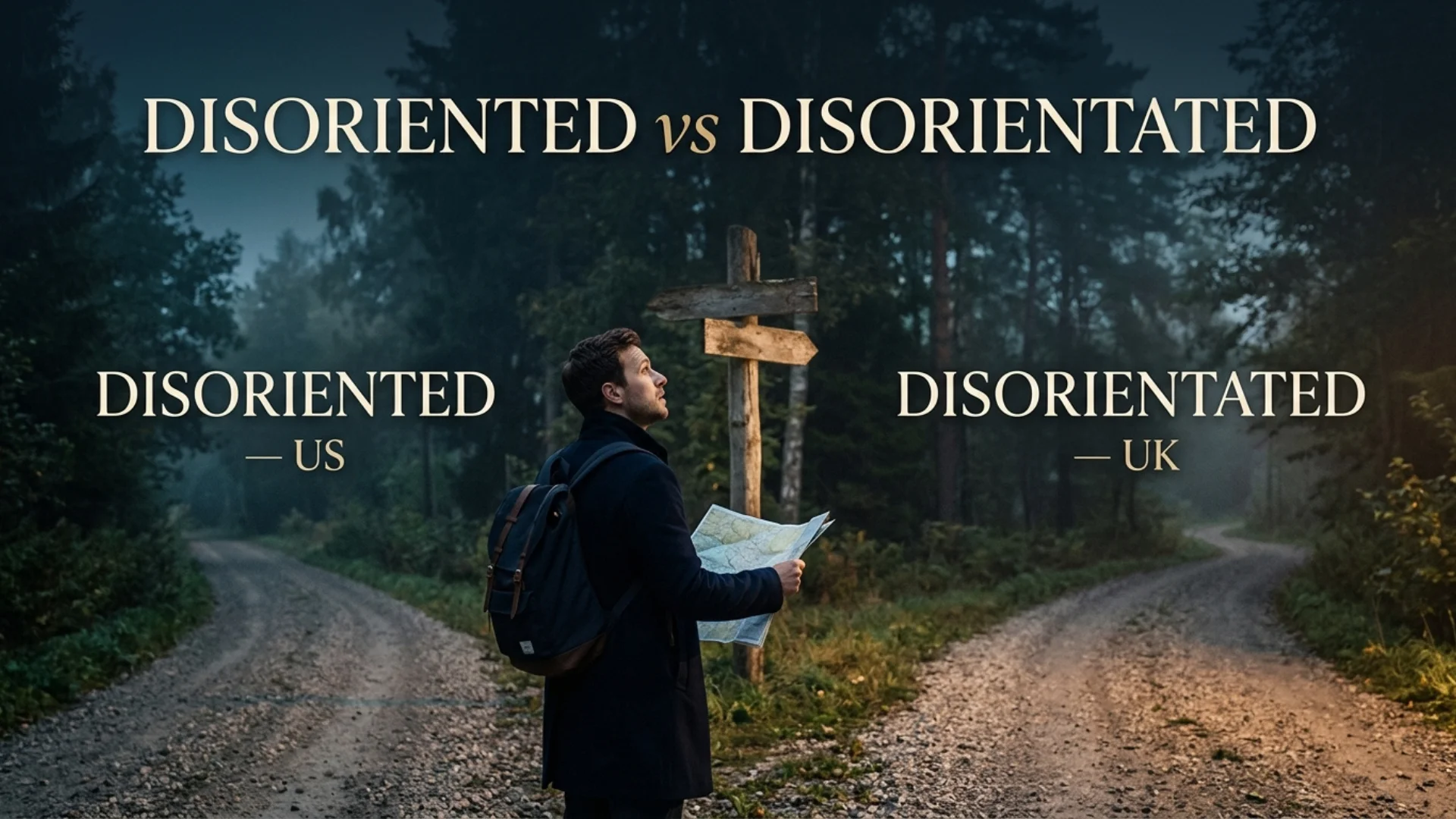
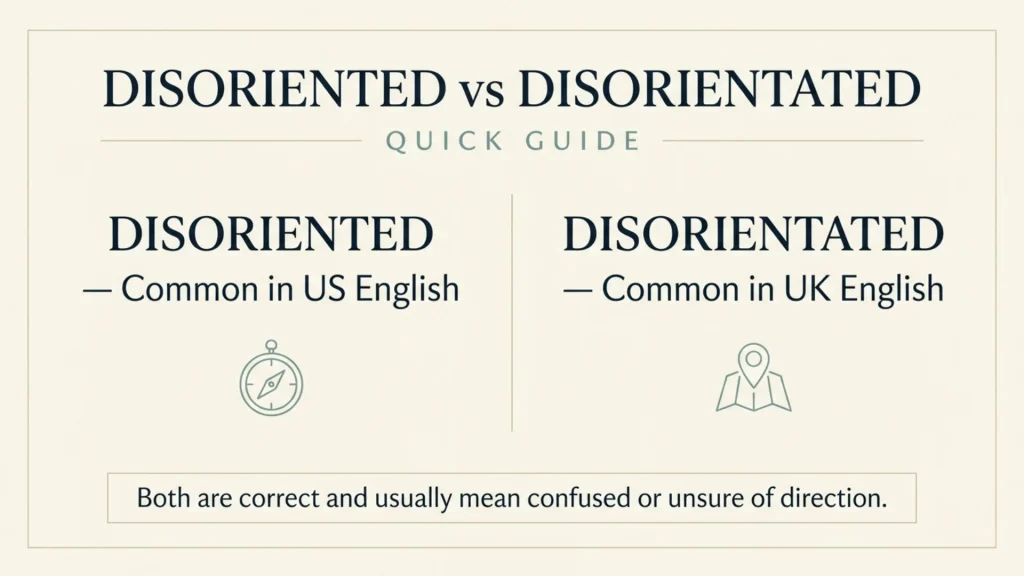
Disoriented and disorientated are both correct English words, and in most contexts they mean the same thing: confused, unsure of your surroundings, or unable to tell clearly where you are or what you should do.
The main difference is regional usage:
- Disoriented is more common in American English.
- Disorientated is more common in British English.
- Both forms are understood internationally.
- British writers also use disoriented, so the distinction is a preference rather than a strict rule.
If you are writing for an American audience, disoriented is usually the safer choice. For a British audience, either form is acceptable, although disorientated remains common.
Disoriented vs Disorientated at a Glance
| Word | Correct? | Common Usage | Meaning |
|---|---|---|---|
| Disoriented | Yes | Especially American English | Confused or unsure of direction |
| Disorientated | Yes | Especially British English | Confused or unsure of direction |
| Disorient | Yes | More common in American English | To confuse someone’s sense of direction |
| Disorientate | Yes | More common in British English | To confuse someone’s sense of direction |
| Disorienting | Yes | Common, especially US | Causing confusion |
| Disorientating | Yes | Commoner in British usage | Causing confusion |
The simplest rule is:
US English: disoriented
UK English: disoriented or disorientated
What Does Disoriented Mean?
Disoriented means confused about your location, direction, surroundings, situation, or what is happening.
Examples:
- I woke up feeling disoriented.
- The unfamiliar building left him disoriented.
- She became disoriented after waking suddenly.
- The hikers were disoriented in the fog.
- The sudden change made everyone feel disoriented.
It can describe physical or spatial confusion:
He became disoriented in the dark tunnel.
It can also describe mental or situational confusion:
She felt disoriented during her first week at the new job.
Cambridge Dictionary defines disoriented as being confused and not knowing where to go or what to do, while also listing disorientated as a mainly UK alternative. Cambridge Dictionary: disoriented
What Does Disorientated Mean?
Disorientated means essentially the same thing as disoriented.
Examples:
- He felt disorientated after waking from the long flight.
- The maze left us completely disorientated.
- She seemed tired and disorientated.
- The unexpected change left the staff disorientated.
The difference is not normally one of meaning.
It is mainly one of regional preference.
Cambridge identifies disorientate as mainly British and disorient as mainly American usage.
Also check: “Too Early” vs “To Early”
Is Disorientated Proper English?
Yes.
Disorientated is proper English.
It is not simply a mistake, corruption, or unnecessarily long version invented by people who forgot how many syllables they were using.
It comes from the verb disorientate, which is established in British English.
Its forms include:
- disorientate
- disorientates
- disorientated
- disorientating
Similarly, disorient produces:
- disorient
- disorients
- disoriented
- disorienting
Both verb families exist.
Why Do People Say Disorientated Instead of Disoriented?
People say disorientated largely because it is an established form in British English and several other varieties influenced by British usage.
Compare:
American-style preference:
The pilot became disoriented.
British-style preference:
The pilot became disorientated.
Neither sentence is inherently wrong.
The choice often depends on:
- regional English
- personal habit
- editorial style
- audience
- publication preferences
Do British People Say Disorientated?
Yes.
Disorientated is particularly associated with British English.
However, that does not mean every British speaker uses it.
Disoriented also appears in British English.
So avoid treating the distinction as:
American = disoriented, British = disorientated, no exceptions
A better summary is:
Disoriented is strongly preferred in American English, while British English accepts both and commonly uses disorientated.
Disoriented or Disorientated in UK English?
Both can be used.
If you are writing in British English:
- disorientated is established
- disoriented is also understood and accepted
Consistency is more important than switching forms throughout the same piece of writing.
For example, avoid writing:
The patient was disorientated earlier but later became disoriented.
unless there is a genuine stylistic reason.
Choose one form and stick with it.
Disoriented or Disorientated in American English?
Use disoriented in most American writing.
Examples:
- I felt disoriented after waking up.
- The confusing map left us disoriented.
- The pilot became spatially disoriented.
- The flashing lights were disorienting.
Disorientated will usually be understood by American readers, but it may sound unusual or distinctly British.
Is Disoriented a Word?
Yes.
Disoriented is a standard English word.
It can function as:
- the past tense of disorient
- the past participle of disorient
- an adjective
Example as a verb:
The flashing lights disoriented him.
Example as an adjective:
He looked disoriented.
Disorient vs Disorientate
Both verbs mean to cause someone to lose their sense of direction or become confused.
Disorient
More common in American English.
Examples:
- The darkness disoriented me.
- Sudden movement can disorient a person.
- The unusual layout disoriented visitors.
Disorientate
More strongly associated with British English.
Examples:
- The unfamiliar streets disorientated him.
- The sudden change disorientated everyone.
- The complex layout can disorientate visitors.
There is normally no important semantic difference.
Disorienting vs Disorientating
Both forms are correct.
Disorienting
Derived from:
disorient + ing
Examples:
- The flashing lights were disorienting.
- It was a disorienting experience.
- The constant movement can be disorienting.
Disorientating
Derived from:
disorientate + ing
Examples:
- The experience was highly disorientating.
- The layout can be disorientating for visitors.
- Rapid visual movement may feel disorientating.
Again, regional preference is the main difference.
American English generally favors:
disorienting
British English may use:
disorienting or disorientating
Disorienting or Disorientating: Which Should You Use?
For an international audience, disorienting is usually the simpler choice.
It is:
- shorter
- widely understood
- common in American English
- accepted in British English
However, disorientating is not incorrect.
Example:
US-style:
The virtual-reality experience was disorienting.
British-style alternative:
The virtual-reality experience was disorientating.
Are Disoriented and Disorientated Exactly the Same?
In normal modern usage, they generally describe the same state.
Both can describe someone who is:
- confused
- lost
- unsure where they are
- unsure what is happening
- unable to establish direction
- mentally unsettled by unfamiliar circumstances
Claims that one must mean physical confusion while the other must mean mental confusion are not reliable general rules.
Context determines the exact kind of disorientation.
Disoriented vs Confused
These words overlap, but they are not always identical.
Confused
A very broad word.
You can be confused because:
- you do not understand an explanation
- two ideas seem contradictory
- instructions are unclear
- you cannot make a decision
Example:
I am confused by this grammar rule.
Disoriented
Usually suggests loss of bearings, context, direction, or mental orientation.
Example:
I woke up in an unfamiliar room and felt disoriented.
So:
confused = broad lack of understanding
disoriented = confusion involving bearings, surroundings, situation, or orientation
Disoriented Meaning in Everyday English
In everyday conversation, disoriented often means:
- lost
- confused
- unsure where you are
- mentally unsettled
- unable to get your bearings
Examples:
I woke up from a nap completely disoriented.
The new office layout was surprisingly disorienting.
After leaving the subway station, I felt disoriented for a minute.
The word does not automatically imply a serious medical problem.
Context matters.
Disoriented Synonyms
Depending on context, synonyms include:
- confused
- bewildered
- perplexed
- lost
- dazed
- muddled
- befuddled
- unsettled
- thrown off
- at sea
- unsure
- directionless
- dizzy
- groggy
- discombobulated
Not every synonym works in every sentence.
For example:
I was confused by the instructions.
is natural.
But:
I was disoriented by the instructions.
sounds less natural unless the instructions caused broader confusion.
Examples of Disoriented in Sentences
- I woke up feeling disoriented.
- The fog left the hikers disoriented.
- She seemed confused and disoriented.
- The sudden noise disoriented him.
- He became disoriented in the unfamiliar building.
- The flashing lights were disorienting.
- She felt disoriented after the long journey.
- The complicated layout left visitors disoriented.
- I was briefly disoriented after waking from the nap.
- The darkness made it difficult to stay oriented.
- He looked tired and disoriented.
- The rapid camera movement was disorienting.
- The unfamiliar city made me feel disoriented.
- She became disoriented when the lights went out.
- He paused because he felt completely disoriented.
Examples of Disorientated in Sentences
- He felt disorientated in the unfamiliar surroundings.
- The strange layout left visitors disorientated.
- She woke feeling tired and disorientated.
- The darkness disorientated him.
- They were briefly disorientated by the sudden change.
- The complex map was rather disorientating.
- He looked confused and disorientated.
- The experience left her disorientated.
- The sudden movement can be disorientating.
- Several passengers appeared disorientated.
These examples sound particularly natural in British English.
Common Mistakes
Mistake 1: Saying Disorientated Is Not a Word
Incorrect.
Disorientated is an established English form, particularly in British English.
Mistake 2: Assuming They Have Completely Different Meanings
Usually they do not.
Regional preference explains most of the difference.
Mistake 3: Mixing Regional Styles Randomly
Better:
The experience was disorienting, and I felt disoriented afterward.
Also acceptable in British style:
The experience was disorientating, and I felt disorientated afterward.
Less polished:
The experience was disorientating, and I felt disoriented afterward.
The mixed version is not necessarily grammatically wrong, but consistency usually reads better.
Mistake 4: Assuming Disoriented Always Means Dizzy
Disorientation can involve confusion about surroundings, direction, time, or circumstances.
Dizziness and disorientation are not automatically the same thing.
Pronunciation Difference
The words differ mainly because disorientated contains an additional syllable.
Disoriented
Approximately:
dis-OR-ee-en-tid
Disorientated
Approximately:
dis-OR-ee-en-TAY-tid
The longer form can therefore sound noticeably more British to American ears.
Disoriented in Spanish
A common Spanish equivalent is:
desorientado for masculine usage
or
desorientada for feminine usage.
Depending on context, it can mean confused, lost, or lacking a sense of direction.
As always, translations depend on the specific sentence.
When Should You Use Disoriented?
Use disoriented when:
- writing primarily for American readers
- writing for a broad international audience
- you prefer the shorter form
- your style guide favors it
- you want consistency with disorienting
Examples:
- He looked disoriented.
- The experience was disorienting.
When Should You Use Disorientated?
Use disorientated when:
- writing in British English
- it sounds more natural in your dialect
- your publication or organization prefers it
- you are using the verb disorientate
Examples:
- The patient appeared disorientated.
- The surroundings were disorientating.
Quick Test: Disoriented or Disorientated?
1. American English
“The confusing layout left me ___.”
Best choice:
disoriented
2. British English
“He appeared tired and ___.”
Both are possible, but:
disorientated
may sound especially natural.
3. International English
“The unusual experience was ___.”
Simplest choice:
disorienting
4. British Verb Form
“The unfamiliar environment ___ him.”
Possible answer:
disorientated
5. American Verb Form
“The unfamiliar environment ___ him.”
Preferred answer:
disoriented
FAQs About Disoriented vs Disorientated
Why Do People Say Disorientated Instead of Disoriented?
Because disorientated is an established British English form derived from disorientate. It is not simply an accidental extension of disoriented.
Is Disorientated Proper English?
Yes. Disorientated is proper English, especially in British usage.
Do British Say Disorientated?
Yes. British speakers commonly use disorientated, although disoriented is also used.
What Does Disorientated Mean?
It means confused, unsure of your surroundings, or unable to establish your direction or situation clearly.
What Is Another Word for Disorientated?
Depending on context:
- confused
- lost
- bewildered
- dazed
- muddled
- perplexed
- unsettled
What Makes You Feel Disorientated?
In ordinary life, people may briefly feel disoriented after waking suddenly, entering an unfamiliar place, traveling, moving through darkness, experiencing visually confusing motion, or losing their sense of direction.
Persistent, sudden, or severe disorientation can also have medical causes and should not be diagnosed from a grammar article.
What Are 5 Signs Your Brain Is in Trouble?
There is no universal checklist called “five signs your brain is in trouble.” Concerning neurological symptoms can include sudden confusion, new difficulty speaking, sudden weakness or numbness, severe balance problems, or a sudden severe headache.
Sudden neurological symptoms can require urgent medical assessment. This FAQ is general information, not a diagnosis.
Is Disorientation a Symptom of Dementia?
Disorientation can occur in dementia, particularly as cognitive impairment progresses, but it has many other possible causes.
Temporary or sudden confusion may also be associated with illness, medication effects, sleep problems, dehydration, delirium, neurological conditions, or other factors.
Disorientation alone does not establish a dementia diagnosis.
What Are 6 Signs of Confusion or Disorientation?
Possible signs include:
- not knowing where you are
- being unsure of the date or time
- difficulty following a conversation
- trouble recognizing familiar surroundings
- unusual difficulty making simple decisions
- appearing unusually lost, dazed, or unable to focus
Sudden confusion, especially when severe or accompanied by other new neurological symptoms, deserves prompt medical attention.
What Is the Difference Between Disorientation and Confusion?
Confusion is a broad difficulty understanding or thinking clearly.
Disorientation more specifically involves difficulty establishing your position, surroundings, time, situation, or bearings.
A person can be confused without being disoriented.
Final Answer: Disoriented or Disorientated?
Both are correct.
Use disoriented if you are writing in American English or for a broad international audience.
Use disorientated if you prefer established British English usage.
The meaning is usually the same:
confused, lost, or unsure of your surroundings or situation.
The same pattern applies to the verbs and participles:
- disorient → disoriented → disorienting
- disorientate → disorientated → disorientating
So the useful distinction is not:
correct vs incorrect
It is mostly:
regional preference vs regional preference
English occasionally manages to give us two correct words for exactly the same problem, presumably because one was not enough trouble.