Driver’s License vs Drivers License: Which Is Correct?
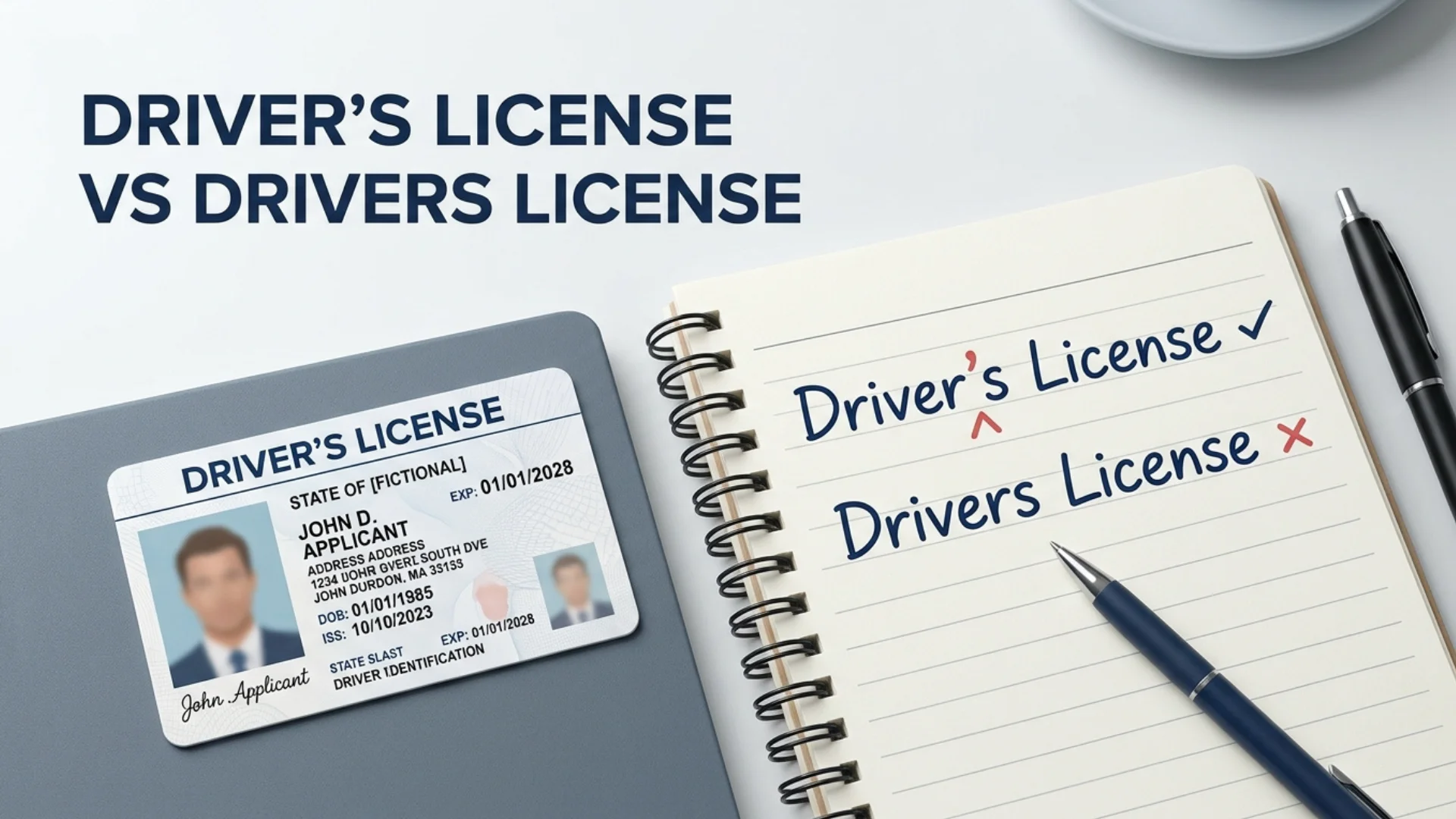
Driver’s license vs drivers license comes down to one small mark with a big grammatical job: the apostrophe. In standard American English, driver’s license is the normal form. Drivers license without an apostrophe is generally incorrect in ordinary writing, while driver license can appear as an official government or administrative label.
The easiest rule to remember is this: if you mean the license held by a driver, write driver’s license. If a state agency officially calls the document a driver license, follow that wording in that specific context.
Quick Answer: Driver’s License vs Drivers License?
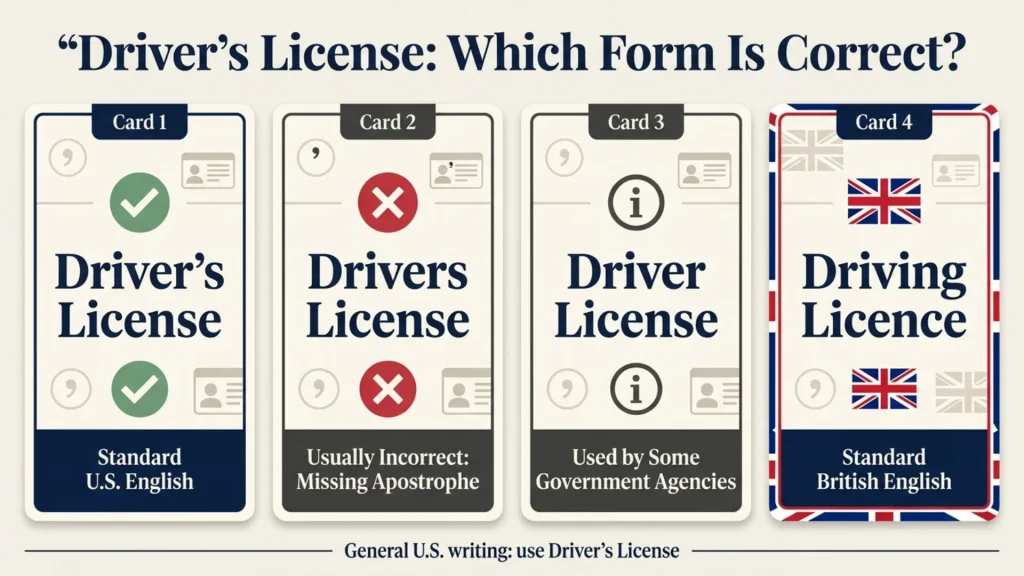
| Form | Is It Correct? | When to Use It |
|---|---|---|
| Driver’s license | Yes | Standard American English |
| Drivers license | Usually no | Common misspelling; missing apostrophe |
| Driver license | Yes in some official contexts | Used by certain government agencies as a label |
| Drivers’ license | Rare and context-specific | Could refer to a license belonging to multiple drivers, but not the normal name of the document |
| Driving licence | Yes | Standard British English form |
Why “Driver’s License” Has an Apostrophe
The apostrophe in driver’s license marks the singular possessive form of driver. Grammatically, the phrase developed as a license associated with or belonging to a driver.
That does not mean “my driver’s license” normally refers to the license of a chauffeur or another driver. In modern usage, driver’s license functions as a familiar fixed phrase for the document that permits a person to drive.
Compare these similar constructions:
- a pilot’s license
- a learner’s permit
- a teacher’s certificate
- a doctor’s office
In each case, the apostrophe helps form a possessive or classifying expression.
Is “Drivers License” Without an Apostrophe Correct?
In normal edited American English, drivers license is not the preferred spelling. Drivers is simply the plural form of driver, so writing drivers license creates an awkward noun combination without showing possession.
The standard general-English form is:
Correct: I renewed my driver’s license yesterday.
Usually incorrect: I renewed my drivers license yesterday.
The missing apostrophe is one of the most common errors because search engines, filenames, form fields, URLs, and informal online writing often drop punctuation.
Driver License vs Driver’s License
Driver’s license is the safest choice in ordinary American English. However, driver license is not automatically wrong.
Some U.S. agencies use driver license as an official administrative term, heading, program name, or wording printed on documents. In that situation, driver functions as a noun modifier, similar to phrases such as student ID or business license.
So the difference is mostly one of context:
- General writing: driver’s license
- Official label used by an agency: follow that agency’s wording, which may be driver license
- Drivers license: usually a punctuation error
How Do You Spell Driver’s License?
In American English, the usual spelling is:
driver’s license
It contains:
- driver
- an apostrophe
- s
- license with an s, not licence
A simple memory trick is: one driver + one license = driver’s license.
Does Driver’s License Have an Apostrophe?
Yes. In standard American English, driver’s license normally uses an apostrophe before the s.
The apostrophe is not there to make driver plural. Apostrophes do not normally create plurals. They commonly show possession or omitted letters.
That distinction is why these forms mean different things:
- driver = one person who drives
- drivers = more than one driver
- driver’s = belonging or relating to one driver
- drivers’ = belonging or relating to multiple drivers
If singular and plural grammar trips you up elsewhere, our guide to People Do or People Does explains another common number-agreement problem.
Drivers’ or Driver’s License?
Driver’s license is the normal name of the document.
Drivers’ license would grammatically suggest a license associated with multiple drivers. That is rarely what people mean when naming the document itself.
For example:
Normal: Each applicant must show a driver’s license.
Possible but unusual: The drivers’ licenses were collected by the officer.
In the second example, drivers’ refers to several drivers, and licenses is also plural.
What Is the Plural of Driver’s License?
The normal plural is:
driver’s licenses
The word licenses becomes plural, while driver’s remains part of the established expression.
Example:
The clerk checked three driver’s licenses.
You may also see drivers’ licenses when the writer specifically wants to emphasize that the licenses belong to several different drivers. In most ordinary references to multiple documents, however, driver’s licenses is the more natural fixed expression.
For another common singular-versus-plural choice, see Was There or Were There.
Is Driver’s License Capitalized?
Usually, no. In normal sentences, driver’s license is a common noun phrase and should be lowercase.
Correct: Please bring your driver’s license.
Capitalize it when capitalization is required for another reason, such as:
- the beginning of a sentence
- a title or heading
- an official form or department label that uses title case
Example:
Heading: Driver’s License Requirements
Sentence: You need a valid driver’s license to apply.
Driver’s License or Driving License?
Both expressions exist, but regional usage differs.
American English
Driver’s license is the standard everyday term in the United States.
British English
Driving licence is the normal British form. Notice that British English also commonly spells the noun licence with a c.
The Cambridge Dictionary entry for “licence” explicitly contrasts British driving licence with U.S. driver’s license.
License vs Licence
In American English, license is normally used as both the noun and the verb.
American noun: I renewed my license.
American verb: The state licenses drivers.
In British English, the traditional distinction is:
- licence = noun
- license = verb
So an American usually writes driver’s license, while a British writer usually writes driving licence.
Common Misspellings of Driver’s License
| Spelling | Status |
|---|---|
| driver’s license | Standard U.S. form |
| drivers license | Usually incorrect; apostrophe missing |
| drivers’ license | Different possessive meaning; not the standard document name |
| driver licence | Mixed regional style in most contexts |
| driver’s licence | Possible hybrid usage, but U.S. and UK conventions normally use different phrases |
| driving license | Understandable; U.S. spelling combined with British-style phrase |
| driving licence | Standard British English |
Why Do Some States Write “Driver License”?
Government terminology does not always follow the most common conversational phrasing. An agency may use driver license as a formal compound noun, department label, database term, or card heading.
This does not make driver’s license incorrect. It simply means official institutional terminology can differ from general prose.
If you are writing about a specific agency, copy its official label. If you are writing a normal sentence for a U.S. audience, driver’s license remains the safest default.
Operator’s License vs Driver’s License
Operator’s license is an older or jurisdiction-specific term for a license authorizing someone to operate a motor vehicle. Some laws, historical documents, and state systems have used operator where modern everyday English usually uses driver.
The two terms can refer to similar credentials, but the exact legal terminology depends on the jurisdiction.
For ordinary modern U.S. writing, driver’s license is clearer unless you are quoting a law, form, or agency that specifically uses operator’s license.
Examples of Driver’s License in Sentences
- I forgot my driver’s license at home.
- She renewed her driver’s license online.
- Please show your driver’s license and proof of insurance.
- His driver’s license expires next month.
- The police officer asked to see my driver’s license.
- Applicants must present a valid driver’s license.
- Three driver’s licenses were found in the lost-property box.
- The form asks for your driver’s license number.
Easy Rule to Remember
Use this three-part rule:
- Driver’s license for normal American English.
- Driver license when reproducing an official agency term that uses that form.
- Avoid drivers license in edited prose because the missing apostrophe usually makes it incorrect.
Frequently Asked Questions
Is it correct to say driver’s license or driver’s license?
The two forms in the question are identical. If you meant driver’s license vs driver license, both can be correct depending on context. Driver’s license is the standard general American English form, while driver license appears in some official government terminology.
Is a driver’s license spelled with an apostrophe?
Yes. In standard American English, driver’s license normally has an apostrophe before the s.
What is the difference between driver’s and drivers?
Driver’s is singular possessive, while drivers is simply plural. One driver’s car has an apostrophe; three drivers arrived does not.
Is license ever spelled license?
Yes. License is the standard U.S. spelling of the noun and verb. In British English, the noun is usually licence, while the verb is license.
How do you spell “license” in the United States?
In American English, spell it license, with an s. This spelling is used for both the noun and the verb.
What is a common misspelling of license?
Licence is not a misspelling in British English, but it is usually the wrong regional spelling for the noun in American English. Other genuine misspellings include forms such as lisence and lisense.
What is the plural spelling of “driver’s license”?
The common plural is driver’s licenses. The noun licenses becomes plural while driver’s remains part of the fixed expression.
What is another word for “license”?
Depending on context, alternatives include permit, authorization, certification, credential, or permission. They are not always interchangeable in legal contexts.
Final Answer
For normal American English, write driver’s license.
Drivers license without an apostrophe is generally incorrect. Driver license can be correct when it is the official terminology used by a government agency or document. In British English, the usual expression is driving licence.
If you only remember one rule, make it this one: general U.S. prose = driver’s license.