Listen to Music vs Listen to the Music: Meaning & Correct Usage
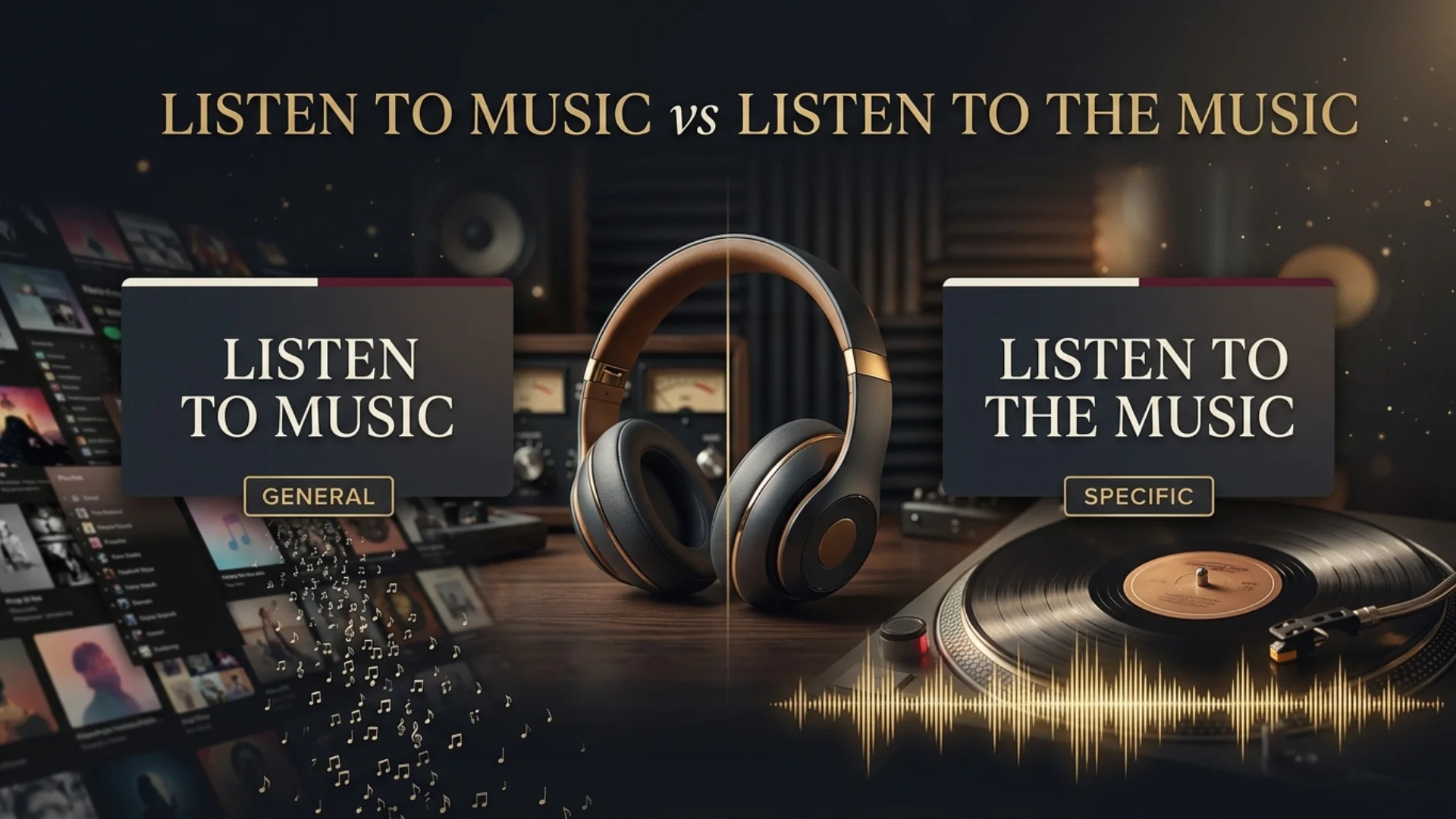
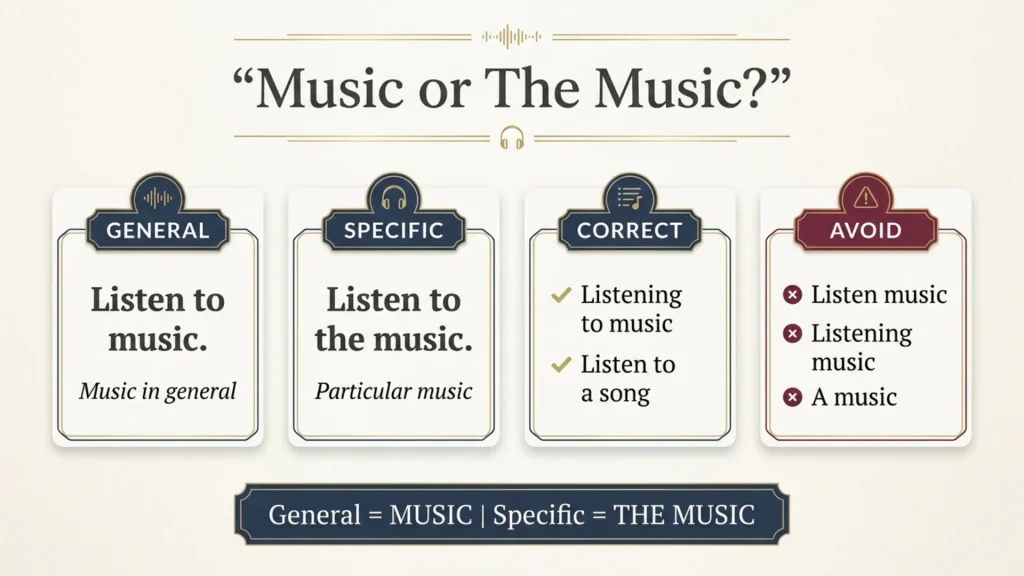
Listen to music vs listen to the music is mainly a difference between talking about music in general and talking about specific music.
Use listen to music when you mean music generally as an activity, habit, hobby, or preference:
I listen to music while working.
Use listen to the music when you mean particular music that the listener can identify:
Listen to the music playing in the next room.
Both phrases are correct. The word the changes the meaning from general to specific.
Quick Answer: Listen to Music or Listen to the Music?
| Phrase | Meaning | Example |
|---|---|---|
| listen to music | Music generally | I listen to music every day. |
| listen to the music | Specific music | Listen to the music in this video. |
| listening to music | General activity | Listening to music helps me relax. |
| listening to the music | Listening to particular music | She is listening to the music from the film. |
| listen music | Incorrect in standard English | ❌ I listen music. |
| listen to a music | Usually incorrect | ❌ I listen to a music. |
The easiest rule is:
General music = no “the”
Specific music = use “the”
What Does “Listen to Music” Mean?
Listen to music means to pay attention to music generally without referring to one particular song, recording, performance, or soundtrack.
Examples:
I listen to music before bed.
She likes to listen to music while studying.
We listened to music during the drive.
He spends hours listening to music.
In all of these examples, the exact music is not important.
The speaker is talking about the general activity.
What Does “Listen to the Music” Mean?
Listen to the music means to pay attention to particular music that is already known, mentioned, playing, or otherwise identifiable.
Examples:
Listen to the music coming from upstairs.
I love the movie, but listen to the music in the final scene.
Listen to the music they are playing at the wedding.
She listened to the music we recorded yesterday.
In each case, you can reasonably ask:
Which music?
And the sentence gives you an answer.
Listen to Music vs Listen to the Music: Main Difference
The difference comes from the definite article:
the
Compare:
I enjoy music.
This means music generally.
Now:
I enjoy the music.
This means particular music that the speaker and listener can identify.
The same principle applies after listen to:
I listen to music.
General.
I listen to the music from that show.
Specific.
Why Does “The” Change the Meaning?
The is the definite article.
It generally signals that the noun refers to something specific or identifiable in the context.
Compare:
Music helps me concentrate.
Music in general.
The music is too loud.
Specific music that is currently playing or already understood from the context.
For a reference on how the definite article works, see the Cambridge Dictionary guide to “the”.
Is Music Countable or Uncountable?
Music is normally an uncountable noun.
That is why we naturally say:
I like music.
I listen to music.
Music is important to me.
We do not normally say:
I like a music. ❌
I listen to a music. ❌
If you want to refer to one individual musical item, use a countable noun such as:
- a song
- a track
- a recording
- a composition
- a piece of music
Examples:
I listened to a song.
She played a beautiful piece of music.
Is “Listen Music” Correct?
No. In standard English, use:
listen to + object
Correct:
I listen to music.
Incorrect:
I listen music.
Other examples:
Listen to me.
Listen to the radio.
Listen to the teacher.
Listen to this song.
Listen to the sound.
The preposition to is normally required when you state what someone is listening to.
Listen vs Listen To
Use listen alone when you are not naming the object.
Example:
Please listen carefully.
But if you identify the thing receiving your attention, use listen to:
Listen to me.
Listen to the song.
Listen to music.
Listen to your teacher.
So:
Listen! ✅
and:
Listen to me! ✅
are both correct.
But:
Listen me! ❌
is not standard English.
Listening to Music Meaning
Listening to music simply means paying attention to or experiencing music through hearing.
It is the -ing form of:
listen to music
Examples:
Listening to music helps me concentrate.
My favorite hobby is listening to music.
She enjoys listening to music in the evening.
We were listening to music in the car.
Is “Listening to Music” a Correct Sentence?
On its own, listening to music is normally a phrase rather than a complete sentence.
For example:
Listening to music.
This can work as a caption, short answer, heading, or fragment in casual contexts.
For a complete sentence, write something like:
I am listening to music.
Listening to music helps me relax.
My hobby is listening to music.
Listening Music or Listening to Music?
Use:
listening to music
Not:
listening music
Correct:
I enjoy listening to music.
Incorrect:
I enjoy listening music.
Correct:
She is listening to music.
Incorrect:
She is listening music.
Again, listen normally requires to before the thing being listened to.
Listening to Music or Listening Music in a Resume?
For a resume, use:
Listening to music
rather than:
Listening music
However, simply writing Listening to music in a professional resume may be too generic unless the hobbies section genuinely adds value.
Possible wording:
Interests: Music, reading, fitness, and travel
or:
Hobbies: Listening to music, photography, and hiking
If your interest is more specific, that can sound stronger:
Exploring jazz and classical music
Music production and audio editing
Live music and cultural events
Your grammar should not become less accurate merely because the sentence lives inside a resume. Apparently bullet points have no magical exemption from prepositions.
Hobby: Listening to Music or Listening Music?
Correct:
Listening to music
Example:
My hobby is listening to music.
Not:
My hobby is listening music.
You could also say:
One of my hobbies is listening to music.
I enjoy listening to music in my free time.
“I Like Listening to Music” or “I Like to Listen to Music”?
Both are correct.
I Like Listening to Music
I like listening to music while I work.
I Like to Listen to Music
I like to listen to music before bed.
In many contexts, the meanings are nearly identical.
The -ing form often sounds natural when talking about activities you enjoy, while like to + verb can sometimes sound more like a habit or preference.
But there is no major error in either sentence.
Is “I Like to Listen to Music” Correct?
Yes.
I like to listen to music.
is completely natural standard English.
You can also say:
I like listening to music.
Both are correct.
Listen to Music Sentence Examples
Here are natural examples using listen to music generally:
- I listen to music every morning.
- She likes to listen to music while studying.
- We listened to music during the trip.
- They often listen to music together.
- He listens to music before going to sleep.
- I usually listen to music at the gym.
- She enjoys listening to music while cooking.
- We sometimes listen to music after dinner.
- Many students listen to music while doing homework.
- He loves to listen to music from different countries.
- I started listening to music more often this year.
- They were listening to music in the car.
- Listening to music helps me relax.
- I rarely listen to music while reading.
- She spends the evening listening to music.
Listen to the Music Sentence Examples
Use the music when the music is specific:
- Listen to the music playing outside.
- Listen to the music in this scene.
- I listened to the music you sent me.
- Did you listen to the music from the concert?
- She was listening to the music in the background.
- Listen to the music carefully before answering.
- I love the music in this film.
- He listened to the music from the ceremony.
- Listen to the music coming from downstairs.
- We listened to the music they recorded yesterday.
A Useful “Which Music?” Test
If you are unsure whether to use the, ask:
Can I identify which music I mean?
If no:
I listen to music every day.
General music.
If yes:
Listen to the music coming from the kitchen.
Which music?
The music coming from the kitchen.
So the is appropriate.
General vs Specific Meaning
Compare these pairs.
Example 1
I like listening to music.
General preference.
I like listening to the music from this game.
Specific soundtrack.
Example 2
We listened to music during dinner.
The exact music is not important.
We listened to the music that Sarah recommended.
Specific music.
Example 3
He studies while listening to music.
General habit.
He is listening to the music from yesterday’s rehearsal.
Specific recording or performance.
“The” Does Not Mean More Careful Listening
A common misconception is that:
listen to the music
means listening more deeply, emotionally, or carefully than:
listen to music
That is not the normal grammatical difference.
The main distinction is specificity.
Listen to music.
means music generally.
Listen to the music.
means particular music.
You could listen very carefully to music generally, and you could barely pay attention to specific music. The article does not measure your emotional devotion to the guitar solo.
Hear Music vs Listen to Music
Hear and listen are different.
Hear
Often refers to sound reaching your ears without deliberate effort.
I can hear music from next door.
Listen
Usually suggests deliberately paying attention.
I am listening to music.
Compare:
I heard a song playing outside.
You became aware of it.
I listened to the song.
You deliberately paid attention to it.
Hear the Music vs Listen to the Music
Both can refer to specific music, but the verbs differ.
Can you hear the music?
asks whether the sound is audible.
Listen to the music.
asks someone to pay attention to it.
That distinction is useful far beyond this one phrase.
Listen to a Song vs Listen to Music
Use a song when referring to one countable song:
I listened to a song.
Use music when speaking generally:
I listened to music.
Use the song when referring to a specific known song:
I listened to the song you recommended.
Use the music when referring to specific identifiable music:
I listened to the music from the film.
Listen to the Song vs Listen to the Music
Listen to the Song
Refers to one particular song.
Listen to the song I sent you.
Listen to the Music
Can refer more broadly to specific music, soundtrack, instrumental background, performance, or musical sound.
Listen to the music during the opening scene.
Listen to the Radio vs Listen to Music
We normally say:
listen to the radio
because the radio refers to the medium or broadcast service in a conventional expression.
But we say:
listen to music
because music is being discussed generally.
Examples:
I listen to the radio on my way to work.
I listen to music at the gym.
Articles are helpful right up until English turns them into idioms and expects learners to smile politely.
Listen to Music at Work
Natural:
I listen to music at work.
This describes a general habit.
Specific:
I listened to the music the designer chose for the presentation.
Now a particular piece or selection is being discussed.
Listen to Music While Studying
Natural:
I listen to music while studying.
Also:
I like listening to music while I study.
Specific version:
I listened to the music our teacher assigned while studying.
Listen to Music Before Sleeping
Natural:
I listen to music before sleeping.
More idiomatically:
I listen to music before I go to sleep.
I like listening to music before bed.
All describe a general habit.
Listening to Music as a Hobby
If someone asks:
What are your hobbies?
you can answer:
I enjoy listening to music.
or:
One of my hobbies is listening to music.
You do not need the because you are talking about music generally.
Listening to the Music Meaning
Listening to the music means paying attention to particular music that can be identified from context.
Example:
She sat quietly listening to the music.
This usually implies that specific music is currently playing or has already been mentioned.
Another:
The students are listening to the music selected by their teacher.
The phrase selected by their teacher identifies which music.
When Can Context Make Music Specific?
You do not always need to describe the music explicitly.
Situation can identify it.
Imagine music is playing at a party. Someone says:
Listen to the music!
The music is obvious because both people can hear it.
Likewise:
Turn down the music.
The listener knows which music you mean from the situation.
Is “The Music” Always Followed by More Information?
No.
You can say:
I love the music.
if the context has already established which music you mean.
For example:
Have you seen the new film?
Yes. I love the music.
Both speakers understand that the music means the music in that film.
Zero Article With Music
When an uncountable noun is used generally, English often uses no article.
Examples:
Music can change your mood.
I love music.
She studies music.
We listen to music.
This absence of an article is sometimes called the zero article.
The + Music
Use the music when the reference is specific.
Examples:
The music at the wedding was excellent.
The music in this game is beautiful.
I remember the music from that night.
The music playing downstairs is too loud.
Can You Say “A Music”?
Usually no.
Music is normally uncountable.
Instead of:
I heard a music. ❌
say:
I heard some music.
or:
I heard a song.
or:
I heard a piece of music.
Some Music vs The Music
Some Music
Unspecified amount or selection:
Let’s listen to some music.
The Music
Specific music:
Let’s listen to the music you downloaded.
Music
General:
I like listening to music.
Listen to Some Music
This is extremely natural.
Let’s listen to some music.
It suggests an unspecified selection of music.
Compare:
Let’s listen to music.
General activity.
Let’s listen to some music.
An unspecified amount/selection.
Let’s listen to the music.
Specific identifiable music.
Music or the Music in Questions
General:
Do you listen to music while working?
Specific:
Did you listen to the music I sent you?
General:
What music do you listen to?
Specific:
What did you think of the music in the film?
Resume Examples
Simple Hobbies Section
Hobbies: Reading, listening to music, hiking, and photography.
More Professional Interests Section
Interests: Music, fitness, technology, and travel.
More Specific Version
Interests: Live music, jazz, photography, and recreational running.
Avoid:
Listening music ❌
Use:
Listening to music ✅
Common Mistakes
Mistake 1: Listen Music
Incorrect:
I listen music.
Correct:
I listen to music.
Mistake 2: Listening Music
Incorrect:
My hobby is listening music.
Correct:
My hobby is listening to music.
Mistake 3: A Music
Incorrect:
I listened to a music.
Correct:
I listened to music.
or:
I listened to a song.
Mistake 4: Unnecessary “The”
Awkward if discussing a general habit:
I listen to the music every day.
Better:
I listen to music every day.
Unless specific music has already been established.
Mistake 5: Missing “The” for Specific Music
Less natural:
Listen to music playing in the background.
Better when referring to the identifiable background music:
Listen to the music playing in the background.
Listen to Music vs Listen the Music
Correct:
Listen to music.
Correct:
Listen to the music.
Incorrect:
Listen the music.
The problem in the third example is not the. The missing word is to.
For another guide where one small word changes the grammar, see Appreciative of vs Appreciative for.
Listen to vs Hear
A quick rule:
hear = perceive sound
listen to = deliberately pay attention to sound
Example:
I heard music from the restaurant.
I stopped to listen to the music.
The second action is intentional.
Listen Carefully vs Listen to Carefully
Use:
Listen carefully.
But when an object follows:
Listen carefully to the instructions.
or:
Listen to the instructions carefully.
Not:
Listen carefully the instructions.
“Listen to Music” in Different Tenses
Present
I listen to music.
Present Continuous
I am listening to music.
Past
I listened to music.
Present Perfect
I have listened to music all morning.
Future
I will listen to music later.
The preposition to remains.
“Listen to the Music” in Different Tenses
I listen to the music during each rehearsal.
I am listening to the music now.
I listened to the music you sent.
I have listened to the music several times.
I will listen to the music tonight.
How Do You Say “I Listen to Music” in Spanish?
A common Spanish translation is:
Escucho música.
The exact translation can vary with tense and context, but this corresponds naturally to the general English sentence:
I listen to music.
Notice that grammar does not map word-for-word across languages, so English article and preposition choices should be learned as English patterns rather than translated mechanically.
Listen to Music Chords vs Listen to the Music Chords
If you are talking about the chords of a particular song, the phrase would normally identify the song:
the chords to “Listen to the Music”
Here “Listen to the Music” is the title of a song, not an example of choosing between general and specific music.
That creates a slightly bizarre SEO overlap, courtesy of language and classic rock conspiring together.
“Listen to the Music” by The Doobie Brothers
“Listen to the Music” is also the title of a song by The Doobie Brothers, released in 1972.
It was written by Tom Johnston, who performed vocals and guitar on the recording.
The song title uses the music because it presents music as something specific enough for the listener to focus on.
Do not confuse searches for the song with the grammar question. They happen to use the same words for completely different reasons.
Who Sang “Listen to the Music”?
The song “Listen to the Music” was recorded by The Doobie Brothers.
Tom Johnston was the principal lead vocalist on the recording, while Patrick Simmons also contributed vocals.
Who Sang “Listen to the Music” in the 70s?
The Doobie Brothers released the song in 1972.
Which Doobie Brother Sang “Listen to the Music”?
Tom Johnston handled the principal lead vocal and wrote the song. Patrick Simmons also contributed vocals, including the bridge.
Similar General vs Specific Examples
The same article principle appears with many other nouns.
Coffee
I like coffee.
General.
I like the coffee you made.
Specific.
Food
We need food.
General.
We ate the food on the table.
Specific.
Information
I need information.
General.
I need the information you promised.
Specific.
Advice
She gave me advice.
General/unspecified.
I followed the advice my doctor gave me.
Specific.
Understanding music vs the music therefore teaches a much wider English grammar pattern.
Related Grammar Guides
If you’re cleaning up other small English usage traps, these GrammarRead guides are relevant:
- Resignate or Resonate for correct word choice and sound-related vocabulary.
- On the Plane or In the Plane for another common preposition choice.
- Too Early vs To Early for the difference between too and to.
- Appreciative of vs Appreciative for for preposition usage.
Practice: Choose the Correct Phrase
1. I usually ______ while exercising.
A. listen music
B. listen to music
C. listen to the music
Answer: B. listen to music
It describes a general habit.
2. ______ playing in the background.
A. Listen music
B. Listen to music
C. Listen to the music
Answer: C. Listen to the music
The background music is specific.
3. My hobby is ______.
A. listening music
B. listening to music
C. listening the music
Answer: B. listening to music
4. Did you ______ I sent yesterday?
A. listen the music
B. listen to the music
C. listen to music
Answer: B. listen to the music
The phrase identifies specific music.
5. She likes to ______ before sleeping.
A. listen to music
B. listen the music
C. listen music
Answer: A. listen to music
Frequently Asked Questions
Is it correct to say “listen to the music”?
Yes. Listen to the music is correct when you mean specific music that the listener can identify.
Listen to the music playing outside.
Which is correct: “listening to music” or “listen to music”?
Both are correct, but they have different grammatical forms.
Listen to music uses the base verb:
I like to listen to music.
Listening to music uses the -ing form:
Listening to music helps me relax.
Which is correct: “listen to” or “listen”?
Both can be correct.
Use listen when no object follows:
Listen carefully.
Use listen to when you identify what someone should hear:
Listen to me.
What does “listening to the music” mean?
It means paying attention to particular music that is identifiable from the context.
She is listening to the music from the concert.
What’s another way to say listening to music?
Depending on the context, you might say:
- enjoying music
- playing some music
- hearing a playlist
- relaxing with music
- listening to songs
- enjoying a soundtrack
These are not perfect synonyms in every sentence.
Who sang “Listen to the Music”?
The Doobie Brothers recorded “Listen to the Music.” Tom Johnston was the principal lead vocalist and songwriter.
Who sang “Listen to the Music” in the 70s?
The Doobie Brothers released “Listen to the Music” in 1972.
Which Doobie Brother sang “Listen to the Music”?
Tom Johnston sang the principal lead vocal. Patrick Simmons also contributed vocals.
Is it correct to say “I like to listen to music”?
Yes.
I like to listen to music.
is completely natural English.
You can also say:
I like listening to music.
Is “I listen music” correct?
No. Use:
I listen to music.
Is “listening music” correct?
Not when you mean the activity. Use:
listening to music.
Should I write “listening to music” on my resume?
Yes, if you want to include it as a hobby. Grammatically, listening to music is correct. Whether the hobby is useful enough to include depends on the resume and role.
Final Answer: Listen to Music vs Listen to the Music
Both phrases are correct.
Use listen to music when talking about music generally:
I listen to music every day.
Use listen to the music when talking about specific, identifiable music:
Listen to the music playing upstairs.
Remember these three rules:
- General = listen to music
- Specific = listen to the music
- Never drop “to” before music
So:
I listen to music. ✅
Listen to the music. ✅
I listen music. ❌
That tiny the is not decorative. English has assigned an entire specificity job to three letters, because apparently nouns were not already busy enough.