Respond vs. Response: Meaning, Difference & Correct Usage
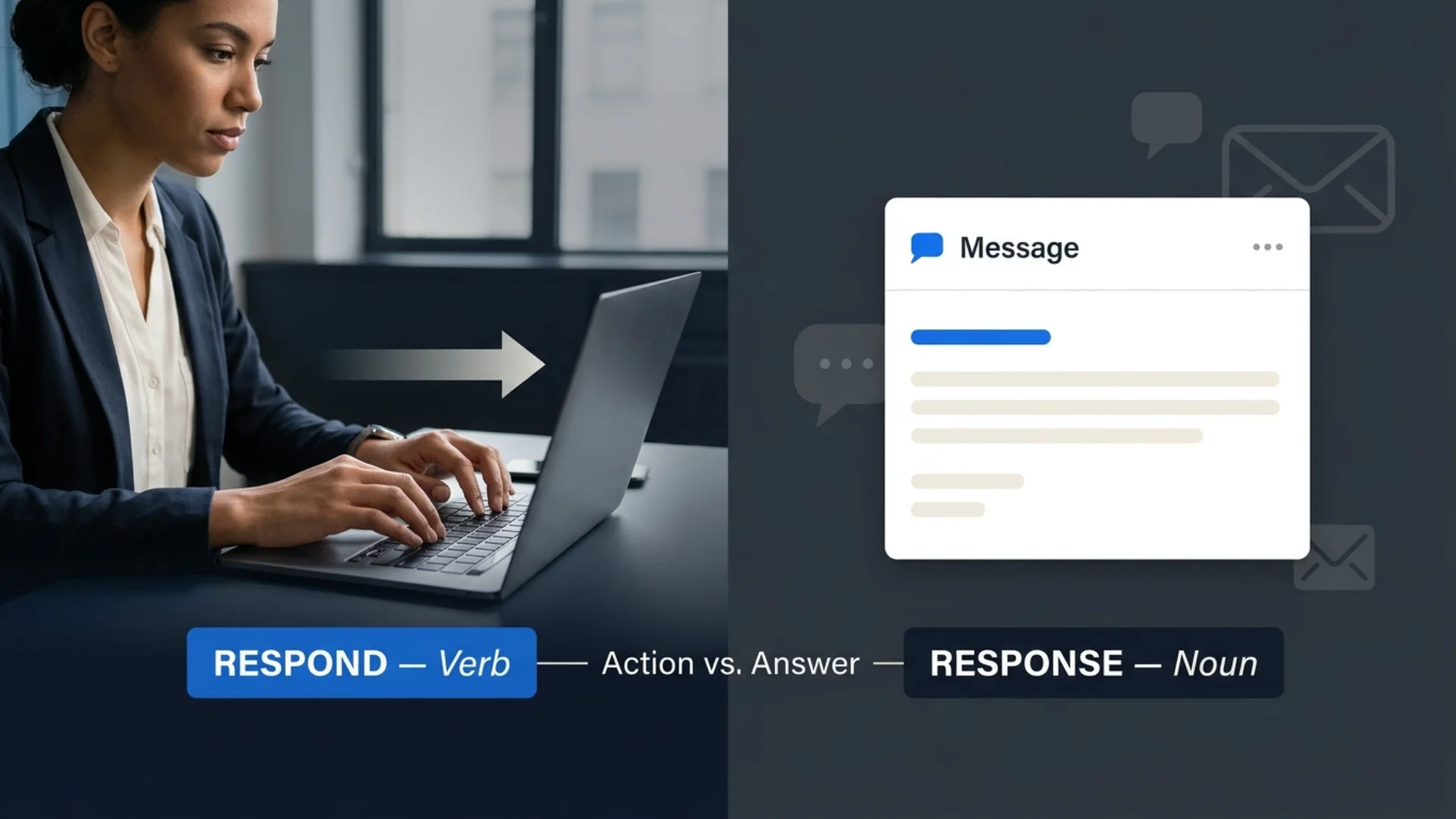
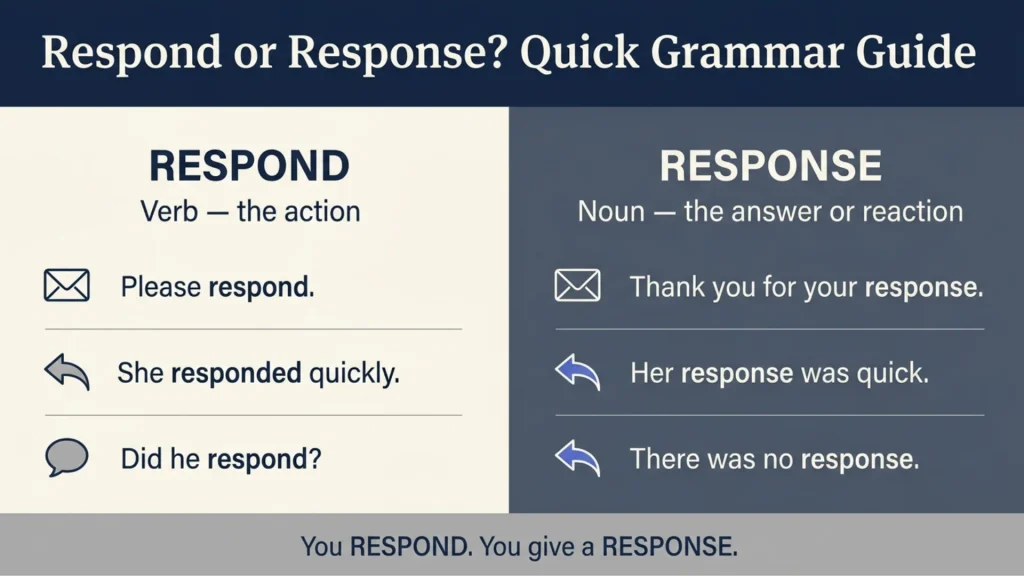
Respond vs. response is easy to understand once you know one simple grammar rule: respond is a verb, while response is a noun.
You respond when you take the action of answering or reacting. A response is the answer or reaction itself.
For example:
- Please respond to my email.
- Thank you for your response.
The first sentence needs a verb because someone must perform an action. The second needs a noun because it refers to the reply itself.
This guide explains the difference between respond and response, correct grammar patterns, email usage, common mistakes, plural forms, and related words such as reply and reaction.
Quick Answer: Respond vs. Response
| Word | Part of Speech | Meaning | Example |
|---|---|---|---|
| Respond | Verb | To answer, reply, or react | Please respond to my message. |
| Response | Noun | An answer, reply, or reaction | I received your response. |
| Responds | Verb | Third-person singular form of respond | She responds quickly. |
| Responses | Plural noun | More than one response | We received three responses. |
A quick memory trick:
Respond = action
Response = answer or reaction
You respond to something, but you give, receive, write, or wait for a response.
What Does Respond Mean?
Respond is a verb meaning to answer, reply, or react to something.
The Cambridge Dictionary describes respond as saying or doing something as a reaction to something that has been said or done. Cambridge Dictionary definition of “respond”
Examples:
- Please respond to my question.
- She responded to the email yesterday.
- He did not respond to the message.
- They responded quickly to the emergency.
- The company responded to customer complaints.
- She responded positively to the suggestion.
Because respond is a verb, its form can change depending on tense and subject.
Forms of Respond
| Form | Example |
|---|---|
| Respond | I respond to emails every morning. |
| Responds | She responds quickly. |
| Responded | He responded yesterday. |
| Responding | They are responding to complaints. |
Notice that responds is still a verb. It is not the plural of response.
What Does Response Mean?
Response is a noun meaning an answer, reply, reaction, or result produced because of something.
Examples:
- I received your response.
- Her response was polite.
- We are still waiting for a response.
- His response surprised everyone.
- The company issued a formal response.
- There was no response to my message.
Because response is a noun, it can appear after words such as:
- a
- the
- my
- your
- his
- her
- quick
- immediate
- positive
- negative
Examples:
- a response
- the response
- your response
- a quick response
- her immediate response
You cannot normally use respond in those positions.
Incorrect:
Thank you for your quick respond.
Correct:
Thank you for your quick response.
Respond and Response Difference
The main difference between respond and response is grammatical function.
Respond describes an action.
Response names the answer or reaction produced by that action.
Compare:
She responded immediately.
Here, responded tells us what she did.
Her response was immediate.
Here, response names the thing she gave.
Another example:
The company responded to the complaint.
The company’s response to the complaint was professional.
The basic meaning remains related, but the sentence structure changes because one word is a verb and the other is a noun.
Respond vs. Response Examples
Here are side-by-side examples showing the difference clearly.
| Respond | Response |
|---|---|
| Please respond soon. | I need a response soon. |
| She responded politely. | Her response was polite. |
| Did he respond? | Did you receive his response? |
| They responded quickly. | Their response was quick. |
| He responded to my email. | His response to my email was helpful. |
| The patient responded well. | The patient’s response was positive. |
| We will respond tomorrow. | We will send a response tomorrow. |
| She did not respond. | There was no response. |
The pattern is remarkably consistent:
Respond = what someone does.
Response = what someone gives, receives, shows, or gets.
Please Respond or Please Response?
Please respond is correct.
Please response is incorrect.
After please, English normally uses the base form of a verb when making a request.
Correct:
- Please respond.
- Please respond soon.
- Please respond to this message.
- Please respond by Friday.
- Please respond to my email when you have time.
Incorrect:
- Please response.
- Please response to my email.
- Please response soon.
Since response is a noun, it cannot replace the verb in these sentences.
You could instead write:
Please provide a response.
Here, provide is the verb and response is the noun.
Thank You for Your Respond or Response?
The correct expression is:
Thank you for your response.
Not:
Thank you for your respond.
Why?
The possessive word your needs a noun in this sentence.
Response is the noun.
Examples:
- Thank you for your response.
- Thank you for your quick response.
- Thank you for your detailed response.
- Thank you for your prompt response.
- Thank you for your thoughtful response.
If you want to use the verb, restructure the sentence:
Thank you for responding.
Both are correct:
Thank you for your response.
Thank you for responding.
Sorry for the Late Response or Respond?
The correct phrase is:
Sorry for the late response.
You can also write:
Sorry for my late response.
I apologize for the delayed response.
Sorry for responding late.
Do not write:
Sorry for the late respond.
The word late is functioning as an adjective describing a noun, so response is required.
Quick Response or Respond?
Quick response is correct when referring to a fast reply.
Examples:
- Thank you for your quick response.
- I appreciate the quick response.
- We received a quick response from customer support.
You can use respond when describing the action:
- She responded quickly.
- Please respond quickly.
- They usually respond within an hour.
Notice the grammar change:
quick response = adjective + noun
respond quickly = verb + adverb
No Respond or No Response?
The correct phrase is:
No response.
Examples:
- I received no response.
- There was no response to my email.
- We still have no response from the company.
- After three messages, I got no response.
Do not normally write:
I received no respond.
Since respond is a verb, it cannot function as the noun after no in this construction.
You can use the verb by changing the sentence:
He did not respond.
Compare:
He did not respond.
Verb
There was no response.
Noun
Respond or Response to an Email?
Both words can be used when talking about email, but the grammar changes.
Use Respond for the Action
- Please respond to my email.
- She responded to the email this morning.
- I will respond tomorrow.
- Why didn’t he respond to your email?
Use Response for the Reply
- I received a response to my email.
- Thank you for your response.
- Her response to the email was helpful.
- I am waiting for a response from HR.
A useful pattern is:
respond to + email/message/request
but:
response to + email/message/request
Examples:
Please respond to the request.
We received a response to the request.
Do You Respond an Email or Respond to an Email?
In normal English, use:
respond to an email
Not:
respond an email
Examples:
- I need to respond to this email.
- Did she respond to your message?
- We responded to every customer request.
Respond is normally followed by to when you mention the thing that caused the reaction.
This also works outside email:
- respond to criticism
- respond to a question
- respond to treatment
- respond to an emergency
- respond to feedback
- respond to a request
Responds vs. Responses
This is another common source of confusion.
Responds
Responds is a verb.
Use it with a third-person singular subject in the simple present tense.
Examples:
- She responds quickly.
- He responds to every message.
- The system responds automatically.
- My manager responds within a day.
Responses
Responses is the plural noun form of response.
Examples:
- We received ten responses.
- Their responses were helpful.
- The survey generated hundreds of responses.
- I read all the responses.
Compare:
She responds to customers.
Her responses are helpful.
One is an action. The other refers to multiple replies.
Response Plural: Response or Responses?
The plural of response is responses.
Singular:
I received one response.
Plural:
I received several responses.
Other examples:
- two responses
- many responses
- customer responses
- survey responses
- written responses
- different responses
Do not use responds as the plural noun.
Incorrect:
We received five responds.
Correct:
We received five responses.
The Article Test: An Easy Grammar Check
A useful way to decide between respond and response is to see whether a, the, or a possessive word can appear before it.
These are correct:
- a response
- the response
- my response
- your response
- her response
These do not work when respond is being used as a verb:
- a respond
- the respond
- my respond
So if the sentence naturally needs a, the, my, your, or another determiner before the word, you probably need response.
The Modal Verb Test
Another quick test involves words such as:
- will
- can
- should
- must
- might
- may
These modal verbs are followed by the base form of a verb.
Therefore:
- will respond
- can respond
- should respond
- must respond
- might respond
- may respond
Incorrect:
- will response
- should response
- can response
Examples:
I will respond tomorrow.
You should respond politely.
The company must respond to the complaint.
Respond After Do, Does, and Did
After do, does, and did, use the base verb respond.
Correct:
- Do they respond?
- Does she respond?
- Did he respond?
- She doesn’t respond.
- They didn’t respond.
Incorrect:
- Does she responds?
- Did he responded?
- He didn’t responded.
This follows the same auxiliary-verb pattern used throughout English.
If subject-verb agreement is something you regularly check, our guide to People Do or People Does? explains the same kind of verb-form logic in detail.
Common Respond vs. Response Mistakes
Here are some of the most common errors.
Incorrect: Please response soon.
Correct:
Please respond soon.
Incorrect: Thank you for your respond.
Correct:
Thank you for your response.
Incorrect: I will response tomorrow.
Correct:
I will respond tomorrow.
Incorrect: There was no respond.
Correct:
There was no response.
Incorrect: Sorry for the late respond.
Correct:
Sorry for the late response.
Incorrect: She response quickly.
Correct:
She responds quickly.
Incorrect: We received several responds.
Correct:
We received several responses.
Incorrect: Did she responded?
Correct:
Did she respond?
Most errors disappear once you identify whether the sentence needs an action or a thing.
Response vs. Reaction
Response and reaction are related, but they are not always identical.
A response can be a deliberate or automatic answer to something.
A reaction often emphasizes what happens because of a stimulus, event, or experience.
Examples:
Her response to the email was professional.
This focuses on her answer.
Her reaction to the news was shock.
This focuses on her emotional or behavioral change.
In many contexts, both words can describe what happens after an event, but response is especially natural for communication and answers.
Respond vs. Reply
Respond and reply are close in meaning.
The important grammatical difference is that reply can function as both a verb and a noun.
Verb:
Please reply to my email.
Noun:
Thank you for your reply.
With respond/response, English uses two related forms:
Verb:
Please respond to my email.
Noun:
Thank you for your response.
So:
- respond = verb
- response = noun
- reply = verb or noun
This is one reason learners sometimes expect respond to work as a noun too.
Respond vs. Answer
Answer can also function as both a noun and a verb.
Verb:
Please answer the question.
Noun:
Your answer is correct.
However, respond often needs the preposition to:
Respond to the question.
While answer usually takes the object directly:
Answer the question.
Not:
Answer to the question when answer is being used as the verb in this meaning.
Response in Formal and Professional Writing
Response is common in emails, reports, academic writing, customer service, surveys, and official communication.
Common phrases include:
- in response to
- immediate response
- rapid response
- formal response
- written response
- customer response
- emotional response
- positive response
- negative response
- response rate
- response time
Examples:
I am writing in response to your email.
The company issued a formal response.
Customer response to the new service was positive.
We are waiting for a written response.
Respond in Professional Writing
Common professional patterns include:
- respond to an email
- respond to a request
- respond to feedback
- respond promptly
- respond professionally
- respond appropriately
- respond within 24 hours
- respond to customer complaints
Examples:
Please respond by Friday.
Our team aims to respond within one business day.
Employees should respond professionally to customer complaints.
The organization responded quickly to the issue.
Response vs. Respond in Chat and Text Messages
The grammar rule does not change in informal communication.
Use respond when talking about the action:
- Why didn’t you respond?
- Please respond when you’re free.
- He never responds to my messages.
Use response when talking about the reply:
- That was a funny response.
- I wasn’t expecting that response.
- I still haven’t received a response.
Texting may be informal, but verbs stubbornly remain verbs and nouns remain nouns. English apparently refused to simplify this part for our convenience.
Respond vs. Response in Medical and Technical Contexts
The same grammar distinction applies outside ordinary conversation.
Examples:
The patient responded well to treatment.
Here, responded is the action or change.
The patient’s response to treatment was encouraging.
Here, response names the reaction.
Technical example:
The server failed to respond.
The server returned an unexpected response.
Scientific example:
The organism responded to the stimulus.
Researchers measured its response to the stimulus.
The subject matter changes, but the grammar does not.
Response and Respond in the Same Sentence
Both words can appear naturally in one sentence.
Examples:
Please respond as soon as possible so we can record your response.
She responded politely, and her response resolved the issue.
The company responded quickly, but its official response came later.
How someone responds can influence the response they receive from others.
Seeing both forms together makes the grammatical difference particularly clear.
A Simple Way to Remember Respond vs. Response
Remember:
You RESPOND.
You give a RESPONSE.
Or use this test:
If you need an action, choose respond.
If you need an answer, reply, or reaction as a thing, choose response.
Another useful comparison:
She responds.
Her response.
That small shift from subject + verb to possessive + noun solves most cases.
For another guide where sentence structure determines which verb form is correct, see Was There or Were There?.
Frequently Asked Questions
Is it correct to say response?
Yes. Response is a noun meaning an answer, reply, or reaction. For example, “I received your response” and “Her response was helpful” are correct.
How do you use respond in a sentence?
Use respond as a verb describing the action of replying or reacting. For example: “Please respond to my email,” “She responded quickly,” and “How did he respond to the news?”
Is it thank you for your response or respond?
Thank you for your response is correct because response is the noun needed after your. You can also say thank you for responding.
Should I use “respond” or “response” in chat?
Use respond for the action and response for the reply itself. For example, “Why didn’t you respond?” but “I wasn’t expecting that response.”
When to use response vs. respond?
Use respond when describing what someone does. Use response when naming the answer or reaction. You respond to a message, but you receive a response.
Which is correct: “respond” or “response” to an email?
Both can be correct depending on the sentence. Say respond to an email when describing the action. Say response to an email when referring to the reply itself.
Which is correct: “quick response” or “respond”?
Quick response is correct because quick is an adjective modifying the noun response. If you use the verb, say respond quickly.
Which is correct: “please respond” or “please response”?
Please respond is correct. Respond is the verb needed after please. Response is a noun, so “please response” is incorrect.
What does “respond” mean?
Respond means to answer, reply, react, or take action because of something that was said, done, or experienced.
Is “no respond” correct?
No. Use no response when you need a noun, as in “I received no response.” Use the verb in a structure such as “He did not respond.”
What is the plural of response?
The plural is responses.
One response:
I received a response.
More than one:
I received several responses.
Conclusion
The difference between Respond vs. Response is mainly a difference in grammar.
Respond is a verb. It describes the action of answering or reacting.
Response is a noun. It names the answer, reply, or reaction itself.
Remember these two examples:
Please respond to my email.
Thank you for your response.
Once you remember respond = action and response = answer or reaction, phrases such as please respond, quick response, late response, no response, and responses become much easier to use correctly.