Smooth vs. Smoothe: Correct Spelling, Meaning & Examples
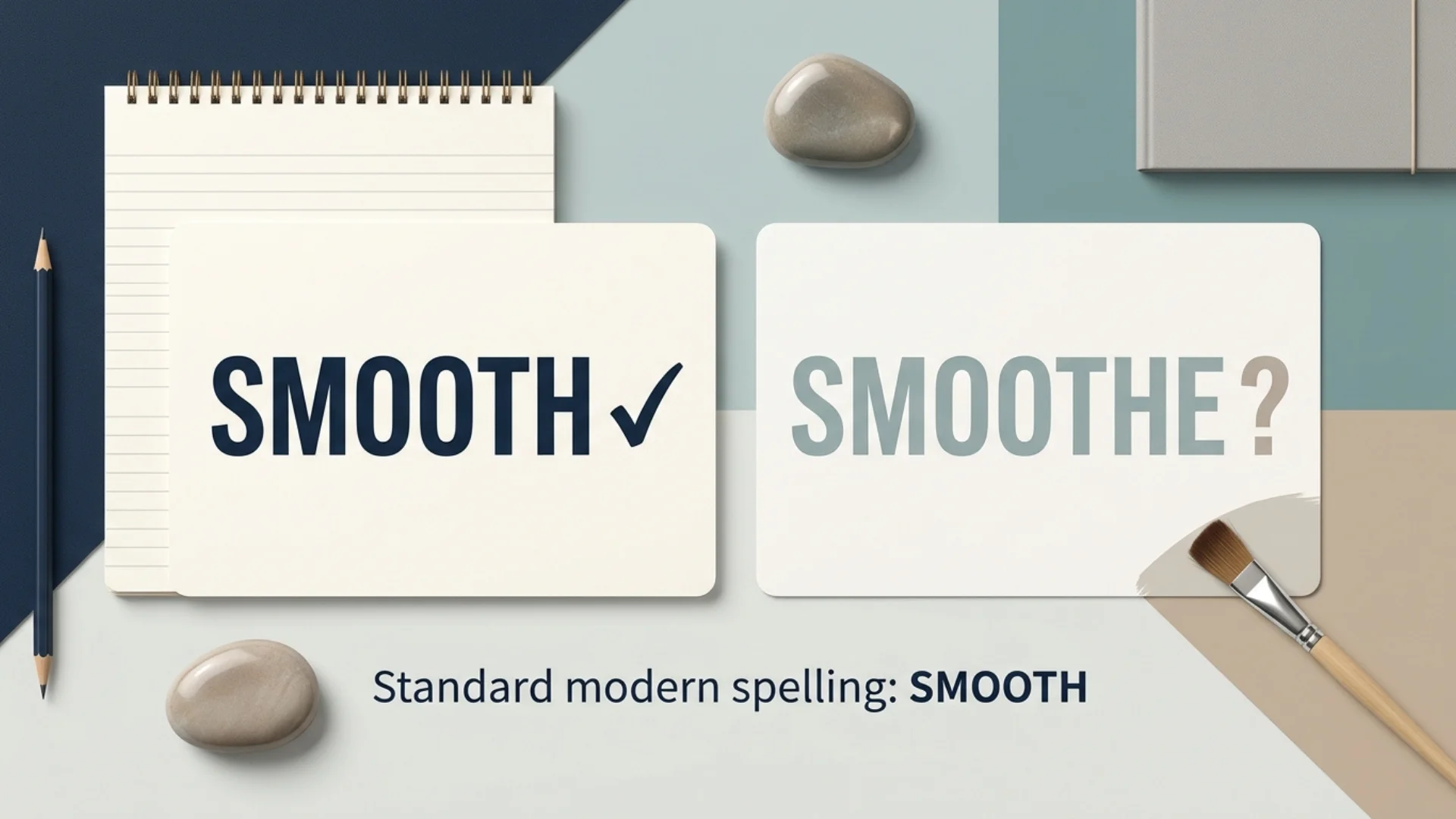
Smooth vs. smoothe has a simple modern answer: use smooth in standard English. Smooth works as both an adjective and a verb, while smoothe survives mainly as a rare historical or alternative spelling and is not the normal choice for everyday, academic, professional, or edited writing.
Write a smooth surface, smooth the edges, she smooths her hair, and he smoothed the fabric. The extra e is not needed in the base verb.
Quick Answer: Smooth or Smoothe?
| Form | Modern Standard? | Example |
|---|---|---|
| smooth | Yes | The road is smooth. |
| smooth | Yes, as a verb | Smooth the paper flat. |
| smoothe | Rare / historical alternative | Avoid in ordinary modern writing. |
| smooths | Yes | She smooths the blanket. |
| smoothes | Also recorded | She smoothes the blanket. |
| smoothed | Yes | He smoothed the surface. |
| smoothing | Yes | She is smoothing the fabric. |
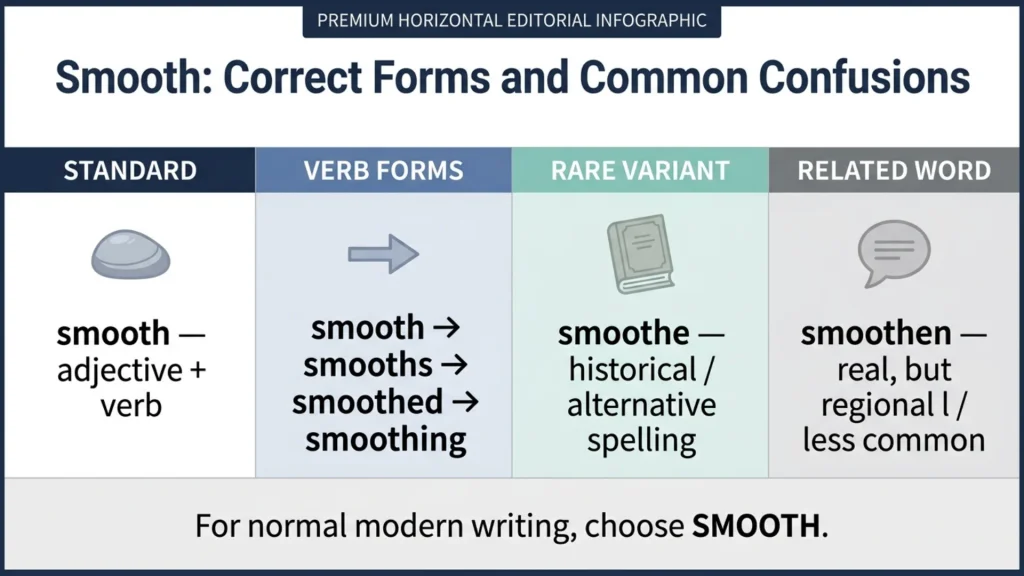
| smoothen | Yes, but regional / less common | The tool helps smoothen the surface. |
The safest rule is easy: if you mean “even, polished, free from roughness,” or “to make something smooth,” spell the word smooth.
What Is the Difference Between Smooth and Smoothe?
Smooth is the normal modern spelling. It functions as an adjective, verb, and sometimes a noun.
Smoothe is not the spelling most writers should choose today. Some dictionaries record it as an alternative form, and it can appear in older writing, dialectal use, surnames, brand names, or deliberate stylization. That does not make it the preferred spelling in modern prose.
The distinction is therefore mostly about standard usage, not meaning. When writers type smoothe, they usually mean the same thing as smooth.
How Do You Spell Smooth?
The standard spelling is:
S-M-O-O-T-H
There is no final e in the usual modern form.
- smooth surface
- smooth skin
- smooth transition
- smooth voice
- smooth the edge
- smooth out the wrinkles
- smooth over a disagreement
A useful memory trick is that the adjective and verb use the same spelling:
- The table feels smooth.
- Please smooth the table surface.
Smooth Definition and Meaning
The central meaning of smooth is something free from roughness, irregularity, interruption, or difficulty.
The Merriam-Webster entry for smooth lists it as both an adjective and a verb. As an adjective, it can describe an even surface or something free from difficulties. As a verb, it can mean to make something smooth, flatten it, remove obstacles, or reduce friction.
Smooth as an Adjective
- The stone has a smooth surface.
- She has smooth hair.
- It was a smooth flight.
- The project had a smooth launch.
- He has a smooth speaking style.
Smooth as a Verb
- Smooth the icing before decorating the cake.
- She smoothed the wrinkles out of the sheet.
- He tried to smooth over the disagreement.
- The new process should smooth the transition.
The spelling does not change to smoothe just because the word is being used as a verb.
Smooth Verb Forms
| Verb Form | Spelling | Example |
|---|---|---|
| Base form | smooth | They smooth the surface. |
| Third-person singular | smooths | She smooths her hair. |
| Alternative third-person form | smoothes | She smoothes the fabric. |
| Past tense | smoothed | He smoothed the paper. |
| Past participle | smoothed | The edge has been smoothed. |
| Present participle | smoothing | She is smoothing the blanket. |
Smooths or Smoothes: Which Is Correct?
Smooths is the straightforward and common third-person singular form:
- She smooths her hair before leaving.
- The software smooths the data.
- This cream smooths the appearance of dry skin.
Smoothes is also recorded by major dictionaries as an alternative third-person form. It is less common, but it should not be confused with smoothe as the base verb.
The simplest conjugation to remember is:
smooth → smooths → smoothed → smoothing
What Does Smoothes Mean?
Smoothes means “makes smooth” or “causes something to become more even, flat, calm, or free from difficulty.” It is an alternative third-person singular form of the verb smooth.
- The brush smoothes the paint.
- The filter smoothes sudden changes in the data.
- She smoothes the fabric with her hand.
In many contexts, smooths is more common and visually simpler.
Is Smoothe a Word?
Smoothe has historical and dictionary-recorded use as an alternative spelling of the verb smooth, but it is rare in current standard writing.
That makes two oversimplified claims worth avoiding:
- “Smoothe has never been a word.” Too absolute.
- “Smoothe and smooth are equally standard today.” Also misleading.
For modern English, choose smooth unless you are quoting historical text, preserving a proper name, or intentionally reproducing a rare variant.
Smooth or Smoothe in UK English?
Use smooth in normal British English as well as American English.
- UK: a smooth journey
- US: a smooth journey
- UK: smooth the surface
- US: smooth the surface
The main spelling choice does not switch between British and American English. Smoothe may appear historically or exceptionally, but it is not the normal UK spelling of the modern word.
How Is Smooth Pronounced?
Smooth is pronounced approximately “smoov”, with the final th voiced, like the sound in this rather than the sound in thin.
The IPA pronunciation is commonly written /smuːð/.
That voiced ending may help explain why some writers expect a spelling similar to soothe or breathe. English spelling, being English spelling, declines to behave that politely.
Why Do People Write Smoothe?
The extra e feels plausible because several English verbs end in -the:
- breath → breathe
- cloth → clothe
- bath → bathe
- tooth → teethe
That pattern can make smoothe look natural. But smooth already functions as both the adjective and the verb:
- The finish is smooth.
- Smooth the finish.
No extra letter is required to turn it into a verb.
Smooth vs. Smoothen
Smoothen is a real verb meaning “to make or become smooth.” It is especially associated with Indian English and appears in other regional or technical contexts.
- The treatment helps smoothen the surface.
- The software smoothens fluctuations in the signal.
In broad international, US, and UK edited English, the shorter verb smooth is often more natural:
- Smooth the surface.
- The software smooths fluctuations.
Is Smoothen a Word?
Yes. Smoothen is an established verb. It is not simply a misspelling of smooth, although its frequency and naturalness vary by dialect.
Smooth Out or Smoothen Out?
Smooth out is generally the more common and natural expression in international English.
- Smooth out the wrinkles.
- We need to smooth out the process.
- They tried to smooth out the disagreement.
Smoothen out can occur, particularly in regional varieties, but it is usually more wordy than necessary.
Smooth vs. Smoothie
Smooth and smoothie are different words.
- smooth — adjective or verb: The sauce is smooth.
- smoothie — noun: a blended drink, usually made with fruit and other ingredients.
The spelling smoothie does not imply that smoothe is the standard base word. It is simply the established spelling of a different noun.
Smooth vs. Smoove
Smoove is a nonstandard or stylized spelling that may be used in names, branding, music, slang, or playful writing.
For ordinary English prose:
- smooth = standard spelling
- smoove = stylized or nonstandard
If you mean polished, easy, suave, or free from roughness in formal writing, use smooth.
Smooth vs. Rough
Smooth and rough are common opposites when describing texture, movement, sound, or experience.
| Smooth | Rough |
|---|---|
| smooth stone | rough stone |
| smooth skin | rough skin |
| smooth ride | rough ride |
| smooth surface | rough surface |
| smooth transition | rough transition |
What Does Smooth Mean in Indonesian?
For Indonesian learners searching arti smooth or smooth artinya, the translation depends on context. Common equivalents include:
- halus — smooth or fine in texture
- licin — smooth/slippery
- lancar — smooth in the sense of running or proceeding without difficulty
For example, a smooth surface may be translated differently from a smooth process, so context matters more than a single one-word translation.
Synonyms for Smooth
The best substitute depends on what smooth means in the sentence.
For a Surface or Texture
- even
- flat
- polished
- silky
- sleek
- level
For a Process or Experience
- seamless
- effortless
- uninterrupted
- easy
- fluid
- trouble-free
For a Person’s Manner
- suave
- polished
- charming
- confident
- urbane
What Is a More Professional Way to Say Smooth?
For professional writing, alternatives such as seamless, efficient, polished, streamlined, uninterrupted, or well-coordinated may be more precise.
Instead of:
The implementation was smooth.
You might write:
- The implementation was seamless.
- The rollout proceeded efficiently.
- The transition was well coordinated.
- The process ran without interruption.
Is “Smooth” Slang?
Smooth itself is a standard English word, but it can be used informally to describe someone who is charming, confident, persuasive, or socially skilled.
- He is a smooth talker.
- That was a smooth move.
- She handled the situation smoothly.
Informal alternatives can include slick, suave, or cool, depending on context. They are not exact synonyms in every sentence.
Common Smooth vs. Smoothe Mistakes
| Avoid | Prefer |
|---|---|
| Smoothe the edges. | Smooth the edges. |
| The table feels smoothe. | The table feels smooth. |
| She smoothe her hair. | She smooths her hair. |
| He smooth the fabric yesterday. | He smoothed the fabric yesterday. |
| She is smoothening it. | She is smoothing it. (widely preferred) |
Easy Rule to Remember
Think of one sentence:
The surface is smooth, so smooth the surface.
The spelling stays smooth whether it is an adjective or a verb.
Then remember the main verb forms:
- smooth
- smooths
- smoothed
- smoothing
If you are working through other common grammar choices, our guides to people do or people does and was there or were there use the same quick-rule-and-examples approach.
Practice: Choose the Correct Form
- Please ___ the blanket before folding it. (smooth / smoothe)
- The stone feels ___. (smooth / smoothe)
- She ___ her hair with her hand. (smooths / smooth)
- He ___ the paper yesterday. (smoothed / smootheed)
- She is ___ the icing. (smoothing / smoothening)
- The team tried to ___ out the problem. (smooth / smoothe)
Answers
- smooth
- smooth
- smooths
- smoothed
- smoothing
- smooth
Frequently Asked Questions
When to use smooth and smoothe?
Use smooth in normal modern writing as both an adjective and a verb. Smoothe is a rare historical or alternative spelling and is usually avoided in contemporary edited English.
Is it smooth out or smoothen out?
Smooth out is generally the more natural and widely used phrase. Smoothen out exists in some regional varieties but is usually unnecessary.
Does smooth have an e on the end?
No. The standard spelling is smooth, ending in -th. The past tense is smoothed, where an e appears as part of the -ed ending.
Is “smooths” or “smoothes” the correct spelling?
Both forms are recorded, but smooths is the simpler and more common third-person singular form. For example: She smooths the blanket.
What does “smoothes” mean?
Smoothes is an alternative third-person singular form of the verb smooth. It means “makes smooth,” “flattens,” or “reduces irregularity.”
What is another word for “smooth”?
Depending on context, alternatives include even, polished, sleek, silky, seamless, effortless, fluid, suave, and streamlined.
What is a professional way to say “smooth”?
In professional contexts, consider seamless, efficient, streamlined, well-coordinated, or uninterrupted, depending on the sentence.
What is an urban slang term for “smooth”?
Informal choices can include slick, suave, or cool, but each has a different tone and should be chosen according to context.
What can I say instead of smooth?
Use a more precise synonym: polished for appearance, seamless for a process, sleek for design, fluid for movement, or suave for manner.
Final Rule
For smooth vs. smoothe, use smooth in modern standard English. It works as both the adjective and the verb: a smooth surface and smooth the surface.
Smoothe has historical and alternative-spelling evidence, but it is not the form most readers, editors, schools, or professional contexts expect today. If you want the safest spelling, leave the extra e unemployed.