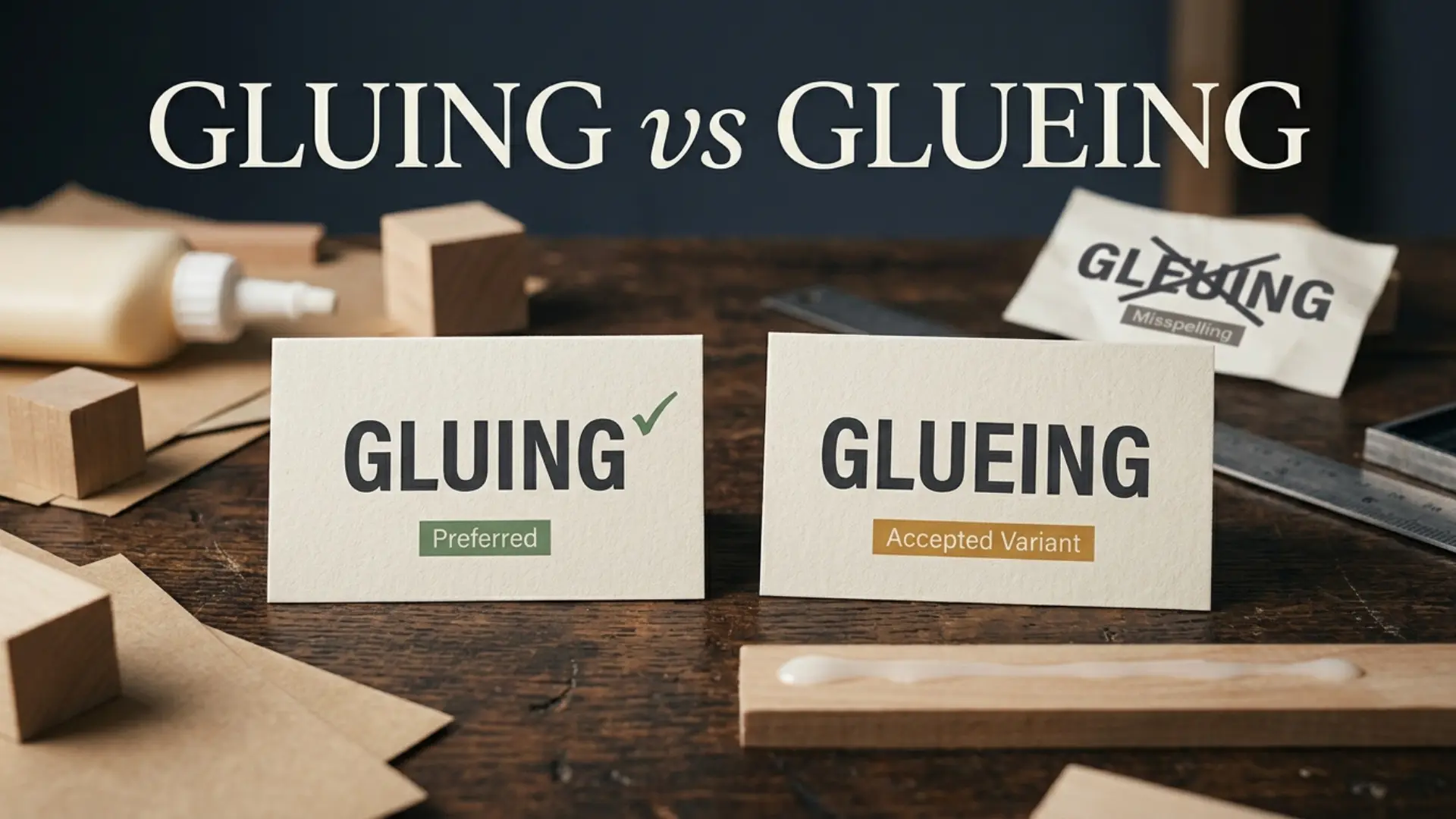
Gluing vs Glueing: Which Spelling Is Correct?
Gluing vs glueing is not quite as simple as “one is a word and the other is wrong.”
Both spellings are documented forms of the verb glue, but gluing is the more common and safer choice in modern everyday writing.
Use:
She is gluing the pieces together.
You may also see:
She is glueing the pieces together.
That second form looks unusual to many readers, but major dictionaries still record it as a variant.
So the practical rule is:
Use gluing by default.
Recognize glueing as an accepted but less common variant.
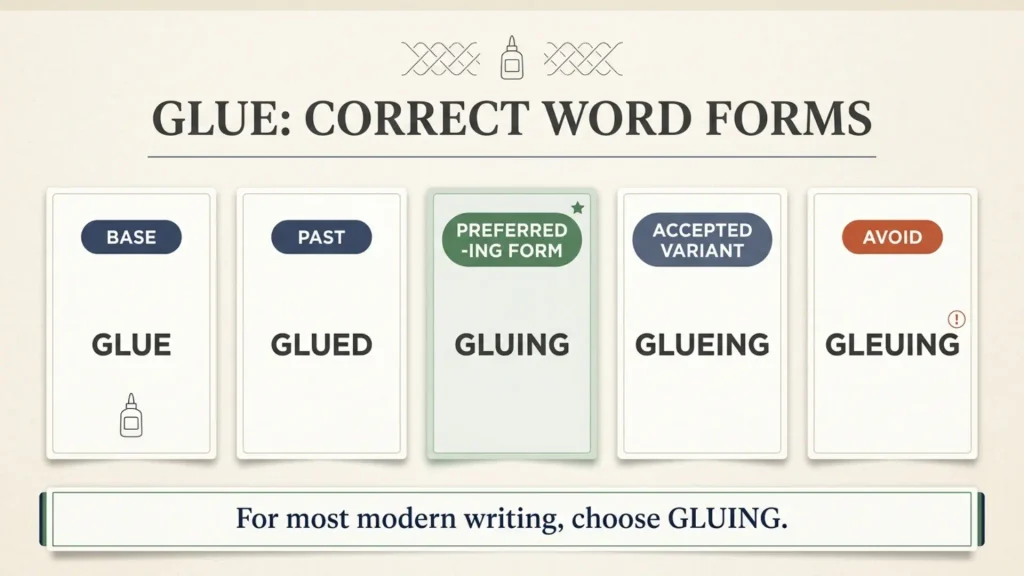
Quick Answer: Gluing or Glueing?
| Spelling | Accepted? | Best Use |
|---|---|---|
| gluing | Yes | Preferred default |
| glueing | Yes, as a variant | Less common |
| gleuing | No | Misspelling |
| glued | Yes | Past tense / past participle |
| glue | Yes | Base verb |
If you are writing:
- an essay
- a school assignment
- a professional email
- website copy
- instructions
- business documents
- academic writing
gluing is usually the best spelling to choose.
What Does Gluing Mean?
Gluing means joining, attaching, or sticking things together with glue or another adhesive.
Examples:
She is gluing paper onto cardboard.
He spent the afternoon gluing the broken model together.
Gluing wood properly requires even pressure.
We are gluing labels onto the boxes.
The word can act as either:
- a present participle
- a gerund
Gluing as a Present Participle
A present participle helps form continuous verb tenses.
Example:
She is gluing the pieces together.
Here, gluing is part of the verb phrase:
is gluing
More examples:
They were gluing decorations to the wall.
I am gluing the handle back onto the cup.
He has been gluing parts together all morning.
Gluing as a Gerund
A gerund uses the -ing form as a noun.
Example:
Gluing takes patience.
Here, gluing names an activity.
Other examples:
Gluing is easier with the right adhesive.
Proper gluing can improve the strength of the joint.
Gluing the pieces carefully prevents gaps.
What Does Glueing Mean?
Glueing has the same meaning as gluing.
It refers to joining or attaching things using glue.
The difference is spelling, not meaning.
For example:
Gluing the pieces together takes time.
and:
Glueing the pieces together takes time.
communicate the same idea.
However, gluing is much more familiar to modern readers, so it is normally the better editorial choice.
Is Glueing a Real Word?
Yes.
This is where many grammar articles oversimplify the issue.
Glueing is documented as a variant spelling of gluing.
Cambridge Dictionary lists the present participle of glue as “glueing or gluing.” You can verify that directly in the Cambridge Dictionary entry for glue.
That does not mean the two spellings are equally common.
For normal modern writing:
gluing is still the stronger default.
Why Do People Think Glueing Is Wrong?
Because glue ends in a silent e, and English commonly drops that e before adding -ing.
Compare:
- make → making
- hope → hoping
- write → writing
- use → using
- glue → gluing
So gluing looks like the spelling that follows the familiar pattern.
That is why many teachers, editors, and spellcheckers prefer it.
The Drop-the-E Rule
A common spelling rule says:
When a verb ends in silent e, drop the e before adding -ing.
Examples:
| Base Verb | -ing Form |
|---|---|
| make | making |
| take | taking |
| write | writing |
| hope | hoping |
| move | moving |
| glue | gluing |
This explains why gluing feels natural to most writers.
Why Does Glueing Exist Then?
English spelling is not a perfectly mechanical system, because apparently that would have been too merciful.
Some verbs ending in -ue have historically shown variation in their -ing forms.
As a result, glueing has remained documented alongside gluing in major dictionaries.
That makes it different from obvious spelling errors such as:
gleuing ❌
Gluing vs Glueing: Main Difference
| Feature | Gluing | Glueing |
|---|---|---|
| Meaning | Joining with glue | Joining with glue |
| Pronunciation | Same | Same |
| Dictionary recognition | Yes | Yes |
| Frequency | More common | Less common |
| Best general choice | Yes | Usually not |
| Professional default | Recommended | Usually avoided |
Which Is More Common: Gluing or Glueing?
Gluing is more common in modern writing.
It appears more naturally in:
- instructions
- manuals
- education
- craft guides
- woodworking
- product documentation
- technical writing
- everyday English
Because readers recognize it immediately, it usually creates less friction.
So even though glueing is documented, there is rarely a practical reason to prefer it unless:
- a publication style requires it
- you are quoting original text
- you are preserving historical spelling
- a specialist context uses it consistently
Is It Gluing or Glueing in American English?
Use:
gluing
It is the safest and most familiar spelling in American English.
The existence of glueing should not be treated as proof of a simple British-vs-American distinction.
Is It Gluing or Glueing in British English?
Gluing is also completely standard in British English.
Glueing appears as a recognized variant in dictionary sources, but that does not mean British writers universally prefer it.
So do not use this oversimplified rule:
American = gluing
British = glueing
That is not a reliable distinction.
How Do You Spell Gluing?
The preferred spelling is:
G-L-U-I-N-G
gluing
Notice that the final e in glue is removed:
glue + ing → gluing
How Do You Spell Glueing?
The variant form is:
G-L-U-E-I-N-G
glueing
It preserves the e from glue before adding -ing.
It is less common, so if you are simply trying to choose one spelling, use:
gluing
Glue + Ing: What Happens?
The normal preferred formation is:
glue → gluing
not:
glue → glueing
for most everyday writing.
The same general spelling pattern appears in:
- use → using
- move → moving
- change → changing
- write → writing
If tricky spelling forms keep ambushing your sentences, see GrammarRead’s guide to Resetted or Reset.
Gluing Definition
Gluing can be defined as:
the act or process of joining, fixing, or attaching something with glue or adhesive
Examples:
The gluing process took twenty minutes.
Gluing the edge first made the repair easier.
Industrial gluing can replace mechanical fasteners in some applications.
Glueing Definition
Glueing means the same thing as gluing.
It can refer to:
- sticking
- attaching
- bonding
- joining
- fixing with adhesive
The distinction is spelling preference, not definition.
Gluing Meaning in Simple English
In simple terms:
gluing = sticking things together with glue
Example:
He is gluing two pieces of paper together.
Glueing Meaning in Simple English
Same meaning:
glueing = sticking things together with glue
It is simply the less common spelling.
Is It “I Am Gluing” or “I Am Glueing”?
Both can be recognized, but use:
I am gluing the pieces together.
for normal modern writing.
That spelling will look natural to the greatest number of readers.
Is It “Gluing Together” or “Glueing Together”?
Preferred:
gluing together
Variant:
glueing together
Example:
She is gluing the broken frame together.
Is It “Gluing Paper” or “Glueing Paper”?
Preferred:
gluing paper
Example:
The children are gluing paper shapes onto cards.
You may encounter glueing paper, but gluing paper is the cleaner default.
Is It “Gluing Wood” or “Glueing Wood”?
Use:
gluing wood
Example:
Gluing wood requires clean surfaces and enough clamping pressure.
The grammar is the same regardless of the material.
Is It “Gluing Fabric” or “Glueing Fabric”?
Preferred:
gluing fabric
Example:
She is gluing fabric onto the decorative panel.
Past Tense of Glue
The past tense is:
glued
Examples:
I glued the pieces together.
She glued the label onto the box.
They glued the broken part back into place.
The past participle is also:
glued
The pieces have been glued together.
Glue Verb Forms
| Form | Word |
|---|---|
| Base verb | glue |
| Third-person singular | glues |
| Past tense | glued |
| Past participle | glued |
| Preferred -ing form | gluing |
| Variant -ing form | glueing |
Is “Gleuing” Correct?
No.
Gleuing is a misspelling.
Correct:
gluing
Accepted variant:
glueing
Incorrect:
gleuing
The letters u and e should not switch places.
Why Gleuing Is Wrong
The base word is:
glue
When forming the common -ing spelling, you drop the final e:
glu + ing = gluing
You do not rearrange the word into:
gleu
So:
gleuing ❌
Glue Spelling
The base word is:
glue
Spelled:
G-L-U-E
Examples:
Please pass me the glue.
I need to glue this handle back on.
Do not confuse the base spelling with its preferred -ing form:
glue
gluing
Glued vs Gluing
Glued
Past action or past participle:
She glued the pieces together yesterday.
Gluing
Ongoing activity:
She is gluing the pieces together now.
Compare:
The label was glued onto the bottle.
He is gluing another label onto the bottle.
For another past-vs-base-form comparison, see Drove vs Driven.
Gluing vs Glued
The difference is primarily tense and grammatical function.
| Word | Function | Example |
|---|---|---|
| gluing | -ing form | She is gluing the card. |
| glued | past / past participle | She glued the card. |
Is Gluing a Noun?
It can function like one.
Example:
Gluing is the final step.
Here gluing is a gerund.
It names an activity.
Is Gluing a Verb?
It can also be part of a verb phrase.
Example:
She is gluing the pieces.
Here it is the present participle of glue.
Gluing Synonyms
Depending on context, synonyms or close alternatives include:
- sticking
- attaching
- bonding
- joining
- adhering
- fastening
- affixing
- cementing
- fixing
- mounting
- securing
- pasting
Not every synonym works in every context.
For example:
gluing paper
may become:
pasting paper
But:
structural adhesive bonding
is a more technical phrase.
Another Word for Gluing
The simplest alternatives are:
sticking
attaching
bonding
Example:
We are gluing the panels together.
could become:
We are bonding the panels together.
Fancy Word for Glue
Depending on context, a more formal word for glue is:
adhesive
Example:
Apply the adhesive evenly.
Instead of:
Apply the glue evenly.
Other related words include:
- bonding agent
- cement
- paste
- sealant
But these are not always interchangeable because different materials serve different purposes.
Fancy Word for “Put Together”
Depending on meaning:
- assemble
- combine
- construct
- join
- integrate
- unite
- connect
- compile
- consolidate
- compose
Example:
We put the frame together.
More formal:
We assembled the frame.
Fancy Word for “Gunk”
Possible alternatives depend heavily on what the substance actually is.
Words may include:
- residue
- sludge
- grime
- muck
- buildup
- deposit
- goo
- adhesive residue
- contaminant
For example:
Remove the sticky gunk.
More precise:
Remove the adhesive residue.
Gluing in Craft Writing
Examples:
Start by gluing the paper to the cardboard.
Avoid gluing the edges until the pieces are aligned.
She finished the project by gluing on the decorations.
Let the glue dry after gluing each section.
Gluing in Woodworking
Examples:
Proper gluing begins with clean surfaces.
He is gluing the joint before clamping it.
Gluing end grain may require special preparation.
The pieces were glued and clamped overnight.
Gluing in Technical Writing
In technical or professional contexts, you may also encounter:
- adhesive bonding
- bonding process
- adhesive application
- surface bonding
- lamination
- joining process
These terms may be more precise than gluing depending on the material and process.
Gluing in a Sentence
Here are 20 examples:
- She is gluing the photograph into her scrapbook.
- I am gluing the handle back onto the cup.
- They spent the afternoon gluing decorations.
- He is gluing the model together.
- Gluing the pieces requires patience.
- We are gluing fabric onto cardboard.
- She kept gluing the labels crookedly.
- Gluing wood is easier with clean surfaces.
- The children are gluing shapes onto paper.
- He finished gluing the final panel.
- I avoid gluing anything until I check the alignment.
- Proper gluing can strengthen the joint.
- She was gluing beads onto the costume.
- They are gluing tiles onto the board.
- He started gluing the frame at noon.
- Gluing plastic may require a suitable adhesive.
- I am gluing the loose edge now.
- She prefers gluing rather than stapling the material.
- We finished gluing all the parts.
- Gluing the components incorrectly can weaken the assembly.
Glueing in a Sentence
Because glueing is an accepted variant, sentences such as these are possible:
She is glueing the pieces together.
They spent the morning glueing labels onto boxes.
Glueing requires a steady hand.
However, if you are editing the text for broad modern readership, changing those to gluing is usually sensible.
Should Editors Change Glueing to Gluing?
Usually, yes, if the publication prefers the dominant modern form.
An editor may change:
glueing
to:
gluing
for:
- consistency
- readability
- house style
- reader expectations
That does not necessarily mean glueing is linguistically invalid.
Why Spellcheck May Flag Glueing
Spellcheck systems do not all use the same dictionary.
A program may prefer the dominant form gluing and flag glueing, even though a major dictionary records the variant.
This is why spellcheck is useful but not a substitute for dictionary evidence.
English spelling software, much like humans, occasionally develops very strong opinions from incomplete information.
Is Glueing Old-Fashioned?
It can look old-fashioned or unusual to modern readers because gluing dominates current general usage.
However, calling it purely obsolete would be too strong because contemporary dictionaries still document it.
A better description is:
recognized but less common variant
Is Glueing British?
Not exclusively.
Do not treat:
gluing = American
and:
glueing = British
as a strict rule.
British sources also use gluing, and dictionaries recognize variation.
Is Gluing American?
It is standard in American English, but it is not exclusively American.
It is also widely used outside the United States.
Why Gluing Is the Best Default
Choose gluing because it:
- is widely recognized
- follows the familiar drop-e pattern
- looks natural to most readers
- is common in professional writing
- reduces unnecessary spelling questions
So even when both forms are defensible, one is clearly more convenient.
Similar Words That Drop the Final E
Examples:
- bake → baking
- come → coming
- drive → driving
- give → giving
- have → having
- hope → hoping
- make → making
- move → moving
- take → taking
- use → using
- write → writing
For another spelling-choice article, see Too Early vs To Early.
Words That Keep the E Before -ing
The simple “always drop e” rule has exceptions.
Examples:
- see → seeing
- agree → agreeing
- flee → fleeing
- free → freeing
- knee → kneeing
Some spellings preserve the vowel sequence because simply removing the e would produce a different-looking or confusing form.
Dyeing vs Dying
This is a useful example of why -ing spelling rules cannot be reduced to one line.
dye → dyeing
because:
dying
already serves as the -ing form of die.
English sometimes preserves letters to keep meanings distinct.
Aging vs Ageing
Another example of accepted spelling variation is:
- aging
- ageing
Both occur, with preferences varying by region and style.
That makes it easier to understand why dictionaries can record more than one spelling for a word without both forms being equally frequent.
Judgment vs Judgement
Likewise, English sometimes maintains multiple standard spellings.
The existence of a more common form does not automatically make the less common form imaginary.
That is the important lesson in gluing vs glueing.
Is Glueing a Scrabble Word?
Yes.
Glueing is listed as playable in Merriam-Webster’s Scrabble word resource.
That fits the broader dictionary evidence that glueing is an attested variant.
However, tournament word lists can be updated over time, so players should always use the official list required by their specific game or event.
Is Gluing a Scrabble Word?
Yes.
Gluing is also playable.
So the spelling question in normal prose and the question of Scrabble legality should not be confused.
Gluing or Glueing for SEO Writing?
Use:
gluing
in normal article copy unless you are intentionally discussing the spelling variant.
Why?
Because readers are more likely to recognize gluing immediately.
But if your topic is literally:
Gluing vs Glueing
then naturally discuss both spellings.
Gluing or Glueing in Academic Writing?
Use:
gluing
unless:
- your style guide specifies otherwise
- you are quoting a source
- a specialist field uses a different convention
Consistency matters more than trying to look unusual.
Gluing or Glueing in Professional Emails?
Prefer:
gluing
Example:
We are gluing the protective layer onto the panel.
That form is least likely to distract the reader.
Gluing or Glueing in School?
Use:
gluing
unless your teacher or assigned dictionary specifically accepts or requests the variant form.
It is the easiest spelling to defend in standard educational writing.
How to Remember the Spelling
Use this simple memory trick:
Glue loses the E when ING arrives.
glue
gluing
You can compare it with:
make
making
or:
use
using
Common Mistakes
Mistake 1: Writing Gleuing
Incorrect:
gleuing
Correct:
gluing
Variant:
glueing
Mistake 2: Saying Glueing Has a Different Meaning
It does not.
Gluing and glueing refer to the same action.
Mistake 3: Calling Glueing Completely Fake
That claim is too strong because major dictionaries record it.
Mistake 4: Assuming Glueing Is Automatically British
There is no simple US/UK split.
Mistake 5: Thinking Gluing Is Only a Verb
It can also function as a gerund:
Gluing is difficult.
Gluing vs Glueing Examples
| Example | Recommendation |
|---|---|
| She is gluing the paper. | Preferred |
| She is glueing the paper. | Accepted variant |
| He spent an hour gluing the model. | Preferred |
| He spent an hour glueing the model. | Accepted variant |
| They are gleuing the pieces. | Incorrect |
| The parts were glued together. | Correct |
Frequently Asked Questions
Is glueing a Scrabble word?
Yes. Glueing is playable in Merriam-Webster’s Scrabble word resource. Check the official word list required by your particular tournament or version because game dictionaries can change.
What does glueing mean?
Glueing means joining or attaching things with glue. It has the same meaning as gluing.
What is the past tense of glue?
The past tense is:
glued
Example:
She glued the pieces together.
How do you spell glue with ing?
The preferred spelling is:
gluing
The variant:
glueing
is also recorded by major dictionaries.
Which is correct, gluing or glueing?
Both are documented, but gluing is the better default for most modern writing.
What is another word for “gluing”?
Possible alternatives include:
- sticking
- attaching
- bonding
- adhering
- affixing
- joining
- fastening
- cementing
What is a fancy way to say “glue”?
Depending on context, use:
adhesive
or:
bonding agent
What is a fancy word for put together?
Depending on context:
- assemble
- combine
- construct
- integrate
- join
- consolidate
What is a fancy word for “gunk”?
Depending on the substance:
- residue
- sludge
- grime
- buildup
- deposit
- adhesive residue
Final Answer: Gluing vs Glueing
For most writing, choose:
gluing
Example:
She is gluing the pieces together.
However, glueing is not simply an invented spelling. Major dictionaries document it as a variant of the same verb form.
So the most accurate summary is:
Gluing = preferred and more common
Glueing = recognized but less common variant
Gleuing = misspelling
If you only want one spelling to remember, make it:
gluing