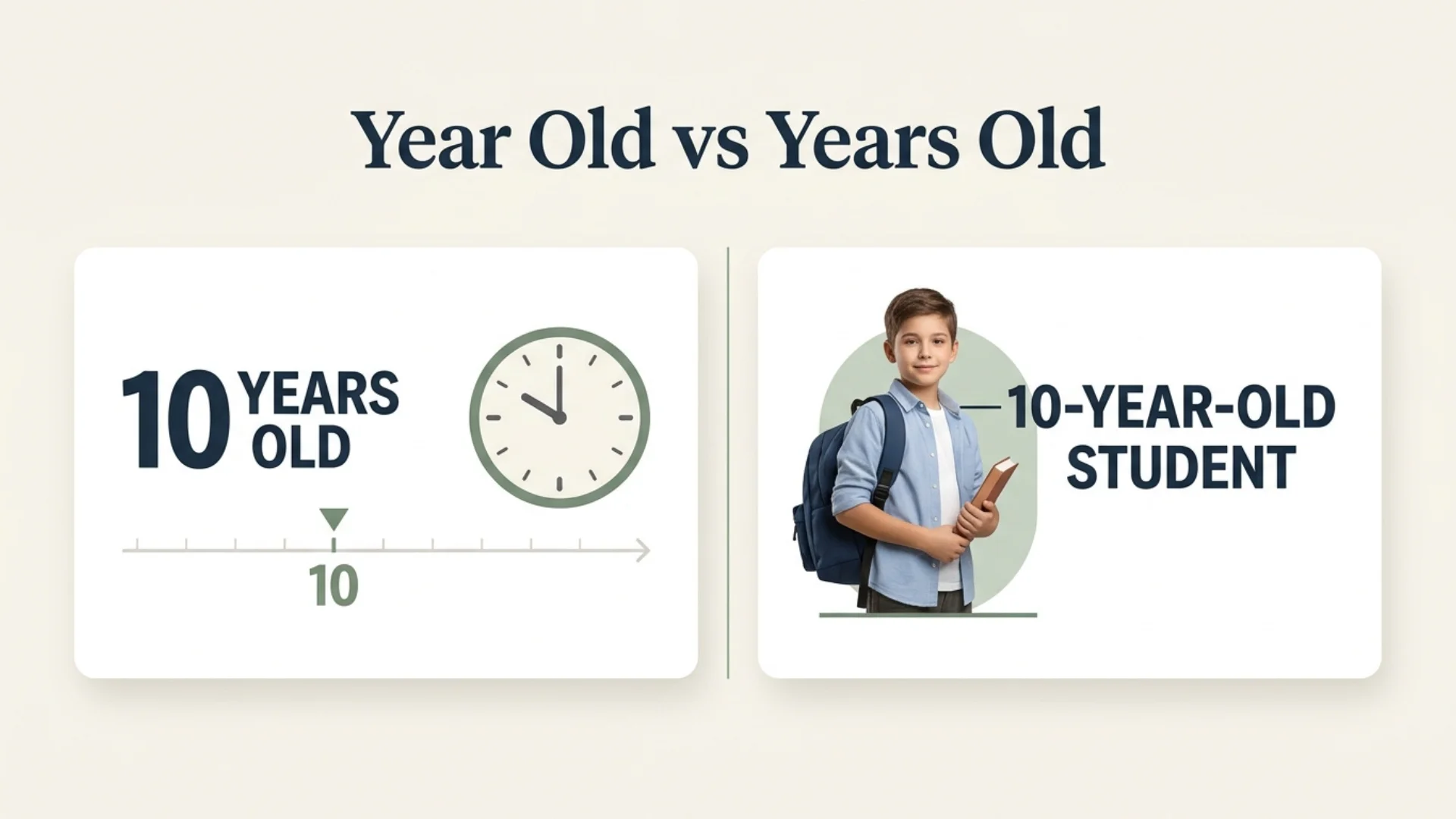
Year Old vs Years Old: Correct Grammar, Hyphens & Examples
Year old vs years old is mainly a question of sentence position, number, and hyphenation. Both forms are correct, but they are used differently.
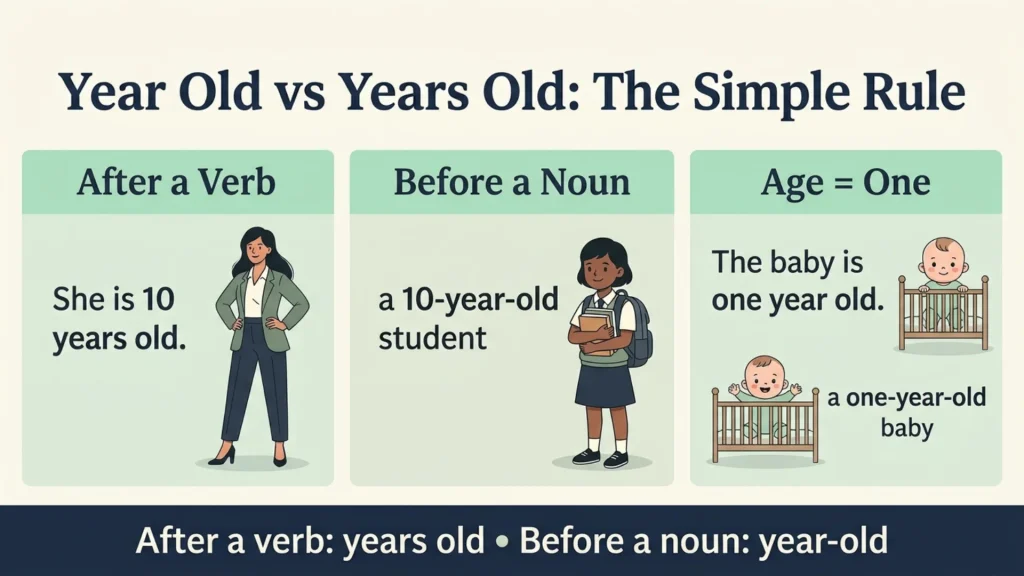
The simplest rule is:
- Use years old after a verb when the age is more than one: She is 10 years old.
- Use year old after a verb when the age is exactly one: The baby is one year old.
- Use year-old inside a hyphenated compound before a noun: a 10-year-old student.
- Use year-old as a noun-like age label: The 10-year-old won the race.
So “10 years old” and “a 10-year-old child” are both correct. What changes is the grammatical job the age expression is doing.
Quick Answer: Year Old vs Years Old
| Structure | Correct Form | Example |
|---|---|---|
| Age after a verb, more than one | years old | He is 14 years old. |
| Age after a verb, exactly one | year old | The baby is one year old. |
| Age before a noun | year-old | a 14-year-old student |
| Age used as a noun | year-old / year-olds | a 14-year-old / two 14-year-olds |
If you remember only one thing, remember this:
After a verb: “years old.” Before a noun: “year-old.”
Why “Year Old” and “Years Old” Change
English handles ages differently depending on whether the age phrase is acting as a normal description after a verb or as a compound modifier before a noun.
After a Verb: Use “Years Old”
When you state someone’s age after is, am, are, was, or were, use the ordinary singular or plural form of year.
For ages greater than one:
- I am 18 years old.
- She is 25 years old.
- The building is 100 years old.
- My dog is 3 years old.
For exactly one:
- The baby is one year old.
- The puppy is 1 year old.
Because one is singular, “one years old” is incorrect.
Before a Noun: Use a Hyphenated “Year-Old” Form
When the age comes directly before a noun, the entire age expression works as a compound adjective.
- a 5-year-old child
- a 10-year-old car
- a 14-year-old student
- a 40-year-old building
Notice that year stays singular even when the number is greater than one.
That is because 5-year-old works as one compound modifier. The same pattern appears in expressions such as:
- a five-mile walk
- a three-hour meeting
- a two-week holiday
- a ten-dollar bill
For more compound-word and hyphen examples, see our guide to How-To vs. How-Tos.
Year Old vs Year-Old: What Is the Difference?
Year old without a hyphen usually appears after a number in a normal age statement:
The baby is one year old.
Year-old with a hyphen appears as part of a compound modifier or noun:
She has a one-year-old baby.
The one-year-old is sleeping.
For ages greater than one, the contrast becomes even clearer:
- The boy is seven years old.
- He is a seven-year-old boy.
- The seven-year-old is reading.
Is It One Year Old or One Years Old?
The correct form is one year old.
Correct:
- My daughter is one year old.
- The phone is 1 year old.
Incorrect:
- My daughter is one years old.
- The phone is 1 years old.
The reason is simple: one takes the singular noun year.
Is It 1 Year or 1 Years?
Use 1 year, not “1 years.”
Examples:
- I lived there for 1 year.
- The contract lasts 1 year.
- The child is 1 year old.
With numbers above one, use the plural:
- 2 years
- 5 years
- 10 years
If plural forms in English keep finding ways to be inconvenient, our Passerbyers vs. Passersby vs. Passerby guide deals with a much stranger plural problem.
Is It 2 Year or 2 Years?
By itself, use 2 years.
Correct:
- I worked there for 2 years.
- The dog is 2 years old.
But before another noun, year becomes singular inside a compound adjective:
- a 2-year contract
- a 2-year-old dog
So both of these are correct:
The dog is 2 years old.
It is a 2-year-old dog.
5 Year Old or 5-Year-Old?
Before a noun, the standard form is 5-year-old.
Correct:
- a 5-year-old child
- a 5-year-old laptop
Incorrect in standard edited writing:
- a 5 year old child
- a 5 years old child
- a 5-years-old child
After a verb, use:
The child is 5 years old.
Hyphens join the number, year, and old when they work together as one modifier before a noun. The Microsoft Writing Style Guide’s hyphen guidance likewise distinguishes compound modifiers from predicate adjectives.
10 Years Old or 10-Year-Old?
Both are correct in different structures.
Use “10 Years Old” After a Verb
- She is 10 years old.
- The computer is 10 years old.
Use “10-Year-Old” Before a Noun
- a 10-year-old girl
- a 10-year-old computer
Use “10-Year-Old” as a Noun
- The 10-year-old answered correctly.
- Two 10-year-olds joined the group.
12 Years Old or 12-Year-Old?
Use 12 years old after a linking verb:
He is 12 years old.
Use 12-year-old before a noun:
He is a 12-year-old student.
You can also use the hyphenated expression as a noun:
The 12-year-old won the competition.
14 Years Old or 14-Year-Old?
The rule does not change at 14.
- She is 14 years old.
- She is a 14-year-old student.
- The 14-year-old joined the team.
Do not write “a 14 years old student.”
18 Years Old or 18-Year-Old?
If you are stating your age, write:
I am 18 years old.
Not:
I am 18 year-old.
But before a noun:
an 18-year-old student
And as a noun:
an 18-year-old
25 Years Old or 25-Year-Old?
Again, sentence position determines the form.
- She is 25 years old.
- She is a 25-year-old engineer.
- The 25-year-old started a business.
26 Year Old or 26 Years Old?
If the age comes after a verb, use 26 years old.
Correct:
He is 26 years old.
If it comes before a noun, use:
a 26-year-old man
“He is 26 year old” is not standard.
40 Years Old or 40-Year-Old?
- She is 40 years old.
- She is a 40-year-old teacher.
- The 40-year-old changed careers.
This same grammar applies to people, animals, products, buildings, companies, traditions, and almost anything else whose age can be stated.
Do You Hyphenate “Years Old”?
Normally, no.
When the age follows a verb, do not hyphenate it:
- The child is six years old.
- The house is 80 years old.
Do not write:
- The child is six-years-old.
- The house is 80-years-old.
Before a noun, change the structure to the singular compound form:
- a six-year-old child
- an 80-year-old house
Why Does “Year” Stay Singular in “Five-Year-Old”?
Inside a compound adjective, year functions as part of the modifier rather than as an ordinary counted noun.
English commonly keeps measurement nouns singular inside compound modifiers:
- a five-mile walk
- a four-hour flight
- a three-day trip
- a ten-year-old building
That is why “five-years-old child” is incorrect.
Year-Olds or Year Olds?
When the hyphenated age expression functions as a noun and becomes plural, add -s to old:
- one five-year-old
- two five-year-olds
- a class of six-year-olds
The word year still stays singular.
This is similar to other compound-plural patterns where the plural marker does not necessarily go where a learner first expects it. Our guide to How-To vs. How-Tos covers another useful compound-plural case.
Year or Years: Singular and Plural Rule
The basic plural of year is years.
| Quantity | Correct Form |
|---|---|
| 1 | 1 year |
| 2 | 2 years |
| 5 | 5 years |
| 10 | 10 years |
That ordinary singular/plural rule changes only when year sits inside a compound modifier such as five-year-old or ten-year plan.
For another everyday plural spelling issue, see Tomatoes or Tomatos?
Years, Year’s, and Years’: What Is the Difference?
These forms look similar but perform different jobs.
Years
Years is simply the plural of year.
- five years
- many years
- She is 20 years old.
Year’s
Year’s is usually the singular possessive form.
- this year’s budget
- a year’s experience
- one year’s salary
Years’
Years’ is the plural possessive form.
- five years’ experience
- ten years’ service
This is an apostrophe issue, not an age-expression issue. For another possessive-form discussion, see our article on Driver’s License vs Drivers License.
Does “Years Old” Need an Apostrophe?
No.
Do not use an apostrophe when simply stating age.
Correct:
She is 30 years old.
Incorrect:
She is 30 year’s old.
The phrase is plural, not possessive.
How Do You Abbreviate “Years Old”?
Common informal or technical abbreviations include:
- yr for year
- yrs for years
- y/o for years old or year old in some informal, medical, and note-taking contexts
Examples:
- 6 yrs old
- 6 y/o
- a 6-year-old child
In polished general prose, spelling out years old is usually clearer.
Can “Year Old” Describe Things as Well as People?
Yes. The same grammar applies to objects, animals, organizations, buildings, and ideas.
- The car is five years old.
- It is a five-year-old car.
- The company is 20 years old.
- It is a 20-year-old company.
- The tree is 100 years old.
- It is a 100-year-old tree.
Common Mistakes With Year Old and Years Old
Mistake 1: “She Is Five Year Old”
Incorrect:
She is five year old.
Correct:
She is five years old.
Mistake 2: “A Five Years Old Girl”
Incorrect:
a five years old girl
Correct:
a five-year-old girl
Mistake 3: “One Years Old”
Incorrect:
The baby is one years old.
Correct:
The baby is one year old.
Mistake 4: “Five-Years-Old”
Incorrect:
a five-years-old child
Correct:
a five-year-old child
Mistake 5: Hyphenating After the Verb
Less appropriate:
The building is 50-years-old.
Correct:
The building is 50 years old.
50 Correct Examples of Year Old and Years Old
- The baby is one year old.
- She has a one-year-old baby.
- The puppy is two years old.
- It is a two-year-old puppy.
- My son is three years old.
- I have a three-year-old son.
- The phone is four years old.
- It is a four-year-old phone.
- The child is five years old.
- A five-year-old child opened the door.
- My niece is six years old.
- My six-year-old niece loves books.
- The boy is seven years old.
- The seven-year-old boy smiled.
- The laptop is eight years old.
- I still use an eight-year-old laptop.
- She is nine years old.
- The nine-year-old won the race.
- My brother is ten years old.
- I have a ten-year-old brother.
- The dog is 11 years old.
- Our 11-year-old dog is healthy.
- He is 12 years old.
- The 12-year-old student answered correctly.
- The car is 13 years old.
- It is a 13-year-old car.
- She is 14 years old.
- The 14-year-old joined the team.
- The house is 15 years old.
- They bought a 15-year-old house.
- He is 16 years old.
- The 16-year-old passed the test.
- She is 17 years old.
- The 17-year-old applied for the program.
- I am 18 years old.
- He is an 18-year-old student.
- The machine is 20 years old.
- They replaced a 20-year-old machine.
- She is 25 years old.
- The 25-year-old started a company.
- He is 26 years old.
- The 26-year-old moved abroad.
- The building is 40 years old.
- It is a 40-year-old building.
- The bridge is 75 years old.
- It is a 75-year-old bridge.
- The tree is 100 years old.
- It is a 100-year-old tree.
- Two five-year-olds were playing outside.
- A group of ten-year-olds visited the museum.
Frequently Asked Questions
Is it 25 years old or 25 year old?
Use 25 years old after a verb: “She is 25 years old.” Use 25-year-old before a noun: “She is a 25-year-old doctor.”
Where do you put the hyphen in year old?
When the age comes before a noun, hyphenate the full compound: a five-year-old child. When the age follows a verb, do not hyphenate it: The child is five years old.
Is it correct to say “5 year old” or “5 years old”?
5 years old is correct after a verb: “He is 5 years old.” Before a noun, use 5-year-old: “a 5-year-old boy.”
Is it 12 years old or 12 year old?
Use 12 years old to state age after a verb. Use 12-year-old before a noun or as a noun-like age label.
Is it correct to say “26 year old” or “26 years old”?
Say 26 years old after a verb: “He is 26 years old.” Write 26-year-old before a noun: “a 26-year-old man.”
Do you say 3 year old or 3 years old?
Use 3 years old after a verb and 3-year-old before a noun. Example: “The child is 3 years old” and “a 3-year-old child.”
Is “9 years old” or “9 year old” correct?
Both structures can be correct in different positions. “She is 9 years old” is correct after a verb. “A 9-year-old girl” is correct before a noun.
Is a 4 year old still a toddler?
The grammar question is separate from developmental labels. Grammatically, write a 4-year-old with hyphens when the age expression functions as a noun or adjective.
Is it “7 year old” or “years old”?
Use 7 years old after a verb: “He is 7 years old.” Use 7-year-old before a noun: “a 7-year-old boy.”
Final Answer: Year Old vs Years Old
The difference between year old vs years old is mainly about grammar and position.
- one year old = correct after a verb for age 1
- five years old = correct after a verb for ages above 1
- one-year-old baby = correct before a noun
- five-year-old child = correct before a noun
- a five-year-old = correct when the age expression functions as a noun
- five-year-olds = correct plural noun form
The easiest memory trick is simple: if the age comes before a noun, hyphenate it and keep “year” singular. If the age comes after a verb, use normal singular/plural grammar and no hyphens.