Serpent vs Snake: What Is the Difference?
Serpent vs snake is mostly a difference in tone, context, and connotation, not a distinction between two separate groups of animals.
In ordinary modern English, snake is the normal word for the long, legless reptile. Serpent can refer to the same animal, but it sounds older, more literary, religious, mythological, or symbolic.
The simplest rule is:
Snake = ordinary, factual, and scientific usage
Serpent = literary, symbolic, religious, or dramatic usage
So if you see a cobra crossing a road, you would normally call it a snake. If that same creature appears in an ancient myth, religious story, fantasy novel, or symbolic image, a writer may choose serpent instead.
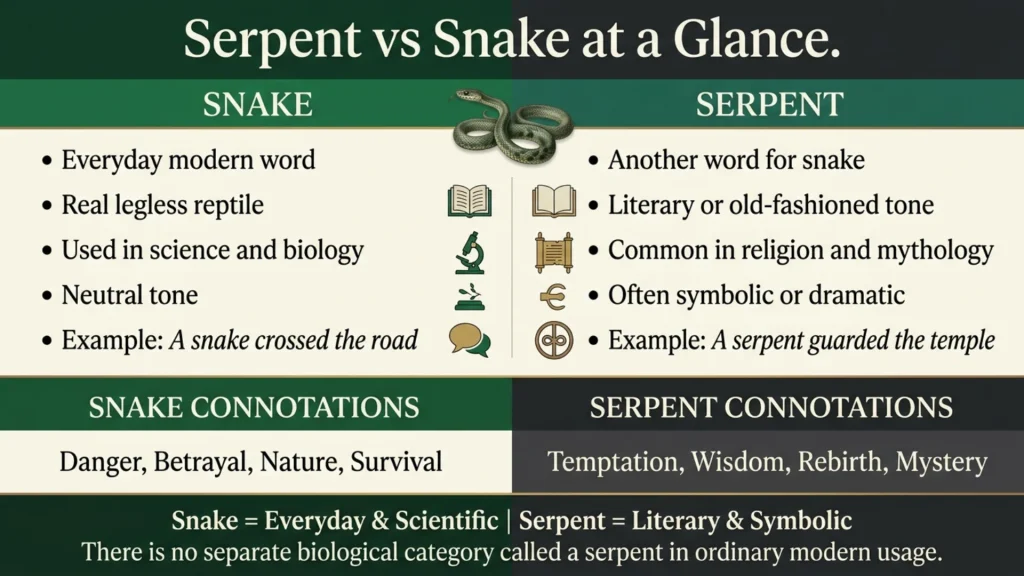
Quick Answer: Serpent vs Snake
| Feature | Snake | Serpent |
|---|---|---|
| Basic meaning | A long, legless reptile | A snake |
| Everyday speech | Very common | Uncommon |
| Scientific writing | Normal choice | Usually avoided |
| Literary writing | Possible | Very common |
| Religious usage | Possible | Common |
| Mythological usage | Possible | Common |
| Tone | Neutral | Ancient, dramatic, symbolic |
| Connotations | Animal, danger, dishonesty | Temptation, mystery, wisdom, evil, power |
| Biological difference | None implied | None implied |
Cambridge Dictionary defines serpent simply as “a snake” and labels the word as old or literary usage, which captures the core distinction well. Cambridge Dictionary
For a dictionary reference, see the Cambridge Dictionary definition of serpent.
What Is a Snake?
A snake is a reptile with a long body and no legs.
It is the ordinary modern English term used when discussing real animals in:
- everyday conversation
- wildlife reporting
- biology
- zoology
- nature documentaries
- scientific writing
- news reports
- safety information
Cambridge describes a snake as a reptile with a long body and no legs. Cambridge Dictionary
Examples:
I saw a snake near the garden.
The snake disappeared into the grass.
Some snakes use venom to subdue prey.
The biologist studied snake behavior.
Nothing dramatic is required. It is simply the standard animal name.
What Is a Serpent?
A serpent is also a snake, but the word normally carries a different style or emotional effect.
You are more likely to encounter serpent in:
- religious texts
- mythology
- legends
- poetry
- fantasy
- literary prose
- symbolic descriptions
- ancient-style storytelling
Examples:
A great serpent guarded the entrance to the temple.
The serpent became a symbol of temptation.
A golden serpent was carved into the stone.
The animal may still be a snake. The writer chooses serpent because it creates a more ancient, mysterious, symbolic, or dramatic tone.
Are Serpents and Snakes the Same?
In ordinary English, yes.
A serpent is not a separate biological category competing with snakes.
The important distinction is linguistic:
- snake describes the animal neutrally
- serpent describes the same kind of animal with a particular literary, historical, religious, or symbolic tone
This is where several explanations make the subject unnecessarily theatrical. There is no secret zoological checkpoint where a snake completes paperwork and gets promoted to serpent.
What Is the Biological Difference Between a Serpent and a Snake?
There is no standard biological distinction.
Modern zoology discusses snakes, which belong to the suborder Serpentes.
Notice the mildly amusing detail:
The scientific group is called Serpentes, but ordinary scientific English still normally calls the animals snakes, not serpents.
So in a biology paper, you would expect phrases such as:
- snake species
- snake venom
- snake behavior
- snake anatomy
- snake habitat
rather than:
- serpent species
- serpent venom research
- serpent population survey
The latter versions sound literary rather than scientific.
Serpent vs Snake: The Main Difference
The easiest way to understand the distinction is to compare actual contexts.
Everyday Conversation
Natural:
There’s a snake in the yard.
Possible but dramatic:
There’s a serpent in the yard.
Unless you live in a medieval prophecy, the first sentence sounds considerably more normal.
Scientific Writing
Natural:
The snake uses camouflage to avoid predators.
Unusual:
The serpent uses camouflage to avoid predators.
Fantasy or Mythology
Neutral:
A giant snake guarded the cave.
More atmospheric:
A giant serpent guarded the cave.
Both can describe the creature, but serpent adds tone.
Religious Writing
Serpent is common because older religious language and symbolism often use the term.
Poetry
A poet may prefer serpent because it carries stronger imagery and historical associations.
Denotation of Snake
The denotation of a word is its direct or dictionary meaning.
The denotation of snake is:
a long, legless reptile
That is the literal meaning.
For example:
A snake crossed the road.
There is no need to interpret the animal symbolically. The word simply identifies the reptile.
Connotation of Snake
A connotation is an idea or emotional association that goes beyond the literal definition.
Although snake has a neutral animal meaning, it can also carry negative human associations.
Common connotations include:
- dishonesty
- betrayal
- danger
- secrecy
- treachery
- untrustworthiness
For example:
He’s a snake.
The sentence does not mean the person has transformed into a reptile, inconvenient though that would be.
It means the speaker considers him dishonest or untrustworthy.
Denotation and Connotation of Snake
The distinction can be summarized like this:
| Type | Meaning |
|---|---|
| Denotation | A long, legless reptile |
| Positive/neutral associations | Nature, adaptation, survival |
| Negative connotations | Betrayal, danger, deceit |
| Symbolic associations | Transformation, rebirth, secrecy |
Context determines which meaning is active.
Connotative Meaning of Serpent
Serpent tends to carry stronger symbolism than snake.
Depending on the culture, text, or story, a serpent may represent:
- temptation
- evil
- deception
- knowledge
- wisdom
- rebirth
- immortality
- healing
- transformation
- danger
- supernatural power
Not all serpents symbolize evil.
That point matters because internet summaries often treat “serpent = evil” as if thousands of years of world mythology somehow held one committee meeting and agreed on a single interpretation.
They did not.
Why Does “Serpent” Sound More Dramatic?
Part of the reason is frequency.
Modern speakers encounter snake constantly in ordinary contexts:
- snake bite
- snake venom
- snake habitat
- snake species
- snake enclosure
Serpent appears much more often in older, religious, poetic, fantastic, or symbolic language.
Because of that history, it naturally sounds elevated or dramatic.
Compare:
The snake moved through the grass.
with:
The serpent moved through the shadows.
The second version immediately feels more like storytelling.
Serpent vs Snake in Literature
Literary writers use both words, but they produce different effects.
Use Snake for Realism
A small snake moved beneath the fallen leaves.
This sounds observational and natural.
Use Serpent for Atmosphere
A black serpent coiled beneath the ruined altar.
This sounds more ominous, ancient, or symbolic.
Use Serpent for Myth
The warrior faced the sea serpent.
Here, serpent can suggest a legendary or supernatural creature rather than an ordinary zoological specimen.
Serpent vs Snake in Mythology
Mythological creatures are frequently called serpents because the word suits legendary descriptions.
Examples of serpent-like figures across world mythology can include:
- giant sea serpents
- dragons with serpentine bodies
- divine snakes
- underworld guardians
- feathered serpents
- multi-headed snake creatures
Calling such beings merely “snakes” can sometimes remove part of the intended grandeur.
Compare:
an ancient serpent god
with:
an ancient snake god
The second is understandable. The first sounds considerably more mythological.
Serpent vs Snake in Religion
Religious writing is one of the strongest contexts for serpent.
The word appears frequently in older English Bible translations and religious discussion because it carries historical and symbolic weight.
That does not mean the underlying creature belongs to a special biological species called “serpent.”
The difference is mainly translation, tradition, tone, and symbolism.
Does the Bible Say Snake or Serpent?
Many well-known English Bible translations use serpent, especially in Genesis 3.
The Genesis story describes the creature involved in the temptation of Eve as the serpent.
Modern readers therefore strongly associate the word with:
- temptation
- deception
- sin
- cunning
- the Fall
That biblical association is one major reason serpent feels more symbolic than ordinary snake in English.
Is the Serpent in Genesis Literally Called a Snake?
The English word chosen depends partly on translation.
Traditional English translations frequently use serpent, which reflects older English religious vocabulary.
From a modern vocabulary perspective, serpent is a word for snake, but theological interpretation of the Genesis figure goes far beyond a simple zoological identification.
For a grammar or vocabulary article, the safe distinction is:
Serpent is the traditional English term used in the passage; it is not evidence of a separate biological animal class.
Why Did Jesus Compare Himself to a Serpent?
This question usually refers to John 3:14, where Jesus refers to Moses lifting up the serpent in the wilderness.
The background is the bronze serpent episode in Numbers 21.
The comparison is not that Jesus is being described as morally serpent-like. Instead, the passage uses the lifted bronze serpent as part of a theological comparison involving being lifted up and bringing salvation to those who believe.
That is a religious and interpretive context, not an example of everyday vocabulary.
What Did Jesus Say About Snakes?
Several New Testament passages use snake or serpent imagery depending on translation.
One well-known example is the instruction often translated:
Be wise as serpents and innocent as doves.
The point is symbolic.
The serpent represents qualities such as caution, shrewdness, or awareness in that context.
Again, serpent symbolism is not automatically negative.
What Qualifies as a Serpent?
In normal English, a serpent is a snake, especially when described in literary, religious, mythological, or old-fashioned language.
The word can also be extended to:
- snake-like mythical creatures
- dragon-like creatures with elongated bodies
- symbolic snake figures
- artistic depictions of snakes
So the exact meaning depends on the sentence.
What Animals Are Considered Serpents?
Strictly speaking, the ordinary word serpent primarily refers to snakes.
Historically or poetically, it can also describe creatures imagined as:
- giant snakes
- sea serpents
- dragon-like reptiles
- snake-bodied monsters
But calling every elongated reptile a serpent would be too broad.
For example:
- snake → naturally called a serpent in literary contexts
- lizard → not normally called a serpent
- crocodile → not a serpent
- worm → may look serpentine, but is not a serpent
- eel → serpent-like in shape, but not a snake
Serpent vs Snake in Scientific Writing
Use snake.
Examples:
Researchers recorded the snake’s body temperature.
The region supports several snake species.
Snake venom varies considerably among species.
Avoid using serpent unless you are discussing the history of the word, symbolism, or the name of a mythological creature.
Scientific writing rewards precision and generally does not need vocabulary wearing a dramatic cloak.
Serpent vs Snake in Everyday English
Use snake almost every time you are talking about an actual animal.
Natural:
There’s a snake by the fence.
What kind of snake is that?
Are there venomous snakes here?
Unusually dramatic:
What kind of serpent is that beside the trash can?
Technically understandable. Socially suspicious.
Serpent vs Snake in Creative Writing
Both words can work.
Use snake for:
- realism
- modern settings
- factual description
- ordinary wildlife
Use serpent for:
- fantasy
- symbolism
- religious imagery
- myth
- ancient settings
- ominous atmosphere
Serpent as a Metaphor
Calling a person a serpent can suggest:
- deceit
- treachery
- hidden danger
- evil intentions
Example:
The king trusted the adviser, unaware that a serpent stood beside his throne.
The sentence may describe the adviser metaphorically rather than an actual reptile.
The word feels literary and dramatic.
Snake as a Metaphor
Snake can also describe an untrustworthy person.
Example:
Don’t trust him. He’s a snake.
This metaphor is common in ordinary English and generally means:
- dishonest
- treacherous
- untrustworthy
- deceptive
The phrase snake in the grass carries a similar idea of hidden betrayal.
Serpentine Meaning
The adjective serpentine means snake-like, especially in shape or movement.
Examples:
A serpentine road wound through the mountains.
The river followed a serpentine path.
The road is not a reptile. It curves like one.
This word is useful when discussing the broader serpent word family.
Serpent vs Snakelike
Both can express the idea of resembling a snake.
Serpentine
More formal or literary:
a serpentine pattern
Snakelike
More direct:
a snakelike movement
The meaning overlaps, but the tone differs in much the same way as serpent and snake themselves.
How Do You Spell Serpent?
Correct spelling:
S-E-R-P-E-N-T
Pronunciation:
SUR-puhnt
Common errors may include:
- serpant
- serpint
- surpent
The correct form is:
serpent
How Do You Pronounce Serpent?
In American English, it is approximately:
SUR-puhnt
In British English, the vowel differs slightly, but the word still has two syllables:
ser-pent
The stress falls on the first syllable.
How Do You Pronounce Snake?
Snake has one syllable:
SNAYK
It rhymes with:
- cake
- lake
- make
- take
Serpent and Snake: Etymology
The two words entered English through different historical routes.
Snake has Germanic roots and is closely connected with the ordinary English name for the animal.
Serpent entered English through French and ultimately Latin, which helped give it the more formal and literary flavor it carries today.
That history helps explain why one sounds at home in wildlife instructions while the other sounds at home guarding a cursed temple.
Is Serpent an Old-Fashioned Word?
In everyday animal references, it can sound old-fashioned.
Cambridge labels serpent as old or literary usage while defining it simply as a snake. Cambridge Dictionary
However, the word is not obsolete.
It remains perfectly natural in:
- religion
- mythology
- fantasy
- heraldry
- symbolism
- literature
- historical discussion
Is Snake More Common Than Serpent?
In ordinary modern English, yes.
You are far more likely to hear:
There’s a snake outside.
than:
There’s a serpent outside.
The second sentence may cause people to expect either a dragon or someone carrying a medieval prophecy.
Can Serpent and Snake Be Used Interchangeably?
Sometimes.
Interchangeable
A serpent lay beside the rock.
A snake lay beside the rock.
Both can literally describe the same animal.
Not Stylistically Interchangeable
Snake venom can contain complex biological compounds.
Replacing snake with serpent makes the scientific sentence sound unusual.
Likewise:
The sacred serpent represented rebirth.
Replacing serpent with snake is grammatically possible, but it weakens the mythic or symbolic tone.
So the words overlap in dictionary meaning but not always in style.
Common Mistakes
Mistake 1: Thinking a Serpent Is a Separate Species
It is not a separate everyday biological category.
Mistake 2: Saying Serpent Means a Mythical Creature Only
A serpent can describe an ordinary snake.
Mistake 3: Saying Snake Has No Symbolism
Snake can also be symbolic or metaphorical.
Mistake 4: Saying Every Serpent Symbolizes Evil
Serpent symbolism can include wisdom, rebirth, protection, healing, knowledge, or danger depending on context.
Mistake 5: Using Serpent in Scientific Writing
Use snake when referring neutrally to real animals in biology or zoology.
Easy Memory Rule
Remember:
Snake = science and everyday speech
Serpent = symbolism and storytelling
That is not an absolute dictionary barrier, but it is an excellent usage rule.
Related Grammar Guides
If tiny vocabulary differences are once again consuming more human attention than they reasonably deserve, these GrammarRead guides cover similar usage questions:
- People Do or People Does? Correct Grammar & Examples
- Was There or Were There? Grammar Rules & Examples
Frequently Asked Questions
Are serpents and snakes the same?
Yes. Serpent can refer to a snake. The main difference is usage: snake is the normal everyday and scientific term, while serpent sounds literary, religious, mythological, or symbolic.
Does the Bible say snake or serpent?
Many major English Bible translations traditionally use serpent, especially in Genesis 3. This wording contributes strongly to the symbolic and religious associations of the word.
Why did Jesus compare himself to a serpent?
John 3:14 refers to Moses lifting up the serpent in the wilderness, connecting Jesus’ being “lifted up” with the bronze-serpent episode in Numbers 21. The comparison is theological rather than a claim that Jesus shares the ordinary symbolic traits associated with snakes.
What qualifies as a serpent?
In normal English, a serpent is essentially a snake, especially when the context is literary, religious, symbolic, mythological, or old-fashioned.
What animals are considered serpents?
Snakes are the animals most directly called serpents. Mythology may also use the word for giant, sea-dwelling, dragon-like, or supernatural snake creatures.
What did Jesus say about snakes?
One well-known teaching is commonly translated as being wise as serpents and innocent as doves. The serpent imagery there emphasizes shrewdness or prudence rather than evil.
What is the denotation of snake?
The denotation of snake is a long, legless reptile. That is its direct dictionary meaning.
What is the connotative meaning of snake?
Depending on context, snake can suggest dishonesty, betrayal, hidden danger, treachery, transformation, or rebirth.
Is serpent more dangerous than a snake?
No. The word serpent does not identify a more dangerous class of animal. Actual danger depends on the snake species, venom, behavior, and situation.
Is a cobra a serpent?
Yes, a cobra can be called a serpent in literary or symbolic language because a cobra is a snake. In ordinary conversation and biology, cobra or snake is more natural.
Final Thoughts
The difference in Serpent vs Snake is mainly about language rather than zoology.
Both words can refer to the same animal.
Use snake when you want:
- ordinary modern English
- biological accuracy
- scientific tone
- neutral description
Use serpent when you want:
- literary style
- religious language
- mythology
- symbolism
- dramatic imagery
The easiest way to remember the difference is:
A snake is the animal. A serpent is usually the same animal described with extra cultural, literary, or symbolic weight.