Copy That vs Roger That: Meaning, Difference & Correct Usage
Copy That vs Roger That is mostly a question of emphasis and communication style.
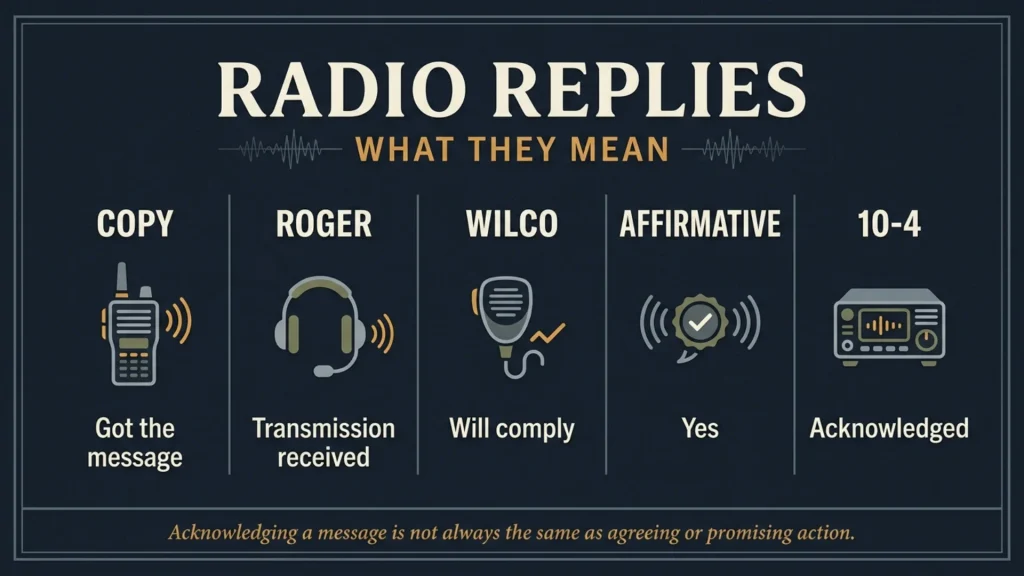
Both expressions can acknowledge a message, and in everyday speech they often overlap. However, their traditional radio meanings are not perfectly identical:
- Copy that generally means “I received and understood the information.”
- Roger that traditionally means “I received your transmission.”
- Wilco goes further and means “I received it, understood it, and will comply.”
- Affirmative means “yes.”
- 10-4 is another acknowledgment expression associated especially with ten-code radio systems.
The biggest mistake is assuming that Roger that automatically means “I agree” or “I will do it.”
It does not necessarily mean either.
Quick Answer: Copy That vs Roger That
| Expression | Basic Meaning | Promises Action? | Typical Context |
|---|---|---|---|
| Copy that | I received/understood the message | No | Radio-style, military, emergency, casual |
| Roger that | I received your transmission | No | Traditional radio, aviation, military-style speech |
| Wilco | I received, understood, and will comply | Yes | Formal radio procedure |
| Affirmative | Yes | Not necessarily | Radio yes/no response |
| 10-4 | Message received / acknowledged | No | Ten-code/public-safety/CB-style usage |
| Got it | I understand | No | Everyday English |
| Understood | I understand | No | Professional/general English |
For ordinary conversation, copy that and roger that may both sound like “got it.”
In precise radio communication, though, the distinction matters more.
What Does “Copy That” Mean?
Copy that usually means:
“I received your message and understand it.”
Examples:
“The meeting has moved to Room 4.”
“Copy that.”
“Use the east entrance.”
“Copy that.”
“The delivery will arrive at 3 p.m.”
“Copy that.”
The phrase is short, direct, and strongly associated with radio-style communication.
In everyday English, people may also use it humorously or casually:
“Pick up milk on your way home.”
“Copy that.”
No radios required. Humans borrowed the phrase anyway.
What Does “Roger That” Mean?
Roger that traditionally acknowledges receipt of a transmission.
Its practical meaning is close to:
“I received your message.”
Examples:
“Hold your current position.”
“Roger that.”
“Weather conditions have changed.”
“Roger that.”
“Report back at 1600.”
“Roger.”
In modern everyday speech, roger that often carries a broader sense of:
- message received
- understood
- acknowledged
- got it
But it should not automatically be interpreted as:
- yes
- I agree
- permission granted
- I will comply
Those are separate ideas.
Copy That vs Roger That: Main Difference
The simplest useful distinction is:
Copy that → I got and understood the information.
Roger that → I received the transmission.
In modern conversation, the difference is often small.
In formal radio communication, Roger has a more specific historical and procedural meaning.
That is why treating these phrases as completely different would be misleading, but treating them as perfectly identical is also too simplistic.
Are “Copy That” and “Roger That” the Same?
Not exactly, although they overlap heavily.
Both acknowledge communication.
The difference is mostly one of traditional emphasis:
Copy That
Often emphasizes that the information was received and understood.
Roger That
Traditionally emphasizes successful receipt of the transmission.
In casual speech, either may simply mean:
“Got it.”
Context therefore matters more than many comparison charts admit.
Does “Roger That” Mean “I Understand”?
In everyday English, it often does.
Someone saying:
“Roger that.”
will usually be understood as saying:
“I got your message.”
or:
“Understood.”
But traditional radio terminology is more precise.
The FAA defines Roger as acknowledgment that the speaker has received the other person’s last transmission. Its current radio communication guidance distinguishes acknowledgment words such as Roger from Wilco, which communicates that the message has been received, understood, and will be followed.
That distinction becomes important in safety-critical communication.
Does “Copy That” Mean “I Will Do It”?
No.
Copy that normally acknowledges information.
It does not automatically promise action.
Compare:
“The gate has changed to Gate 8.”
“Copy that.”
That means the information was received.
Now consider:
“Move the equipment to Gate 8 immediately.”
Replying:
“Copy that.”
may be understood socially as acceptance of the task, but the phrase itself does not explicitly state:
“I will comply.”
If compliance needs to be unmistakable, clearer wording is better.
What Does “Wilco” Mean?
Wilco comes from will comply.
It communicates more than Roger.
A useful breakdown is:
Roger: Message received.
Wilco: Message received, understood, and I will comply.
Example:
“Proceed to checkpoint Bravo.”
Roger acknowledges the transmission.
Wilco communicates that the instruction will be followed.
This is why saying Roger Wilco can be somewhat redundant in strict procedural terms: the acknowledgment component is already contained in Wilco.
Roger vs Wilco
| Phrase | Message Received | Understood | Will Comply |
|---|---|---|---|
| Roger | Yes | Not a separate promise | No |
| Wilco | Yes | Yes | Yes |
If someone gives information only, Roger may be enough.
If someone gives an instruction and you need to explicitly indicate that you will follow it, Wilco conveys more.
Copy vs Roger vs Wilco
These three phrases are easy to confuse because all can appear after a radio message.
Copy
“I got the information.”
Roger
“I received your transmission.”
Wilco
“I received it, understood it, and will comply.”
In real-world speech, organizations may use these less rigidly, particularly outside formal aviation.
So the context and local communication procedure still matter.
Copy vs Roger vs 10-4
10-4 is another acknowledgment expression, but it comes from a different radio tradition.
It is strongly associated with ten-code systems and later with CB-radio culture.
Its everyday meaning is roughly:
“Message received.”
Compare:
Copy that
I got/understood your message.
Roger that
Your transmission was received.
10-4
Acknowledged / message received.
All three may sound interchangeable in a movie scene, but they come from different communication traditions.
Is 10-4 the Same as Roger That?
They are similar in practical conversational use.
Both can acknowledge receipt of information.
However, 10-4 belongs to ten-code terminology, while Roger comes from radio phraseology associated with acknowledging a received transmission.
Neither automatically means:
“I will carry out your instruction.”
Roger That vs Affirmative
These expressions should not be confused.
Roger That
Means:
Message received.
Affirmative
Means:
Yes.
Consider:
“Did you see the vehicle?”
If the answer is yes, affirmative directly answers the question.
Simply saying Roger acknowledges the transmission but does not necessarily answer the yes/no question.
This difference can matter a lot when communication needs to be precise.
For another case where two words may sound interchangeable but serve different grammatical jobs, see Agreed vs Agree.
Negative vs Roger
Similarly:
Negative means no.
Roger means the transmission was received.
Example:
“Do you have visual contact?”
Possible answer:
Negative.
Answering only:
Roger.
would acknowledge the question without clearly answering it.
Where Did “Roger” Come From?
Before the modern NATO phonetic alphabet used Romeo for the letter R, earlier English-language radio alphabets used Roger for R.
The letter R was associated with received in radio acknowledgment.
As a result, Roger became a spoken acknowledgment indicating that a transmission had been received.
Today, Romeo is the standard ICAO phonetic word for R, but Roger survived as an established radio expression.
So when someone says:
Roger that,
they are not discussing an unfortunate man named Roger who somehow wandered into the transmission.
Where Does “Copy That” Come From?
Copy has long been used in communications to mean receiving or successfully taking down information.
In radio-style speech, copy can refer to receiving a transmission clearly enough to understand or record it.
You may hear questions such as:
Do you copy?
Meaning:
Can you receive/understand my transmission?
A response might be:
Copy.
or:
Copy that.
Modern entertainment has helped move the expression far beyond radio communication.
What Does “Do You Copy?” Mean?
Do you copy? generally asks:
“Are you receiving me?”
or:
“Did you receive and understand the message?”
Example:
“Unit 12, change to channel four. Do you copy?”
Response:
“Copy.”
In casual conversation it can even be used jokingly:
“Do not eat my leftovers. Do you copy?”
Someone has apparently transformed refrigerator boundaries into tactical communications.
Is It “Roger” or “Roger That”?
Both forms are used.
Roger
The shorter radio acknowledgment.
“Roger.”
Roger That
An expanded expression common in modern speech and popular culture.
“Roger that.”
In formal aviation-style phraseology, Roger itself is sufficient.
In ordinary conversation, Roger that often sounds more familiar.
Is It “Copy” or “Copy That”?
Both are possible.
Copy
Shorter and more radio-like.
“Copy.”
Copy That
More common in general speech.
“Copy that.”
Both normally communicate acknowledgment.
Copy That Meaning in Text Messages
In texts or workplace chats, copy that usually means:
- understood
- got it
- noted
- acknowledged
Example:
“Please send the file before lunch.”
Reply:
“Copy that.”
It can sound playful, military-inspired, or unusually brisk depending on the relationship.
For ordinary professional chat, Understood, Got it, or Will do may often sound more natural.
Roger That Meaning in Text Messages
In text conversations, roger that usually means:
- message received
- understood
- okay
- got it
Example:
“We moved the call to 4:30.”
“Roger that.”
It often carries a slightly more playful, radio-style tone than plain okay.
Copy That in Military Communication
Copy and related forms are widely associated with military radio speech, but exact terminology can vary by service, unit, mission, country, and communications procedure.
The safest general explanation is:
Copy acknowledges information that has been received or understood.
It should not automatically be treated as a universal promise to obey an order.
Movies tend to flatten all military communications into approximately six dramatic phrases, which is convenient for screenwriters and less useful for precision.
Roger That in Military Communication
Roger is also strongly associated with military and radio communication.
Its core idea is acknowledgment of a received message.
Military users may employ different prescribed terminology depending on the communications system involved, so there is no sensible rule saying every service member must always use Roger instead of Copy or vice versa.
Do Marines Say Roger or Copy?
They may use radio acknowledgments appropriate to their procedures and context.
There is no useful universal rule that says:
Marines always say Roger
or:
Marines always say Copy.
Actual usage varies by unit, communication procedure, message type, and operational setting.
When writing dialogue, forcing one expression into every Marine conversation is more Hollywood shortcut than linguistic law.
Why Do Soldiers Say “Copy That”?
Because short acknowledgments are useful in radio communication.
Copy quickly indicates that information was successfully received or understood without repeating the whole message.
Its advantages include:
- brevity
- clarity
- easy recognition over radio
- reduced unnecessary transmission time
Why Do Cops Say “Copy That”?
Police and emergency personnel often use short acknowledgments because radio channels need efficient communication.
However, exact codes and phraseology vary substantially between departments.
Some agencies use plain language, some use ten-codes, and others use combinations of standardized and local terminology.
So copy that should not be presented as mandatory police vocabulary everywhere.
Copy That in Aviation
You may hear copy in aviation-related conversation, but it is important not to treat casual aviation slang and official ATC phraseology as identical.
Formal pilot-controller communications use standardized acknowledgment terminology and readbacks where required.
That is why an article about everyday English should not tell readers that pilots simply answer every instruction with “copy that.”
For another aviation-related language distinction, see “On the Plane” or “In the Plane”.
Does Roger Mean Yes?
No.
Roger means a message was received.
It is not a direct synonym for yes.
If someone asks:
“Are you ready?”
A true yes/no response would be:
Affirmative.
Using Roger only tells the other person that you received their question.
In everyday conversation, people may use it loosely, but precise radio language keeps these functions separate.
Does Roger Mean Agreement?
Not necessarily.
Acknowledging a message and agreeing with its content are different actions.
Consider:
“We think the problem started yesterday.”
“Roger.”
That can simply mean:
I received what you said.
It does not necessarily mean:
I agree with your conclusion.
This difference resembles the distinction between acknowledging information and explicitly agreeing with it, which is also useful in Agreed vs Agree.
Does Copy That Mean Agreement?
Also no.
Someone can understand a message without agreeing with it.
Copy that primarily signals reception or understanding.
If agreement matters, say so directly:
- I agree.
- Agreed.
- That works for me.
- Approved.
- Yes.
Professional Alternatives to “Copy That”
In ordinary workplaces, radio language may sound unnecessarily tactical.
Better alternatives include:
- Understood.
- Got it.
- Noted.
- Acknowledged.
- Confirmed.
- I understand.
- I’ve got it.
- Will do.
- I’ll take care of it.
- Thanks, I’ve noted that.
Choose the response based on what you actually mean.
If You Only Acknowledge Information
Use:
Noted.
or:
Understood.
If You Will Take Action
Use:
Will do.
or:
I’ll take care of it.
If You Agree
Use:
Agreed.
or:
That works for me.
This is clearer than using one vague phrase for four different intentions.
How to Professionally Say “Copy That”
In professional emails or chat, these alternatives usually sound better:
Understood, thank you.
Noted.
Confirmed.
I’ve received the update.
I’ll proceed accordingly.
I’ll take care of that.
Which one is best depends on whether you are merely acknowledging, confirming, or promising action.
For distinctions around replying and responding, see Respond vs Response.
What Is a Synonym for “Copy That”?
Depending on context:
- got it
- understood
- noted
- acknowledged
- received
- roger
- okay
- confirmed
But these are not perfect synonyms in every technical situation.
For example:
Will do adds an intention to act.
Yes adds affirmation.
Noted simply records acknowledgment.
What Should You Reply to “Roger That”?
Often, nothing.
If someone says Roger or Roger that, they have already acknowledged your transmission.
Example:
“The briefing begins at 0700.”
“Roger.”
The communication may be complete.
You do not need to reply:
“Roger your Roger.”
That is how humans accidentally build an infinite acknowledgment loop.
If another response is required, respond with the next relevant piece of information rather than mechanically sending another acknowledgment.
What Should You Say After “Roger That”?
It depends on the conversation.
If no further information is needed, say nothing.
If you need to continue:
“Roger that. I’ll send the coordinates now.”
or:
“Roger. Stand by for the next update.”
In everyday speech:
“Roger that, thanks.”
can also be perfectly natural.
What Is a Good Reply to “Copy That”?
Often no reply is needed.
If someone says:
“Copy that.”
they are confirming your message.
You can simply continue with the next relevant instruction or end the conversation.
Copy That vs Got It
These usually communicate similar ideas in everyday English.
Copy That
Sounds:
- operational
- radio-inspired
- military-style
- playful in casual use
Got It
Sounds:
- natural
- conversational
- informal
- widely usable
Example:
“Use the side entrance.”
Copy that.
and:
Got it.
both work, but they create different tones.
Copy That vs Understood
Understood is more neutral and professional.
Copy that sounds more like radio or operational language.
In an office email:
Understood, I’ll update the file.
usually sounds more natural than:
Copy that, commander.
Unless your accounting department has become significantly more exciting than expected.
Roger That vs Understood
In casual speech, they can overlap.
But Roger that carries radio-style associations, whereas understood is ordinary general English.
Use understood when you want clarity without the military or aviation flavor.
Copy That vs Received
Received focuses on successful receipt.
This makes it conceptually closer to traditional Roger than many people realize.
However, in normal conversation:
“Received.”
can sound formal or administrative.
“Copy that.”
sounds more operational.
Copy That vs Confirmed
Confirmed means something has been verified or formally established.
That is stronger than simply acknowledging receipt.
Example:
“Is the booking finalized?”
Confirmed.
This means the booking is actually verified.
Copy that would merely acknowledge the question or information.
Copy That vs Agreed
These phrases communicate different things.
Copy that = I understand/received the message.
Agreed = I share or accept the position.
You can understand something and still disagree with it.
For a deeper explanation of that grammatical distinction, see Agreed vs Agree.
Copy That vs Roger That in Movies
Movies, television, video games, and police dramas often use both expressions to create a radio or tactical atmosphere.
That has helped make them familiar in ordinary English.
But fictional dialogue frequently treats:
- copy
- roger
- affirmative
- 10-4
- wilco
as roughly interchangeable acknowledgments.
Real formal communication systems can be more precise.
So entertainment is excellent for explosions and somewhat less reliable as a procedural manual.
Common Mistakes
Mistake 1: Assuming Roger Means Yes
It does not necessarily mean yes.
Use affirmative or an explicit yes when a positive answer is required.
Mistake 2: Assuming Copy Means I Will Do It
Copy acknowledges the message.
If you are committing to action, say:
Will do.
or use appropriate procedural terminology.
Mistake 3: Treating Wilco as Another Word for Roger
Wilco adds compliance.
That is a meaningful difference.
Mistake 4: Using Radio Slang in Formal Business Writing
A message such as:
“Copy that, boss.”
may be perfectly fine in an informal team chat.
In a formal client email, this usually reads better:
“Understood. I’ll proceed accordingly.”
Mistake 5: Assuming Every Military or Police Organization Uses the Same Terms
Communication procedures vary.
Avoid claiming one phrase is universally required across all units, services, agencies, or countries.
35 Examples of Copy That, Roger That, and Related Replies
- “The meeting starts at eight.” “Copy that.”
- “Use the rear entrance.” “Copy.”
- “Your message came through.” “Roger.”
- “Hold your position.” “Roger that.”
- “Proceed to the next checkpoint.” “Wilco.”
- “Did you receive the update?” “Affirmative.”
- “The shipment is delayed.” “Copy that.”
- “Weather has changed.” “Roger.”
- “Send the report before noon.” “Will do.”
- “The booking is final.” “Confirmed.”
- “Please use version three.” “Got it.”
- “The schedule has changed.” “Understood.”
- “Move to channel six.” “Roger.”
- “The north entrance is closed.” “Copy.”
- “Begin the procedure.” “Wilco.”
- “Do you copy?” “Copy.”
- “Are you ready?” “Affirmative.”
- “Are you unable to proceed?” “Negative.”
- “The client approved it.” “Copy that.”
- “Leave the package at reception.” “Will do.”
- “Report back at 1500.” “Roger.”
- “The road ahead is blocked.” “Copy that.”
- “Change to the backup channel.” “Roger.”
- “Follow the revised instructions.” “Wilco.”
- “The deadline moved to Friday.” “Noted.”
- “The room has changed.” “Got it.”
- “Can you hear me?” “Copy.”
- “Did you understand the update?” “Understood.”
- “Do you agree with the plan?” “Affirmative.”
- “Your request has been processed.” “Received, thank you.”
- “Expect another update shortly.” “Roger that.”
- “Take the next exit.” “Copy that.”
- “Complete the inspection and report back.” “Wilco.”
- “The system is online.” “10-4.”
- “Please review the new file.” “Will do.”
A Simple Memory Rule
Use this quick guide:
COPY = I got it.
ROGER = Message received.
WILCO = I got it and will comply.
AFFIRMATIVE = Yes.
NEGATIVE = No.
10-4 = Acknowledged.
That rule is more useful than pretending every acknowledgment phrase has exactly the same meaning.
Frequently Asked Questions
Why do cops say copy that?
Police and emergency services often need short radio acknowledgments. Copy efficiently indicates that a message was received or understood. Exact terminology varies between departments.
Do Marines say Roger or copy?
Both forms may appear depending on the communication procedure and context. There is no useful universal rule that every Marine always uses one instead of the other.
Is Roger the same as Copy?
Not exactly. Their everyday meanings overlap, but Roger traditionally acknowledges receipt of a transmission, while Copy commonly indicates that information was received or understood.
Is it correct to say “copy that”?
Yes. Copy that is a well-established radio-style and colloquial acknowledgment meaning roughly “message received” or “understood.”
Why do soldiers say copy that?
Because short acknowledgments make radio communication efficient. Copy can quickly indicate that transmitted information was received or understood without unnecessarily repeating it.
What can I say instead of copy that?
Natural alternatives include got it, understood, noted, acknowledged, confirmed, received, and will do, depending on what you mean.
How do you professionally say “copy that”?
Use phrases such as:
- Understood.
- Noted.
- Confirmed.
- I’ve received the update.
- I’ll proceed accordingly.
- I’ll take care of it.
What is the difference between “copy that” and “roger that”?
Copy that generally emphasizes receiving and understanding information. Roger that traditionally emphasizes acknowledgment that the transmission was received. In casual modern use, the two often overlap.
What do you say after Roger that?
Often nothing is required. Roger that already acknowledges the message. Continue only if you have more relevant information or instructions to communicate.
Final Answer: Copy That vs Roger That
The Copy That vs Roger That difference is real, but smaller than many articles make it sound.
Copy that generally communicates:
“I received and understood the information.”
Roger that traditionally communicates:
“I received your transmission.”
Neither one automatically means:
“I agree.”
Neither necessarily means:
“I will do it.”
For explicit compliance:
Wilco is more precise.
For a direct yes:
Affirmative is more precise.
For ordinary everyday conversation, Got it, Understood, or Will do may sound more natural than any radio expression.
The safest memory rule is:
Copy = got it. Roger = received. Wilco = will comply.