“On the Plane” or “In the Plane”: Which Is Correct?
“On the plane” or “in the plane” can both be grammatically possible, but they are not equally natural in every situation.
For ordinary travel and passenger conversations, on the plane is the standard choice:
I’m on the plane now.
Use in the plane when you specifically want to emphasize the physical interior of the aircraft:
There was a strange smell in the plane.
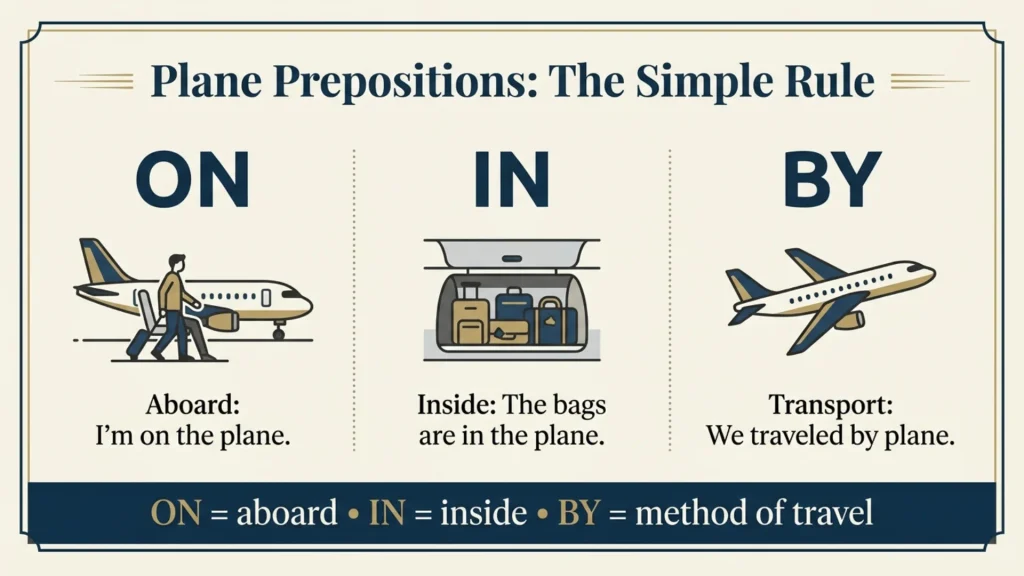
The easiest rule is:
On the plane = aboard the aircraft.
In the plane = physically inside the aircraft.
For most everyday travel situations, choose on the plane.
Quick Answer: On the Plane vs In the Plane
| Expression | Best Use | Example |
|---|---|---|
| on the plane | Passenger, travel, being aboard | I’m on the plane now. |
| in the plane | Physical interior or enclosed space | The luggage is still in the plane. |
| on a plane | Any unspecified aircraft | I met her on a plane. |
| in a plane | Physically inside an unspecified aircraft | The device was tested in a plane. |
| by plane | Method of transportation | We traveled by plane. |
| on the flight | Passenger on a particular flight | She was on the flight to Dubai. |
| in flight | While an aircraft is flying | The aircraft was damaged in flight. |
For normal conversation, on the plane is the safest default.
What Does “On the Plane” Mean?
On the plane usually means that someone is aboard an aircraft as a passenger or crew member.
Examples:
- I’m on the plane now.
- She fell asleep on the plane.
- We ate dinner on the plane.
- He left his headphones on the plane.
- There were more than 200 passengers on the plane.
- I’ll message you when I’m on the plane.
- We met on the plane to London.
In these examples, on does not mean physically sitting on top of the airplane.
It means aboard.
English uses the same pattern with several forms of shared transportation:
- on the bus
- on the train
- on the subway
- on the ferry
- on the ship
- on the plane
The British Council also teaches on with forms of public transport, including planes, while in is commonly used with cars and taxis. British Council’s guide to in, on and at
What Does “In the Plane” Mean?
In the plane focuses on being physically inside the aircraft or on something located within its interior.
Examples:
- The temperature in the plane was very high.
- There was smoke in the plane.
- The equipment is still in the plane.
- The lights in the plane were dim.
- Several bags remained in the plane.
- The air in the plane felt dry.
These sentences treat the aircraft mainly as an enclosed physical space.
That is different from talking about traveling as a passenger.
Is “In the Plane” Wrong?
No.
In the plane is not automatically incorrect.
It simply has a narrower and more literal use than on the plane.
Compare:
I’m on the plane.
This normally means:
I have boarded the aircraft.
Now compare:
The mechanic found a loose cable in the plane.
Here, the speaker is describing something physically located inside the aircraft.
The second sentence sounds natural because the focus is the aircraft’s interior.
“I Am on the Plane” or “I Am in the Plane”?
For normal travel conversation, say:
I am on the plane.
Or more naturally:
I’m on the plane.
Example:
I’m on the plane now. We should take off soon.
You would normally not text:
I’m in the plane now.
That sentence is understandable, but it puts unusual emphasis on your physical position inside the aircraft.
When “I’m in the Plane” Could Work
Imagine someone asks:
Are you still outside the aircraft?
You could answer:
No, I’m already in the plane.
Here, in creates a clear inside-versus-outside contrast.
Even then, I’m already on the plane would be very natural.
On a Plane or In a Plane?
The same basic distinction applies when you use a instead of the.
On a Plane
Use on a plane when talking about traveling aboard an unspecified aircraft.
Examples:
- I have never slept on a plane.
- She met her husband on a plane.
- Can you use Wi-Fi on a plane?
- I always feel cold on a plane.
In a Plane
Use in a plane when focusing on the physical enclosed space.
Examples:
- The experiment was conducted in a plane.
- It can become noisy in a small plane.
- They found the equipment in a plane at the hangar.
For passenger travel, on a plane remains more natural.
On the Plane vs On the Flight
Both are correct, but they refer to slightly different things.
On the Plane
Refers to the aircraft itself.
Example:
I left my headphones on the plane.
On the Flight
Refers to the journey, service, or scheduled flight.
Example:
There were 180 passengers on the flight.
You can also say:
I watched two movies on the flight.
or:
I watched two movies on the plane.
Both can work.
The first emphasizes the flight experience.
The second emphasizes the aircraft.
“On the Flight” or “In the Flight”?
Usually say:
on the flight
when referring to someone traveling as a passenger.
Examples:
- She was on the flight to New York.
- Were you on the same flight?
- There were several empty seats on the flight.
In the flight is generally not the normal phrase for being a passenger.
However, another expression is common:
in flight
This means while flying.
Examples:
- The aircraft was refueled in flight.
- The system can be adjusted in flight.
- The bird changed direction in flight.
Notice that in flight usually has no article.
By Plane vs On a Plane
These expressions answer different questions.
By Plane
Describes the method of transportation.
Example:
We traveled to Istanbul by plane.
Question:
How did you travel?
Answer:
By plane.
On a Plane
Describes being aboard an aircraft.
Example:
We spent six hours on a plane.
So:
I traveled by plane.
and:
I traveled on a plane.
can both be correct, but the emphasis is different.
Why Do We Say “On a Plane” but “In a Car”?
This is one of those English patterns that feels designed to irritate learners personally.
English commonly uses on with forms of transport where passengers are treated as being aboard a service or shared vehicle:
- on a plane
- on a train
- on a bus
- on a ship
- on a ferry
English usually uses in with smaller enclosed road vehicles:
- in a car
- in a taxi
Compare:
She is on the bus.
She is in the car.
The difference is idiomatic convention, not simply whether a roof exists over your head.
For another example of a small wording difference that changes the natural English form, see Timeslot vs Time Slot.
Does Size Matter?
Sometimes, but size alone is not a perfect rule.
A common learner shortcut is:
large/shared transport → on
small/private vehicle → in
That helps explain:
- on a bus
- on a train
- on a commercial plane
versus:
- in a car
- in a taxi
But English usage depends on convention as much as physical size.
That is why it is better to learn the common expressions rather than trying to calculate the cubic volume of every vehicle before selecting a preposition.
In a Helicopter or On a Helicopter?
For ordinary travel, in a helicopter is usually the most natural expression.
Examples:
- We flew in a helicopter.
- She was sitting in the helicopter.
- There were four passengers in the helicopter.
If you say someone is on the helicopter, listeners may interpret it literally as being on the exterior surface, depending on context.
However, aviation or military contexts can sometimes use aboard:
There were six people aboard the helicopter.
For everyday English, in a helicopter is the safest choice.
On the Aircraft or In the Aircraft?
Both forms can occur.
On the Aircraft
Natural when on means aboard:
- All passengers are on the aircraft.
- The crew is already on the aircraft.
- No food may be brought on the aircraft.
In the Aircraft
Natural when emphasizing the aircraft’s physical interior:
- The temperature in the aircraft increased.
- Smoke was detected in the aircraft.
- The equipment remained in the aircraft.
The difference is essentially the same as on the plane vs in the plane.
Are You In or On a Plane?
Normally, you are on a plane when talking about traveling.
Example:
I’m on a plane to Madrid.
Physically, you are also inside the aircraft, so in the plane can describe your location when that distinction matters.
But if someone casually asks:
Where are you?
The natural answer is:
I’m on the plane.
Is It Flying In or On a Plane?
Both structures can appear, but flying on a plane and flying in a plane can have slightly different emphasis.
Flying on a Plane
Common when describing the passenger experience:
I hate flying on small planes.
Flying in a Plane
Also possible, especially when emphasizing the physical experience of being inside the aircraft:
It was my first time flying in a small plane.
With the verb fly, both can sound natural depending on context.
For general commercial air travel, fly on a plane is a safe choice.
Do You Sleep on the Plane or In the Plane?
Normally:
sleep on the plane
Examples:
- I always sleep on the plane.
- She slept for five hours on the plane.
- Can you sleep on a plane?
If you say sleep in the plane, it sounds more like you are emphasizing the aircraft as a physical place rather than describing normal air travel.
For example:
The stranded pilot had to sleep in the plane overnight.
Here, the aircraft is being treated almost like a temporary shelter, so in becomes more natural.
Inside the Plane vs In the Plane
Inside the plane explicitly emphasizes physical location.
Examples:
- The luggage is inside the plane.
- Nobody was inside the plane.
- The smell was strongest inside the plane.
This can be clearer than in the plane when you deliberately want to contrast the interior with the exterior.
Compare:
Passengers are on the plane.
This means they have boarded.
Passengers are inside the plane.
This specifically emphasizes physical location inside the aircraft.
Get on the Plane or Get in the Plane?
For normal commercial air travel, say:
get on the plane
Examples:
- We need to get on the plane.
- Everyone got on the plane before noon.
- When can we get on the plane?
You also:
- get on a bus
- get on a train
- get on a ship
But:
- get in a car
- get in a taxi
What About a Small Private Plane?
You may sometimes hear get in the plane when a very small aircraft is treated like a compact enclosed vehicle.
Still, get on the plane remains widely understood and natural in general aviation contexts.
Get Off the Plane or Get Out of the Plane?
For normal passenger travel:
get off the plane
Examples:
- We finally got off the plane.
- Please remain seated until it is time to get off the aircraft.
If someone needs to escape or physically exit the interior in an unusual situation, get out of the plane may emphasize movement from inside to outside.
For normal arrival and passenger movement, use get off.
On Board, Aboard, and On the Plane
These expressions are closely related.
On Board
Everyone is on board.
This means everyone has boarded the aircraft, ship, train, or other vehicle.
Aboard
All passengers are aboard the plane.
This is slightly more formal.
On the Plane
All passengers are on the plane.
This is the most ordinary conversational version.
On Plane or On the Plane?
Usually, you need an article.
Natural:
I’m on the plane.
Natural:
I’m on a plane.
Usually unnatural in ordinary prose:
I’m on plane.
English countable singular nouns normally require a determiner such as a, the, my, or this.
Examples:
- on a plane
- on the plane
- on my plane
- on this plane
In Plane or In the Plane?
The same article rule applies.
Use:
in the plane
or:
in a plane
rather than simply:
in plane
unless plane belongs to a special technical expression.
“In Plane” in Geometry and Technical Writing
The phrase in-plane or in plane can have completely different meanings in mathematics, engineering, physics, and geometry.
For example, something may move in the plane of a surface.
You may also see technical compounds such as:
in-plane stress
or:
out-of-plane motion
These expressions have nothing to do with being inside an airplane.
That distinction matters because search results for “in plane” can mix aviation grammar with mathematical or engineering terminology.
In Plane vs Out of Plane
In technical fields:
in-plane means lying or acting within a defined plane or flat geometric surface.
out-of-plane means extending, moving, or acting outside that plane.
Examples:
- in-plane motion
- out-of-plane vibration
- in-plane force
Again, this use of plane means a geometric plane, not an aircraft.
English apparently decided one spelling should be responsible for both air travel and geometry. Efficient, if slightly hostile.
On the Plane vs In the Plain
Plane and plain are different words.
Plane
Can mean an aircraft or a flat geometric surface.
Plain
Can mean:
- simple
- obvious
- an area of flat land
Examples:
I’m on the plane.
The village lies on a wide plain.
Mixing these spellings creates a completely different sentence.
On the Plane vs In the Car
Compare the natural patterns:
I’m on the plane.
I’m in the car.
Likewise:
She’s on the train.
She’s in the taxi.
These are conventional transportation preposition patterns.
For another article about choosing between forms that look almost interchangeable but are not, see Year Old vs Years Old.
On the Plane vs On the Bus vs On the Train
These all use the same common passenger pattern:
- on the plane
- on the bus
- on the train
- on the ferry
- on the ship
Examples:
- I left my coat on the bus.
- We ate breakfast on the train.
- She slept on the plane.
- They met on the ferry.
This is one of the most useful transport-preposition patterns to memorize.
Common Mistakes
Mistake 1: Using “In the Plane” for Every Travel Situation
Less natural:
I’m in the plane. We’re about to take off.
Better:
I’m on the plane. We’re about to take off.
Mistake 2: Saying “In Flight” When You Mean a Specific Flight
Wrong meaning:
She was in flight 702.
Better:
She was on flight 702.
or:
She was on the flight.
In flight means while flying.
Mistake 3: Saying “By the Plane”
For transportation method, use:
by plane
Not:
by the plane
Example:
We traveled by plane.
Mistake 4: Assuming “On” Means on Top of the Aircraft
If someone says:
I’m on the plane,
they normally mean they are aboard it.
To describe the exterior surface, say something clearer:
The worker is on top of the plane.
Mistake 5: Using “On” With a Car
Normally:
I’m in the car.
Not:
I’m on the car.
The latter normally sounds as if you are physically sitting on the roof or hood.
For more examples of small wording distinctions that change natural English, see In Process vs In Progress.
40 Examples of On the Plane and In the Plane
- I’m on the plane now.
- We slept on the plane.
- She left her phone on the plane.
- They served dinner on the plane.
- There were 150 passengers on the plane.
- I met him on the plane.
- The Wi-Fi on the plane was slow.
- We watched a movie on the plane.
- I’ll call after I get on the plane.
- Are you on the plane yet?
- The air in the plane felt dry.
- There was a strange smell in the plane.
- The equipment remained in the plane.
- Smoke was detected in the plane.
- The temperature in the plane increased.
- The lights in the plane were dim.
- We traveled by plane.
- It was my first time on a plane.
- She hates sleeping on a plane.
- They tested the device in a plane.
- We were on the flight to Paris.
- The problem occurred in flight.
- Everyone is on board.
- All passengers are aboard the plane.
- We need to get on the plane.
- We finally got off the plane.
- He is in the car.
- She is on the bus.
- They are on the train.
- We flew in a helicopter.
- Nobody was inside the plane.
- The bags were still inside the plane.
- I am on a plane to London.
- She is on the plane we booked yesterday.
- There was a technical problem in the aircraft.
- All passengers were on the aircraft.
- The pilot remained in the plane.
- The children slept on the plane.
- We spent ten hours on the plane.
- The emergency equipment is stored in the plane.
A Simple Memory Trick
Use this:
ON = aboard
IN = inside
BY = method
Examples:
I’m on the plane.
You are aboard.
The bags are in the plane.
They are physically inside.
We traveled by plane.
Plane is the method of travel.
This simple rule handles most everyday situations.
Frequently Asked Questions
Do we say “I am on the plane” or “in the plane”?
Normally say “I am on the plane.”
That is the natural expression when you mean you have boarded and are traveling as a passenger.
Use in the plane when you specifically emphasize being physically inside the aircraft.
Why do you say “on a plane” and not “in a plane”?
English convention commonly uses on for passengers aboard planes, trains, buses, ferries, and similar transport.
In is still possible when the aircraft is being treated as an enclosed physical space.
Do we say “in flight” or “on flight”?
Both expressions exist, but they mean different things.
In flight means while flying:
The system failed in flight.
Use on a flight for being a passenger:
I met him on a flight to Rome.
Which is correct: “on the aircraft” or “in the aircraft”?
Both can be correct.
Use on the aircraft for being aboard as a passenger or crew member.
Use in the aircraft when emphasizing the physical interior.
Do you say “on” or “in a plane”?
For ordinary passenger travel, say on a plane.
Use in a plane when the interior or physical enclosure is important.
Are you in or on a plane?
In normal travel conversation, you are on a plane.
Physically, you are also inside it, so in the plane can be correct in more literal contexts.
Is it flying in or on a plane?
Both occur.
Flying on a plane commonly describes the passenger experience.
Flying in a plane can emphasize being physically inside the aircraft, especially a smaller plane.
Why do you say “on a plane” but “in a car”?
English convention treats planes, buses, trains, and similar shared transport as vehicles you are on or aboard.
Cars and taxis generally take in.
Is it on or in a helicopter?
For ordinary travel, in a helicopter is usually the natural choice.
Example:
We flew in a helicopter.
Final Answer: “On the Plane” or “In the Plane”?
For the “on the plane” or “in the plane” question, the most useful rule is simple:
Use on the plane for normal passenger travel:
I’m on the plane.
We slept on the plane.
She left her bag on the plane.
Use in the plane when emphasizing physical location inside the aircraft:
The equipment is in the plane.
The temperature in the plane was high.
Use by plane for the method of travel:
We traveled by plane.
And remember:
On = aboard. In = inside. By = method of travel.
Once that distinction is clear, the choice becomes much easier.