To Fast or Too Fast: Correct Usage, Rules & Examples
If you have ever typed “to fast” and wondered whether it should be “too fast,” you are not alone. These two words sound identical but mean completely different things — and mixing them up is one of the most common spelling mistakes in English. The confusion gets an extra twist because “to fast” can actually be correct in one specific situation: when “fast” is the verb meaning to abstain from food.
In this guide, you will learn exactly when to write too fast and when to fast is right, with clear rules, 20+ real examples, common mistakes with fixes, practice exercises, and answers to the questions people ask most.
Quick Answer: To Fast or Too Fast?
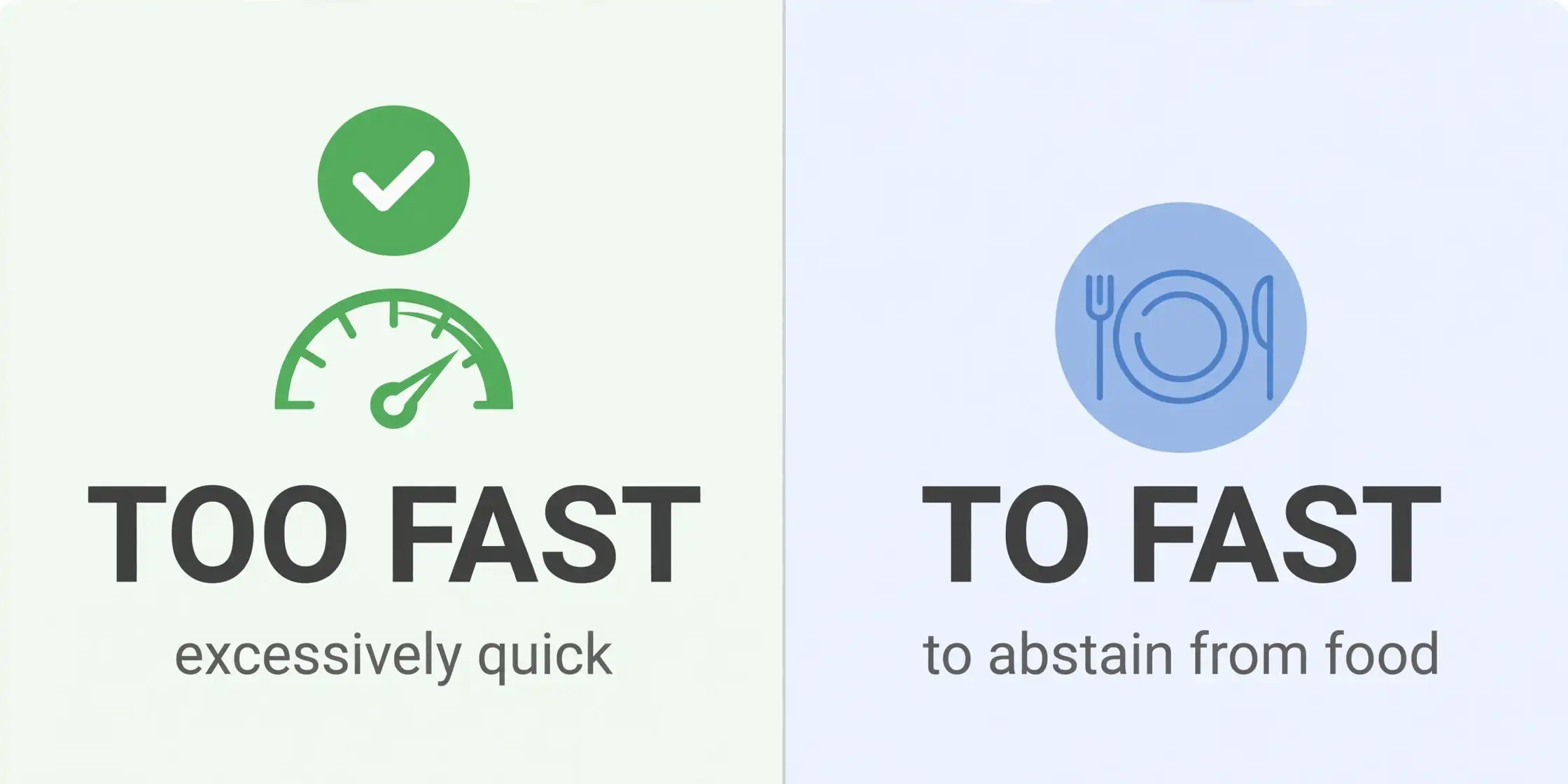
Use “too fast” when you mean “excessively fast.” The extra “o” in too means “more than enough” or “also”: You are driving too fast. This is way too fast. Use “to fast” only as the infinitive verb meaning to abstain from food: They decided to fast before the surgery. In every other situation, “to fast” is a misspelling of “too fast.”
| Form | Meaning | Example | Correct? |
|---|---|---|---|
| too fast | Excessively fast (adverb “too” + adjective/adverb “fast”) | You are driving too fast. | ✅ Yes |
| to fast | Infinitive verb: to abstain from food | He plans to fast on Mondays. | ✅ Yes (rare) |
| to fast | Meant as “excessively fast” | You are driving to fast. | ❌ No — write “too fast” |
What Does “Too Fast” Mean?
“Too fast” means “faster than it should be” — excessively fast. The word too is an adverb meaning “to an excessive degree” (Merriam-Webster) or simply “more than is acceptable” (Cambridge). It goes before adjectives and adverbs:
- You are walking too fast. (adjective)
- He speaks too quickly. (adverb)
- This is way too fast. (intensified — “way” is always followed by “too,” never “to”)
- The company is growing too fast to keep up with demand.
- Things are moving too fast in this relationship.
The key pattern: too + adjective/adverb. If you can replace “too” with “excessively” or “overly” and the sentence still makes sense, “too” is correct: You are driving (excessively) fast.
“Too Fast” vs “So Fast”
Both intensify “fast,” but with different shades: “too fast” is negative — it says the speed is a problem (Slow down, you’re going too fast!). “So fast” is neutral or admiring — it just expresses surprise at the degree (Wow, you finished so fast!). “Too fast” complains; “so fast” marvels.
What Does “To Fast” Mean?
“To fast” is the infinitive of the verb “fast,” meaning to abstain from food — for a period of time, especially for religious or medical reasons (Oxford Learner’s Dictionaries). Examples:
- Many people to fast… no — many people fast during Ramadan. (infinitive: They chose to fast during Ramadan.)
- She had to fast for twelve hours before the blood test.
- He plans to fast one day a week.
Outside of this verb meaning, “to fast” is simply wrong. If you are describing speed, it is always too fast.
Comparison Table: To vs Too vs Two
| Word | Type | Meaning | Example |
|---|---|---|---|
| to | Preposition / infinitive marker | Direction, purpose, or forms infinitives | Go to school. I want to learn. |
| too | Adverb | Excessively; also | Too fast. Me too. |
| two | Number | 2 | Two tickets, please. |
Correct Examples of “Too Fast” and “To Fast”
Everyday conversation
- Slow down — you are driving too fast.
- This music is way too fast for dancing.
- You are eating too fast; you will get hiccups.
- Time is passing too fast this year.
Driving and speed
- He got a ticket for going too fast in a school zone.
- The car was moving too fast to stop in time.
- She talks too quickly for me to follow.
- That roller coaster goes way too fast for me.
Work and business (“growing too fast”)
- The startup is growing too fast — they cannot hire quickly enough.
- Costs are rising too fast for the budget to handle.
- He was promoted too fast and was not ready to lead.
Relationships (“moving too fast”)
- I think we are moving too fast; let us slow down.
- She felt the relationship was progressing too fast.
School
- The teacher speaks too fast for the beginners.
- He finished the test too quickly and made careless mistakes.
“To fast” as the verb (fasting)
- They decided to fast before the surgery.
- She has to fast for twelve hours before the blood test.
- Many athletes choose to fast overnight.
Incorrect vs Correct: Common Mistakes
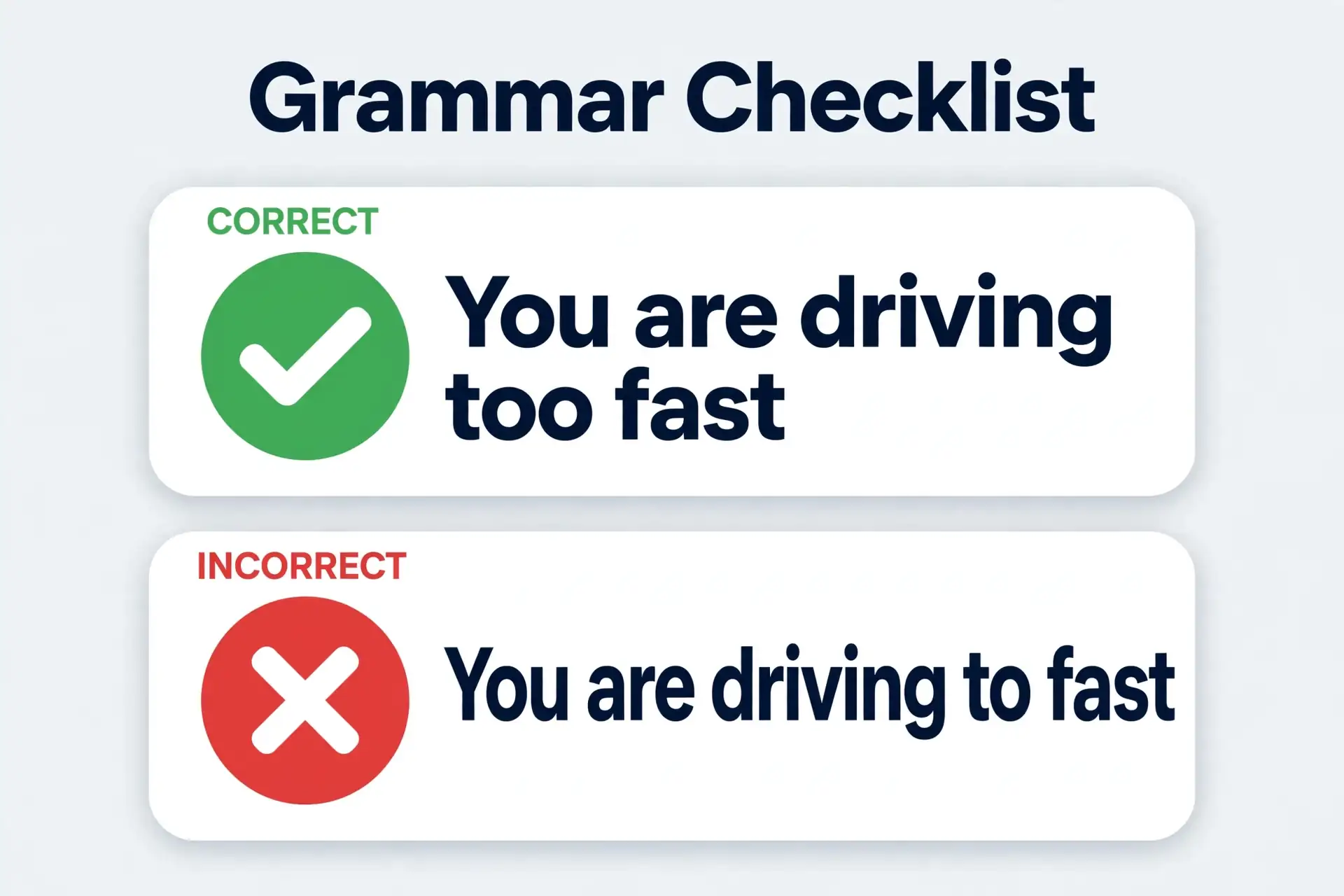
Incorrect: You are driving to fast.
Correct: You are driving too fast.
Why: “Excessively fast” needs the adverb “too.”
Incorrect: This is way to fast.
Correct: This is way too fast.
Why: “Way” intensifies “too” — the pair is always “way too.”
Incorrect: He talks to quickly.
Correct: He talks too quickly.
Why: Before adverbs like “quickly,” only “too” works. (Exception: “to quickly” can appear in a split infinitive — to quickly finish — but that is a different construction entirely.)
Incorrect: The company is growing to fast.
Correct: The company is growing too fast.
Why: “Growing too fast” = growing excessively fast.
Incorrect: I think we’re moving to fast.
Correct: I think we’re moving too fast.
Why: Same rule — “excessively” test: “moving excessively fast” works, so use “too.”
Correct (do not “fix”): They plan to fast on Mondays.
Why: This is the verb “fast” (abstain from food), not a speed description. Do not change it to “too.”
Grammar Rules and Exceptions
1. “Too” + adjective/adverb = excessively
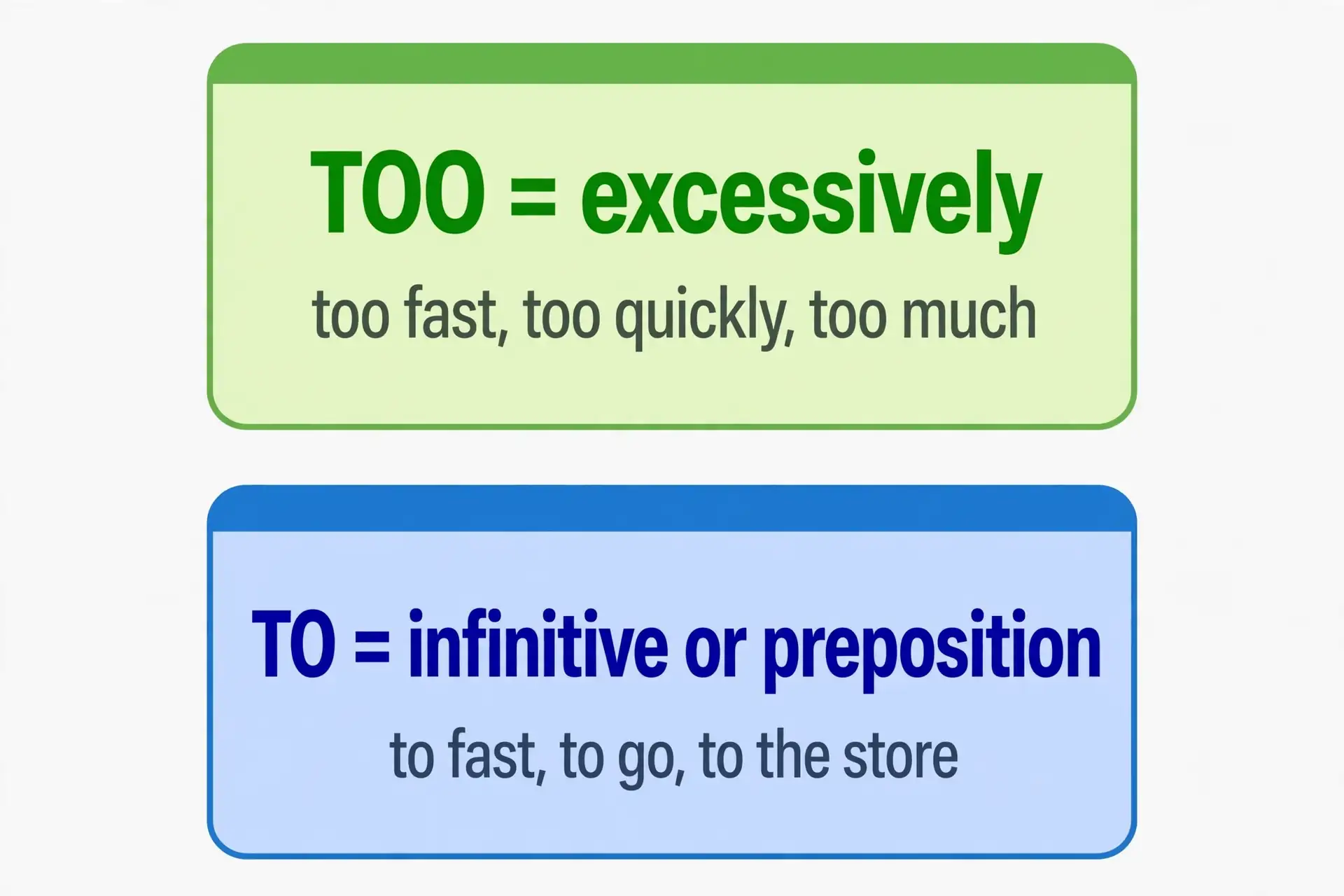
“Too fast,” “too quickly,” “too much,” “too many” — “too” before a descriptive word means “more than acceptable.” This is the only correct choice for speed: “too fast.”
2. “Too” can also mean “also”
“Me too,” “I like it too.” This “too” is unrelated to speed — but it is spelled the same. If you can substitute “also,” use “too”: I want to slow down too.
3. “To” is a preposition or infinitive marker
“To” shows direction (go to bed), purpose (to help), or forms infinitives (to go, to fast, to eat). It never means “excessively.”
4. The “excessively” test
Whenever you hesitate, substitute “excessively”: You are driving (excessively) fast → works → write too fast. They plan (excessively) fast on Mondays → nonsense → the verb “to fast” is meant.
5. “Too fast to ___” result clauses
“Too” often pairs with an infinitive of result: too fast to catch, too tired to continue, too expensive to buy. Note the structure: too + adjective + to + verb — the “to” here is the infinitive marker, not part of “too.”
6. American vs British English
No difference. Both varieties spell it “too fast” for excessive speed and “to fast” for the fasting verb.
For more to/too/two confusion, see our guides to too early vs to early and me too vs me as well vs I as well.
Real-World Usage
Driving: “You’re going too fast — the limit is 30 here.” Getting this right matters in formal writing like insurance claims and police reports.
Work: “We’re growing too fast to maintain quality.” Investors and managers use this phrase constantly.
Relationships: “I feel like things are moving too fast.” A common, emotionally loaded sentence — the spelling still follows the same rule.
Medical: “You must fast for 12 hours” vs “You must fast too fast” — the second is nonsense; context decides, and “to fast” only appears as the infinitive verb.
Easy Memory Technique: The Extra “O” for Extra Speed
Too has an extra “o” — for “extra” speed. When something is extra fast, it needs the extra letter: t-o-o. “To” is the plain, ordinary word (go to, want to) — it has nothing extra, just like normal speed.
Second check: the “excessively” test. If “excessively” fits, write “too”: too fast, too quickly, too much. If it doesn’t, you probably want “to” — as in to fast (the verb).
Practice Exercises
Choose “to” or “too” for each blank.
- You are driving ___ fast. Slow down!
- They decided ___ fast before the operation.
- This song is way ___ fast for a slow dance.
- She speaks ___ quickly for beginners to understand.
- The startup is growing ___ fast to keep up.
- He has ___ fast for twelve hours before the test.
- I think we are moving ___ fast. Let’s take a break.
Answer Key
- too — excessively fast.
- to — infinitive verb: to fast (abstain from food).
- too — “way too” is the fixed pair.
- too — before the adverb “quickly.”
- too — growing excessively fast.
- to — infinitive verb: has to fast.
- too — moving excessively fast.
Frequently Asked Questions
Which is correct: “to fast” or “too fast”?
“Too fast” is correct when you mean excessively fast — which is what people mean almost every time. “To fast” is only correct as the infinitive of the verb “fast” (to abstain from food): They plan to fast on Mondays.
Is it “way too fast” or “way to fast”?
“Way too fast” — always. “Way” is an intensifier that pairs with “too”: way too big, way too late, way too fast. “Way to fast” is never correct.
Is it “too quickly” or “to quickly”?
“Too quickly” is correct for excessive speed: He talks too quickly. “To quickly” only appears in split infinitives like to quickly finish (to + adverb + verb) — a completely different construction.
What does “too fast” mean?
It means “faster than is acceptable, safe, or comfortable” — excessively fast. Merriam-Webster defines “too” as “to an excessive degree.” The negativity is built in: “too fast” always implies a problem.
What does the verb “to fast” mean?
To abstain from food for a period of time, especially for religious or medical reasons (Oxford Learner’s Dictionaries). Example: She had to fast before the blood test.
How do you spell “too fast”?
T-O-O F-A-S-T. The two-o spelling is the adverb meaning “excessively.” Remember: the extra “o” is for extra speed.
“Too fast” or “so fast” — what’s the difference?
“Too fast” is negative (the speed is a problem); “so fast” is neutral or admiring (surprise at the degree). Slow down, you’re going too fast! vs Wow, you finished so fast!
What is considered “too fast”?
There is no universal number — it depends on context. On the road, it means above the speed limit or unsafe for conditions. In business, growth is “too fast” when quality, hiring, or cash flow can’t keep up. In relationships, it’s “too fast” when one person feels rushed. The grammar never changes; only the judgment does.
Conclusion
The rule fits in one line: “too fast” describes excessive speed; “to fast” is the verb for abstaining from food. The extra “o” in “too” means “extra” — extra speed, extra degree. Run the “excessively” test whenever you hesitate, remember that “way” always pairs with “too,” and keep “to fast” reserved for fasting. One letter, two meanings, zero confusion from now on.
For more commonly confused spellings, see Segway vs Segue, Gluing vs Glueing, and sustain vs substain.
Grammar references: Merriam-Webster’s entry for “too” (adverb: “to an excessive degree”); Cambridge Dictionary’s “too” (more / very / also); Oxford Learner’s Dictionaries “fast” (verb: to eat little or no food for a period of time).