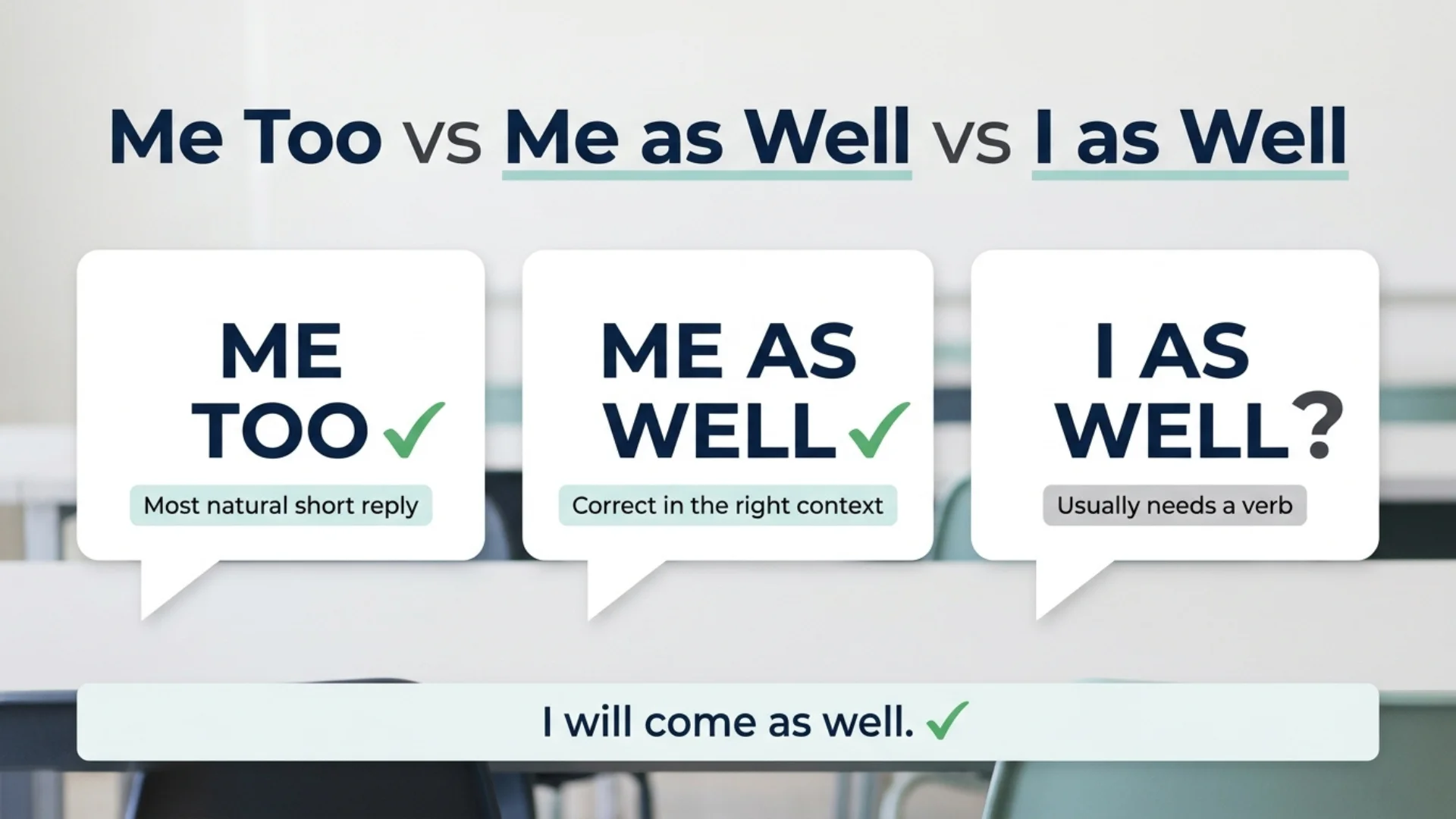
Me Too vs Me as Well vs I as Well: Which Is Correct?
“Me too” is the most natural short reply when you want to say that the same thing is true for you. “Me as well” can also work, but it is less common as a standalone response. “I as well” usually sounds incomplete when used by itself, although I is perfectly correct when it is the subject of a complete clause, such as “I will come as well.”
Quick Answer: Say “Me too” for a simple, natural reply. “Me as well” is possible but less idiomatic as a standalone answer. Do not normally reply with just “I as well.” Instead, use a complete structure such as “I do as well,” “I am as well,” “I will as well,” or simply place as well at the end of the clause.

Me Too vs Me as Well vs I as Well: Quick Comparison
| Expression | Correct? | Natural Use | Example |
|---|---|---|---|
| Me too | Yes | Very natural short reply | “I love coffee.” → “Me too.” |
| Me as well | Yes, in some contexts | Possible short reply; less common than “me too” | “I enjoyed it.” → “Me as well.” |
| I as well | Usually not by itself | Needs a full clause in normal modern English | “I will attend as well.” |
| I do too | Yes | Natural agreement with an action | “I like jazz.” → “I do too.” |
| I do as well | Yes | Slightly more deliberate or formal | “I like jazz.” → “I do as well.” |
| Me also | Possible, but often awkward | Less natural as a standalone reply | Usually prefer “Me too.” |
What Does “Me Too” Mean?
Me too means that the same statement, feeling, preference, or experience applies to you.
It is an elliptical response, meaning some words are left unstated because the listener can easily understand them.
For example:
A: I love this song.
B: Me too.
The second speaker means something like:
I love this song too.
English allows the shorter form because the missing information is obvious.
Examples of “Me Too”
- “I’m tired.” → “Me too.”
- “I want pizza.” → “Me too.”
- “I enjoyed the movie.” → “Me too.”
- “I miss home.” → “Me too.”
- “I need a break.” → “Me too.”
For everyday conversation, texts, chats, and informal workplace speech, me too is usually the safest and most natural choice.
Is “Me Too” Grammatically Correct?
Yes. Me too is a standard and natural English response.
Some learners worry because me is an object pronoun and the fully expanded sentence would normally use I. But short responses in English do not always mirror the full sentence word for word.
Cambridge Grammar notes that in informal short answers English normally prefers “me too” rather than “I too.” You can see the broader rule in the Cambridge Grammar guide to also, as well, and too.
What Does “Me as Well” Mean?
Me as well usually means the same thing as me too: the same statement also applies to you.
Example:
A: I’d like a copy of the report.
B: Me as well.
This is understandable and can be grammatical as an elliptical response. However, me too is generally more common and more natural in casual conversation.
Where “Me as Well” Sounds More Natural
Me as well can sound especially natural when me is clearly functioning as an object or complement:
- She invited me as well.
- Please send the document to me as well.
- They included me as well.
- The change affected me as well.
In these sentences, there is no pronoun problem. Me is the correct object form.
Is “Me as Well” Grammatically Correct?
Yes, me as well can be grammatically correct. The important question is how it is being used.
As a standalone response, it is possible:
“I want to go.” → “Me as well.”
But most speakers would naturally say:
“I want to go.” → “Me too.”
As part of a larger sentence, me as well is completely ordinary:
“They asked me as well.”
So the rule is not “me as well is wrong.” The better rule is: me too is usually the more natural standalone reply.
Is “I as Well” Grammatically Correct?
I as well is not normally used as a complete standalone reply.
For example:
A: I enjoy hiking.
B: I as well. ❌
The problem is not that I is always wrong. The problem is that I is a subject pronoun, so normal English expects it to be part of a clause with a verb.
Better alternatives include:
- I do too.
- I do as well.
- I enjoy hiking too.
- I enjoy hiking as well.
When “I” and “As Well” Are Correct Together
They are completely correct when the sentence has a full structure:
- I will attend as well.
- I agree as well.
- I would like one as well.
- I have finished as well.
- I am tired as well.
So saying that the words I and as well can never appear together would be inaccurate.
I as Well or Me as Well?
Choose between I and me according to the pronoun’s grammatical role.
Use “I” as the Subject
- I will go as well.
- I agree as well.
- I need one as well.
Use “Me” as the Object
- She invited me as well.
- They emailed me as well.
- Please include me as well.
The phrase as well does not decide whether you need I or me. The sentence structure does.
Me Too vs Me As Well
Both expressions can communicate agreement, but they differ in frequency and naturalness.
| Feature | Me Too | Me as Well |
|---|---|---|
| Meaning | The same applies to me | The same applies to me |
| Standalone reply | Very common | Possible, less common |
| Conversation | Very natural | Understandable, more marked |
| Object position | Usually not used this way | Natural: “Include me as well.” |
| Best default | Yes | Use when structure calls for it |
If you are simply agreeing with another person, me too is normally the cleanest choice.
Me Too vs I Too
Me too and I too are both possible, but they are used differently.
Use “Me Too” as a Short Reply
“I love reading.” → “Me too.”
Use “I Too” Inside a Clause for Emphasis
I too believe this needs to change.
I too was surprised by the result.
This use of I too is more formal or emphatic. In ordinary conversation, a standalone me too is much more natural.
Is “Me Also” Correct?
Me also can occur in English, but it is usually not the most natural standalone reply.
Compare:
- “I love it.” → Me too. ✅ Most natural
- “I love it.” → Me as well. ✅ Possible
- “I love it.” → Me also. ⚠ Understandable, but less idiomatic
Also is usually more natural inside a clause:
- I also agree.
- She also called me.
- They also invited John.
Too vs As Well vs Also
| Word | Typical Position | Example |
|---|---|---|
| too | Usually at the end | I want one too. |
| as well | Usually at the end | I want one as well. |
| also | Usually before the main verb | I also want one. |
This gives you three natural patterns:
- I like tea too.
- I like tea as well.
- I also like tea.
Which Is More Formal: Too or As Well?
There is no simple rule that as well is automatically “formal” and too is automatically “informal.” Both are standard English.
Too is especially common in conversation and short responses. As well is also common in speech and normally appears at the end of a clause.
In truly formal writing, a complete sentence often matters more than swapping one expression for another.
Instead of:
“Me as well.”
You might write:
“I agree with that conclusion as well.”
Why “I” and “Me” Cause So Much Confusion
I is normally a subject pronoun. Me is normally an object pronoun.
- I called Sarah.
- Sarah called me.
The confusion becomes worse when another person’s name is added:
- John and I went home.
- She called John and me.
A simple test is to remove the other person’s name.
“I went home” sounds correct, so “John and I went home” is correct.
“She called me” sounds correct, so “She called John and me” is correct.
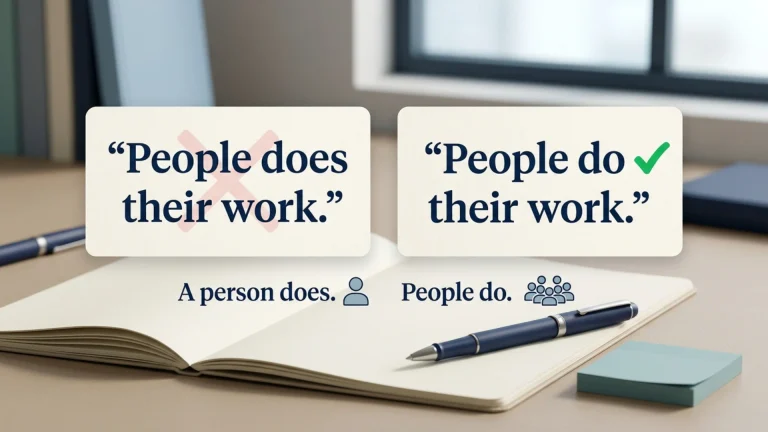
This same subject-versus-object logic is useful across English grammar. For more agreement practice, see People Do or People Does and our guide to Was There or Were There.
Sally and Me or Sally and I?
Both can be correct. It depends on the sentence.
Sally and I when the phrase is the subject:
Sally and I went to the store.
Sally and me when the phrase is the object:
The teacher spoke to Sally and me.
Remove Sally to test it:
- I went to the store. ✅
- The teacher spoke to me. ✅
Me and John or John and I?
If the pair is the subject, use:
John and I are leaving.
If the pair is the object, use:
She called John and me.
In formal or careful English, putting the other person first is also considered more polite and stylistically preferable: John and I, not me and John.
Common Mistakes
Using “I as Well” as a Bare Reply
“I as well” usually sounds incomplete. Use me too or complete the clause: I do as well.
Thinking “Me as Well” Is Always More Formal
It is not automatically a formal upgrade. In many contexts, a complete sentence is more professional.
Using “I” Just Because It Sounds More Formal
“Between you and I” is not made correct by sounding formal. Pronoun case depends on grammar, not prestige.
Using “Me” as the Subject of a Formal Sentence
“Me and Sarah completed the report” is common in casual speech, but standard formal English prefers “Sarah and I completed the report.”
Frequently Asked Questions
Which is correct: “me too” or “me as well”?
Both can be correct, but me too is the more common and natural standalone response. Me as well is possible and is especially natural when me is an object, as in “They invited me as well.”
Which is correct, “I too” or “Me too”?
For a short response, me too is normally more natural. I too is useful inside a full clause for emphasis, as in “I too was surprised.”
Is it better to say “too” or “as well”?
Both are standard. Too is extremely common in conversation and short replies, while as well also commonly appears at the end of a clause. Choose the one that sounds natural in your sentence.
Which is correct, Sally and Me or Sally and I?
Use Sally and I as the subject: “Sally and I left.” Use Sally and me as the object: “They called Sally and me.”
Should I say me and John or John and I?
If the phrase is the subject, use John and I: “John and I agree.” If it is the object, use John and me: “She invited John and me.”
Should I use “Kelly and I” or “Kelly and me”?
Use Kelly and I for a subject and Kelly and me for an object. Test it by removing Kelly: “I went” versus “She called me.”
Should I use “Kathy and me” or “Kathy and I”?
Both can be correct. “Kathy and I arrived early” uses the subject form. “They seated Kathy and me together” uses the object form.
Is it Sue and I or Sue and me?
Use Sue and I when doing the action and Sue and me when receiving the action or following a preposition.
Which is correct, Julie and I or Julie and me?
Use Julie and I as a subject: “Julie and I spoke.” Use Julie and me as an object: “He spoke to Julie and me.”
Is “me too” correct?
Yes. Me too is a standard, natural short response meaning that the same statement applies to you.
What does “me as well” mean?
Me as well means that you are included too or that the same thing applies to you. It is possible as a short reply, though me too is usually more idiomatic.
Is “me as well” grammatically correct?
Yes. It is clearly correct in sentences such as “They invited me as well,” and it can also be used elliptically as a short response. It is simply less common than “me too” in that role.
Is “I as well” grammatically correct?
Not normally as a standalone reply. Use a complete clause such as “I do as well,” “I will as well,” or “I am as well.”
Final Answer
For a quick response, “Me too” is the best default.
“Me as well” can be correct, especially when me is functioning as an object, but it is less common as a standalone reply.
“I as well” usually should not stand alone. If I is the subject, give it a full clause: “I do as well,” “I will as well,” or “I agree as well.”
The easiest rule to remember is:
Short reply: “Me too.”
Subject: “I + verb + as well.”
Object: “me + as well.”