A MA or An MA? Which Is Correct? Grammar Rule + Examples
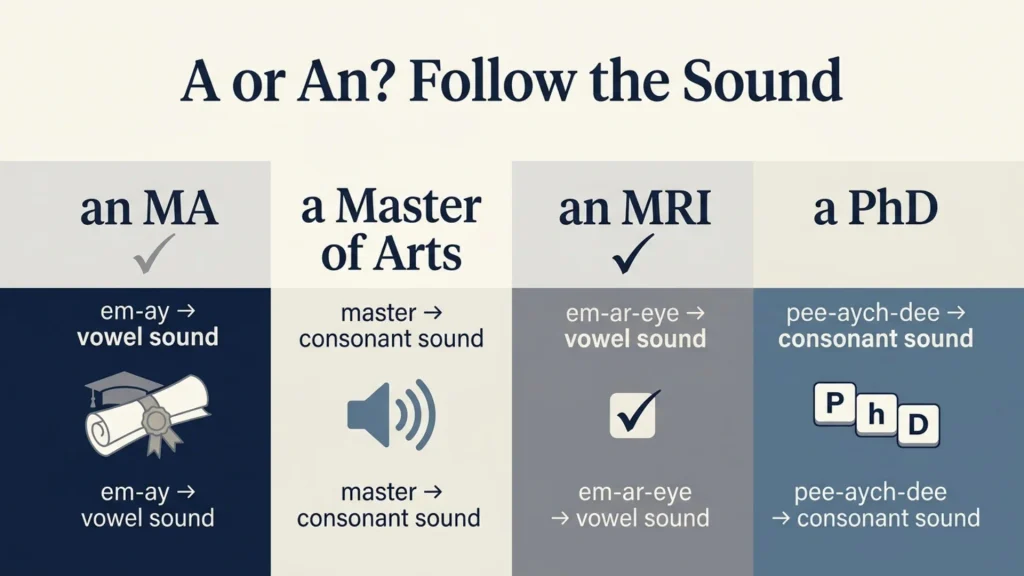
The correct form is “an MA.” MA is normally pronounced letter by letter as “em-ay,” and the first sound you hear is a vowel sound. In English, the choice between a and an depends on pronunciation, not simply on the first written letter.
So write an MA, an MA degree, or an MA in English. If you spell out the qualification, however, write a Master of Arts because Master begins with a consonant sound.
A MA or An MA: The Quick Answer
| Phrase | Correct? | Why? |
|---|---|---|
| an MA | Yes | MA begins with the vowel sound “em.” |
| a MA | No | The written letter M is a consonant, but its spoken name starts with a vowel sound. |
| an MA degree | Yes | The first sound after the article is still “em.” |
| a Master of Arts | Yes | Master begins with the consonant sound /m/. |
This is the key distinction: an MA but a Master of Arts.
Why “An MA” Is Correct
Many learners are taught to use a before consonants and an before vowels. That shortcut works often, but the more accurate rule is based on sound.
- Use a before a consonant sound: a university, a book, a PhD.
- Use an before a vowel sound: an hour, an MBA, an MA.
The British Council’s grammar reference on the indefinite article explains the same principle: the choice between a and an depends on sound rather than spelling.
When MA is spoken, the letter M is pronounced “em.” Because “em” starts with a vowel sound, an is the natural article.
Say It Aloud: “Em-Ay”
A simple test is to pronounce the abbreviation. If you say “em-ay,” you can hear why an MA flows naturally while a MA does not.
This same test works for many abbreviations. Do not judge only by the written first letter. Judge by the first sound you actually pronounce.
What Does MA Stand For?
In the academic context, MA stands for Master of Arts. If you are looking for the MA full form in English, that is the standard expansion used for the degree.
The abbreviation and the full form take different articles because they begin with different sounds:
- an MA because MA begins with “em”
- a Master of Arts because Master begins with /m/
MA can have other meanings in other contexts, so the surrounding sentence matters. On university, academic, resume, or degree-related pages, MA normally refers to Master of Arts.
Is It “An MA Degree” or “A MA Degree”?
“An MA degree” is correct. Adding the word degree does not change the article because the article comes immediately before MA, and MA is still pronounced “em-ay.”
Correct examples:
- She earned an MA degree in history.
- He is applying for an MA program in linguistics.
- She completed an MA before starting her doctorate.
- He holds an MA in English.
Incorrect in standard English:
- a MA degree
- a MA program
- a MA in English
“An MA” vs “A Master of Arts”
The change can look odd until you remember that article choice follows the next sound, not the underlying meaning.
| Expression | First Sound | Correct Article |
|---|---|---|
| MA | “em” | an |
| Master of Arts | /m/ | a |
| M.A. | “em” | an |
| master’s degree | /m/ | a |
So all of these are correct:
- She has an MA.
- She has an M.A.
- She has a Master of Arts.
- She has a master’s degree.
MA or M.A.: Does Punctuation Change the Article?
No. Whether you write MA or M.A., the abbreviation is still normally pronounced letter by letter as “em-ay.” That means both forms take an.
Different universities, publishers, and style guides may prefer MA or M.A. The safest approach is to follow the style required by your institution or publication and stay consistent throughout the document.
Other Abbreviations That Use A or An by Sound
The same pronunciation rule explains several abbreviations that often confuse writers.
| Abbreviation | Typical Pronunciation | Correct Form |
|---|---|---|
| MA | em-ay | an MA |
| MBA | em-bee-ay | an MBA |
| MRI | em-ar-eye | an MRI |
| FBI | ef-bee-eye | an FBI agent |
| BA | bee-ay | a BA |
| PhD | pee-aych-dee | a PhD |
The pattern is consistent: listen to the opening sound. If that sound is a vowel sound, use an. If it is a consonant sound, use a.
How to Write MA on a Resume, CV, or Application
In professional writing, you can use either the abbreviation or the full degree name, depending on the space available and the style of the document.
Natural examples include:
- I hold an MA in English.
- She earned an MA in International Relations.
- He completed a Master of Arts in History.
- She has a master’s degree in Sociology.
For most sentences, an MA in [field] is concise and clear. If you are listing credentials in an education section, you may not need an article at all, for example: MA in English, University Name.
Common Mistakes to Avoid
1. Choosing the Article by Letter Instead of Sound
The letter M is a consonant, but the name of the letter starts with a vowel sound. That is why a MA is not the standard form.
2. Using “An” Before the Full Degree Name
Do not write an Master of Arts. Once the abbreviation is expanded, the next word is Master, which begins with a consonant sound. Use a Master of Arts.
3. Writing “Masters Degree” Without an Apostrophe
When you use the generic phrase, write master’s degree. The formal degree name Master of Arts does not use the apostrophe.
4. Assuming Every Abbreviation Uses “An”
Abbreviations do not automatically take an. A BA and a PhD both take a because their spoken forms begin with consonant sounds.
A Simple Rule You Can Use Every Time
When you are unsure, read the word or abbreviation aloud and listen to its first sound:
- If the first sound is a vowel sound, use an.
- If the first sound is a consonant sound, use a.
This sound-first method also helps with other grammar choices. For more quick rule explanations, see our guides to people do or people does and was there or were there.
Frequently Asked Questions
Which is correct, a MA or an MA?
An MA is correct. MA is pronounced “em-ay,” so it begins with a vowel sound.
Is it a MA degree or an MA degree?
Write an MA degree. The article is determined by the opening sound of MA, which is “em.”
Is it correct to say “a MA student” or “an MA student”?
An MA student is correct when MA is pronounced “em-ay.” The same rule applies to an MA program and an MA applicant.
Do you say a or an MRI?
Use an MRI. MRI begins with the spoken sound “em,” just like MA.
Why do we say an MRI instead of a MRI?
Because MRI is pronounced “em-ar-eye.” The first sound is a vowel sound, so English uses an.
Do you put an before an abbreviation?
Sometimes. Use an before an abbreviation whose spoken form begins with a vowel sound, such as an MA or an FBI agent. Use a before one that begins with a consonant sound, such as a BA or a PhD.
What comes before a or an?
A and an are indefinite articles placed before singular countable noun phrases. The choice depends on the sound immediately after the article. For example, we say a useful guide but an easy guide.
What is the MA abbreviation for in education?
In education, MA is the abbreviation for Master of Arts. In other contexts, MA can stand for other things, so context should guide the meaning.
Conclusion
Use an MA, not a MA, because MA is pronounced “em-ay” and begins with a vowel sound. If you write the degree in full, use a Master of Arts. The easiest rule to remember is simple: choose a or an by the first sound you pronounce, not by the first letter you see.