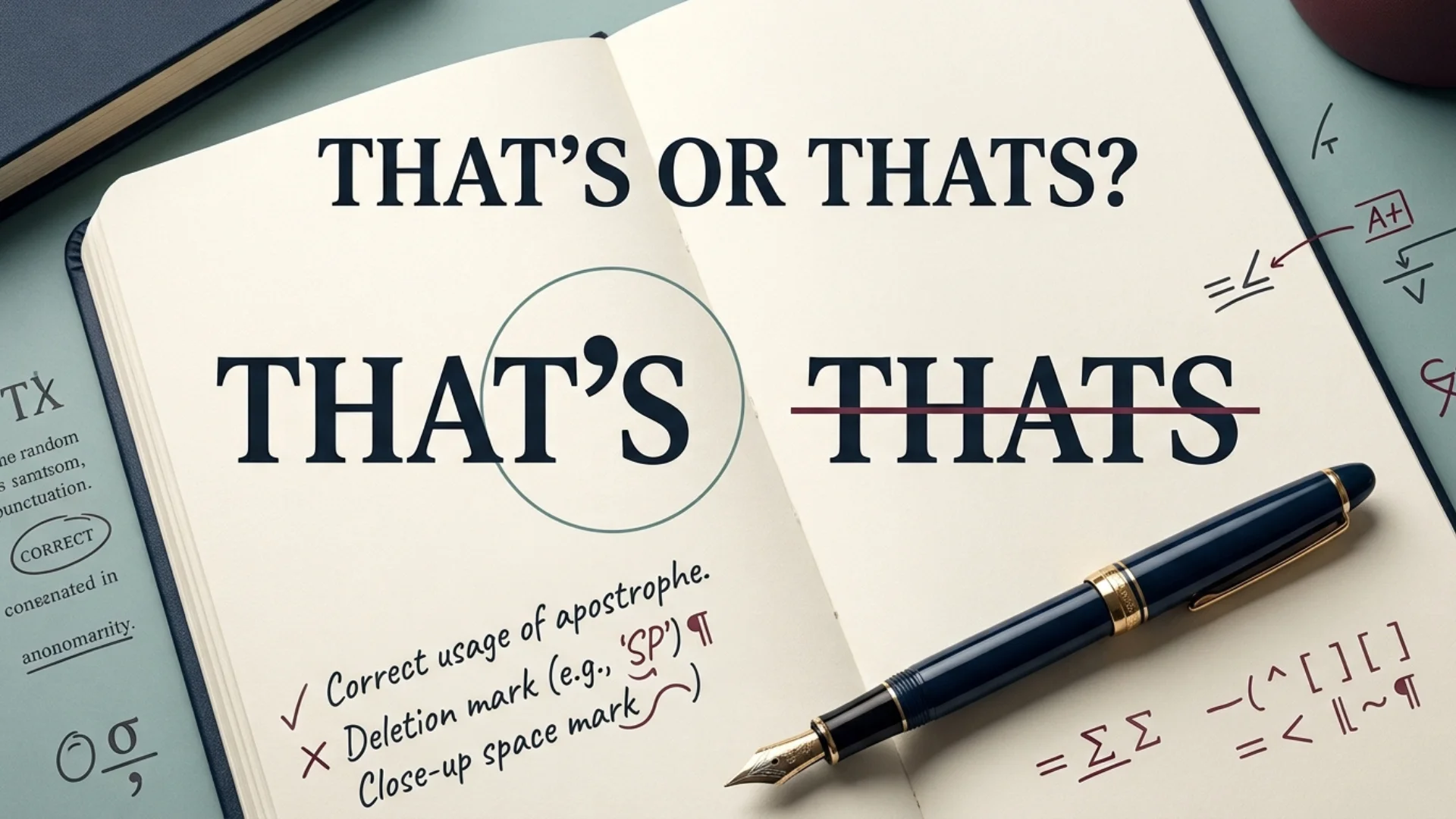
That’s or Thats: Which Is Correct?
That’s or thats has a very simple answer: that’s is the correct standard form when you mean “that is” or “that has.” The apostrophe is required because that’s is a contraction.
Thats without an apostrophe is generally a spelling error in ordinary English.
Examples:
- That’s a great idea. = That is a great idea.
- That’s been helpful. = That has been helpful.
- Thats a great idea. ❌
- Thats been helpful. ❌
The apostrophe may be tiny, but removing it turns a normal English contraction into a nonstandard spelling. Apparently punctuation needed this much responsibility.
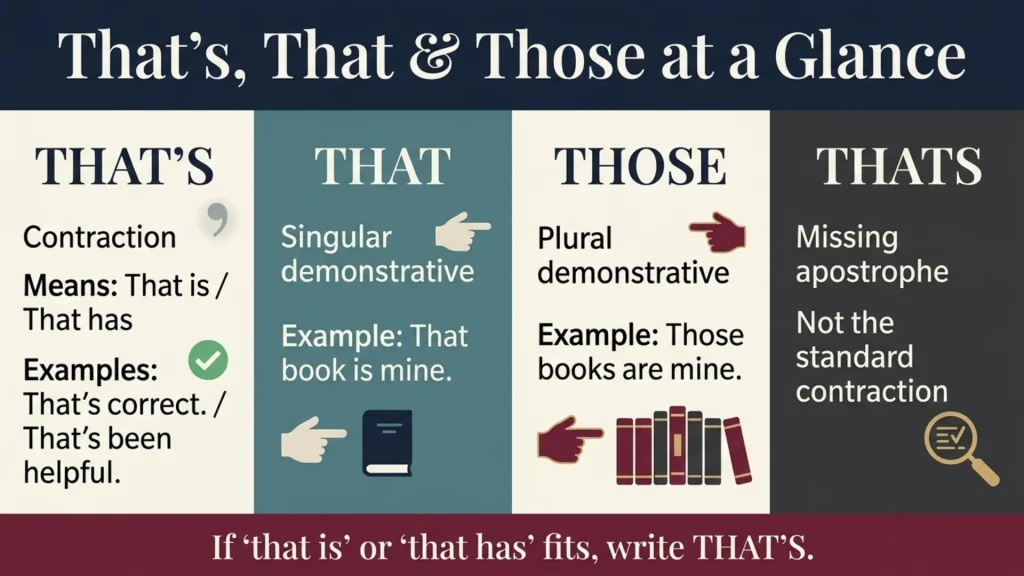
Quick Answer: That’s or Thats
| Form | Correct? | Meaning | Example |
|---|---|---|---|
| that’s | Yes | that is / that has | That’s my bag. |
| thats | Usually no | No standard contraction meaning | Thats my bag. ❌ |
| that | Yes | Demonstrative, determiner, pronoun, conjunction, etc. | That book is mine. |
| those | Yes | Plural demonstrative corresponding to that | Those books are mine. |
| thats’ | No in normal grammar | Incorrect apostrophe placement | Thats’ mine. ❌ |
| thats’s | No | Incorrect/nonstandard form | Thats’s mine. ❌ |
The easiest rule to remember is:
That’s = that is or that has.
If neither expansion works, you probably need that rather than that’s.
What Does That’s Mean?
That’s is a contraction of either:
- that is
- that has
Cambridge Dictionary defines that’s as the short form of “that is” or “that has.” Cambridge Dictionary
That gives the word two common grammatical uses.
That’s = That Is
This is the most common use.
Examples:
- That’s my phone.
= That is my phone. - That’s the answer.
= That is the answer. - That’s really interesting.
= That is really interesting. - That’s what I meant.
= That is what I meant. - That’s why I called you.
= That is why I called you. - That’s a beautiful house.
= That is a beautiful house.
Whenever that is works naturally, you can usually contract it to that’s.
That’s = That Has
That’s can also mean that has.
This typically happens before a past participle in a present-perfect construction.
Examples:
- That’s been difficult.
= That has been difficult. - That’s happened before.
= That has happened before. - That’s changed everything.
= That has changed everything. - That’s made a big difference.
= That has made a big difference. - That’s already started.
= That has already started.
The surrounding words usually make the meaning obvious.
The Easy Replacement Test
If you are unsure whether that’s is correct, expand it.
Test 1: Replace It With “That Is”
Sentence:
That’s my jacket.
Expanded:
That is my jacket.
The sentence still works, so that’s is correct.
Test 2: Replace It With “That Has”
Sentence:
That’s been my biggest concern.
Expanded:
That has been my biggest concern.
Again, it works.
When Neither Works
Consider:
I like that’s color.
Try:
I like that is color.
Wrong.
Try:
I like that has color.
Also wrong.
The sentence needs something else, such as:
I like that color.
This replacement test solves most that’s vs thats confusion in seconds.
Is “Thats” a Word?
In standard English, thats is not the normal spelling of the contraction.
If you mean:
- that is
- that has
you need:
that’s
Correct:
That’s exactly what I wanted.
Incorrect:
Thats exactly what I wanted.
However, there is one narrow exception worth mentioning.
A business, username, product, brand, title, surname, or other proper name could deliberately use Thats as its official spelling.
That would not make thats a standard English contraction. It would simply be a proper name using an unconventional spelling.
Why Does That’s Need an Apostrophe?
The apostrophe shows that letters have been omitted.
That Is
Start with:
that is
The contraction becomes:
that’s
The apostrophe marks the shortened form.
That Has
Start with:
that has
The shortened form is also:
that’s
This is the same reason English uses contractions such as:
- it is → it’s
- cannot → can’t
- do not → don’t
- we are → we’re
- they have → they’ve
- I am → I’m
The apostrophe is part of the spelling, not optional decoration.
Thats vs. That’s in Texting
In texting, people frequently write:
thats
without an apostrophe because they are typing quickly.
You may see:
- thats crazy
- thats fine
- thats cool
- thats what I mean
- thats hilarious
Readers normally understand them.
But in standard written English, the correct versions are:
- that’s crazy
- that’s fine
- that’s cool
- that’s what I mean
- that’s hilarious
Casual typing explains the mistake. It does not create a new grammar rule.
What Does That’s Mean in Texting?
The meaning does not change in a text message.
That’s still normally means:
- that is
- that has
Examples:
That’s funny 😂
= That is funny.
That’s been happening all day.
= That has been happening all day.
Texting may be less formal, but the grammatical meaning remains the same.
What Is the Full Form of That’s?
There are two possible full forms:
That Is
That’s my seat.
That is my seat.
That Has
That’s happened already.
That has happened already.
So writing that the full form of that’s is always “that is” is incomplete.
The context decides which expansion is correct.
That’s Meaning and Definition
A concise definition is:
That’s is a contraction of “that is” or “that has.”
Examples:
That’s correct.
= That is correct.
That’s been corrected.
= That has been corrected.
The difference becomes especially clear when you look at the word that follows the contraction.
“That’s Correct” Meaning
The expression:
That’s correct.
normally expands to:
That is correct.
It means:
- that is accurate
- that is right
- that statement is true
- you have understood correctly
Example:
“The meeting starts at nine, right?”
“That’s correct.”
That’s vs. That
That’s and that are not interchangeable.
That’s
A contraction:
That’s my car.
Meaning:
That is my car.
That
Can function in several different grammatical ways.
Examples:
That car is mine.
Here, that is a demonstrative determiner.
That is mine.
Here, that is a demonstrative pronoun.
I know that she called.
Here, that introduces a clause.
So not every occurrence of that needs an apostrophe.
Demonstratives: This, That, These, Those
One reason this topic expands beyond punctuation is that that belongs to the English demonstrative system.
The four core demonstratives are:
| Singular | Plural | General Distance |
|---|---|---|
| this | these | nearer |
| that | those | farther away |
Examples:
- This is my pen.
- That is your pen.
- These are my shoes.
- Those are your shoes.
This
Singular and usually nearer:
This is delicious.
That
Singular and usually farther away:
That is expensive.
These
Plural and usually nearer:
These are mine.
Those
Plural and usually farther away:
Those are yours.
The neat part is that only that is normally contracts to:
that’s
You do not normally create equivalent standard contractions such as this’s, these’re, or those’re in ordinary edited writing.
Is “That” Singular or Plural?
That is singular.
Example:
That book is expensive.
For plural nouns, use:
those
Example:
Those books are expensive.
So the plural of demonstrative that is not thats.
It is:
those
This distinction is particularly useful because searches for the plural of that sometimes lead people to assume an s should simply be added.
English, naturally, declined to make this convenient.
What Is the Plural of That?
The plural demonstrative corresponding to that is:
those
Compare:
- that house → those houses
- that child → those children
- that idea → those ideas
- that problem → those problems
Not:
- thats houses
- that’s houses
Use those.
That’s vs. Those
These words can sound somewhat similar to learners, but their grammar is completely different.
That’s
Means:
- that is
- that has
Example:
That’s my computer.
Those
Plural demonstrative:
Those are my computers.
A quick comparison:
| Word | Meaning |
|---|---|
| that’s | that is / that has |
| that | singular demonstrative |
| those | plural demonstrative |
Is “Thats’” Correct?
Normally, no.
Thats’ places the apostrophe after the s, which does not create the contraction that is or that has.
Incorrect:
Thats’ the answer.
Correct:
That’s the answer.
There is no ordinary English contraction spelled:
thats’
Is “Thats’s” Correct?
No, not in standard ordinary usage.
Forms such as:
- thats’s
- thats’
- that s
often appear because users know an apostrophe or s belongs somewhere but are unsure where.
The standard contraction is simply:
that’s
That S vs. That’s
Writing:
that s
does not form the contraction.
You need an apostrophe:
that’s
Compare:
- that is → that’s
- that has → that’s
The apostrophe joins the shortened elements into one written form.
Does the Apostrophe Show Possession in That’s?
No.
The apostrophe in that’s marks a contraction, not possession.
This is similar to:
it’s
which means:
- it is
- it has
Compare:
It’s raining.
= It is raining.
But:
The dog wagged its tail.
Here, its is possessive and has no apostrophe.
With that’s, the apostrophe likewise tells you that words have been shortened.
That’s in Formal Writing
That’s is grammatically correct in formal as well as informal English.
However, the preferred tone may vary.
In very formal academic, legal, or ceremonial writing, an author may choose the full form:
that is
instead of:
that’s
Compare:
Conversational:
That’s the main conclusion.
More formal:
That is the main conclusion.
Both can be grammatically correct. The difference is tone, not whether the apostrophe magically stops working when somebody wears a suit.
That’s in Academic Writing
Academic style varies by institution, field, publication, and instructor.
Some academic writing freely uses contractions.
Other formal styles prefer:
that is
rather than:
that’s
But if you do use the contraction, the spelling remains:
that’s
Never remove the apostrophe simply to make the writing look more formal.
Common Expressions With That’s
That’s Why
Means:
that is why
Example:
That’s why I left early.
That’s What
Means:
that is what
Example:
That’s what she told me.
That’s How
Means:
that is how
Example:
That’s how the machine works.
That’s Where
Means:
that is where
Example:
That’s where we met.
That’s When
Means:
that is when
Example:
That’s when I noticed the problem.
That’s Been
Usually means:
that has been
Example:
That’s been difficult.
That’s Got
Can represent:
that has got
Example:
That’s got to be the answer.
That’s It vs. That’s All
Both expressions can signal completion, but they are not always identical.
That’s It
Common meanings include:
- there is nothing more
- something is finished
- that is the exact thing
- a decision is final
Examples:
That’s it. We’re finished.
That’s it! That’s the book I wanted.
That’s All
Usually means:
- there is nothing more
- that is the complete amount
- no additional information or action is needed
Example:
I only need your signature. That’s all.
Difference
That’s it can sound more final, emphatic, or identifying.
That’s all often emphasizes that nothing more is included or required.
“That’s It” or “Thats It”?
Correct:
That’s it.
Incorrect in standard English:
Thats it.
Why?
Because:
That’s it = That is it.
The apostrophe is therefore required.
What Are Demonstrative Pronouns?
Demonstrative pronouns point to specific people, objects, ideas, or situations without directly naming the noun.
The main forms are:
- this
- that
- these
- those
Examples:
This is delicious.
That is mine.
These are expensive.
Those belong to Sarah.
When the noun follows directly, the same words traditionally called demonstrative adjectives are more commonly analyzed in modern grammar as demonstrative determiners.
Example:
That car is mine.
Here, that comes before and identifies the noun car.
The Four Demonstratives
The core English demonstratives are:
- this
- that
- these
- those
Their basic pattern is:
| Near | Farther Away |
|---|---|
| this | that |
| these | those |
And:
| Singular | Plural |
|---|---|
| this | these |
| that | those |
Distance can be physical, conversational, temporal, or conceptual rather than literally measured in metres.
10 Examples of Demonstrative Pronouns
- This is mine.
- That looks expensive.
- These belong to me.
- Those were delicious.
- This feels strange.
- That was unexpected.
- These are ready.
- Those need cleaning.
- This will work.
- That explains everything.
Notice that no noun immediately follows the demonstrative in these examples.
Demonstratives Used Before Nouns
Compare:
That is mine.
Here, that is standing alone as a pronoun.
Now:
That laptop is mine.
Here, that modifies or determines the noun laptop.
More examples:
- this phone
- that building
- these shoes
- those people
How Do You Identify a Demonstrative Pronoun?
Ask whether this, that, these, or those is standing in for a noun rather than appearing directly before one.
Example:
That is broken.
That is a demonstrative pronoun.
But:
That chair is broken.
Here, that comes directly before chair, so it functions as a demonstrative determiner.
20 Examples of Pronouns
Pronouns are much broader than demonstratives. Examples include:
- I
- me
- you
- he
- him
- she
- her
- it
- we
- us
- they
- them
- mine
- yours
- ours
- theirs
- this
- that
- these
- those
Not every word in this list performs the same type of pronoun function, but all can function within the broader pronoun system.
Common That’s Grammar Mistakes
Leaving Out the Apostrophe
Incorrect:
Thats a good idea.
Correct:
That’s a good idea.
Putting the Apostrophe After the S
Incorrect:
Thats’ a good idea.
Correct:
That’s a good idea.
Using That’s When You Need That
Incorrect:
I like that’s jacket.
Correct:
I like that jacket.
Using Thats as the Plural of That
Incorrect:
Thats are expensive.
Correct:
Those are expensive.
Assuming That’s Only Means “That Is”
Incomplete rule:
That’s = that is only.
Correct rule:
That’s = that is or that has.
Correct and Incorrect Examples
| Incorrect | Correct | Explanation |
|---|---|---|
| Thats my car. | That’s my car. | That is my car. |
| I think thats right. | I think that’s right. | That is right. |
| Thats been difficult. | That’s been difficult. | That has been difficult. |
| Thats’ enough. | That’s enough. | Apostrophe goes before s. |
| Thats are mine. | Those are mine. | Plural of that is those. |
| I like that’s color. | I like that color. | No contraction is needed. |
| That s my seat. | That’s my seat. | Contraction needs apostrophe. |
| Thats it. | That’s it. | That is it. |
A Simple Way to Remember the Difference
Whenever you type that’s, expand it mentally.
Ask:
Can I say “that is”?
If yes, use that’s.
If not, ask:
Can I say “that has”?
If yes, use that’s.
If neither works, you may need:
- that
- those
- another construction entirely
Example:
That’s beautiful.
→ That is beautiful. ✓
Example:
That’s been fixed.
→ That has been fixed. ✓
Example:
That’s car is red.
→ That is car is red. ✗
→ That has car is red. ✗
Correct:
That car is red.
That’s vs. Its and It’s
These apostrophe rules are often confused.
It’s
Means:
- it is
- it has
It’s raining.
Its
Possessive:
The company changed its policy.
That’s
Means:
- that is
- that has
That’s the problem.
The useful principle is:
apostrophes in these contractions mark omitted letters, not possession.
For another common grammar distinction involving agreement rather than apostrophes, see GrammarRead’s guide to People Do or People Does?.
That’s in Questions
The contraction also appears naturally in questions.
Examples:
- What’s that?
- Who’s that?
- Is that yours?
- Do you think that’s correct?
- Is that’s correct? ❌
Notice the last example.
You would not normally say:
Is that’s correct?
because expanding it produces:
Is that is correct?
Instead:
Is that correct?
The expansion test catches the mistake immediately.
That’s With “Why,” “What,” and “How”
These combinations are extremely common.
That’s Why
That’s why we changed the plan.
That’s What
That’s what I wanted.
That’s How
That’s how I learned.
That’s Where
That’s where I parked.
These all normally expand with:
that is
Can You Use That’s at the Start of a Sentence?
Yes.
Examples:
That’s correct.
That’s exactly what happened.
That’s been bothering me all day.
That’s the reason we came.
Capitalization does not change the contraction rule.
Can You Use That’s in the Middle of a Sentence?
Yes.
Examples:
I think that’s correct.
She knows that’s the problem.
The option that’s available today may change tomorrow.
The correct form still depends on whether that is or that has fits.
Is That’s Always a Contraction?
In ordinary English grammar, that’s is a contraction.
It does not normally represent possession.
When you see:
that’s
read it as:
that is
or:
that has
Then decide which meaning fits the sentence.
Frequently Asked Questions
What Is the Difference Between “That’s It” and “That’s All”?
That’s it can mean something is finished, settled, or exactly identified. That’s all usually means there is nothing more to add, include, or do.
For example:
That’s it! That’s the missing key.
Here, that’s it identifies something.
I only need your name. That’s all.
Here, that’s all means nothing else is required.
What Is the Definition of “Thats”?
Thats has no standard grammatical meaning when used as a replacement for that’s. In ordinary English, it is usually a misspelling caused by leaving out the apostrophe.
Which Is Correct: “That’s It” or “Thats It”?
That’s it is correct.
It expands to:
That is it.
Therefore, the apostrophe is required.
Are This, That, These, and Those Demonstratives?
Yes. This, that, these, and those are the four central demonstratives in English. They can function as pronouns or as determiners depending on sentence structure.
What Are the Four Demonstratives?
They are:
- this
- that
- these
- those
This and that are singular.
These and those are plural.
What Are 10 Examples of Demonstrative Pronouns?
Examples include:
- This is mine.
- That is yours.
- These are ready.
- Those are expensive.
- This feels right.
- That looks strange.
- These belong upstairs.
- Those were delicious.
- This will help.
- That explains it.
Can You Give Me a List of Demonstratives in English?
The main English demonstratives are:
this, that, these, those
They can point to objects, people, ideas, events, or previously mentioned information.
Can You Give Me 20 Examples of Pronouns?
Yes:
I, me, you, he, him, she, her, it, we, us, they, them, mine, yours, ours, theirs, this, that, these, those.
How Do You Identify a Demonstrative Pronoun?
Look for this, that, these, or those standing independently instead of directly modifying a following noun.
That is expensive.
That is a pronoun.
That phone is expensive.
That functions as a determiner.
Is “Thats’” Ever Correct?
Not as the contraction of that is or that has.
Use:
that’s
not:
thats’
What Is the Plural of “That”?
The plural demonstrative of that is those.
That car → those cars.
Do not write thats as the plural.
What Does That’s Mean in Texting?
It has the same grammatical meaning as elsewhere:
that is or that has.
People sometimes omit the apostrophe while texting, but thats remains nonstandard spelling when the contraction is intended.
Final Answer
For That’s or Thats, use that’s when you mean:
- that is
- that has
The apostrophe is required because that’s is a contraction.
Thats without an apostrophe is generally incorrect in standard English, although it could appear deliberately in a proper name, username, title, or brand.
Also remember:
- that = singular demonstrative
- those = plural of demonstrative that
- that’s = that is / that has
- thats’ = not the standard contraction
- thats’s = incorrect in normal usage
The quickest test is still the best one: expand that’s to that is or that has. If one version makes sense, keep the apostrophe.
For another grammar choice where one tiny form changes the entire sentence, see Was There or Were There?.