Newfound vs. New-Found: Which Is Correct? Meaning & Examples
Newfound vs. New-Found is mostly a spelling and style question, not a difference in meaning. Newfound is the standard modern one-word form in much contemporary English, while new-found is also an accepted variant and remains visible in British-oriented dictionaries and more traditional writing.
If you mean “recently discovered, gained, developed, or begun,” newfound is the safest general-purpose choice. By contrast, new found as two separate words is usually not the standard spelling when the phrase acts as one adjective before a noun.
Quick Answer: Newfound vs. New-Found
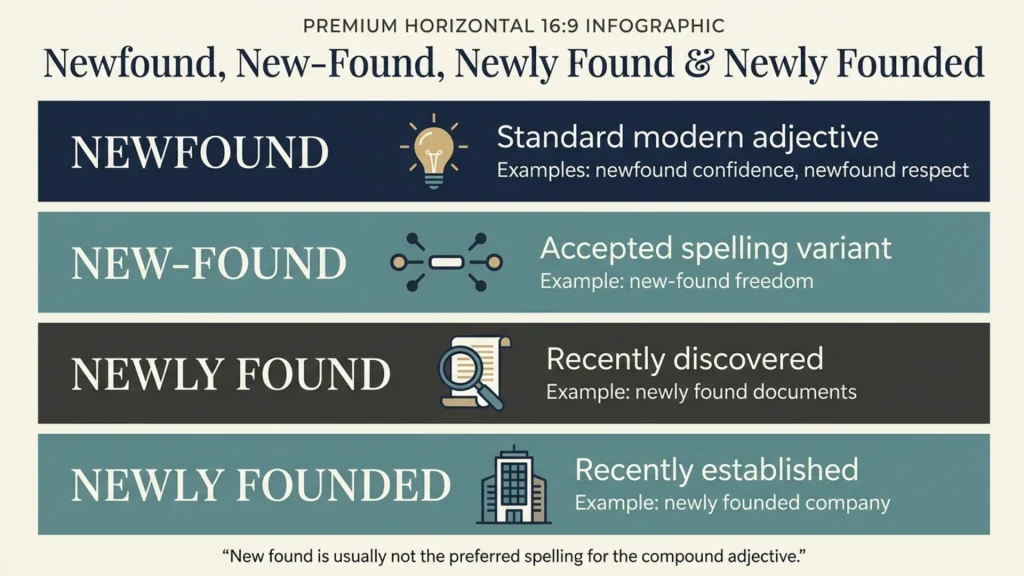
| Form | Is It Correct? | Meaning | Example |
|---|---|---|---|
| newfound | Yes, standard modern form | Recently discovered, gained, or developed | She has newfound confidence. |
| new-found | Yes, accepted variant | Same basic meaning as newfound | He enjoyed his new-found freedom. |
| new found | Usually no as a compound adjective | Not the standard spelling for “recently gained” | Avoid: new found respect |
| newly found | Yes | Recently discovered or located | The newly found documents changed the case. |
| newly founded | Yes, but different word | Recently established or created | A newly founded company opened nearby. |
A useful rule is simple: if you are describing a recently gained feeling, quality, interest, respect, freedom, love, or appreciation, write newfound unless your publication or house style prefers new-found.
What Does Newfound Mean?
Newfound is an adjective meaning recently discovered, recently gained, newly developed, or only recently beginning to exist.
The Cambridge Dictionary entry for “newfound” describes it as something that has started recently and also recognizes new-found as an alternative form.
Common examples include:
- newfound confidence
- newfound appreciation
- newfound freedom
- newfound respect
- newfound love
- newfound interest
- newfound knowledge
- newfound fame
- newfound strength
- newfound enthusiasm
In all these phrases, the adjective tells us that the feeling, state, quality, or interest has been acquired or recognized recently.
Also check: Tomatoes or Tomatos?
Is Newfound One Word?
Yes. Newfound is a standard one-word adjective.
Correct examples include:
- newfound confidence
- newfound appreciation
- newfound respect
- newfound freedom
- newfound knowledge
- newfound enthusiasm
If you are writing ordinary modern English and do not have a style guide telling you otherwise, the one-word form is usually the easiest and safest choice.
Is New-Found With a Hyphen Correct?
Yes. New-found is also a recognized spelling.
The hyphenated form is especially visible in British dictionary treatment, older publications, and some formal or literary writing. It does not normally create a different meaning from newfound.
Compare:
- She enjoyed her newfound freedom.
- She enjoyed her new-found freedom.
Both sentences describe freedom that has recently been gained.
The important point is that the hyphen changes the presentation, not the core definition.
Newfound or New-Found: Which Should You Use?
For most contemporary writing, use newfound.
Choose new-found when:
- your dictionary or house style prefers it
- you are following a publication’s established British spelling style
- you are quoting a source that uses the hyphen
- you deliberately want a more traditional visual style
If consistency matters, pick one accepted form and use it throughout the document rather than switching between both for no reason.
Newfound vs. New-Found in US and UK English
The regional difference is real but easy to exaggerate.
American English strongly favors newfound in modern general writing.
British English also uses newfound, while new-found remains established in some British dictionaries and publications.
So the rule is not:
US = newfound, UK = new-found, always.
A better rule is:
Newfound is a safe modern spelling in both varieties; new-found remains an accepted variant, particularly visible in British usage.
Is “New Found” Correct as Two Words?
Usually not when you mean “recently acquired or discovered” and the expression is functioning as one adjective.
Avoid:
- new found confidence
- new found respect
- new found freedom
- new found love
- new found appreciation
Prefer:
- newfound confidence
- newfound respect
- newfound freedom
- newfound love
- newfound appreciation
Or, if your chosen style uses the variant:
- new-found confidence
- new-found respect
- new-found freedom
The two-word sequence new found can occur when the words are doing separate grammatical jobs, but it should not be your default spelling for the compound adjective newfound.
Newfound vs. Newly Found
Newfound and newly found overlap, but they do not always sound natural in the same contexts.
Use Newfound for Recently Gained Qualities or Feelings
Examples include:
- newfound confidence
- newfound respect
- newfound independence
- newfound appreciation
- newfound love of cooking
- newfound enthusiasm
- newfound freedom
These usually describe a new state, attitude, feeling, or personal development.
Use Newly Found for Something Recently Discovered or Located
Examples include:
- newly found documents
- a newly found manuscript
- newly found evidence
- a newly found species
- newly found photographs
- newly found archaeological remains
Newly found is an ordinary adverb-plus-participle construction. It often sounds especially natural when something has literally been discovered or located.
Can Both Be Correct?
Sometimes.
For example:
- a newfound interest in history
- a newly found interest in history
Both are understandable, but newfound interest is more idiomatic when talking about a recently developed interest rather than something physically discovered.
Newly Found vs. Newly Founded
These are completely different.
- found = discovered or located
- founded = established or created
Examples:
- The newly found letters were placed in the archive.
- The newly founded charity opened its first office.
- Researchers studied a newly found fossil.
- She joined a newly founded startup.
If a company, organization, school, settlement, club, or institution has recently been established, use newly founded, not newly found.
Newfound Appreciation Meaning
Newfound appreciation means a sense of value, gratitude, or understanding that someone has developed recently.
Examples:
- After living abroad, she gained a newfound appreciation for her hometown.
- Parenthood gave him a newfound appreciation for patience.
- The course created a newfound appreciation for classical music.
- Working from home gave her a newfound appreciation for quiet mornings.
The phrase does not mean the appreciation was physically “found.” It means the feeling developed or was recognized recently.
Newfound Respect or New Found Respect?
Use newfound respect in standard modern writing.
Correct:
After working together, they developed newfound respect for each other.
The hyphenated new-found respect is also acceptable if that is the style you are following.
New found respect is usually the form to avoid when you intend the compound adjective.
Newfound Freedom or New Found Freedom?
Newfound freedom is the standard modern phrasing.
It means freedom or independence that has been gained recently.
Examples:
- She used her newfound freedom to travel.
- Remote work gave him newfound freedom over his schedule.
- The students celebrated their newfound independence.
- Retirement gave them newfound freedom to spend more time abroad.
The hyphenated new-found freedom is also possible, particularly in styles that preserve the hyphen.
Newfound Love or New Found Love?
Use newfound love when you mean affection, enthusiasm, or enjoyment that has developed recently.
Examples:
- He discovered a newfound love of hiking.
- She has a newfound love for jazz.
- The trip gave them a newfound love of coastal towns.
- Cooking classes sparked his newfound love of Italian food.
If you literally found a new romantic partner, English would usually phrase that idea differently rather than relying on new found love as a two-word adjective.
Newfound Friend Meaning
A newfound friend is a friend someone has met, discovered, or come to value recently.
However, in ordinary conversation, new friend is usually simpler and more natural.
Compare:
- I met a new friend at the conference.
- She found unexpected support in her newfound friend.
The second sounds slightly more literary and emphasizes the recent discovery or development of the friendship.
New Found Friends or Newly Found Friends?
If you mean people you have only recently become friends with, new friends is usually the most natural wording.
Newfound friends is also possible and sounds more literary or reflective.
Newly found friends may suggest friends who were recently located, rediscovered, or newly encountered.
So:
- new friends = most natural in everyday English
- newfound friends = recently developed friendships
- newly found friends = grammatically possible but often suggests discovery or location
Newfound Favorite Meaning
A newfound favorite is something that has only recently become one of your favorite things.
Examples:
- This café is my newfound favorite.
- The album quickly became a newfound favorite.
- That recipe is a newfound favorite in our house.
- The small bookstore became her newfound favorite weekend stop.
In many sentences, simply saying new favorite is even more natural.
Newfound Knowledge Meaning
Newfound knowledge means knowledge that someone has gained recently.
Examples:
- He used his newfound knowledge to fix the problem.
- The class gave students newfound knowledge of local history.
- She applied her newfound knowledge to the project.
- His newfound knowledge changed how he approached the subject.
The phrase often suggests that the knowledge has affected someone’s understanding or behavior.
Newfound in a Sentence
Here are some natural examples:
- She spoke with newfound confidence.
- He developed a newfound respect for the profession.
- The family enjoyed their newfound freedom.
- I have a newfound appreciation for quiet mornings.
- The trip sparked a newfound interest in architecture.
- They used their newfound knowledge to improve the design.
- Her success brought newfound attention from the media.
- He approached the challenge with newfound determination.
- She discovered a newfound love of gardening.
- The experience gave him newfound perspective.
Common Collocations With Newfound
| Phrase | Typical Meaning |
|---|---|
| newfound confidence | confidence recently gained |
| newfound freedom | freedom recently acquired |
| newfound appreciation | recently developed gratitude or understanding |
| newfound respect | respect recently developed |
| newfound love | recently developed affection or enthusiasm |
| newfound knowledge | knowledge recently gained |
| newfound fame | fame recently acquired |
| newfound strength | strength or resilience recently realized |
| newfound interest | interest recently developed |
| newfound independence | independence recently gained |
These combinations sound natural because newfound frequently modifies abstract qualities, feelings, attitudes, or states.
Synonyms for Newfound
The best synonym depends on the noun.
Useful alternatives include:
- newly discovered
- recently discovered
- newly gained
- recently acquired
- newly developed
- recently developed
- newly realized
- fresh
- new
- recent
Examples:
- newfound confidence → recently gained confidence
- newfound appreciation → newly developed appreciation
- newfound knowledge → recently acquired knowledge
- newfound evidence → newly discovered evidence
Not every synonym works equally well in every sentence, so context matters.
Synonyms for Newly Found
If you mean something that has recently been discovered or located, useful alternatives include:
- newly discovered
- recently discovered
- newly uncovered
- recently uncovered
- newly located
- recently identified
- newly detected
For example:
newly found evidence can often be rewritten as newly discovered evidence.
Common Mistakes With Newfound
Writing “New Found” as the Compound Adjective
Less standard:
She has new found confidence.
Better:
She has newfound confidence.
Also acceptable in a style that uses the hyphen:
She has new-found confidence.
Confusing Found With Founded
Found relates to discovering or locating something.
Founded relates to establishing or creating something.
Correct:
- a newly found document
- a newly founded company
Inventing a Strict US-vs-UK Rule
British English has a stronger tradition of using new-found, but newfound also appears in British usage.
The two forms should not be treated as if a passport officer checks the hyphen at the border.
Switching Spellings Without a Reason
If you choose newfound, keep using it unless you are quoting someone or following a different house style in a specific passage.
Consistency usually matters more than pretending the two accepted spellings have different definitions.
Which Form Is Best in Different Contexts?
| Context | Best Default |
|---|---|
| General modern English | newfound |
| US business writing | newfound |
| Academic prose | newfound, unless house style differs |
| British publication | newfound or new-found; follow house style |
| Recently discovered physical item | newly found often sounds natural |
| Recently established organization | newly founded |
A Simple Test for Choosing the Right Form
Ask what you mean:
- Recently gained quality, feeling, state, or interest? Use newfound.
- Following a style that keeps the hyphen? Use new-found.
- Something was literally discovered recently? Newly found may be more natural.
- An organization was created recently? Use newly founded.
If you keep those four distinctions straight, most uses become easy.
Frequently Asked Questions
Is “New Found” One Word or Hyphenated?
When you mean “recently discovered or acquired,” newfound is the standard modern one-word form. New-found is also an accepted variant. The two-word compound new found is usually not the preferred spelling.
Can You Use “Newfound” in a Sentence?
Yes.
Example:
She approached the new job with newfound confidence.
Other common phrases include newfound respect, newfound freedom, newfound appreciation, and newfound love.
Which Is Correct, “Newly Found” or “New Found”?
Newly found is correct when something has recently been discovered or located.
If you mean the adjective “recently gained,” use newfound or the accepted variant new-found, rather than new found.
What Does “New Found” Mean?
If someone writes new found intending a single adjective, they usually mean newfound: recently discovered, gained, developed, or recognized.
As a standard compound adjective, the closed or hyphenated spelling is clearer.
What Is a Better Way to Say “New Found”?
Depending on context, use:
- newfound
- newly found
- newly discovered
- recently acquired
- newly developed
- recently gained
- recently discovered
What Does the Phrase “My New Found Friend” Mean?
The intended meaning is usually a friend acquired or discovered recently.
In standard modern spelling, write:
my newfound friend
In everyday speech, my new friend is often more natural.
What Does “Newfound Love” Mean?
Newfound love means affection, enthusiasm, or enjoyment that has developed recently.
Example:
She discovered a newfound love of painting.
What Does Newfound Freedom Mean?
Newfound freedom means freedom or independence that someone has only recently gained, discovered, or recognized.
What Does “New-Found Favorite” Mean?
New-found favorite means something that has only recently become a favorite.
In modern general writing, newfound favorite or simply new favorite will usually look more natural.
Final Answer
For Newfound vs. New-Found, both spellings are legitimate, but newfound is the best default for most modern writing. It means recently discovered, gained, developed, or begun.
New-found is an accepted variant and remains visible in British-oriented and traditional writing. New found should generally be avoided when you intend the single compound adjective.
Use newly found when something was literally discovered recently, and use newly founded when an organization, company, institution, or settlement was recently established.