STTM Meaning in Text: What It Really Means in Chat and on Instagram
If someone just sent you “STTM” and you are staring at your phone wondering what it means, here is the short answer: STTM most commonly means “stop talking to me” in texting and chat. It is a blunt little abbreviation people use when they are annoyed, overwhelmed, or jokingly pretending to be fed up. But there is a catch worth knowing before you reply: STTM is informal slang, not a dictionary term, and its tone depends almost entirely on context. A friend who sends “STTM 😂” usually means something very different from someone who sends “STTM.” in the middle of an argument.
This guide explains the sttm meaning in text in plain language, shows how it changes on Instagram and Snapchat, clears up the lookalike abbreviations people mix it up with, and gives you safe replies for every situation.
What Does STTM Mean in Text?
In casual texting, STTM stands for “stop talking to me.” People use it as a shortcut when they want the other person to stop messaging, stop arguing about a topic, or simply give them some space. It is direct by design — that is the whole point of sending it instead of a longer sentence.
So, what does sttm mean in text in everyday use? In most cases, one of these four things:
- A real request for space: “I have explained everything. STTM.”
- Annoyance or frustration: “You keep bringing up the same thing. STTM.”
- Feeling overwhelmed: “STTM, I need a minute to think.”
- Playful teasing between friends: “STTM 😂 you always embarrass me.”
Notice how the same four letters can be serious or silly. The words around STTM, the emojis, and your relationship with the sender are what tell you which one it is. A laughing emoji usually softens it; a period at the end usually hardens it. If you are unsure, do not guess — the reply section below gives you a polite way to ask.
One honest note: you will not find STTM in a standard dictionary. Like much of modern texting slang, it grew out of chat culture rather than formal English. Cambridge Dictionary defines slang as very informal language used especially by particular groups of people, and STTM fits that description exactly — it belongs to casual chat, not to formal writing.
STTM Meaning in Slang: Examples in Real Conversations
The sttm meaning in slang is easiest to understand through examples. Here is how it sounds in real chats:
- During an argument: “I am not discussing this again. STTM.”
- When someone is busy: “STTM, I am trying to study for my exam.”
- When someone is tired: “STTM, I am going to sleep.”
- Between close friends, joking: “Bro, STTM 😂 you lost again.”
- After too many messages: “STTM 😭 I cannot keep up with this group chat.”
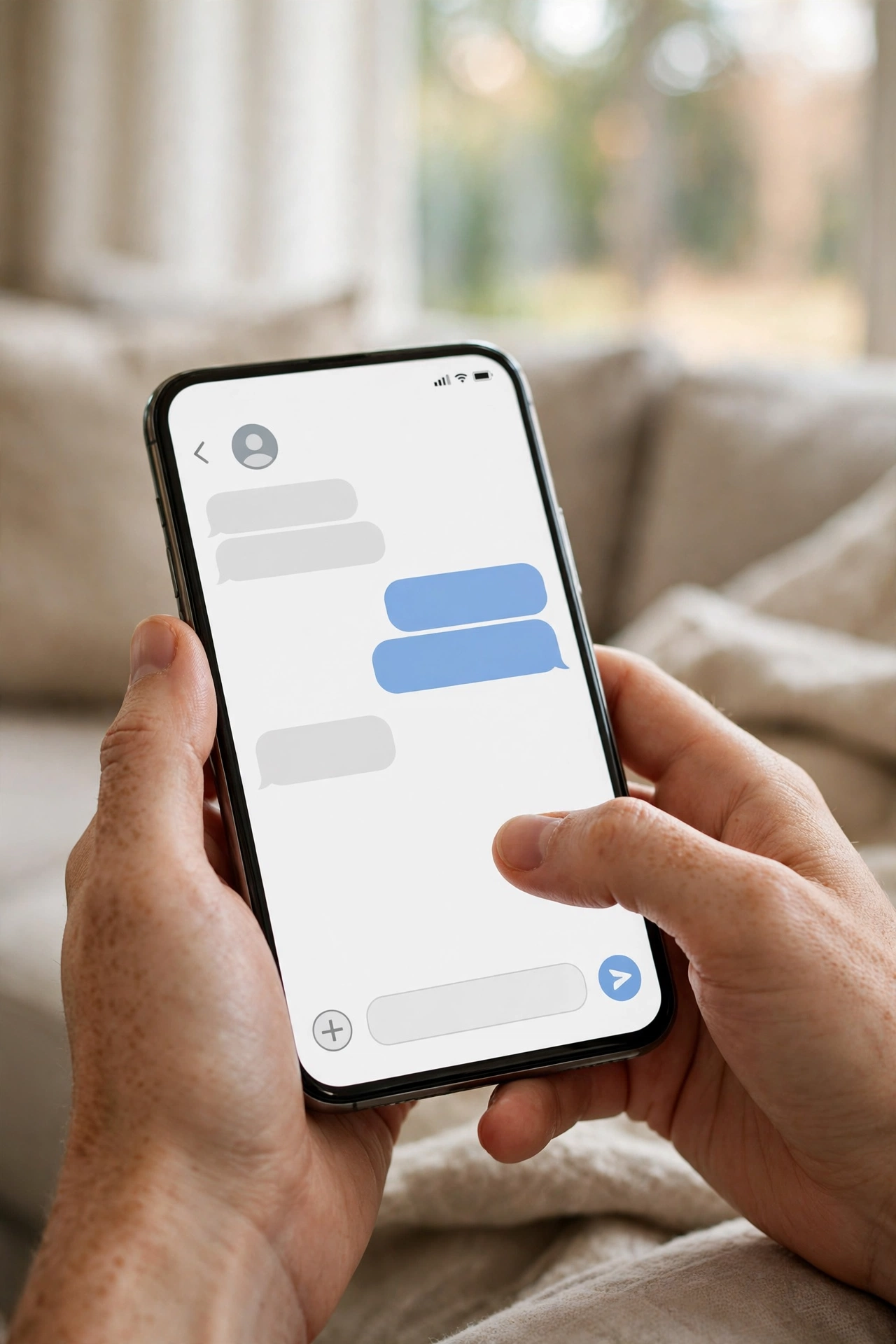 STTM usually appears in a fast-moving chat, where a short, blunt message carries a lot of feeling.
Notice a pattern: STTM almost never shows up in polite or professional messages. It is too direct for that. If you need to ask for space at work or in a formal setting, a full sentence such as “Could we pick this up later?” is a much better choice. For softer ways to close a conversation, see these other ways to say “sounds good” professionally — the same principle applies: match your words to the setting.
STTM Meaning on Instagram, Snapchat, and WhatsApp
STTM Meaning in Instagram DMs and Comments
The sttm meaning in instagram chats is the same as in texting: “stop talking to me.” On Instagram it usually appears in direct messages rather than in public comments. Someone might send it after a string of unwanted messages, or a friend might drop it playfully in a DM thread full of teasing. Because Instagram DMs mix close friends and near-strangers, context matters even more here — a playful STTM from a best friend and a cold STTM from someone you barely know are not the same message at all.
STTM on Snapchat
On Snapchat, STTM works the same way. Snaps and chats disappear quickly, and people tend to write even more casually there, so a short burst like “STTM 😭” often means “you are embarrassing me right now” rather than a genuine demand to end the friendship. If the snap streak or conversation has been friendly until now, treat it as a joke first and only take it seriously if the tone clearly turns cold.
STTM on WhatsApp and in Group Chats
WhatsApp is where STTM is most likely to be serious, because WhatsApp conversations are usually with real-life friends, family, or coworkers. In a one-to-one chat, “STTM” after an argument is usually a genuine request for space. In a group chat, it can be trickier: one person may aim a joking STTM at a friend while everyone else reads it literally. If you see it in a group and you are not sure who it was aimed at, stay out of it — jumping in usually makes things worse.
STTM Meaning from a Girl: Does It Mean Something Different?
People often search for the sttm meaning from a girl hoping for a secret, gender-specific definition. There is not one. STTM means the same thing no matter who sends it: “stop talking to me.” What changes is the social reading, not the definition.
If a girl sends you STTM, read the same clues you would for anyone else:
- With laughing or crying-laughing emojis (😂 😭): almost certainly playful teasing, especially if you were joking around.
- After an argument, with no emoji: most likely serious — she wants space.
- After repeated messages from you: probably a boundary: you have been messaging too much, and she wants a pause.
- Out of nowhere, with no prior tension: possibly a joke or a reference to something you both find funny — ask, don’t assume.
The safest rule applies to everyone: if STTM follows a fight, respect it as a request for space. If it follows a joke, laugh it off. And never read a hidden romantic meaning into it — STTM is not a flirty abbreviation, it is a “please stop” abbreviation.
 Between close friends, STTM is often playful teasing — the same words, a completely different feeling.
STTM vs Lookalikes: STT, SGTM, STG, TGM, and SGT
Part of the confusion around STTM is that it looks like several other abbreviations. Here is how to tell them apart at a glance.
STT vs STTM
STT is a different abbreviation entirely. In tech contexts, STT usually stands for “speech-to-text,” the technology that turns spoken words into written text. In casual chat, some people also use STT loosely, but it does not mean “stop talking to me” — that extra M matters. If you see STT in a message about phones, apps, or transcription, it is almost certainly “speech-to-text.” If you are curious about other texting abbreviations, our guides to DND meaning in text, HYD meaning in text, and TTS meaning in text cover similar short forms.
SGTM vs STTM
SGTM means “sounds good to me.” It is the friendly opposite of STTM: instead of shutting a conversation down, it agrees with something. Example: “Let’s meet at 6?” — “SGTM!” Confusing these two would flip the meaning of a message completely, so double-check the second letter: S-G-T-M agrees, S-T-T-M stops. For polite agreement phrases you can use instead, see these other ways to say “sounds good” professionally.
STG vs STTM
STG usually means “swear to God.” People use it to emphasize that they are telling the truth or to express surprise: “STG, that actually happened!” It has nothing to do with telling someone to stop talking. The shared “ST” beginning is the only similarity.
TGM vs STTM
TGM is less settled than the others. It is sometimes read as “thank God, man” or “thank goodness, man,” but this is not a widely standardized abbreviation, so treat it with caution and rely on context rather than assuming either reading. Either way, TGM is an expression of relief or gratitude — the opposite mood from STTM’s “leave me alone.” Note the honest uncertainty here: unlike STTM, TGM does not have one firmly established texting meaning, so if someone sends it and the context does not make it obvious, asking is the smart move.
SGT vs STTM
SGT is most often a title or rank abbreviation — Sergeant — rather than texting slang at all. In a chat, SGT on its own rarely means anything, and it certainly does not mean “stop talking to me.” If you see it in a message, it is likely a name, a title, or a typo, not a slang term.
Quick comparison table:
- STTM — “stop talking to me” (texting slang)
- STT — “speech-to-text” (tech term)
- SGTM — “sounds good to me” (agreement)
- STG — “swear to God” (emphasis)
- TGM — possibly “thank God, man” (uncertain, context-dependent)
- SGT — Sergeant (title, not slang)
When Should You Use STTM — and When Should You Avoid It?
STTM is best avoided in most situations, honestly. It is blunt, it is easy to misread, and it can hurt feelings even when you mean it lightly. Use it only with close friends who will definitely understand the joke, and even then, an emoji helps.
Avoid STTM entirely:
- At work or in any professional message
- With someone you do not know well
- During a serious conversation about feelings
- When you actually want to keep the friendship warm — a softer sentence does that better
Instead of STTM, try: “I need some space right now,” “Can we talk later?” or “I’m not in the mood to chat about this.” These say the same thing without sounding harsh. If you want to keep things friendly while setting a boundary, the phrases in our guide to other ways to say “good morning” show the same idea in reverse: small word choices change how warm a message feels. And if you are dealing with a disagreement rather than a boundary, Swap vs Swop is a reminder that even tiny differences in wording can change meaning — STTM versus SGTM is exactly that kind of trap.
How to Reply to STTM
Your reply depends on whether the sender is joking or serious:
- If they are joking (laughing emojis, friendly thread): play along lightly — “Okay okay, I’ll behave 😂” or “Fine, silent mode on 🤐.”
- If they seem serious (after an argument, no emoji): respect it simply — “Okay, I understand. We can talk later.” Do not send five follow-up messages explaining yourself; that is the opposite of what they asked for.
- If you are not sure: ask once, kindly — “Are you serious, or joking?” One question clears up the ambiguity without escalating anything.
- If you think you upset them: a short apology plus space works best — “I’m sorry if I upset you. I’ll give you some space.”
What not to do: do not reply with STTM back in anger, do not demand an explanation immediately, and do not keep messaging to “fix it” in the same hour. Space is usually what the sender actually wants, and giving it is the fastest way to keep the relationship intact.
Frequently Asked Questions
What does STTM stand for?
STTM stands for “stop talking to me” in texting and chat slang. It is an informal abbreviation people use when they want someone to stop messaging, stop arguing, or give them space. It is not a dictionary term, and its tone — serious or joking — depends on the conversation around it.
What does stt mean in text slang?
STT is a different abbreviation from STTM. In most contexts, STT stands for “speech-to-text,” the technology that converts spoken words into written text. It does not mean “stop talking to me,” so do not treat the two as interchangeable just because they look similar.
What does sstm mean in text?
SSTM is not a widely recognized texting abbreviation. It is most likely a typo for STTM (“stop talking to me”) or a private shorthand invented within one friend group. If someone sends you SSTM, the safest move is to check the context — or simply ask what they meant — rather than assuming a standard definition that does not exist.
What does “SGTM” mean in slang?
SGTM means “sounds good to me.” It is an agreement phrase used to accept a plan or idea, for example: “Let’s meet at 6?” — “SGTM!” It is the friendly opposite of STTM: SGTM keeps a conversation going, while STTM asks for it to stop.
What is Sgtm in chat?
In chat, SGTM (sometimes written in lowercase as “sgtm”) is a quick way of saying “sounds good to me.” People use it to agree without typing a full sentence. It is casual and positive, and it is commonly used among friends, in group chats, and in relaxed work chats.
What does stgm mean?
STGM is not a standard texting abbreviation. It is probably a typo — most often for SGTM (“sounds good to me”) or STG (“swear to God”). Because it has no widely accepted meaning of its own, read the surrounding message for clues, and if it is still unclear, ask the sender rather than guessing.
What does stg mean from a girl?
STG means the same thing no matter who sends it: “swear to God.” It is used for emphasis or to insist something is true, as in “STG, I did not know!” If a girl sends you STG, she is emphasizing her point, not flirting and not telling you to stop talking. As with STTM, the sender’s gender does not change the definition — only the tone and context do.
What does TGM mean in slang?
TGM is sometimes read as “thank God, man” or “thank goodness, man,” expressing relief or gratitude. However, this is not a firmly standardized abbreviation, so treat it as uncertain: if the context does not make the meaning obvious, ask the sender. Either way, TGM is a positive expression, very different from STTM’s “stop talking to me.”
What does sgt mean in texting?
In texting, SGT has no standard slang meaning. It is most commonly an abbreviation for Sergeant, a military or police rank, rather than a chat term. If you see SGT in a message, it is likely a title, a name, or a typo — not an instruction to stop talking, and not related to STTM beyond the similar letters.
Conclusion
So, what does STTM mean in text? In almost every casual chat, it means “stop talking to me” — a blunt request for space that can be serious, annoyed, overwhelmed, or jokingly playful depending on context. It is informal slang, not a dictionary word, and it is easy to confuse with lookalikes like SGTM (“sounds good to me”), STG (“swear to God”), and STT (“speech-to-text”). When you receive STTM, read the whole conversation before reacting: emojis, timing, and your relationship with the sender tell you whether to laugh it off or respectfully give them space. And when you are tempted to send it, remember that a softer sentence — “Can we talk later?” — usually gets you the same space without the sting. If you want to keep building your texting vocabulary, our guides on other ways to say “I believe in you” and maximal vs maximum are good next reads.