Hassle vs Hastle: Meaning, Correct Spelling & Examples
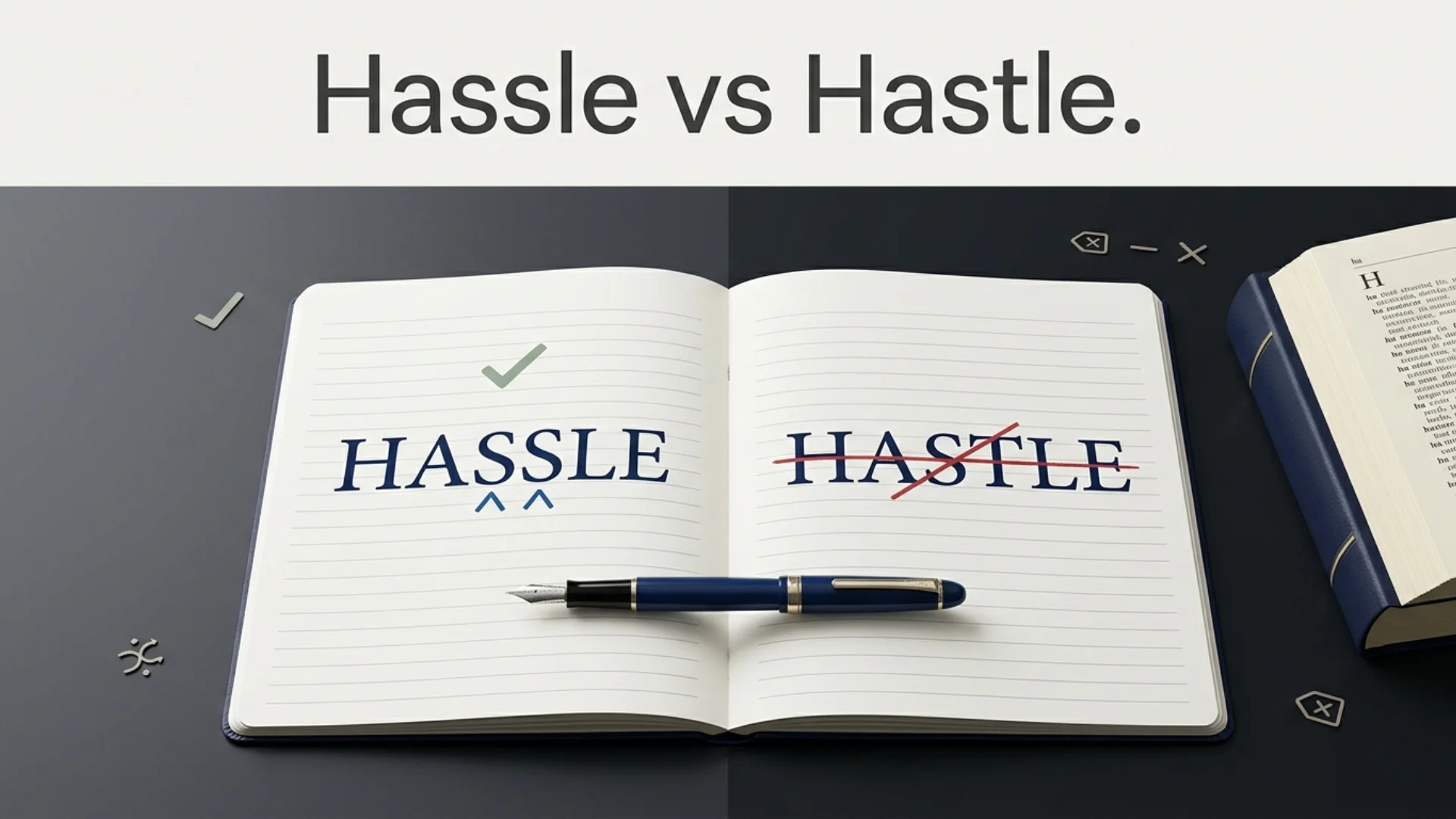
If you are choosing between hassle vs hastle, the correct spelling is hassle.
Hassle is a standard English word that can mean trouble, difficulty, inconvenience, or an annoying situation. It can also be used as a verb meaning to bother, pressure, or annoy someone.
Hastle, when used with that meaning, is a misspelling.
The easiest spelling rule is:
HASSLE = correct
HASTLE = incorrect
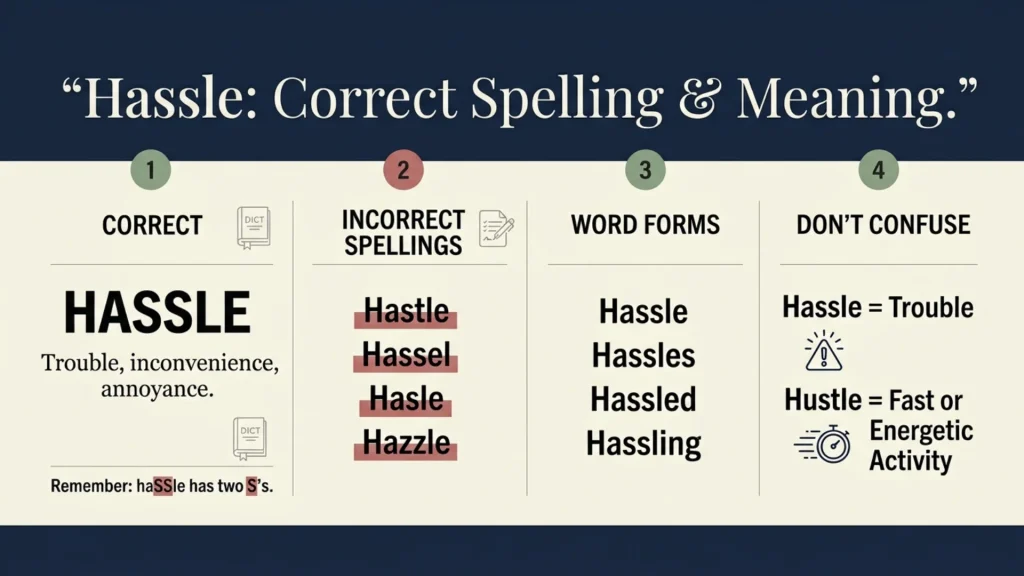
Remember that hassle has two S’s and no T.
Quick Answer: Hassle vs Hastle?
| Word | Correct? | Meaning |
|---|---|---|
| Hassle | Yes | Trouble, inconvenience, annoyance, or bothering someone |
| Hastle | No | Common misspelling of hassle |
| Hassel | No | Common misspelling of hassle |
| Hazzle | No | Nonstandard spelling |
| Hustle | Yes | A different word with different meanings |
If you mean something annoying, difficult, or inconvenient, write hassle.
Example:
Correct: Getting a refund was a hassle.
Incorrect: Getting a refund was a hastle.
What Does Hassle Mean?
Hassle describes trouble, inconvenience, difficulty, annoyance, or unwanted effort.
It can function as both a noun and a verb.
Hassle as a Noun
As a noun, hassle refers to an annoying problem, inconvenience, argument, or troublesome situation.
Examples:
- Finding parking downtown is always a hassle.
- Returning the package became a major hassle.
- I don’t want the hassle of changing banks.
- Moving to another apartment can be a hassle.
- The paperwork was more hassle than I expected.
- It isn’t worth the hassle.
In these sentences, hassle describes the trouble or inconvenience surrounding an activity.
Hassle as a Verb
As a verb, hassle means to bother, annoy, pressure, or repeatedly trouble someone.
Examples:
- Stop hassling me about the deadline.
- The salesperson kept hassling us.
- Don’t hassle the staff about the delay.
- My brother keeps hassling me to lend him the car.
- They hassled him with repeated phone calls.
The difference is simple:
Noun: The paperwork was a hassle.
Verb: They kept hassling me about the paperwork.
What Does Hastle Mean?
If you see hastle being used to mean trouble or inconvenience, it is normally a spelling mistake.
For example:
Incorrect: It was such a hastle.
Write:
Correct: It was such a hassle.
The spelling may look believable because English contains words such as hustle, bustle, castle, and whistle. That does not make hastle the correct spelling.
Also check: Hola or Ola?
Why Do People Spell Hassle as Hastle?
The mistake usually comes from pronunciation and visual similarity to other English words.
Consider:
- hustle
- bustle
- castle
- whistle
Those spellings can make hastle look natural even though the actual word is hassle.
A useful memory trick is:
HaSSle Has Two S’s
Break it visually into:
ha + ss + le
Not:
ha + st + le
If you remember the double S, the mistake becomes much easier to avoid.
How Do You Spell Hassle?
The correct spelling is:
H-A-S-S-L-E
It contains:
- one H
- one A
- two S’s
- one L
- one E
Correct forms include:
- hassle
- hassles
- hassled
- hassling
Incorrect forms include:
- hastle
- hastles
- hastled
- hastling
- hassel
- hasle
- hazzle
Hassle Pronunciation
Hassle is generally pronounced like:
HAS-uhl
The stress falls on the first syllable.
Cambridge gives the pronunciation as /ˈhæs.əl/ in both British and American English. Cambridge Dictionary: hassle definition and pronunciation
The pronunciation helps explain why some people are unsure about the spelling. You do not hear two separate S sounds even though the written word contains ss.
Hassle vs Hassel
Another common spelling question is hassel or hassle.
For the English word meaning trouble or inconvenience:
Hassle is correct.
Hassel is not the standard spelling of this English word.
Example:
Correct: Booking another flight would be too much hassle.
Incorrect: Booking another flight would be too much hassel.
Hassle vs Hazzle
If you mean trouble or annoyance, hazzle is also incorrect.
Use:
hassle
Not:
hazzle
The confusion may happen because English sometimes uses double consonants or a Z sound in words that look somewhat similar, but hassle retains its standard ss spelling.
Hassle vs Hustle
Unlike hastle, hustle is a real English word.
The important point is that hassle and hustle have different meanings.
Hassle Meaning
Hassle generally refers to:
- trouble
- inconvenience
- annoyance
- unwanted effort
- bothering someone
Example:
Getting through airport security can be a hassle.
Hustle Meaning
Hustle can refer to:
- moving quickly
- acting with urgency
- working energetically
- pushing or jostling
- energetic business activity, depending on context
Example:
We need to hustle if we want to catch the train.
So:
Hassle = trouble or annoyance
Hustle = hurried or energetic activity
Hassle vs Hustle Examples
Compare these sentences:
The paperwork was a hassle.
The paperwork was annoying or inconvenient.
I had to hustle to finish the paperwork.
I had to work quickly or energetically.
Another example:
Traveling with five suitcases is a hassle.
But:
We had to hustle through the airport to catch our flight.
The words may look and sound somewhat similar, but they are not interchangeable.
Difference Between Hassle and Hustle
| Feature | Hassle | Hustle |
|---|---|---|
| Basic idea | Trouble or inconvenience | Fast or energetic activity |
| Can be a noun? | Yes | Yes |
| Can be a verb? | Yes | Yes |
| Example | Moving was a hassle. | We had to hustle. |
| Related idea | Annoyance | Speed, effort, activity |
Choosing the right word depends entirely on what you want to express.
Hassle-Free Meaning
Hassle-free means something can be done without unnecessary trouble, difficulty, inconvenience, or frustration.
Examples:
- hassle-free returns
- hassle-free booking
- hassle-free shopping
- hassle-free installation
- hassle-free payment
- hassle-free travel
Example sentence:
The company promises a hassle-free return process.
This means the return process is supposed to be simple and convenient.
Does Hassle-Free Need a Hyphen?
When hassle-free directly modifies a noun, the hyphenated form is standard and clear.
Example:
We offer hassle-free registration.
The two words work together as one adjective describing registration.
Less Hassle Meaning
The phrase less hassle means less trouble, inconvenience, work, or annoyance.
Example:
Booking online is less hassle than waiting in line.
You may also hear:
- less of a hassle
- much less hassle
- without the hassle
- avoid the hassle
- reduce the hassle
A particularly natural form is:
It’s less of a hassle to book online.
Common Expressions With Hassle
A Hassle
Getting a replacement card was a hassle.
Too Much Hassle
Returning it isn’t worth it. It’s too much hassle.
Not Worth the Hassle
The discount isn’t worth the hassle.
Without the Hassle
You can renew online without the hassle of visiting the office.
Save Yourself the Hassle
Save yourself the hassle and book in advance.
Give Someone Hassle
They gave us a lot of hassle about the documents.
Hassle Someone
Stop hassling him about his decision.
Hassle Synonyms
The best synonym depends on the sentence.
For hassle as trouble or inconvenience:
- trouble
- inconvenience
- difficulty
- bother
- annoyance
- nuisance
- complication
- headache
- problem
- fuss
For hassle as a verb:
- bother
- annoy
- pressure
- pester
- trouble
- harass
- nag
For example:
It’s too much hassle.
Could become:
It’s too much trouble.
But synonyms are not always perfectly interchangeable. Hassle is usually more conversational than a formal word such as inconvenience.
Hassle vs Inconvenience
These words overlap, but their tone differs.
Hassle sounds conversational and often emphasizes annoying effort.
Inconvenience sounds more formal and emphasizes disruption or difficulty.
Compare:
Changing hotels was a hassle.
We apologize for the inconvenience.
A company is more likely to use inconvenience in formal customer communication, while a customer may naturally call the same experience a hassle.
Hassle vs Problem
A problem can be serious, technical, minor, or major.
A hassle usually emphasizes the annoying effort or inconvenience involved.
Example:
The engine has a serious problem.
That sounds more natural than:
The engine has a serious hassle.
But:
Getting the car repaired is a hassle.
Here, the annoying experience of arranging the repair is the hassle.
Is Hassle Formal or Informal?
Hassle is generally conversational or informal.
It is perfectly normal in:
- everyday speech
- casual emails
- customer conversations
- social media
- informal workplace communication
- general web content
In very formal writing, alternatives such as difficulty, inconvenience, complication, or problem may fit better.
Hassling, Hassled, or Hassleing?
The correct -ing form is:
hassling
Not:
hassleing
The final silent e is dropped before adding -ing:
hassle + ing → hassling
Other correct forms are:
- hassle
- hassles
- hassled
- hassling
Examples:
He keeps hassling me about the payment.
I was hassled by repeated calls.
What Is the Plural of Hassle?
The plural noun is:
hassles
Example:
Travel comes with a few hassles.
Do not write hastles if you mean the plural of hassle.
“Hassle” in Professional Emails
Hassle is acceptable in many ordinary workplace emails, though the exact tone matters.
Natural:
Sorry for the hassle this caused.
More formal:
We apologize for the inconvenience this caused.
Natural:
To save you the hassle, I’ve attached the document again.
More formal:
For your convenience, I’ve attached the document again.
Knowing the tone difference makes your writing more precise.
For another common English agreement issue, see People Do or People Does? for examples of how number affects verb choice.
Hassle in Everyday Sentences
Here are more natural examples:
- Applying for the permit was a hassle.
- I don’t want the hassle of moving again.
- Parking in the city can be a real hassle.
- Don’t hassle me while I’m working.
- They kept hassling her about the payment.
- Online check-in saves a lot of hassle.
- The repair turned into an unnecessary hassle.
- It wasn’t worth the hassle.
- We chose the easier option to avoid the hassle.
- Returning the item was completely hassle-free.
These examples show how the word works in both noun and verb forms.
Hassle in Questions
You can also use it naturally in questions:
Is it worth the hassle?
Why are they hassling you?
Was returning the item a hassle?
Can we do this without the hassle of paperwork?
If sentence structure itself is the confusing part, Was There or Were There? explains another common English construction that writers frequently second-guess.
Hassle Meaning in Tagalog
There is no single Tagalog translation that fits every use of hassle.
Depending on context, the idea may correspond to expressions involving:
- abala
- istorbo
- hirap
- problema
- perwisyo
The correct translation depends on whether hassle means inconvenience, difficulty, annoyance, or bothering someone.
For example:
It’s such a hassle.
The intended idea is usually that something is troublesome or inconvenient.
But:
Stop hassling me.
Here, the meaning shifts toward repeatedly bothering or annoying someone.
Hassle vs Hustle Meaning in Tagalog
The difference remains important in translation.
Hassle refers more closely to inconvenience, trouble, or annoyance.
Hustle can describe moving quickly, making energetic efforts, or working actively.
They should not be translated as though they were the same English word simply because their spellings look similar.
What Does “Hassle Case” Mean?
Hassle case is not a standard fixed English expression with one dictionary meaning.
Its meaning depends entirely on context.
Someone might informally use it to describe:
- a troublesome case
- a complicated situation
- a case requiring excessive effort
But if you encounter hassle case in software, legal paperwork, customer service, or another specialized system, check the surrounding context before assuming a definition.
Hastle, Hastles, and Hastling
If the intended word is hassle, then these forms are incorrect:
- hastle
- hastles
- hastled
- hastling
Use:
- hassle
- hassles
- hassled
- hassling
A search result containing a misspelling does not turn the misspelling into a standard word. Humanity has tried this experiment many times. Dictionaries remain stubborn.
Hassel or Hassle?
Use hassle when you mean inconvenience, difficulty, or annoyance.
Hassel may occur as a surname or proper name in some contexts, but it is not the standard spelling of the English word hassle.
So:
The paperwork was a hassle.
Not:
The paperwork was a hassel.
Hazzle, Hazle, and Hazel
These spellings create a separate cluster of confusion.
Is It Hazzle or Hassle?
If you mean trouble or inconvenience, use hassle.
What Does Hazle Mean?
Hazle is not the standard spelling of hassle.
If you intended the common given name or the tree/color word, you probably mean hazel.
Is It Hazle or Hazel?
The standard spelling of the common word and name is:
hazel
Example:
She has hazel eyes.
That has nothing to do with hassle.
How Do You Say Hazel?
Hazel is generally pronounced roughly like HAY-zuhl.
It should not be confused with hassle, which begins with the vowel sound in words such as hat.
Common Spelling Mistakes
| Spelling | Correct? | Comment |
|---|---|---|
| hassle | Yes | Standard spelling |
| hastle | No | Common misspelling |
| hassel | No | Wrong for the word “hassle” |
| hasle | No | Missing an S |
| hazzle | No | Nonstandard spelling |
| hastles | No | Use “hassles” |
| hassle | Yes | Correct noun/verb form |
| hassled | Yes | Correct past form |
| hassling | Yes | Correct -ing form |
| hassle-free | Yes | Correct compound adjective |
Easy Memory Tricks
Remember the Double S
The most important pattern is:
haSSle
Connect Hassle With Fuss
Both hassle and fuss can describe annoying trouble.
They also both contain double S.
That can help reinforce the spelling.
Keep Hassle and Hustle Separate
Think:
Hassle = annoyance
Hustle = activity
That prevents the common ss/st mix-up.
Frequently Asked Questions
Is it hassle or hastle?
Hassle is the correct spelling when you mean trouble, inconvenience, annoyance, or bothering someone. Hastle is a common misspelling.
What is the meaning of hastle?
When people write hastle, they usually intend hassle. The standard word hassle means trouble, inconvenience, or annoyance and can also mean to bother someone.
Which word should I use: “hassle” or “hazzle”?
Use hassle. Hazzle is not the standard spelling of this word.
What is a hassel?
If you mean an inconvenience or troublesome situation, the word is hassle. Hassel may occur as a proper name or surname, but it is not the correct spelling for this meaning.
What is another word for “hassel”?
If you mean hassle, useful synonyms include trouble, inconvenience, bother, annoyance, nuisance, complication, and difficulty.
What is the meaning of hazle?
Hazle is not the standard spelling of hassle. If you mean the common name, tree, color description, or eye color, the usual spelling is hazel.
Is it hazle or hazel?
Hazel is the standard spelling of the common English word and given name.
How do you say hazle?
If you mean hazel, it is generally pronounced approximately HAY-zuhl. If you mean hassle, its pronunciation is approximately HAS-uhl.
What is hazel slang for?
Hazel is primarily a standard word for a tree, a brownish-green color, an eye-color description, and a personal name. Any slang interpretation depends on a specific community or context and should not be assumed to be universal.
Final Answer
For hassle vs hastle, there is no real spelling contest:
Hassle is correct. Hastle is a misspelling when you mean trouble, inconvenience, or annoyance.
Remember:
H-A-S-S-L-E
Use hassle as a noun:
The paperwork was a hassle.
Use it as a verb:
Stop hassling me about it.
Do not confuse it with hustle, which is a separate word relating to quick or energetic activity.
Once you remember the double S in hassle, this particular spelling headache becomes considerably less of a hassle.