Emasculate vs. Demasculate: Meaning, Difference & Correct Usage
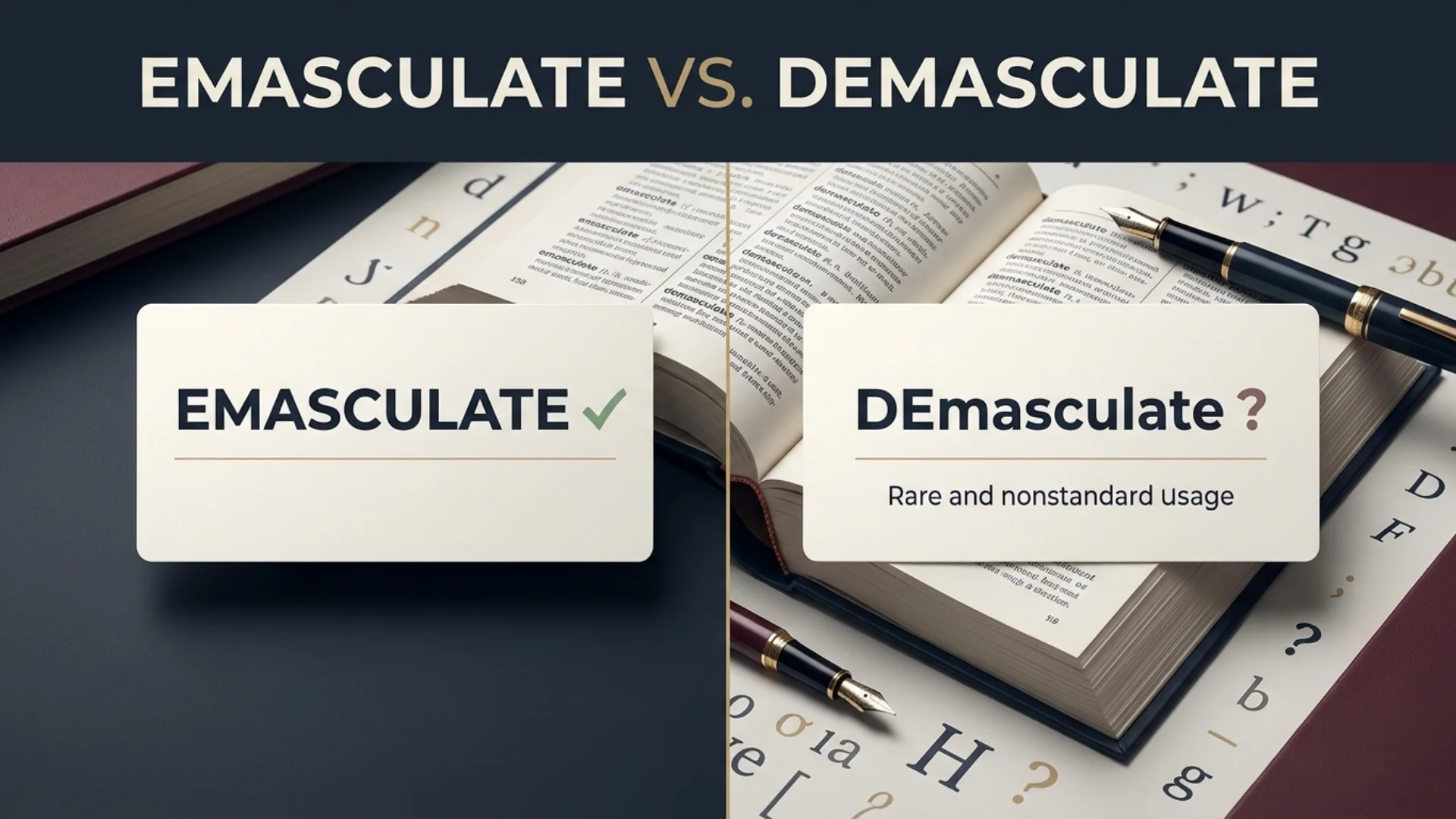
Emasculate vs. demasculate looks like a straightforward spelling choice, but the two words do not have equal status in modern English.
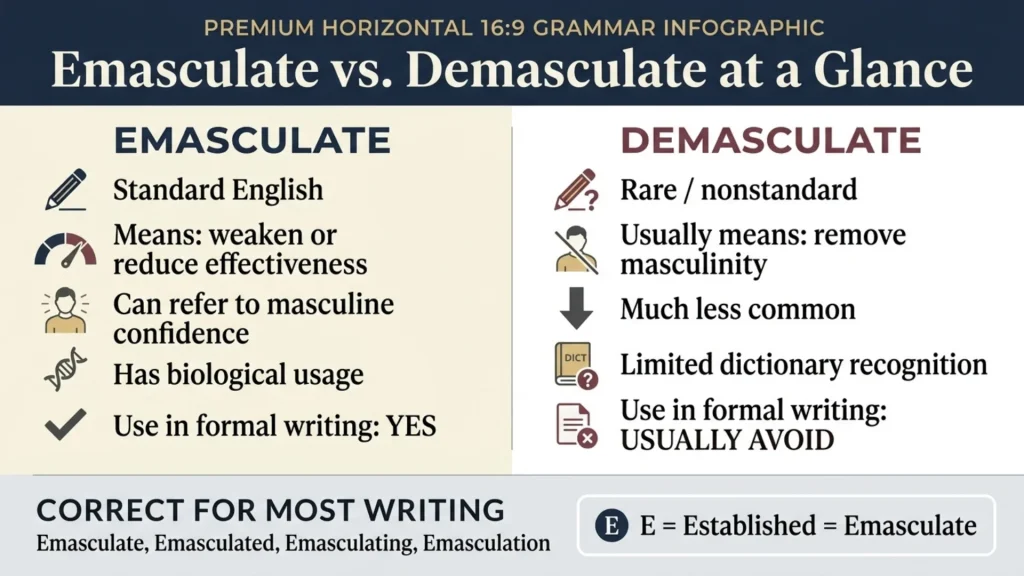
Emasculate is the established and standard verb. It can mean to weaken someone or something, reduce effectiveness, make a man feel deprived of masculine power or confidence, or, in biological contexts, remove male reproductive structures.
Demasculate is much rarer. It is occasionally used to mean removing masculine qualities, but it is not the normal choice in formal or edited English.
If you are unsure which word to use, the practical answer is simple:
Use “emasculate” in standard English.
Quick Answer: Emasculate or Demasculate?
| Word | Status | Main Meaning | Best Choice? |
|---|---|---|---|
| Emasculate | Standard English | To weaken, reduce effectiveness, or deprive of masculine power | Yes |
| Demasculate | Rare/nonstandard | Intended to mean removing masculinity | Usually no |
| Emasculated | Standard | Weakened or deprived of power/masculinity | Yes |
| Emasculating | Standard | Causing someone/something to become weaker | Yes |
| Emasculation | Standard noun | The act or result of emasculating | Yes |
| Demasculated | Rare/nonstandard | Intended past form of demasculate | Avoid in formal writing |
A major dictionary such as Cambridge recognizes emasculate as a formal verb meaning to reduce effectiveness or make a man feel less male by taking away power and confidence. Cambridge Dictionary: emasculate
What Does Emasculate Mean?
Emasculate is a transitive verb.
Its common modern meanings include:
- To make someone or something weaker or less effective.
- To make a man feel deprived of masculine power, confidence, or role.
- In biological or technical contexts, to remove male reproductive structures or functions.
Example: Weakening Something
The amendments could emasculate the original policy.
Here, emasculate means weaken or reduce the effectiveness of.
Example: Masculine Confidence
He said the situation made him feel emasculated.
Here, the word refers to a perceived loss of masculine authority, confidence, or role.
Example: Biological Use
In biology and plant breeding, emasculation can refer to removing male reproductive parts.
That technical use is quite different from the figurative meaning people encounter in ordinary conversation.
Emasculate Pronunciation
Emasculate is commonly pronounced approximately:
ih-MAS-kyuh-layt
IPA is typically represented as:
/ɪˈmæs.kjə.leɪt/
The stress falls on the second syllable:
e-MAS-cu-late
Also check: Family and Friends or Friends and Family
What Does Demasculate Mean?
Demasculate is a rare formation generally intended to mean remove masculinity from someone.
The word feels logical because English often uses the prefix de- to mean removal or reversal:
- deactivate
- defrost
- devalue
- demotivate
So someone may assume:
de + masculine = demasculate
The problem is that English already developed emasculate as the established word centuries ago.
Because of that, demasculate may be understandable, but it is not the normal term used in professional, academic, or carefully edited English.
Is Demasculate a Word?
The most accurate answer is:
Demasculate is attested, but it is rare and not the standard choice in mainstream English.
It appears in some informal or collaborative lexical sources, but major dictionaries overwhelmingly use emasculate for the meanings most people intend.
That distinction matters.
Saying demasculate does not exist anywhere is too absolute.
Saying demasculate and emasculate are equally standard is also misleading.
The useful rule is:
Demasculate exists at the margins of usage; emasculate is the established standard form.
Demasculate Definition
When demasculate is used, it generally means something like:
to remove or reduce masculine qualities
However, because the term is rare, a sentence containing it can look like a spelling error to many readers.
For example:
The experience demasculated him.
A reader will probably understand the intended meaning, but standard English would normally use:
The experience emasculated him.
Demasculated Meaning
Demasculated would be the expected past tense or participle of the rare verb demasculate.
It is intended to mean:
made less masculine
But in polished writing, emasculated is usually the better choice.
Less Standard
He felt demasculated.
Standard
He felt emasculated.
Demasculating vs. Emasculating
The same pattern applies here.
Emasculating
Standard and established.
He described the treatment as emasculating.
Demasculating
Rare and likely to distract readers.
If clarity matters, use emasculating.
Emasculate vs. Demasculate: Key Differences
| Feature | Emasculate | Demasculate |
|---|---|---|
| Standard English | Yes | Rare/nonstandard |
| Major dictionary recognition | Yes | Limited |
| Means weaken | Yes | Not normally |
| Can refer to masculine confidence | Yes | Intended sense |
| Biological meaning | Yes | Not standard |
| Appropriate in formal writing | Yes | Usually avoid |
| Past form | Emasculated | Demasculated, rare |
| -ing form | Emasculating | Demasculating, rare |
Why Do People Say Demasculate?
The confusion is understandable because demasculate looks logically constructed.
English learners see familiar words such as:
- defrost
- deactivate
- deconstruct
- destabilize
and assume masculinity should work the same way.
But word formation is shaped by history and usage, not just modern logic.
Emasculate comes from Latin roots and entered English long before modern speakers started analyzing it as though it should contain de-.
So the issue is not that demasculate is impossible to understand.
It is that emasculate won the usage battle several centuries ago, and English has refused to hold a recount.
Where Does Emasculate Come From?
The word emasculate ultimately comes from Latin.
Its structure contains a prefix related to ex-, expressing removal or change of state, combined with a root connected to male.
Historically, the word was associated with castration or deprivation of male characteristics.
Its figurative meaning later expanded to include:
- weaken
- deprive of power
- reduce effectiveness
- undermine authority
That explains why the word can now apply to things that have no biological sex at all.
For example:
Budget cuts emasculated the department.
The sentence means the department became substantially less effective or powerful.
Emasculate in a Sentence
Referring to a Person
Constant ridicule made him feel emasculated.
Referring to Authority
The reform emasculated the committee’s authority.
Referring to a Law
The final amendments effectively emasculated the legislation.
Referring to an Organization
Severe cuts could emasculate the agency.
Referring to Confidence
He interpreted the public criticism as emasculating.
Emasculated vs. Emasculate
These are different grammatical forms of the same standard word.
Emasculate
Base verb:
The proposal could emasculate the regulator.
Emasculated
Past tense:
The changes emasculated the regulator.
Past participle:
The regulator had been emasculated by years of cuts.
Adjectival-style use:
He felt emasculated.
What Does Emasculation Mean?
Emasculation is the noun form of emasculate.
Depending on context, it can mean:
- weakening or reducing effectiveness
- depriving someone of power
- making a man feel deprived of masculine confidence or role
- biological removal of male reproductive capacity or structures
Examples:
Critics warned about the emasculation of the agency.
He described the experience as deeply emasculating.
The first example concerns institutional power. The second concerns a person’s experience.
Demasculinize and Demasculinization
Demasculinize is a different formation from demasculate.
It can be used in specialized contexts to describe reducing or removing masculine characteristics.
The corresponding noun is:
demasculinization
These terms may appear in academic, biological, psychological, or social-science discussions depending on the context.
They should not automatically be treated as exact substitutes for emasculate.
Demasculinization Meaning
Broadly, demasculinization refers to a reduction or loss of characteristics regarded as masculine.
Its precise meaning depends heavily on context.
What Is Immasculation?
Immasculation is not the normal modern English counterpart of emasculation.
If you mean:
- making something stronger
- making someone more masculine
- reinforcing masculine characteristics
you should normally choose a clearer phrase rather than inventing an opposite by modifying the spelling of emasculate.
What Is the Opposite of Emasculate?
There is no single perfect opposite for every sense of the word.
If emasculate means weaken, possible opposites include:
- strengthen
- empower
- reinforce
- invigorate
- fortify
If it refers specifically to masculine confidence or identity, possible phrases include:
- affirm
- empower
- restore confidence
- reinforce masculinity
The correct opposite depends on what emasculate means in the sentence.
Emasculate vs. Effeminate
These words are sometimes confused, but they are not synonyms.
Emasculate
A verb meaning to weaken or deprive of power, or make a man feel deprived of masculine qualities.
He felt emasculated.
Effeminate
Traditionally an adjective used to describe a man or boy as having qualities culturally stereotyped as feminine.
The writer described the character as effeminate.
The second term can sound judgmental or dated depending on context, so it should be used carefully.
Most importantly:
Effeminate does not mean “weaken.”
Emasculate vs. Castrate
The two words overlap historically and in some literal biological contexts, but they are not interchangeable in every sentence.
Castrate
Usually refers directly to removing or disabling reproductive organs or capacity.
Emasculate
Can have a biological meaning, but modern figurative usage also means:
- weaken
- undermine
- reduce effectiveness
- deprive of perceived masculine power
For example:
The legislation was emasculated.
makes sense.
The legislation was castrated.
would sound metaphorical, unusual, and much more graphic.
Is There a Female Equivalent of Emasculate?
There is no single widely accepted female equivalent that matches all meanings of emasculate.
This is partly because the figurative meaning developed from historical ideas about masculinity, male social roles, and loss of masculine power.
If you are describing a woman whose:
- authority was reduced
- confidence was damaged
- power was taken away
use neutral verbs such as:
- undermine
- disempower
- weaken
- belittle
- humiliate
- diminish
These terms are often clearer anyway.
What Is the Female Equivalent of Emasculation?
There is no exact standard English noun that functions as a direct gender-reversed equivalent.
Depending on the intended meaning, better choices may include:
- disempowerment
- humiliation
- loss of authority
- degradation
- undermining
- belittlement
Trying to mechanically create a feminine opposite usually makes the writing less precise rather than more precise.
Is “De Masculated” Correct?
Usually no.
Forms such as:
- de masculated
- de-masculated
- demasculated
are not the standard forms most writers need.
Use:
emasculated
Example:
He felt emasculated by the experience.
Is “De-Emasculate” Correct?
Usually no.
The prefix would be redundant or confusing because emasculate already carries the established meaning.
If you mean reverse the effects of emasculation, write exactly what you mean:
- restore his confidence
- restore its power
- strengthen the institution
- reverse the weakening
Clarity beats prefix engineering.
Emasculate in Professional Writing
Because the word can carry gendered and emotionally charged implications, make sure it is actually the most precise choice.
Appropriate Institutional Use
The amendments could emasculate the enforcement provisions.
This means the provisions would become ineffective.
Potentially Loaded Personal Use
His wife emasculated him.
This sentence may communicate much more than simple loss of confidence. It can imply assumptions about gender, authority, relationships, and masculinity.
If you only mean undermined his confidence, say that.
Better Synonyms for Emasculate
When the intended meaning is weaken, alternatives include:
- weaken
- undermine
- diminish
- reduce
- cripple
- impair
- neutralize
- sap
- debilitate
- disempower
When the meaning relates to confidence:
- humiliate
- belittle
- undermine
- disempower
- diminish
The best synonym depends on the sentence.
Another Word for Emasculating
Possible alternatives include:
- weakening
- undermining
- disempowering
- diminishing
- humiliating
- belittling
- debilitating
- neutralizing
For example:
The restrictions were emasculating the organization.
could become:
The restrictions were weakening the organization.
The second version is simpler and less loaded.
What Does the Bible Say About Emasculation?
The Bible contains passages concerning eunuchs, castration, bodily injury, and religious or social status, but the modern figurative English use of emasculation as loss of confidence or masculine authority is not a single biblical doctrine.
Translations also differ significantly in wording.
If discussing a specific biblical passage, it is better to cite that passage and its translation rather than claim that “the Bible says” one universal thing about the modern psychological meaning of emasculation.
Examples of Emasculation
The word can describe several very different situations.
Institutional
Removing enforcement powers resulted in the emasculation of the regulator.
Political or Legal
Critics argued that the amendment would emasculate the original law.
Personal
He felt emasculated after being repeatedly mocked in front of his colleagues.
Biological
The word can also refer to removal of male reproductive structures in biological contexts.
The surrounding context determines which meaning is intended.
Common Mistakes
Mistake 1: Assuming Demasculate Is the Standard Form
Less standard:
The policy demasculated the agency.
Standard:
The policy emasculated the agency.
Mistake 2: Thinking Emasculate Only Applies to Men
The figurative verb can apply to organizations, laws, policies, institutions, and arguments.
The restrictions emasculated the commission.
Mistake 3: Treating Emasculate and Effeminate as Identical
They have different grammatical functions and meanings.
Mistake 4: Using the Word When “Weaken” Is Clearer
Sometimes a plain word is better:
The budget cuts weakened the department.
is often preferable to:
The budget cuts emasculated the department.
Easy Memory Rule
Remember:
E = Established = Emasculate
D = Doubtful in standard writing = Demasculate
Not an etymology lesson. Just a memory trick. Humans apparently need these because 400 years of English usage were still not enough.
Frequently Asked Questions
Is there a female version of emasculation?
There is no exact standard female equivalent. Depending on context, use words such as disempowerment, humiliation, undermining, weakening, or loss of authority.
What does the Bible say about emasculation?
The Bible contains passages involving eunuchs and castration, but modern figurative emasculation is not one single biblical concept. Specific passages and translations should be considered individually.
What does it mean if someone is emasculated?
Figuratively, it usually means the person feels deprived of power, confidence, authority, or traditionally masculine status. Literally or biologically, the word has more specific reproductive meanings.
What’s the opposite to emasculate?
Depending on context, opposites include empower, strengthen, reinforce, fortify, and restore confidence.
Is it demasculate or emasculate?
Use emasculate in standard English. Demasculate is rare and much less established.
What is another word for “emasculating”?
Possible alternatives include weakening, undermining, disempowering, diminishing, humiliating, and debilitating.
What is another word for ejaculation?
If you mean the biological process, related terms can include emission or seminal emission, depending on context. Ejaculation itself is the standard medical and general term.
What does the word “demasculate” mean?
When used, demasculate generally means to remove or reduce masculinity. However, it is rare and not the normal standard-English choice.
What are some examples of emasculation?
Examples include weakening a law, reducing an institution’s authority, making someone feel deprived of masculine confidence, or biological removal of male reproductive capacity.
Is demasculate a word?
It is attested in some sources, but it remains rare and nonstandard compared with emasculate. For formal writing, use emasculate.
What is demasculate pronunciation?
Because the word is rare, pronunciation is less standardized. A predictable English pronunciation would be approximately dee-MAS-kyuh-layt, but using emasculate avoids the issue entirely in normal writing.
More Grammar Guides
If confusing word forms are your particular hobby, apparently life was too peaceful, these related GrammarRead guides may also help:
People Do or People Does? explains subject-verb agreement with people.
Was There or Were There? explains when singular and plural nouns change the verb after there.
Final Thoughts
For emasculate vs. demasculate, the practical answer is uncomplicated:
Emasculate is the established standard English word.
It can describe weakening, reducing effectiveness, depriving someone of power, making a man feel less masculine, or specific biological processes.
Demasculate is occasionally encountered and understandable, but it is rare enough that many readers will assume it is an error.
For essays, articles, business writing, academic work, and ordinary communication, use:
emasculate, emasculated, emasculating, and emasculation.
English already supplied the word. There is no need to bolt another prefix onto it and hope nobody notices.