Its Self or Itself: Meaning, Correct Spelling & Usage
Its self or itself? In standard modern English, itself is almost always the correct form.
Itself is a reflexive or emphatic pronoun. It refers back to it, usually when the subject and object are the same thing, animal, situation, or idea.
For example:
The machine turned itself off.
Writing its self instead would normally be incorrect:
The machine turned its self off. ❌
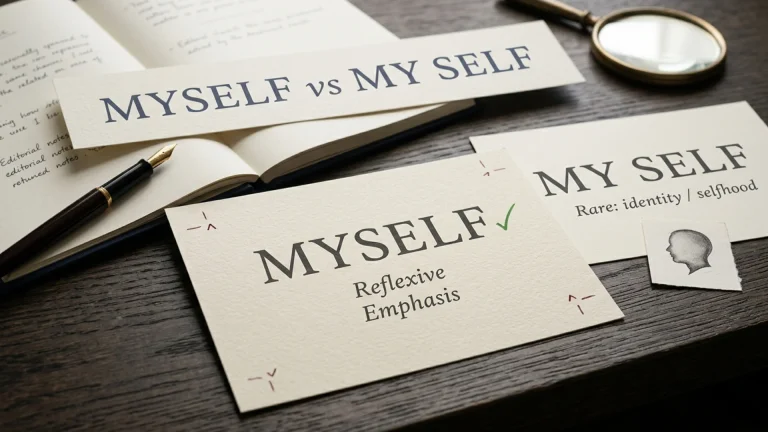
There is one narrow exception: its self can occasionally appear when self is deliberately being used as a separate noun meaning identity, nature, or sense of self. That kind of wording is rare and mostly belongs to philosophical, psychological, literary, or highly specialized contexts.
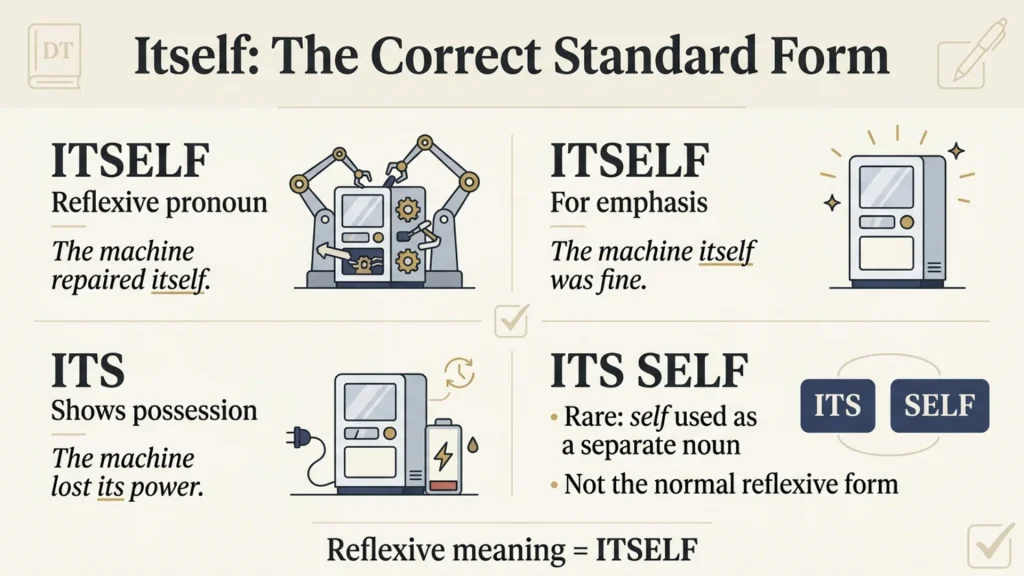
Quick Answer: Its Self or Itself?
| Form | Standard? | Meaning / Use |
|---|---|---|
| itself | Yes | Reflexive or emphatic pronoun |
| its self | Rare | Possessive its + separate noun self |
| it self | No, normally | Incorrect split form of itself |
| it’s self | Usually no | It’s means it is or it has |
| itsself | No | Misspelling |
| its own self | Possible but wordy | Emphatic noun phrase |
For almost all ordinary writing, use:
itself
What Does Itself Mean?
Itself is the reflexive form of it.
According to the Cambridge Dictionary definition of “itself”, it is used when the subject is it and the object refers to the same thing. It is also used for emphasis.
Examples:
The cat cleaned itself.
The system restarted itself.
The company itself admitted the mistake.
The problem resolved itself.
In each sentence, itself points back to a thing already mentioned.
Is Itself One Word?
Yes.
Itself is written as one word.
Correct:
itself
Incorrect for normal reflexive use:
it self
its self
itsself
it-self
English reflexive pronouns are generally written as single words:
| Pronoun | Reflexive Form |
|---|---|
| I | myself |
| you | yourself |
| he | himself |
| she | herself |
| it | itself |
| we | ourselves |
| you | yourselves |
| they | themselves |
That makes itself much easier to remember.
Also check: Mother Tongue vs Native Language
Why Is It Itself and Not Its Self?
The confusion usually comes from the word its.
Its is a real possessive word:
The dog wagged its tail.
The company changed its policy.
The phone lost its signal.
Because its shows possession, writers sometimes assume that the reflexive form should be:
its self
But English does not form the reflexive pronoun that way.
The established form is:
itself
Compare:
The robot repaired itself. ✅
The robot repaired its self. ❌
The first sentence uses a reflexive pronoun correctly.
When Do We Use Itself?
There are several common uses.
Itself as a Reflexive Pronoun
Use itself when the subject performs an action on the same thing represented by it.
Example:
The door closed itself.
The subject is the door.
The object refers back to the same door:
itself
Other examples:
The machine switched itself off.
The program updated itself.
The animal scratched itself.
The organization found itself in financial trouble.
The problem may correct itself.
Itself for Emphasis
Itself can also emphasize a noun.
Example:
The building itself was not damaged.
Here, itself emphasizes the building.
Other examples:
The product itself is excellent.
The law itself is unclear.
The company itself made the announcement.
The device itself was working normally.
The sentence would often remain grammatical without itself, but the emphasis would disappear.
“By Itself” Meaning
The phrase by itself usually means:
- alone
- without help
- independently
Examples:
The machine can operate by itself.
The cat stayed in the room by itself.
The door opened by itself.
The software installed by itself.
Depending on context, by itself can mean either “alone” or “without anyone causing it.”
“In Itself” Meaning
In itself means considering something independently, without adding other circumstances or factors.
Example:
The mistake was not serious in itself.
This means the mistake alone was not serious.
Other examples:
That fact is interesting in itself.
The price is not a problem in itself.
The idea itself is not harmful.
The expression often appears when a writer wants to separate one fact from the wider situation.
“To Itself” Meaning
To itself can indicate that something keeps or directs something toward itself.
Example:
The organization kept the information to itself.
This means the organization did not share the information with others.
Another example:
The island has the beach almost entirely to itself.
The precise meaning depends on context.
Is “Its Self” Ever Correct?
Rarely, yes.
The phrase its self can be grammatically possible if:
- its is genuinely possessive
- self is deliberately functioning as an ordinary noun
Imagine a philosophical discussion about identity:
The theory treats the organism and its self as separate concepts.
Here, self means something like identity or consciousness.
This is very different from:
The organism protects itself.
In the second sentence, the standard reflexive pronoun is required.
For ordinary writing, its self should generally be avoided because it can easily look like a spelling mistake.
Its Self Meaning
When its self is intentionally used, the phrase means roughly:
the self belonging to it
or:
its identity / its sense of self
That is why it is much more likely to appear in philosophical or theoretical writing.
Even then, writers often choose clearer wording such as:
its own self
its identity
its sense of self
instead of simply:
its self
Itself vs Its Self
The difference is grammatical.
Itself
A reflexive or emphatic pronoun.
Example:
The system repaired itself.
Its Self
A rare noun phrase consisting of possessive its plus the noun self.
Example in a specialized context:
The theory separates the organism from its self.
For normal everyday English:
Choose itself.
Itself or It Self?
Use:
itself
Do not split it into:
it self
Incorrect:
The device turned it self off.
Correct:
The device turned itself off.
There are situations where it and self could appear separately because they belong to different grammatical structures, but it self is not the normal spelling of the reflexive pronoun.
It’s Self or Itself?
Usually:
itself
The apostrophe changes everything.
It’s
It’s is a contraction of:
- it is
- it has
Examples:
It’s raining.
means:
It is raining.
And:
It’s been difficult.
means:
It has been difficult.
Therefore:
It’s self
would generally expand to something like:
it is self
which normally does not express the intended reflexive meaning.
Correct:
The system fixed itself.
Not:
The system fixed it’s self.
Its vs It’s vs Itself
These three forms perform different jobs.
| Form | Meaning | Example |
|---|---|---|
| its | possessive | The dog wagged its tail. |
| it’s | it is / it has | It’s getting late. |
| itself | reflexive / emphatic | The dog scratched itself. |
A quick test for it’s is to expand it.
If it is or it has works, use it’s.
If possession is involved, use its.
If something refers back to itself, use itself.
Is “Itsself” Correct?
No.
Itsself is a misspelling.
Correct:
itself
There is no extra s.
Wrong:
itsself
Right:
itself
The presence of its as a separate English word probably causes this spelling error, but the reflexive pronoun does not contain the possessive spelling its.
Itself Spelling
The correct spelling is:
i-t-s-e-l-f
itself
Not:
- itsself
- it self
- its-self
- its self in ordinary reflexive use
A simple memory trick is:
it + self = itself
Itself in a Sentence
Here are natural examples.
The computer restarted itself.
The door locked itself automatically.
The company describes itself as a technology business.
The problem will not solve itself.
The cat cleaned itself.
The building itself is over a century old.
The device can operate by itself.
The situation itself was unusual.
The organization found itself facing criticism.
The software updates itself overnight.
Incorrect and Correct Examples
| Incorrect | Correct |
|---|---|
| The computer restarted its self. | The computer restarted itself. |
| The cat cleaned it self. | The cat cleaned itself. |
| The system repaired itsself. | The system repaired itself. |
| The company introduced it’s self. | The company introduced itself. |
| The machine turned its self off. | The machine turned itself off. |
| The product it self was fine. | The product itself was fine. |
The mistake usually comes from treating self as if it must be attached to the possessive its.
It does not.
Reflexive Pronouns Explained
A reflexive pronoun refers back to the subject.
Consider:
Maria saw herself in the mirror.
Maria and herself refer to the same person.
Likewise:
The cat saw itself in the mirror.
The cat and itself refer to the same animal.
Other reflexive pronouns include:
- myself
- yourself
- himself
- herself
- itself
- ourselves
- yourselves
- themselves
Itself or Himself?
Use itself when the pronoun is it.
Use himself when referring back to a male person or an animal being referred to as he.
Compare:
The machine turned itself off.
John introduced himself.
For animals, usage depends on how the animal is being referred to.
Example:
The dog scratched itself.
But if a specific male dog is already being referred to as he:
Max scratched himself.
The reflexive pronoun should match the pronoun used for the subject.
What Does Himself Mean?
Himself is the reflexive or emphatic form associated with he.
Reflexive example:
He cut himself while cooking.
Emphatic example:
The director himself answered the phone.
The first refers back to the subject.
The second emphasizes the director.
Himself or Himself?
The two forms in this question are identical.
Himself is the standard spelling.
If the intended comparison was him self vs himself, use:
himself
in normal reflexive or emphatic use.
Correct:
He introduced himself.
Incorrect:
He introduced him self.
Their Self or Themselves?
For ordinary reflexive use with plural they, use:
themselves
Example:
The players prepared themselves.
With singular they, themselves is also widely used:
Someone may find themselves in a difficult situation.
You may also encounter themself, particularly when referring to one person with singular they.
However:
their self
is not the normal reflexive form.
Like its self, it could appear only when self is deliberately functioning as a separate noun.
For ordinary reflexive grammar:
themselves
is the safe standard form.
Itself Plural
Itself does not have a normal plural form because it corresponds to the singular pronoun it.
When the subject becomes plural, English normally uses:
themselves
Compare:
The machine shut itself down.
The machines shut themselves down.
So the practical plural counterpart of itself is usually themselves.
Itself vs Themselves
Use itself with singular it.
Example:
The company found itself in trouble.
Use themselves with plural they.
Example:
The companies found themselves in trouble.
Matching number is important.
Incorrect:
The companies found itself in trouble.
Correct:
The companies found themselves in trouble.
Is Itself a Word?
Yes.
Itself is a standard English pronoun.
It has two especially common functions:
Reflexive
The animal hurt itself.
Emphatic
The animal itself was unharmed.
It also appears in common phrases such as:
- by itself
- in itself
- to itself
- of itself
Its Own or Itself?
These expressions are different.
Its Own
Its own shows possession or emphasizes ownership.
Example:
The company has its own building.
Itself
Itself refers back to the subject.
Example:
The company built the website itself.
The first focuses on ownership.
The second indicates that the company performed the action or adds emphasis.
“Its Own Self” vs “Itself”
Its own self can occasionally be used for strong stylistic emphasis or when self is treated as a noun.
Example:
The creature seemed aware of its own self.
However, it often sounds unnecessarily heavy.
If you simply mean the reflexive pronoun:
The creature became aware of itself.
is more natural.
Can Itself Be Used for a Company?
Yes.
Companies, organizations, systems, institutions, and other non-person entities are commonly referred to with it and itself.
Examples:
The company describes itself as independent.
The organization reorganized itself.
The government found itself under pressure.
There is nothing unusual about this use.
Can Itself Be Used for Animals?
Yes.
When an animal is referred to using it, its reflexive form is itself.
Example:
The cat cleaned itself.
If the animal is referred to with he or she, use the corresponding reflexive form:
The dog scratched himself.
The mare injured herself.
Can Itself Be the Subject of a Sentence?
Normally, reflexive pronouns do not replace the ordinary subject pronoun.
Incorrect in ordinary English:
Itself opened the door.
Correct:
It opened the door itself.
Or:
The door opened by itself.
Reflexive pronouns usually depend on another noun or pronoun in the sentence.
Emphatic Itself vs Reflexive Itself
The same word performs two closely related functions.
Reflexive Itself
The action returns to the subject.
The cat scratched itself.
Removing itself changes the grammatical structure significantly.
Emphatic Itself
The pronoun adds emphasis.
The cat itself was unharmed.
Without the emphasis:
The cat was unharmed.
The sentence still works.
That removal test is useful when identifying the function.
Where Does Itself Go in a Sentence?
Placement depends on meaning.
After the Verb
The machine repaired itself.
This is reflexive.
Directly After the Noun
The machine itself was expensive.
This emphasizes the machine.
Later in the Clause
The machine completed the process itself.
This suggests the machine completed the process without another agent doing it.
Context determines the exact emphasis.
Common Phrases With Itself
By Itself
The system works by itself.
Meaning: independently or without help.
In Itself
The result is impressive in itself.
Meaning: when considered alone.
Of Itself
The evidence is not proof of itself.
This construction is less common and highly context-dependent.
To Itself
The organization kept the information to itself.
Meaning: it did not share the information.
Why Do People Write “Its Self”?
There are several understandable reasons.
Confusion With Possessive “Its”
Because its is a real possessive form, writers may assume:
its + self = its self
But the standard reflexive pronoun has already developed as:
itself
Comparison With Other Possessives
English contains phrases such as:
- my own self
- your own self
- his own self
This can make its self look possible.
But ordinary reflexive forms remain:
- myself
- yourself
- himself
- itself
Pronunciation Gives No Clue
Its self and itself can sound very similar in fast speech.
The spelling distinction becomes visible only in writing.
How to Remember Its Self or Itself
Use a simple test.
Ask:
Does the word refer back to “it”?
If yes:
itself
Example:
The system fixed itself.
If self is genuinely a separate noun meaning identity or consciousness, a specialist phrase involving its self may be possible.
But that is rare.
For practically everything else:
write itself.
One’s Self or Oneself?
Both forms can exist, but they are not always used identically.
Oneself is the standard reflexive pronoun corresponding to one.
Example:
One should allow oneself time to rest.
One’s self can appear when self is deliberately treated as a noun:
Understanding one’s self can take time.
However, many writers would choose oneself or another clearer construction depending on the sentence.
This distinction mirrors the central issue with itself versus its self: sometimes self is part of a reflexive pronoun, and sometimes it is an independent noun.
Self as a Separate Noun
Self is itself a noun.
It can refer to:
- identity
- personality
- individual nature
- one’s sense of who one is
Examples:
She wanted to understand her true self.
He returned to his old self.
The concept of the self is central to the discussion.
This explains why unusual combinations such as its self are technically possible in specialized writing.
But that does not make its self the reflexive form of it.
The reflexive form remains:
itself
Frequently Asked Questions
How do you use itself in a sentence?
Use itself when something refers back to the subject or when you want to emphasize it.
Example:
The computer restarted itself.
For emphasis:
The computer itself was not damaged.
What is the meaning of itself?
Itself is the reflexive or emphatic form of it. It can refer back to a thing, animal, situation, or idea, or it can emphasize that subject.
Which is correct, their self or themselves?
For ordinary reflexive use, themselves is correct.
Example:
They prepared themselves.
Their self is not the standard reflexive form, though self may occasionally be treated as a separate noun in specialized writing.
Which is correct, himself or himself?
Both spellings shown in the question are identical: himself.
If the intended comparison is him self versus himself, use himself in normal English.
What does “himself” mean?
Himself is the reflexive or emphatic form associated with he.
Example:
He introduced himself.
For emphasis:
The manager himself answered.
Is it correct to say one’s self?
It can be correct when self is being treated as a separate noun, but oneself is the standard reflexive pronoun.
Is itself a word?
Yes. Itself is a standard English reflexive and emphatic pronoun.
Is it “itself” or “it self”?
Use itself as one word for the reflexive pronoun.
Is “itsself” correct?
No. Itsself is a misspelling. The correct form is itself.
What is the plural of itself?
The practical plural counterpart is themselves.
Example:
The device resets itself.
The devices reset themselves.
Is it “it’s self” or “itself”?
Use itself for reflexive or emphatic meaning. It’s means it is or it has, so it’s self does not normally replace itself.
What does “in itself” mean?
In itself means something considered alone or independently of other factors.
Example:
The mistake was not serious in itself.
Final Answer: Its Self or Itself?
For standard modern English, use:
itself
It is the correct reflexive and emphatic form of it.
Use it in sentences such as:
The machine repaired itself.
The building itself was beautiful.
The problem may solve itself.
The separate form its self is rare and belongs mainly to contexts where self is deliberately being treated as an independent noun meaning identity or nature.
So the simple rule is:
Reflexive or emphasis = itself
Possessive + separate noun “self” = its self, but only in rare specialized contexts
And if you’re staring at itsself, it self, its self, and itself wondering why a six-letter pronoun required this much paperwork, welcome to English.