Myself vs My Self: Meaning, Difference & Correct Grammar
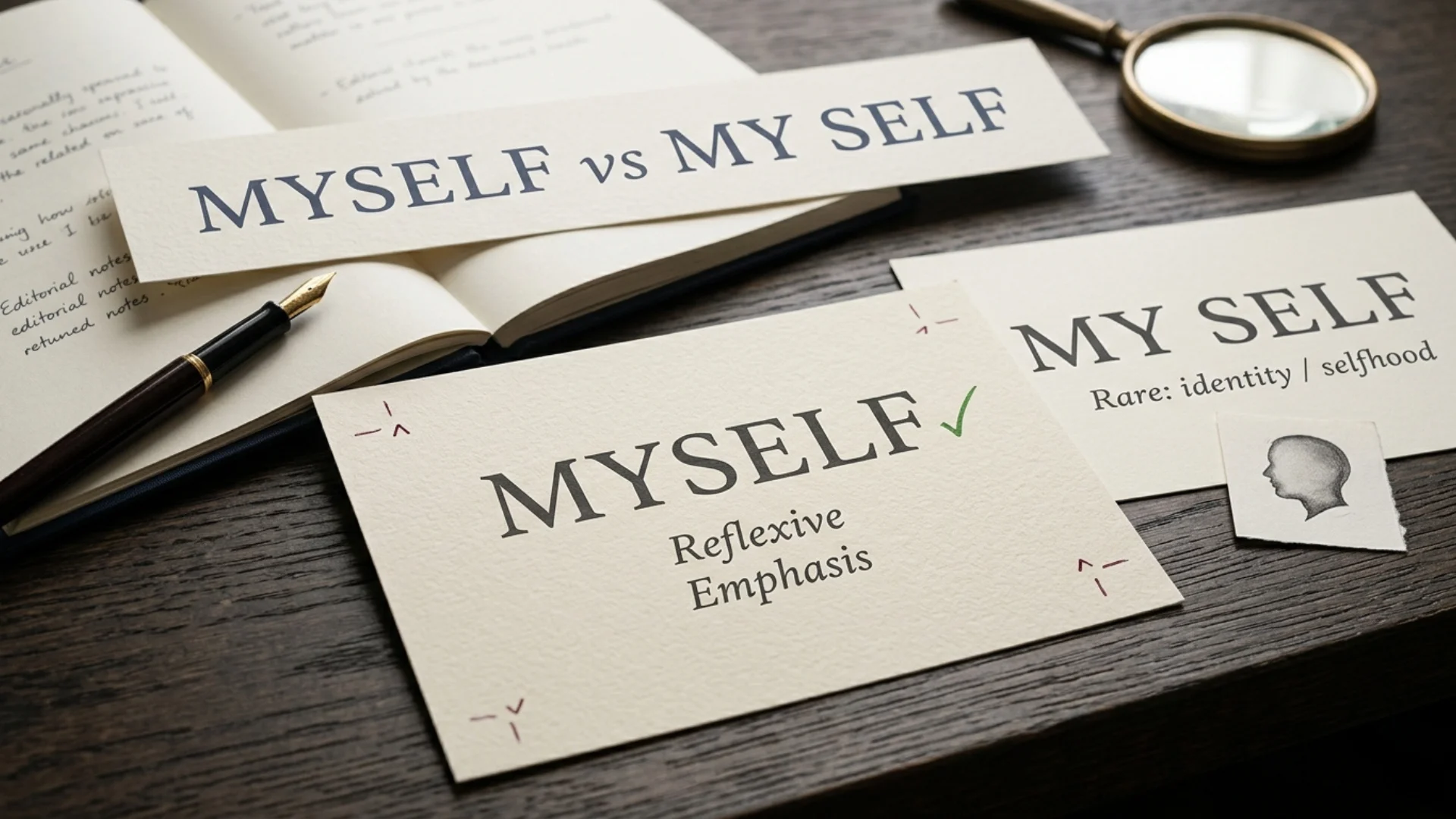
Myself vs my self looks like a tiny spelling difference, but the two forms do different jobs.
In normal English grammar, myself is the standard reflexive or intensive pronoun.
I taught myself to cook.
I completed the project myself.
By contrast, my self is a much rarer two-word phrase in which my is possessive and self is a noun referring to identity, personality, or one’s sense of self.
I wanted to understand my self more deeply.
For almost all ordinary sentences, myself is the form you need.

Quick Answer: Myself or My Self?
| Form | Use | Example |
|---|---|---|
| myself | Reflexive pronoun | I hurt myself. |
| myself | Emphasis | I fixed it myself. |
| by myself | Alone / without help | I went by myself. |
| my self | Rare noun phrase about identity | I reflected on my self. |
| my self | Not normally used as a reflexive pronoun | I taught my self. ❌ |
The easiest rule:
If you mean “me” referring back to “I,” write myself as one word.
Use my self only when self is genuinely functioning as a noun meaning identity or personhood.
What Does Myself Mean?
Myself is the reflexive form of I.
It is mainly used in two ways:
- when the subject and object refer to the same person;
- to emphasize that the speaker personally did something.
Reflexive Use
I accidentally cut myself.
The subject is I, and the person receiving the action is also I.
So we use:
myself
Other examples:
I taught myself Spanish.
I reminded myself about the appointment.
I asked myself an important question.
I blamed myself for the mistake.
I prepared myself for the interview.
Myself for Emphasis
Myself can also emphasize the speaker.
I wrote the report myself.
The sentence still works without it:
I wrote the report.
Adding myself emphasizes that I personally did it.
More examples:
I checked every figure myself.
I made the cake myself.
I spoke to the manager myself.
I saw the accident myself.
This is sometimes called the intensive or emphatic use of a reflexive pronoun.
For a fuller authority explanation, see Cambridge’s guide to reflexive pronouns such as myself, yourself, and themselves.
What Does “My Self” Mean?
My self is different.
Here:
- my = possessive determiner
- self = noun
The phrase can refer to someone’s:
- identity
- personality
- consciousness
- inner self
- sense of who they are
Example:
I am trying to reconnect with my self.
This type of wording may appear in:
- philosophy
- psychology
- spirituality
- literary writing
- reflective writing
However, in everyday English, writers usually choose a clearer phrase such as:
my identity
my sense of self
my true self
who I am
So my self is possible in a narrow conceptual sense, but it should not replace the ordinary pronoun myself.
Myself vs My Self: Main Difference
| Myself | My Self |
|---|---|
| One word | Two words |
| Reflexive/intensive pronoun | Possessive phrase |
| Very common | Rare |
| Refers back to “I” | Refers to identity or the concept of self |
| I taught myself. | I reflected on my self. |
| Standard everyday grammar | Mainly philosophical/stylistic |
Is It Myself or My Self?
In most cases, use:
myself
Correct:
I made myself some coffee.
Incorrect:
I made my self some coffee.
Correct:
I introduced myself.
Incorrect:
I introduced my self.
Correct:
I am proud of myself.
Incorrect:
I am proud of my self.
The two-word form becomes possible only when self is being deliberately treated as a noun.
Proud of Myself or My Self?
The normal expression is:
proud of myself
Example:
I am proud of myself for finishing the course.
Not:
I am proud of my self for finishing the course.
Here, the pronoun refers back to the speaker, so it must be one word.
By Myself or By My Self?
Use:
by myself
It normally means:
- alone
- without another person
- without help
Examples:
I went to the cinema by myself.
I completed the assignment by myself.
I live by myself.
I repaired the chair by myself.
Do not normally write:
by my self
unless you are deliberately talking about an abstract concept of the self, which would be an extremely unusual context.
Myself Meaning in Simple English
Myself basically means:
me, referring back to I
Example:
I saw myself in the mirror.
“I” and “myself” are the same person.
It can also mean:
personally
Example:
I did it myself.
That means:
I personally did it.
What Is Myself in Grammar?
Myself is a reflexive pronoun and can also function intensively for emphasis.
The common English reflexive pronouns are:
| Subject Pronoun | Reflexive Pronoun |
|---|---|
| I | myself |
| you | yourself |
| he | himself |
| she | herself |
| it | itself |
| we | ourselves |
| you | yourselves |
| they | themselves |
Notice that myself follows the same general pattern as:
- yourself
- himself
- herself
- itself
- ourselves
- yourselves
- themselves
If you’re also wondering about itself as one word, see GrammarRead’s guide to Its Self or Itself.
Reflexive Use of Myself
Use myself reflexively when the action performed by I comes back to the speaker.
Pattern:
I + verb + myself
Examples:
I hurt myself.
I introduced myself.
I dressed myself.
I taught myself.
I found myself thinking about the problem.
I convinced myself to continue.
I promised myself I would improve.
Intensive Use of Myself
Use myself after or near I to add emphasis.
Examples:
I myself disagree.
I built the table myself.
I will speak to her myself.
I personally checked it myself.
The last example is grammatically possible but somewhat redundant because personally and myself perform similar emphatic work.
A cleaner sentence is:
I checked it myself.
Is “I Myself” Grammatically Correct?
Yes.
I myself is grammatical when myself adds emphasis.
Example:
I myself would never make that decision.
Another:
I myself saw what happened.
You can remove myself and the basic sentence remains grammatical:
I would never make that decision.
That is a useful sign that myself is being used intensively rather than reflexively.
Me vs Myself
Me and myself cannot normally be swapped freely.
Use Me
Use me when the object does not refer reflexively back to an I subject.
She called me.
Please email me.
John spoke to me.
Use Myself
Use myself when the subject is also I.
I hurt myself.
I reminded myself.
I introduced myself.
Compare:
Sarah called me. ✅
Sarah called myself. ❌
But:
I called myself foolish. ✅
The difference is grammatical, not a matter of which form sounds more sophisticated.
Why Do People Use Myself Instead of Me?
A common error appears in professional emails:
Please contact Sarah or myself.
Many people choose myself because it sounds more formal or polite.
In traditional standard usage, however, me is normally the appropriate object pronoun:
Please contact Sarah or me.
The sentence becomes easier to test if you remove the other person:
Please contact me. ✅
Please contact myself. ❌
Humans apparently decided that adding syllables makes emails more executive. Grammar remains unconvinced.
John and Myself or John and Me?
It depends on the grammatical role.
As an Object
Correct:
She invited John and me.
You would say:
She invited me.
So me remains correct when John is added.
As a Subject
Correct:
John and I attended the meeting.
You would say:
I attended the meeting.
Not:
Myself attended the meeting.
Is “John and Myself” Correct?
It can be correct only in a context where myself genuinely refers back to I.
For example:
I bought tickets for John and myself.
Here the subject is I, and myself refers back to that same subject.
Compare:
Sarah bought tickets for John and me.
Because the subject is Sarah, not I, the correct object is me.
Myself and Jane or Jane and I?
If the phrase is the subject, use:
Jane and I
Correct:
Jane and I completed the project.
Not:
Myself and Jane completed the project.
Not:
Jane and myself completed the project.
If it is the object:
The manager thanked Jane and me.
The simplest test is to remove Jane:
I completed the project. ✅
The manager thanked me. ✅
That trick prevents a remarkable amount of pronoun suffering.
Myself and Tom or Tom and I?
As a subject:
Tom and I went to the store.
As an object:
She spoke to Tom and me.
Reflexive use:
I booked seats for Tom and myself.
Each form has a different grammatical job.
Me and Myself
Me is an object pronoun.
Myself is reflexive or emphatic.
Compare:
She asked me a question.
I asked myself a question.
In the first sentence, another person acts on me.
In the second, I performs the action and receives it too.
Myself and My Self in Examples
Correct Uses of Myself
I saw myself in the mirror.
I introduced myself to everyone.
I taught myself to code.
I bought myself lunch.
I finished the work myself.
I myself disagree with that conclusion.
I am proud of myself.
I went there by myself.
Rare Uses of My Self
The essay examines my self as something shaped by memory.
I began questioning my self and my identity.
Even here, many editors would prefer:
my sense of self
or:
my identity
because those phrases are clearer.
Yourself vs Your Self
The same distinction applies to yourself and your self.
Yourself
A reflexive or intensive pronoun.
You should believe in yourself.
Did you make this yourself?
You hurt yourself.
Your Self
A rare noun phrase where self means identity or consciousness.
The philosophy encourages you to examine your self.
Again, your sense of self is often clearer.
Yourself or Your Self?
In ordinary English:
yourself
is almost always the correct choice.
Correct:
Take care of yourself.
Incorrect:
Take care of your self.
Correct:
Be yourself.
Incorrect:
Be your self.
The two-word version belongs only to contexts where self is functioning independently as a noun.
Difference Between Yourself and Your Self
| Yourself | Your Self |
|---|---|
| Pronoun | Noun phrase |
| Common | Rare |
| Refers back to “you” | Refers to your identity/selfhood |
| Believe in yourself. | Examine your self. |
| Standard everyday grammar | Philosophical or stylistic |
Myself vs Yourself
Myself refers to the speaker:
I taught myself.
Yourself refers to the person being addressed:
You taught yourself.
They are both reflexive pronouns.
Myself Plural Form
The plural equivalent associated with we is:
ourselves
Not:
myselfs
Not:
myselves
Examples:
We prepared ourselves.
We introduced ourselves.
We completed the project ourselves.
The singular/plural pairs are:
- myself → ourselves
- yourself → yourselves
- himself/herself → themselves in broader plural contexts
Is Myslf a Word?
No.
myslf is a misspelling.
Correct:
myself
A useful spelling pattern is:
my + self = myself
with no space.
My Self or Myself in an Essay
In normal essay writing, use myself when you need the reflexive pronoun.
Example:
I challenged myself throughout the semester.
Use my self only if the essay specifically discusses concepts such as:
- identity
- consciousness
- selfhood
- the psychological self
- the philosophical self
Even then, my sense of self is often clearer.
My Self Paragraph vs Myself Paragraph
If a student is writing a basic paragraph introducing themselves, the normal heading or idea is:
About Myself
or:
Myself
rather than:
My Self
For example:
My name is Daniel. I am a student. I enjoy reading, football, and learning new skills.
The phrase my self is not needed simply because the paragraph is about you.
“My Self” in English: 20 Example Sentences
For standard everyday English, these should normally use myself:
- I introduced myself to the teacher.
- I prepared myself for the test.
- I bought myself a new notebook.
- I reminded myself to call home.
- I taught myself how to cook.
- I found myself thinking about the future.
- I hurt myself while running.
- I made myself a cup of tea.
- I asked myself an important question.
- I promised myself I would try again.
- I completed the work myself.
- I saw the mistake myself.
- I cleaned the room myself.
- I solved the problem myself.
- I travelled by myself.
- I am proud of myself.
- I kept the secret to myself.
- I need some time to myself.
- I introduced myself politely.
- I told myself to stay calm.
Notice that myself is one word in every example.
Common Expressions With Myself
By Myself
I went by myself.
Meaning: alone or without help.
To Myself
I kept the information to myself.
Meaning: I did not share it.
For Myself
I wanted to see it for myself.
Meaning: personally.
Of Myself
I am proud of myself.
In Myself
I feel confident in myself.
Be Myself
I can finally be myself.
All of these use myself as one word.
“I Can Do It Myself” Meaning
I can do it myself.
means:
I can do it without someone else’s help.
Here myself adds emphasis and independence.
“I Am Proud of Myself” Meaning
It means you feel satisfaction about your own achievement, behavior, progress, or qualities.
Example:
I am proud of myself for finishing the marathon.
The correct form is always myself here.
“Be Myself” or “Be My Self”?
Use:
be myself
Example:
I feel comfortable enough to be myself around them.
This means behaving naturally and authentically.
Be my self would not normally express that meaning.
My True Self vs Myself
These are different constructions.
Myself
Pronoun:
I reminded myself.
My True Self
Noun phrase:
I want to express my true self.
Here self is legitimately a noun modified by my and true.
This example helps show why my self can theoretically exist, even though the ordinary pronoun is one word.
My Old Self, My Younger Self, My Best Self
These are also normal two-word constructions because self is a noun modified by another adjective.
Examples:
I miss my old self.
I spoke to my younger self in the letter.
Exercise helps me feel like my best self.
Notice the difference:
I reminded myself.
I reminded my younger self.
The second sentence contains a normal noun phrase.
When Is “My Self” Actually Acceptable?
The two-word form becomes defensible when self clearly behaves like a noun.
For example:
There is a conflict between my public self and my private self.
Here the noun self is modified by:
- my
- public/private
Another:
My younger self would have disagreed.
This is completely normal.
But writing:
I taught my self.
is not.
The presence of another modifier often makes the noun use obvious:
- my true self
- my former self
- my younger self
- my public self
- my private self
- my ideal self
My Self vs My Sense of Self
In philosophy or psychology, my sense of self is often clearer than the bare phrase my self.
Compare:
The experience changed my self.
This may sound unusual or ambiguous.
Clearer:
The experience changed my sense of self.
or:
The experience changed how I saw myself.
Myself vs My Identity
These are not interchangeable.
Myself is a pronoun:
I introduced myself.
My identity is a noun phrase:
My identity changed over time.
If you are talking about personality, identity, or self-concept, identity may communicate the idea more precisely.
Reflexive Pronouns vs Personal Pronouns
| Subject | Object | Reflexive |
|---|---|---|
| I | me | myself |
| you | you | yourself |
| he | him | himself |
| she | her | herself |
| it | it | itself |
| we | us | ourselves |
| they | them | themselves |
The reflexive form is not simply a more formal version of the object form.
Compare:
She called me.
not:
She called myself.
But:
I called myself.
Why “Myself” Cannot Always Replace “I”
Wrong:
Sarah and myself attended the meeting.
Correct:
Sarah and I attended the meeting.
Test it without Sarah:
I attended the meeting. ✅
Myself attended the meeting. ❌
That exposes the error instantly.
For another subject-verb and pronoun-choice guide, see Anyone Has or Anyone Have.
Why “Myself” Cannot Always Replace “Me”
Wrong:
Please send the document to myself.
Correct:
Please send the document to me.
But if the sentence has I as the subject and the action returns to the same person:
I sent the document to myself.
Now myself is correct.
Formal Email Examples
Incorrect
Please contact David or myself if you need help.
Better
Please contact David or me if you need help.
Incorrect
Myself and Rachel will review the report.
Correct
Rachel and I will review the report.
Correct Reflexive Use
I have copied Rachel and myself on the email.
The subject I makes the reflexive reference possible.
Myself in Professional Writing
Use myself when grammar requires it, not simply because it sounds formal.
Correct:
I completed the analysis myself.
Correct:
I asked myself whether the numbers were accurate.
Incorrect:
The report was sent to James and myself.
Better:
The report was sent to James and me.
If confusing word forms are a recurring nuisance, GrammarRead’s Complete vs Completed guide covers another common form distinction.
Common Mistakes
Mistake 1: Writing My Self as the Reflexive Pronoun
Incorrect:
I introduced my self.
Correct:
I introduced myself.
Mistake 2: Using Myself Instead of I
Incorrect:
Jennifer and myself attended.
Correct:
Jennifer and I attended.
Mistake 3: Using Myself Instead of Me
Incorrect:
Please call Mark or myself.
Correct:
Please call Mark or me.
Mistake 4: Assuming My Self Is Never Possible
This goes too far.
My self can occur when self is deliberately functioning as a noun.
But such contexts are much rarer than ordinary uses of myself.
Quick Test: Which Form Should You Use?
Ask:
Does it refer back to “I”?
Use:
myself
I blamed myself.
Does it mean “I personally”?
Use:
myself
I checked it myself.
Does it mean alone?
Use:
by myself
I travelled by myself.
Is “self” being discussed as a concept or identity?
A noun phrase may be possible:
my private self
my younger self
my sense of self
The bare phrase my self is rare and often clearer when rewritten.
Practice Questions
Choose myself, my self, me, or I.
- I taught ___ how to swim.
- Sarah called ___ yesterday.
- Mark and ___ attended the conference.
- I completed the assignment ___.
- I am proud of ___.
- The experience changed my sense of ___.
- Please email John or ___.
- I bought a present for ___.
- My younger ___ would never have believed this.
- I went to dinner by ___.
Answers
- myself
- me
- I
- myself
- myself
- self
- me
- myself
- self
- myself
Frequently Asked Questions
Is “myself” or “my self” correct grammar?
Both can exist, but myself is the standard reflexive/intensive pronoun and is correct in almost all ordinary uses. My self is a rare noun phrase referring to identity or selfhood.
Which is correct: “by myself” or “by my self”?
By myself is correct when you mean alone or without help.
I completed it by myself.
Which is correct: “your self” or “yourself”?
Use yourself as the reflexive or intensive pronoun.
Believe in yourself.
Your self may occur only when self is genuinely being treated as a noun.
Is it grammatically correct to say “I myself”?
Yes.
I myself disagree.
Here myself adds emphasis.
Why do people keep saying “myself” instead of “me”?
Some speakers use myself because it sounds more formal or polite. However, it should not automatically replace me.
Please contact me.
is normally better than:
Please contact myself.
Is it correct to say John and myself?
Sometimes.
Correct reflexive context:
I bought tickets for John and myself.
But as an ordinary object:
She invited John and me.
And as a subject:
John and I attended.
Is it correct grammar to say “myself” and “someone”?
It depends on the full sentence. Myself is correct only when it refers back to an I subject or adds emphasis.
Should I use “myself and Jane” or “Jane and I”?
If the phrase is the subject, use:
Jane and I.
Example:
Jane and I attended the meeting.
Is it myself and Tom or Tom and I?
As the subject:
Tom and I went.
As an object:
She invited Tom and me.
A reflexive construction may use:
I bought tickets for Tom and myself.
What is the plural form of myself?
The corresponding plural reflexive pronoun is:
ourselves
We prepared ourselves.
Is “myselves” correct?
No. Use ourselves when referring reflexively to we.
Is “myself” one word?
Yes. The reflexive pronoun myself is always written as one word.
Final Answer: Myself vs My Self
For ordinary English, use myself.
Use myself when:
- the speaker performs an action on themselves;
- you want to emphasize I;
- you mean alone in the phrase by myself;
- expressions such as proud of myself or be myself are being used.
Examples:
I taught myself.
I wrote it myself.
I went by myself.
I am proud of myself.
Use my self only in the much rarer situation where self is being used independently as a noun referring to identity or selfhood.
Even then, clearer expressions such as my sense of self, my true self, my younger self, or my identity are often preferable.
So the practical rule is simple:
Pronoun = myself
Identity as a separate noun = my self / my sense of self