Felt vs Feel: Difference, Meaning & Correct Usage
If you have ever hesitated between "I feel tired" and "I felt tired," you are not alone. Feel and felt come from the same verb, but they belong to different tenses — and mixing them up is one of the most common mistakes English learners make. The confusion gets worse because "felt" is also a noun (a type of fabric), and because the tempting form "feeled" looks logical but is never correct.
In this guide, you will learn exactly when to use feel and when to use felt, with clear rules, a comparison table, 20+ real examples, common mistakes, practice exercises with answers, and FAQs. By the end, choosing between them will feel automatic.
Quick Answer: Felt vs Feel
| Word | Form | Use it for | Example |
|---|---|---|---|
| Feel | Base / present form | Present feelings, sensations, opinions | I feel happy today. |
| Feels | Present (he/she/it) | Third-person singular present | She feels nervous. |
| Felt | Past tense | Finished past feelings | I felt happy yesterday. |
| Felt | Past participle | After have/has/had | I have felt this before. |
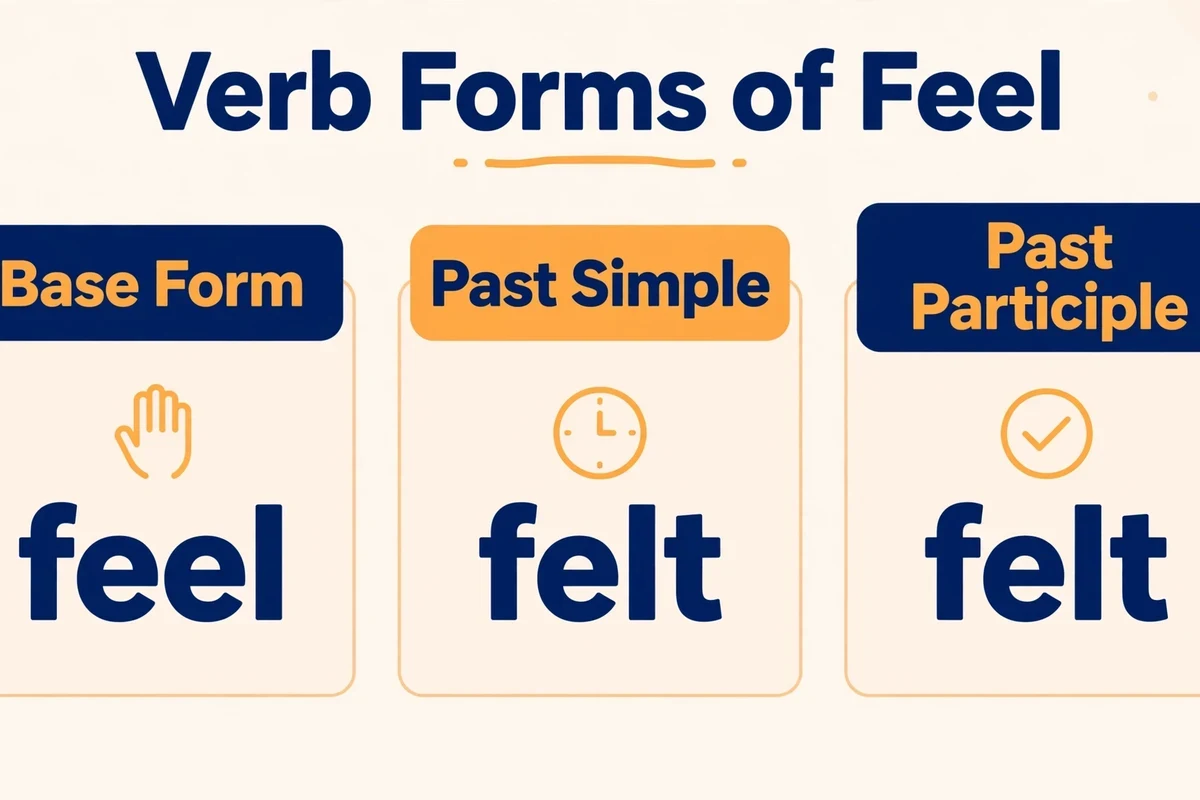
The core rule: use feel for now, felt for the past. "Feeled" is never a word — feel–felt–felt is an irregular verb, like keep–kept–kept.
What Does "Feel" Mean?
Feel is the base form of the verb. It describes emotions, physical sensations, opinions, or perceptions. As a base form, it appears in the present simple (I/you/we/they), after auxiliary verbs (do, did, will, can, should), in infinitives (to feel), and in imperatives.
Oxford Learner's Dictionaries lists feel as a linking verb — it connects the subject to an adjective describing a state: "I feel sick," "She felt betrayed" (Oxford Learner's Dictionaries: feel). This is why we say "I feel bad" (adjective), not "I feel badly" (adverb) — a classic learner error.
Feel has two main jobs:
- Linking verb (state): describes how someone feels — I feel tired. The room feels cold.
- Action verb (touch/perceive): describes the physical act — She felt the fabric. I can feel the heat.
What Does "Felt" Mean?
Felt is both the simple past tense and the past participle of feel. Cambridge Dictionary gives the verb forms plainly: past tense, past participle felt (Cambridge Dictionary: feel). Collins confirms: "Felt is the past tense and past participle of feel" (Collins: felt).
Use felt:
- For completed past feelings: I felt sick yesterday.
- After have/has/had (perfect tenses): I have felt better lately. She had felt nervous before.
Felt is also a completely separate noun: a thick cloth made by matting fibers together — a felt hat, green felt on a billiard table. As an adjective: felt-tip pen. Do not confuse the fabric with the verb form; context always makes the meaning clear.
Felt vs Feel: Comparison Table
| Feature | Feel | Felt |
|---|---|---|
| Verb form | Base form / present | Past tense AND past participle |
| Time | Now or habitual | Finished past |
| 3rd person singular | feels (she feels) | felt (she felt — same for all subjects) |
| After do/did | feel (Did you feel?) | Never after did |
| After have/has/had | Never | felt (have felt) |
| As a noun | No | Yes — a fabric (felt hat) |
| Example | I feel confident today. | I felt confident yesterday. |
The Irregular Verb Table: Feel–Felt–Felt
Feel is irregular — it does not add -ed. It belongs to a small family of verbs that change their vowel and end in -t:
| Base form | Past simple | Past participle | Present participle |
|---|---|---|---|
| feel | felt | felt | feeling |
| keep | kept | kept | keeping |
| sleep | slept | slept | sleeping |
| weep | wept | wept | weeping |
Notice the pattern: like drive–drove–driven (see our guide to drove vs driven), English irregular verbs follow their own historical patterns instead of the regular -ed ending. And just as "resetted" is wrong (see resetted or reset), "feeled" is always wrong — no exceptions.
One tricky exception: there is a different, regular verb "to felt" meaning "to make into felt (the fabric)" — felted, felting. You will almost never need it, but it explains why the -ed form exists in dictionaries without making "feeled" correct.
Correct Examples: Feel vs Felt in Context
Everyday conversation
- I feel great this morning.
- Do you feel better now?
- She feels left out at work. (third person *-s*)
- We feel lucky to have this opportunity.
- I felt embarrassed when I forgot his name.
School and education
- The students feel confident about the exam.
- He felt relieved after submitting his essay.
- Have you ever felt nervous before a presentation? (past participle after *have*)
Business and workplace
- I feel that this strategy will work. (opinion)
- The team felt optimistic after the meeting.
- She has felt under pressure all quarter. (present perfect)
Emails and messages
- I feel we should postpone the deadline.
- Thanks for asking — I felt much better after some rest.
Questions and negatives
- How did you feel after the long flight? (base form after *did*)
- Why does he always feel cold in this office?
- I didn't feel comfortable at the party. (base form after *didn't*)
- They hadn't felt that tired in years. (past participle after *had*)
Physical sensation (action verb)
- The doctor felt my forehead for a fever.
- I can feel the bass through the floor.
- She felt the texture of the silk before buying it.
"Felt" as a noun (the fabric)
- The billiard table is covered in green felt.
- He wore a traditional felt hat.
- The craft kit includes colorful sheets of felt.
Incorrect vs Correct: Common Mistakes
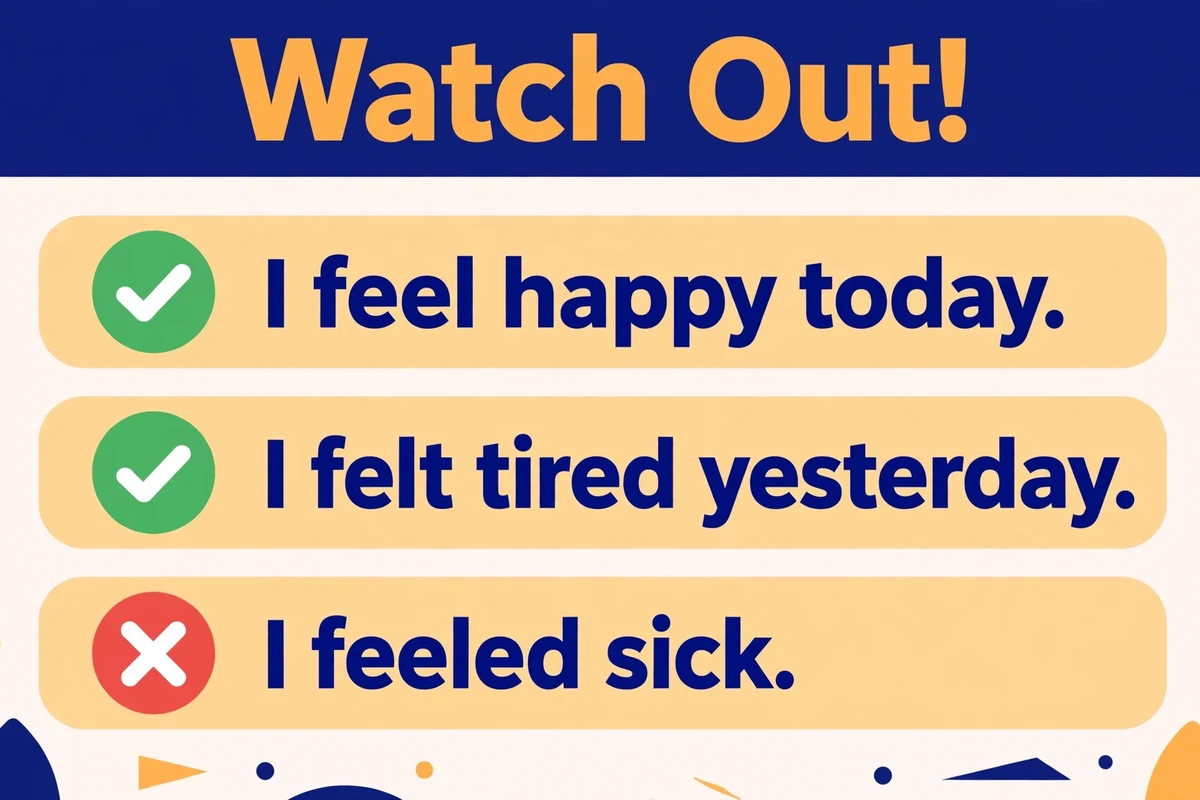
Incorrect: I feel tired yesterday.
Correct: I felt tired yesterday.
Why: "Yesterday" is finished past time, so the past form felt is required.
Incorrect: She feel happy about the news.
Correct: She feels happy about the news.
Why: Third-person singular (she) needs -s in the present: feels. (Same agreement rule as in anyone has or anyone have.)
Incorrect: How did you felt after the test?
Correct: How did you feel after the test?
Why: After the auxiliary did, always use the base form — never the past form. (Compare what happen or what happened.)
Incorrect: I have feel this way before.
Correct: I have felt this way before.
Why: After have/has/had, use the past participle — here, felt.
Incorrect: He feeled a sharp pain.
Correct: He felt a sharp pain.
Why: "Feeled" is not a word. Feel is irregular: feel–felt–felt.
Incorrect: I feel badly about what happened.
Correct: I feel bad about what happened.
Why: Feel is a linking verb here, so it takes an adjective (bad), not an adverb (badly).
Rules and Exceptions
1. Present simple: feel vs feels
- I/you/we/they feel; he/she/it feels.
- They feel ready. She feels ready.
2. Past simple: felt (all subjects)
- Felt never changes: I felt, you felt, she felt, they felt.
3. Perfect tenses: have/has/had + felt
- Present perfect: I have felt, she has felt.
- Past perfect: They had felt uneasy before the announcement.
4. After do/does/did: always "feel"
- Do you feel okay? Does she feel better? Did they feel welcome?
5. Continuous forms: "feeling"
- I am feeling better today is acceptable in modern English (dynamic use for temporary states).
- For general truths, prefer simple: I feel sick rather than I am feeling sick — though both are heard.
6. "Feel" + adjective vs adverb
- Linking use → adjective: feel happy, feel tired, feel confident.
- Action use → adverb possible: She felt the cloth carefully.
7. American vs British English
- No meaningful difference for feel/felt between American and British English. Both varieties use felt as past and past participle.
Real-World Usage
Professional email: Hi Sarah, I feel we should move the launch to next week. The team felt rushed last time, and I don't want a repeat.
Workplace chat: A: How did you feel about the client's feedback? B: Honestly, I felt relieved — I expected worse.
Classroom: Teacher: Have you ever felt nervous before an exam? Everyone has. The trick is preparation — then you'll feel confident walking in.
Customer message: I'm sorry you felt disappointed with the service. We want every customer to feel valued.
Easy Memory Technique
"Feel now, felt finished." Both start with F — feel is for the present moment, felt is finished time.
And to kill the "feeled" habit forever, remember the family: feel–felt rhymes with keep–kept and sleep–slept. If you would never write "keeped" or "sleeped," never write "feeled."
A second check: look at the time word. Today, now, every day → feel. Yesterday, last night, in 2019, ago → felt.
Practice Exercises
Choose the correct form. Answers are at the end — try them first!
- Yesterday I ___ (feel / felt) nervous before the presentation.
- She ___ (feel / feels) tired after long meetings.
- How did you ___ (feel / felt) about the news?
- They have ___ (feel / felt) this pressure before.
- I didn't ___ (felt / feel) comfortable at the party.
- Right now, we ___ (felt / feel) confident about the launch.
- He ___ (feeled / felt) a sharp pain in his shoulder.
- By the time help arrived, she had already ___ (felt / feeled) dizzy.
Answer Key
- felt — "Yesterday" signals simple past.
- feels — third-person singular (she) in the present takes -s.
- feel — base form always follows did.
- felt — past participle follows have.
- feel — base form follows didn't.
- feel — "right now" signals present.
- felt — "feeled" is never correct; feel is irregular.
- felt — past participle follows had (past perfect).
How did you do? 8/8 — excellent. 6–7 — solid, review the did + base form rule. Below 6 — reread the Quick Answer table above.
Frequently Asked Questions
Which is correct: "I felt" or "I feel"?
Both — it depends on when. Use "I feel" for right now (I feel fine today) and "I felt" for the past (I felt fine yesterday). Neither is universally "more correct."
Is it "How did you feel" or "How did you felt"?
"How did you feel?" is correct. After the auxiliary verb did, English always uses the base form of the main verb — never the past form. The same rule applies to negatives: I didn't feel well, not I didn't felt well.
Which is correct: "I felt" or "I've felt"?
Both are correct in different situations. "I felt" (simple past) describes a feeling at a finished time: I felt sick yesterday. "I've felt" (present perfect) describes experience up to now without a specific time: I've felt this way before. Use the simple past when the time is stated or finished; use the present perfect when it isn't.
Where do we use "felt"?
In three places: (1) as the simple past — She felt proud; (2) as the past participle after have/has/had — They have felt ignored; (3) as a noun or adjective for the fabric — a felt hat, felt-tip pen. For more present-vs-past contrasts, see appreciate it vs appreciated it and complete vs completed.
What is another name for "felt" (the fabric)?
There is no exact everyday synonym. In textile terms it is called a nonwoven fabric (fibers matted together rather than woven). Generically, people just say fabric or cloth — but felt specifically means the matted, nonwoven kind. Do not confuse this noun with the verb form: The hat is made of felt (noun) vs I felt cold (verb).
Is "feeled" a word?
No — never. The past tense and past participle of feel is felt. Feel is an irregular verb (feel–felt–felt), so adding -ed is always wrong, just like "resetted" (see resetted or reset).
Can "feel" be used in continuous tenses?
Yes, in modern English. "I'm feeling tired" is widely accepted for temporary states, alongside the traditional "I feel tired." Both are correct; the simple form is slightly more formal.
Conclusion
The felt vs feel choice comes down to time: feel for the present (I feel happy today), felt for the past (I felt happy yesterday) and after have/has/had (I have felt better). Remember three things and you will never go wrong: feel is irregular (never "feeled"), did always takes the base form ("How did you feel?"), and felt doubles as a noun for the fabric.
For your next tense pair, try drove vs driven — another irregular verb that trips up even confident writers.