Appreciative of vs Appreciative for: Which Is Correct?
Appreciative of vs appreciative for is mainly a question of standard English usage. In most sentences, appreciative of is the natural and preferred form: “I’m appreciative of your help.” Appreciative for is sometimes heard, but it is much less idiomatic and is usually better rewritten as either “appreciative of” or “grateful for.”
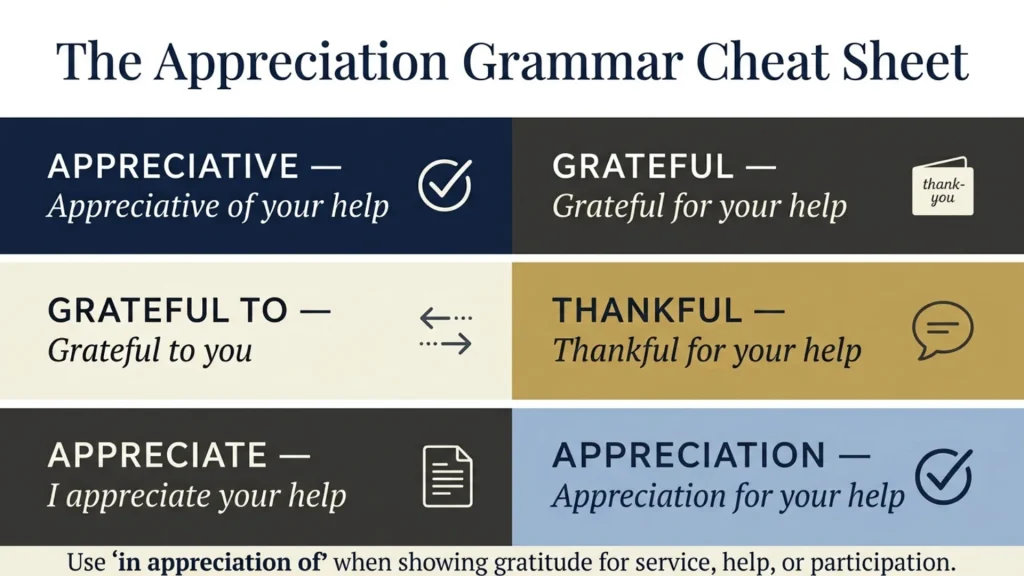
The easiest pattern to remember is: appreciative of, grateful for, thankful for, and appreciate + direct object. Those four patterns handle most real-life sentences without forcing English prepositions to behave logically, which they have never shown much interest in doing.
Quick Answer: Appreciative of vs Appreciative for?
Use “appreciative of” in standard English.
| Expression | Use | Example |
|---|---|---|
| Appreciative of | Standard and natural | I’m appreciative of your support. |
| Appreciative for | Uncommon and less idiomatic | Better: I’m grateful for your support. |
| Grateful for | Standard | I’m grateful for your help. |
| Grateful to | Used for the person receiving your gratitude | I’m grateful to you for your help. |
| Thankful for | Standard | I’m thankful for the opportunity. |
| Appreciate + object | No preposition needed | I appreciate your help. |
| Appreciation for | Common noun phrase | I have great appreciation for your work. |
| Appreciation of | Recognition or understanding of value | She has an appreciation of modern art. |
The Cambridge Dictionary entry for “appreciative of” treats the phrase as an established collocation and uses examples such as being appreciative of support, free time, and other people.
What Does Appreciative Mean?
Appreciative is an adjective. It describes someone who recognizes the value or quality of a person, action, thing, or experience, often with a sense of gratitude.
Natural examples include:
- I’m appreciative of your patience.
- She was appreciative of the feedback.
- We are deeply appreciative of your support.
- He seemed appreciative of the opportunity.
- The audience was very appreciative.
The word can therefore express both gratitude and recognition of value.
Also check: Me Too vs Me as Well vs I as Well
How to Use “Appreciative of”
Appreciative of is the normal construction when the adjective is followed by the person, thing, action, or quality being valued.
Appreciative of a Person
- I’m appreciative of you.
- She is appreciative of her colleagues.
- We are appreciative of everyone who volunteered.
Although “I’m appreciative of you” is grammatical, “I appreciate you” often sounds warmer and more direct in everyday English.
Appreciative of Help or Support
- I’m appreciative of your help.
- We’re appreciative of your continued support.
- She was appreciative of the assistance she received.
Appreciative of an Opportunity
- I’m appreciative of the opportunity to contribute.
- He was appreciative of the chance to learn.
- We are appreciative of the opportunity to work together.
Appreciative of a Quality or Action
- I’m appreciative of your honesty.
- She is appreciative of his patience.
- The team is appreciative of your willingness to help.
Is “Appreciative for” Correct?
Appreciative for appears in real speech and writing, but it is much less established than appreciative of. If you are writing professionally, academically, or for a general audience, “appreciative of” is the safer and more idiomatic choice.
Instead of:
Less natural: I’m appreciative for your support.
Write:
Natural: I’m appreciative of your support.
Or:
Natural: I’m grateful for your support.
The confusion probably persists because grateful for and thankful for are both completely normal. Writers sometimes transfer the same preposition to appreciative.
“I Am Appreciative of” or “I Am Appreciative for”?
Use “I am appreciative of”.
Examples:
- I am appreciative of your guidance.
- I am appreciative of all the work you did.
- I am appreciative of your understanding.
- I am appreciative of the time you gave me.
- I am appreciative of your participation.
If you prefer for, switch the adjective:
- I am grateful for your guidance.
- I am thankful for your understanding.
“Appreciative of You” or “Appreciative for You”?
“Appreciative of you” is the standard form if you want to use the adjective appreciative.
However, different alternatives can express slightly different ideas:
| Sentence | Meaning |
|---|---|
| I’m appreciative of you. | I value you and recognize what you do. |
| I appreciate you. | Direct, natural expression of appreciation. |
| I’m grateful to you. | My gratitude is directed toward you. |
| I’m grateful for you. | I’m thankful that you are in my life or present in this situation. |
That last distinction is useful. Grateful to you usually points to something the person did. Grateful for you can express gratitude for the person’s presence or existence.
Appreciative in a Sentence
Here are natural examples across formal and informal situations.
Professional Examples
- We are appreciative of your prompt response.
- I’m very appreciative of your guidance throughout the project.
- The team is appreciative of your continued cooperation.
- We remain appreciative of your trust and support.
- I am especially appreciative of your detailed feedback.
Personal Examples
- I’m appreciative of everything you do for me.
- She is so appreciative of her family.
- I’m very appreciative of your kindness.
- He was genuinely appreciative of the gesture.
- I’m appreciative of having people I can rely on.
Academic or Formal Examples
- The authors are appreciative of the reviewers’ constructive comments.
- We are appreciative of the participants who contributed to the study.
- The committee is appreciative of the careful work completed by the research team.
“So Appreciative” and “Very Appreciative”
Both expressions are natural.
So appreciative often sounds warmer and more conversational:
- I’m so appreciative of your help.
- We’re so appreciative of everyone who came.
Very appreciative sounds neutral and works well in both professional and personal writing:
- I’m very appreciative of your time.
- We’re very appreciative of your continued support.
For a more formal tone, you can also use:
- deeply appreciative
- especially appreciative
- particularly appreciative
- truly appreciative
- genuinely appreciative
Appreciation of vs Appreciation for
The noun appreciation is more flexible than the adjective appreciative. Both appreciation of and appreciation for are standard, but they often emphasize different things.
Appreciation of
Appreciation of often refers to recognition, understanding, or awareness of the value or qualities of something.
- She has a deep appreciation of classical music.
- The course develops an appreciation of cultural differences.
- He has little appreciation of how difficult the task is.
Appreciation for
Appreciation for is very common when expressing gratitude, admiration, or positive regard.
- I have great appreciation for your help.
- She expressed her appreciation for the team.
- We want to show our appreciation for your support.
Appreciation of vs Appreciation for Someone
When referring to a person, appreciation for someone usually sounds more natural when you mean gratitude or admiration:
- I have enormous appreciation for my teachers.
- We want to express our appreciation for our volunteers.
Appreciation of someone is possible when the emphasis is on understanding or recognizing that person’s qualities, work, or significance, but it can sound more analytical.
“In Appreciation of” or “In Appreciation for”?
“In appreciation of” is the established phrase when something is given or done as a sign of gratitude.
- We presented the award in appreciation of her service.
- This gift is given in appreciation of your support.
- The event was held in appreciation of our volunteers.
- We offer this certificate in appreciation of your contribution.
In appreciation for is much less natural in this construction.
What Does “In Appreciation of” Mean?
It means as an expression or sign of gratitude for someone or something.
For example:
“This certificate is presented in appreciation of your participation.”
The sentence means the certificate is being presented to show gratitude for that participation.
“In Appreciation of Your Participation”
“In appreciation of your participation” is correct and natural, especially on certificates, acknowledgments, event materials, and formal thank-you messages.
You can write:
- In appreciation of your participation.
- In appreciation of your valuable participation.
- In appreciation of your participation and contribution.
- In appreciation of your dedication and commitment.
- In appreciation of your contribution to the program.
Participation, Contribution, Pledge, and Commitment
If you need a polished version of a long phrase such as “in appreciation of your participation and contribution in the pledge and commitment,” avoid stacking abstract nouns.
Better options include:
- In appreciation of your participation, contribution, and commitment.
- In appreciation of your valuable contribution and continued commitment.
- In appreciation of your participation and dedication to this initiative.
- With sincere thanks for your participation, contribution, and commitment.
The shorter versions are clearer and sound more professional.
“Appreciate of” or “Appreciate for”?
Neither is the normal pattern after the verb appreciate.
The verb usually takes a direct object:
- I appreciate your help.
- I appreciate your patience.
- We appreciate your support.
- She appreciates the opportunity.
Not:
- I appreciate of your help.
- I appreciate for your support.
You can also use a possessive plus an -ing form:
- I appreciate your taking the time to help.
- We appreciate your attending the meeting.
Grateful of or Grateful for?
Use grateful for when naming the thing, help, opportunity, or situation that causes gratitude.
- I’m grateful for your help.
- We’re grateful for the opportunity.
- She’s grateful for your patience.
Use grateful to when naming the person or group receiving your gratitude:
- I’m grateful to you.
- We’re grateful to our volunteers.
- She is grateful to her mentor for the advice.
Grateful of is not the standard pattern in these contexts.
Thankful of or Thankful for?
Thankful for is the normal form:
- I’m thankful for your support.
- We’re thankful for another opportunity.
- She is thankful for her family.
Thankful of is generally not used in standard modern English for this meaning.
Difference Between Thankful and Appreciative
Thankful emphasizes gratitude. Appreciative can express gratitude too, but it often carries an additional sense of recognizing value, effort, quality, or importance.
| Word | Main Emphasis | Example |
|---|---|---|
| Thankful | Feeling gratitude | I’m thankful for your help. |
| Grateful | Feeling or expressing thanks | I’m grateful for your support. |
| Appreciative | Gratitude plus recognition of value | I’m appreciative of your effort. |
| Appreciate | Directly valuing or thanking | I appreciate your effort. |
In many everyday sentences, the differences are subtle rather than dramatic.
Appreciative Synonyms
Useful alternatives depend on tone:
- grateful
- thankful
- obliged
- indebted
- pleased
- admiring
- recognizing
- receptive
- gracious
- mindful
Not every synonym is interchangeable. Indebted, for example, is stronger than appreciative, while admiring emphasizes approval rather than gratitude.
Better Ways to Say “I’m Appreciative”
Professional
- I appreciate your support.
- I’m grateful for your assistance.
- Thank you for your time and effort.
- Your support is greatly appreciated.
- I sincerely appreciate your contribution.
- Please accept my sincere thanks.
Warm and Personal
- I really appreciate you.
- I’m so grateful for everything you’ve done.
- Your kindness means a lot to me.
- I’m truly thankful for your support.
- I don’t take your help for granted.
Formal
- I am deeply appreciative of your assistance.
- Please accept my sincere appreciation.
- We are grateful for your continued cooperation.
- Your contribution is sincerely appreciated.
Common Mistakes
| Less Natural or Incorrect | Better |
|---|---|
| I’m appreciative for your help. | I’m appreciative of your help. |
| I appreciate of your support. | I appreciate your support. |
| I appreciate for your feedback. | I appreciate your feedback. |
| I’m grateful of your help. | I’m grateful for your help. |
| I’m thankful of the opportunity. | I’m thankful for the opportunity. |
| In appreciation for your service. | In appreciation of your service. |
| Thanks for appreciation. | Thank you for your appreciation. |
Easy Memory Rule
Remember these four patterns:
- Appreciative of your help.
- Grateful for your help.
- Thankful for your help.
- Appreciate your help.
For the noun:
- Appreciation for your help.
- Appreciation of art, music, complexity, value, or another quality.
- In appreciation of your service.
Frequently Asked Questions
Is it “appreciation of you” or “appreciation for you”?
“Appreciation for you” is usually more natural when you mean gratitude, admiration, or affection toward a person. “Appreciation of you” can work when emphasizing recognition or understanding of that person’s qualities, but it sounds more analytical.
How to use appreciative in a sentence?
Use appreciative of before the person, thing, action, or quality you value: “I’m appreciative of your help,” “She’s appreciative of the opportunity,” or “We’re very appreciative of your support.”
Do you say grateful to or grateful for?
Both are correct, but they do different jobs. Use grateful to for the person: “I’m grateful to you.” Use grateful for for the thing or action: “I’m grateful for your help.” You can combine them: “I’m grateful to you for your help.”
Is the phrase “thanks for appreciation” grammatically correct?
It is understandable but usually sounds incomplete or unnatural. Better options are “Thank you for your appreciation,” “Thank you for your kind words,” or “Thank you for recognizing my work.”
What is the most humble way to say thank you?
A simple, sincere sentence usually sounds more humble than an elaborate one. Try: “Thank you. I truly appreciate your help.” In formal situations, “I’m sincerely grateful for your support” also works well.
What is another way to say “thank you for the appreciation”?
You can say “Thank you for your kind words,” “I appreciate the recognition,” “Your feedback means a lot to me,” or “I’m grateful for your encouragement.”
How to say thanks for appreciation professionally?
Use a concise line such as: “Thank you for your kind recognition. I sincerely appreciate your feedback and support.” Another option is: “I’m grateful for your recognition and appreciate the opportunity to contribute.”
What is a stronger word than “thank you”?
There is no single stronger replacement in every context. Phrases such as “I’m deeply grateful,” “I sincerely appreciate it,” and “I’m truly indebted to you” can express greater intensity, although “indebted” is noticeably stronger and more formal.
How do you say thank you in a very unique way?
Make the gratitude specific rather than merely unusual. For example: “Your help made a real difference, and I’m genuinely grateful,” or “I won’t forget the time and effort you gave me.” Specificity usually sounds more sincere than a decorative phrase.
Is “I’m appreciative of you” correct?
Yes. “I’m appreciative of you” is grammatical. In everyday conversation, “I appreciate you” often sounds more direct and natural.
Is “I am so appreciative” correct?
Yes. “I am so appreciative” is natural, especially in conversational English. If you state what you appreciate, use of: “I am so appreciative of your support.”
Final Thoughts
For appreciative of vs appreciative for, the practical rule is straightforward: use appreciative of in standard English. If for feels more natural, you probably want grateful for or thankful for instead.
Keep the related patterns separate: I appreciate your help, I’m appreciative of your help, I’m grateful for your help, and I have appreciation for your help. Once those combinations are familiar, the choice stops being much of a choice at all.