Assume vs Presume vs Infer: Meaning, Differences & Examples
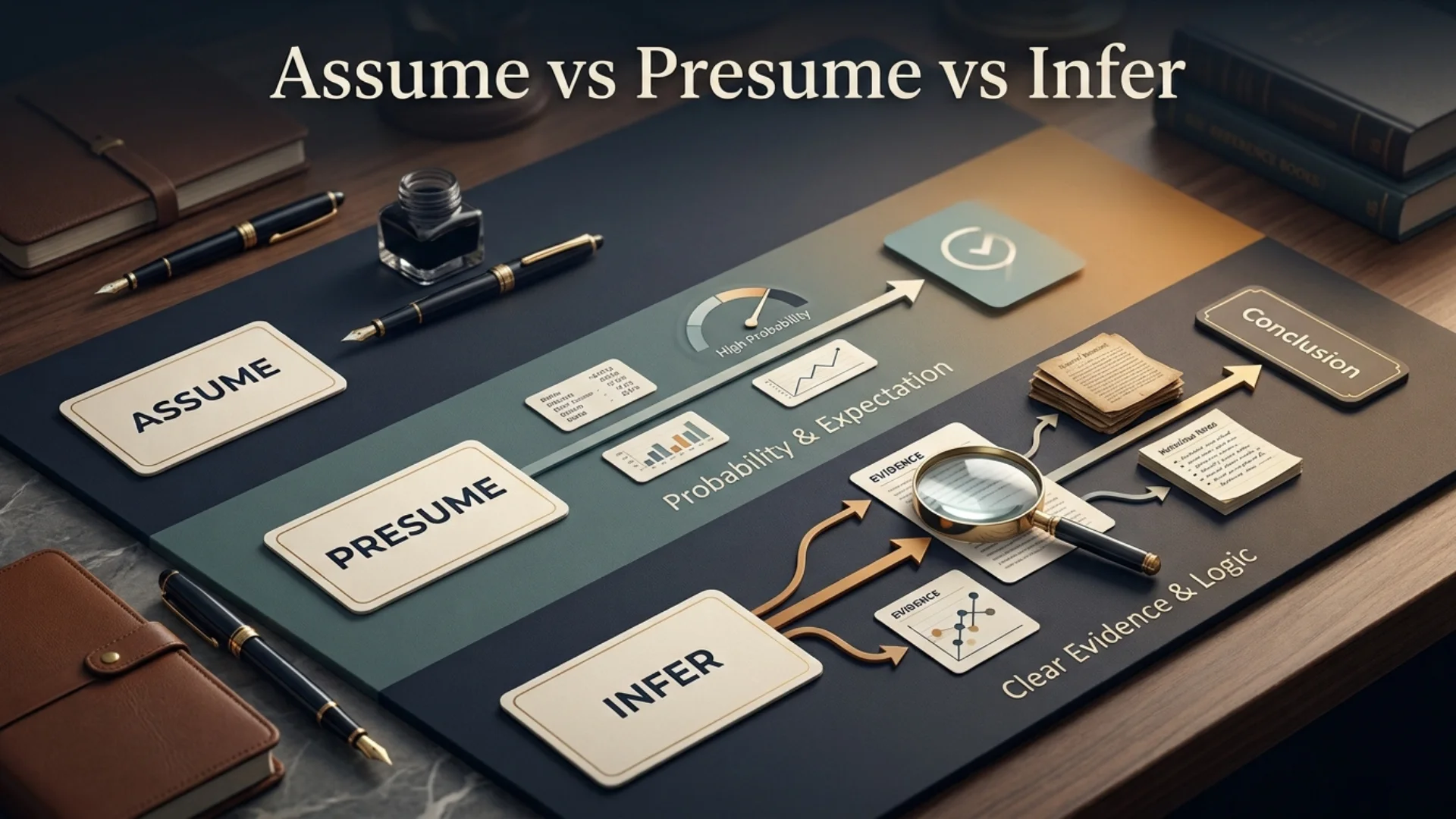
Assume, presume, and infer all involve accepting or forming an idea without complete certainty, but they describe different thinking processes. You assume when you take something as true without confirming it, presume when you believe something is likely or reasonably expected, and infer when information or clues lead you to a conclusion.
The useful distinction is not a rigid “zero evidence, some evidence, lots of evidence” formula. Assume and presume genuinely overlap in English. Presume often carries greater confidence, probability, convention, or formality, while infer focuses much more clearly on drawing a conclusion from available information. Merriam-Webster similarly notes that assume and presume overlap but differ in the confidence or evidence implied. Justia Law
Quick Answer: What’s difference Between Assume vs Presume vs Infer
| Word | Simple Meaning | Typical Basis | Example |
|---|---|---|---|
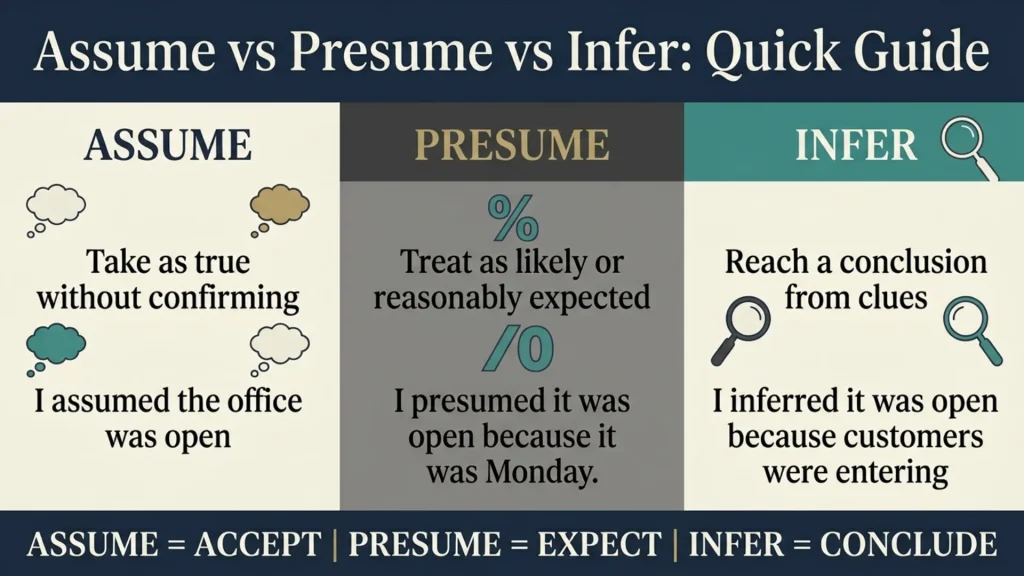
| Assume | Accept something as true without confirming it | An unverified belief or starting point | I assumed the shop was open. |
| Presume | Take something as probably true | Expectation, probability, convention, or some basis | I presume the shop is open because it normally closes at 9. |
| Infer | Reach a conclusion from information | Facts, clues, observations, or reasoning | I inferred the shop was open because customers were walking inside. |
The easiest memory rule is:
Assume = take as true
Presume = expect as likely
Infer = conclude from clues
What Does Assume Mean?
Assume commonly means to accept or suppose something is true without first confirming it.
For example:
I assumed you were at work.
The speaker believed the person was at work, but the sentence does not establish that the belief was verified.
Other examples:
- I assumed the meeting started at nine.
- She assumed he already knew.
- We assumed the restaurant would be open.
- Don’t assume that everyone agrees with you.
- I assumed you had finished the report.
An assumption can turn out to be right. The word does not mean the belief is automatically false. It simply tells us that the speaker accepted something as true without establishing it as fact.
Also check: That’s or Thats
Assume Has Other Meanings Too
One reason assume vs presume cannot be reduced entirely to evidence is that assume has several additional meanings.
Assume Responsibility
She assumed responsibility for the project.
Here, assume means take on.
Assume Control
The new manager assumed control of the department.
Again, this means taking control, not making a guess.
Assume a Role
He assumed the role of team leader.
Assume an Identity
The character assumed a false identity.
You cannot casually replace these uses with presume.
She presumed responsibility for the project would not normally mean the same thing as she assumed responsibility.
That alone should warn against treating the two words as identical twins wearing slightly different ties.
What Does Presume Mean?
Presume can mean to suppose or take something as true before definitive proof is available, often with a stronger sense of expectation, probability, confidence, established practice, or reasonable grounds.
Example:
I presume you’re here for the interview.
The speaker has not necessarily confirmed why the person is there, but the circumstances make the explanation seem reasonable.
Other examples:
- I presume you’ve already read the email.
- We presume the information is accurate.
- I presume you’re the new manager.
- The missing hikers were initially presumed safe.
- A defendant is presumed innocent.
Presume often sounds somewhat more formal than assume, although that is a tendency rather than an absolute grammar rule.
Assume vs Presume: What Is the Difference?
Assume and presume are close synonyms.
A practical distinction is:
Assume: you take an idea as true without confirming it.
Presume: you take an idea as true, often with greater confidence or because circumstances, expectations, probability, or convention support it.
Compare:
I assumed Maya would attend the meeting.
Perhaps you simply expected her to come.
I presumed Maya would attend because she had accepted the invitation.
Now the expectation has an obvious basis.
However, English usage is not an engineering diagram. Native speakers sometimes use assume even when they have reasons for their belief, and dictionaries recognize overlap between the two words.
For a detailed dictionary discussion, see Merriam-Webster’s guide to assume vs. presume.
Is Presume Just Assume With Evidence?
Not exactly.
That shortcut is useful for beginners, but it becomes misleading if treated as an absolute rule.
Consider:
I presume you’re Mr. Harris.
The speaker may have good reason for the belief, but no formal evidence needs to have been examined.
Presume can express:
- probability
- expectation
- confidence
- convention
- something treated as true until disproved
Assume can also be supported by circumstances. The distinction is often about how the speaker frames the belief, not a measurable evidence score.
What Does Infer Mean?
Infer means to reach a conclusion from facts, evidence, observations, statements, or clues.
Example:
I inferred from her message that the meeting had been canceled.
The speaker is not simply accepting an unsupported idea. Something in the message led to that conclusion.
Other examples:
- We inferred his location from the GPS data.
- She inferred that he was upset from his tone.
- Scientists infer past conditions from available evidence.
- The reader can infer the character’s motives from her actions.
- I inferred from the empty parking lot that the office was closed.
The key idea is:
information → reasoning → conclusion
Merriam-Webster’s primary sense of infer is to derive a conclusion from facts or premises. PTACs
Infer vs Assume
The difference between infer vs assume is clearer than the difference between assume and presume.
Assume
You accept an idea without necessarily deriving it from evidence.
I assumed Liam had left.
Infer
You reach the conclusion because something points toward it.
I inferred that Liam had left because his desk was empty, his coat was gone, and his computer was turned off.
Both conclusions could be wrong.
What changes is how the conclusion was formed.
Can an Inference Be Wrong?
Yes.
An inference is a conclusion drawn from information, but the information may be incomplete or misleading.
Suppose the ground outside is wet.
You infer:
It rained.
That is a reasonable inference.
But perhaps a sprinkler had been running.
The inference was logical from the clue, yet still incorrect.
So infer does not mean prove.
Infer vs Presume
Infer emphasizes the reasoning process.
Presume emphasizes accepting something as likely or treating it as true unless circumstances suggest otherwise.
Compare:
I presumed the train would arrive on time because it usually does.
This is an expectation based on normal circumstances.
I inferred that the train was delayed from the departure board and station announcement.
This is a conclusion drawn from specific information.
The difference is subtle, but useful.
Assume vs Presume vs Infer in One Situation
Imagine your coworker has not arrived at the office.
Assume
I assumed she was working from home.
You adopted that explanation without checking.
Presume
I presumed she was working from home because Wednesdays are usually her remote days.
The circumstances make the belief reasonably likely.
Infer
I inferred she was working from home after seeing her status set to remote and reading her message in the team chat.
Specific information produced the conclusion.
This one scenario captures the practical difference better than memorizing a dictionary paragraph and hoping it survives contact with actual English.
Assume vs Presume vs Suppose
Suppose creates another area of overlap.
Suppose can mean to believe, think, or accept something as possible or true.
Suppose as an Opinion
I suppose he’s right.
This often expresses a tentative opinion.
Suppose as a Hypothetical
Suppose the flight is canceled. What would we do?
Here, suppose introduces an imagined condition.
Assume as a Hypothetical
Assume can also establish a condition:
Assume the flight is canceled. What happens next?
In mathematics, logic, planning, and technical explanations, assume is especially common for establishing a premise.
So:
suppose often sounds conversational or hypothetical.
assume can formally establish something as a working premise.
presume more often presents something as likely or expected.
infer describes a conclusion reached from information.
Assume vs Presume vs Suppose vs Infer
| Word | Best Mental Shortcut |
|---|---|
| Assume | Take something as true |
| Presume | Treat something as probably true |
| Suppose | Consider or imagine something |
| Infer | Reach a conclusion from information |
Example:
Suppose the manager is away tomorrow.
Imagine this situation.
Assume the manager is away tomorrow.
Use this as our working premise.
I presume the manager will be away tomorrow.
I expect this is probably true.
I inferred that the manager will be away from the calendar notice.
The available information led me to that conclusion.
Assumption vs Presumption
The noun forms preserve much of the same distinction.
Assumption
An assumption is something taken for granted or accepted as true without confirmation.
Example:
The plan was based on the assumption that demand would remain stable.
Presumption
A presumption is something taken to be true, often because of probability, convention, law, or an accepted basis.
Example:
The legal system begins with the presumption of innocence.
The distinction becomes particularly important in formal contexts because a presumption can have an established procedural or legal basis.
Presume in Legal English
One of the most familiar uses is:
presumed innocent
This does not mean the court has examined evidence and concluded that the accused person is factually innocent.
Instead, innocence is treated as the starting legal presumption unless guilt is established according to the applicable standard.
This illustrates why “presume means assume with evidence” is too crude.
A presumption may arise from an established rule, not merely from someone informally gathering clues.
Infer vs Imply
This pair causes almost as much trouble as assume and presume.
The traditional distinction is:
The speaker implies.
The listener infers.
Imply
To imply is to communicate or suggest something without saying it directly.
Her message implied that the deadline might change.
Infer
To infer is to interpret information and reach a conclusion.
I inferred from her message that the deadline might change.
Think of communication as movement:
Speaker → implies → message → listener → infers
The person sending the clue typically implies.
The person interpreting the clue typically infers.
Does Infer Ever Mean Imply?
Historically, infer has sometimes been used in senses overlapping with imply, and major dictionaries record that history. Still, maintaining the traditional distinction between imply = suggest and infer = conclude usually gives modern readers the clearest sentence. Scribbr
In ordinary writing, this is safest:
What are you implying?
rather than:
What are you inferring?
when you mean “What are you suggesting?”
A Stronger Word Than Imply
The best alternative depends on what you mean.
Possible choices include:
- suggest
- indicate
- signal
- hint
- insinuate
- intimate
- communicate
- convey
- demonstrate
- establish
These are not interchangeable.
For example:
The evidence indicates a decline.
is stronger than:
The evidence hints at a decline.
And:
The evidence proves a decline.
is much stronger than either, because prove claims a level of support that imply does not.
What’s a Better Word for Infer?
Depending on context, alternatives include:
- conclude
- deduce
- reason
- gather
- interpret
- surmise
- derive
- understand
Example:
From the evidence, we inferred that the system had failed.
Could become:
From the evidence, we concluded that the system had failed.
But guess is not always a good replacement because an inference normally has some informational basis.
Assume in Everyday Conversation
Assume is probably the most natural of the three in casual speech.
Examples:
- I assume you’re coming.
- I assumed you had eaten.
- Don’t assume I agree.
- Let’s assume she’s right.
- I wouldn’t assume that.
- I assumed the store closed at ten.
In many of these sentences, replacing assume with presume is grammatically possible but may make the tone sound more formal.
Presume in Everyday and Formal English
Presume is especially natural in expressions such as:
- I presume so.
- I presume not.
- I presume you’ve met.
- presumed innocent
- presumed dead
- presumed owner
- presumed cause
It also has another meaning involving taking an unwarranted liberty.
Presume to Do Something
I wouldn’t presume to tell you how to raise your children.
Here, presume means something closer to dare or take the liberty of doing something without proper authority.
This meaning cannot simply be replaced with assume.
Infer in Academic Writing
Infer is especially useful in analytical writing because it identifies a conclusion as something derived from information rather than directly observed.
Examples:
From the results, researchers inferred that the treatment had an effect.
Readers can infer the narrator’s attitude from the wording.
The archaeological evidence allows us to infer how the settlement was organized.
Good academic writing also distinguishes an inference from an established fact.
If you are working on precise word choice, the same kind of contextual distinction appears in “In Process” vs “In Progress”.
Assume in Academic and Technical Writing
Assume has another useful role in formal reasoning.
It can establish a premise:
Assume that x is greater than zero.
For this model, we assume that demand remains constant.
The writer is not necessarily making a careless guess.
Instead, the assumption establishes a condition under which the analysis operates.
This is why saying assume always means an unsupported guess is inaccurate.
Assume, Presume, and Infer in Professional Emails
Small differences can change the tone of workplace communication.
Assume
I assumed the invoice had already been approved.
This can subtly admit that you acted without confirmation.
Presume
I presume the invoice has been approved because it has moved to the payment queue.
The belief sounds more reasoned or expected.
Infer
I inferred from your message that the invoice had been approved.
Now the sentence identifies communication as the source of the conclusion.
This distinction can matter when responsibility is being discussed. Nobody enjoys discovering that one tiny verb has volunteered them for a meeting with management.
Assume vs Presume Example Sentences
Compare each pair.
Example 1
I assumed the restaurant was open.
No confirmation is emphasized.
I presumed the restaurant was open because its posted hours showed it should be.
There is an expectation or basis.
Example 2
She assumed he knew the password.
She took this as true.
She presumed he knew the password because he had logged in before.
There is a reason behind the expectation.
Example 3
We assumed the package would arrive today.
The expectation may be little more than a working belief.
We presumed the package would arrive today because the tracking page listed today’s date.
The circumstances support the expectation.
Again, these are useful contrasts rather than an unbreakable rule of English.
Infer Example Sentences
- From the footprints, the detective inferred that two people had entered.
- I inferred from his silence that he disagreed.
- We can infer the author’s attitude from her choice of words.
- The doctor inferred nothing until more information became available.
- She inferred that the meeting was canceled from the empty room.
- From these figures, analysts inferred that demand was slowing.
- Students were asked to infer the character’s motive.
- I inferred from your message that you needed help.
- We cannot infer causation from that observation alone.
- What can you infer from the final paragraph?
For another GrammarRead guide built around choosing between similar English forms, see Annunciate vs Enunciate.
How Do I Use Infer Correctly?
A useful sentence pattern is:
infer + conclusion + from + evidence
For example:
I inferred his opinion from his comments.
Or:
infer from + evidence + that + conclusion
From his comments, I inferred that he disagreed.
The word from is useful because it makes the evidence-conclusion relationship explicit.
Infer Does Not Mean “Know for Certain”
This sentence:
I inferred that she had left.
does not mean:
I proved that she had left.
It means the evidence led you to that conclusion.
An inference can be:
- strong
- weak
- reasonable
- mistaken
- tentative
- well supported
That makes infer useful when the evidence points somewhere without providing absolute certainty.
What Does Infer Mean in Simple Words?
In simple terms:
Infer means figure something out from clues.
If a child sees:
- dark clouds
- people carrying umbrellas
- wet pavement
the child might infer that it has been raining.
That is a more accurate kid-friendly explanation than burying the meaning under “derive a proposition from premises,” unless the goal is to make an eight-year-old abandon language permanently.
A Kid-Friendly Word for Infer
Depending on the sentence, kid-friendly alternatives include:
- figure out
- work out
- conclude
- guess from clues
For teaching children, figure out from clues is especially useful.
Example:
What can you infer from the story?
can be explained as:
What can you figure out from the clues in the story?
10 Examples of Inference
Here are ten simple inference examples:
- The pavement is wet, so you infer that it may have rained.
- Someone yawns repeatedly, so you infer that they may be tired.
- A restaurant is dark and its doors are locked, so you infer that it is closed.
- Smoke is rising behind a building, so you infer that something may be burning.
- A student brings an umbrella after checking the forecast, so you infer that rain is expected.
- A dog runs to the door when it hears keys, so you infer that it recognizes someone arriving.
- A character avoids answering a question, so a reader may infer that the character is hiding something.
- Sales decline for several consecutive months, so an analyst may infer that demand has weakened.
- A package’s tracking page says “out for delivery,” so you infer that it may arrive that day.
- Everyone leaves a conference room carrying notes, so you infer that a meeting has just ended.
An inference is a conclusion based on clues, not necessarily a proven fact.
Common Mistakes
Mistake 1: Treating Assume and Presume as Completely Different
They overlap considerably.
The evidence distinction is useful, but it is not absolute.
Mistake 2: Saying Presume Always Requires Evidence
Presume can involve expectation, probability, convention, or confidence. Direct evidence is not always required.
Mistake 3: Treating an Assumption as Necessarily Careless
Technical and academic writing deliberately establishes assumptions all the time.
Mistake 4: Using Infer When You Mean Imply
Traditional clear usage:
The speaker implies.
The listener infers.
Mistake 5: Treating an Inference as Proof
Evidence can support a conclusion without proving it conclusively.
Mistake 6: Replacing Assume With Presume Everywhere
You can assume responsibility, assume office, or assume a role. Presume does not normally replace assume in those senses.
For another example where a tiny spelling difference creates a completely different issue, see Hassle vs Hastle.
Is Assume the Same as Resume?
No.
Assume and resume are entirely different words.
Assume can mean to take something as true or to take on a role or responsibility.
Resume, as a verb, means to begin again after stopping.
Examples:
I assume the office is open.
The meeting will resume after lunch.
A résumé can also mean a document summarizing someone’s education and work experience.
Easy Memory Trick
Remember these three questions:
Am I Simply Taking Something as True?
Use assume.
Am I Treating Something as Likely or Expected?
Use presume.
Did Information Lead Me to the Conclusion?
Use infer.
A compact version:
Assume = accept
Presume = expect
Infer = conclude
It is a memory tool, not a law carved into a grammar mountain.
Frequently Asked Questions
Is It Better to Use Presume or Assume?
Neither word is universally better.
Use assume when you mean taking something as true, using something as a premise, or taking on a role or responsibility.
Use presume when you want to express an expectation or belief treated as probably true, often with greater confidence, convention, or formality.
Is “Presume” a Rude Word?
No. Presume is not inherently rude.
However, expressions such as “I wouldn’t presume to…” involve taking a liberty or acting without proper authority.
Tone and context determine whether it sounds polite, formal, critical, or presumptuous.
What’s a Better Word for Infer?
Possible alternatives include conclude, deduce, gather, reason, interpret, derive, and surmise.
The best synonym depends on how strong the evidence is and what kind of reasoning is involved.
When Do I Use Imply vs Infer?
Use imply for the person, words, or evidence that suggest something.
Use infer for the person who reaches the conclusion.
Example:
Her tone implied that she was annoyed.
I inferred from her tone that she was annoyed.
What’s a Stronger Word Than “Imply”?
Depending on context, indicate, demonstrate, establish, show, or prove may make a stronger claim.
Be careful, though. Prove requires much stronger support than imply.
How Do I Use Infer Correctly?
Use infer when evidence or information leads to a conclusion.
Example:
From the empty desks, I inferred that the employees had already left.
What Does Infer Mean in Simple Words?
Infer means to figure something out from clues or information.
What Are 10 Examples of Inference?
Examples include inferring rain from wet streets, tiredness from repeated yawning, a store closure from locked doors, or a character’s feelings from actions. The common feature is that a conclusion is drawn from clues rather than directly stated.
What Is a Kid-Friendly Word for Infer?
A simple replacement is “figure out from clues.”
For example:
Infer what the character feels
can be explained as:
Figure out what the character feels from clues in the story.
Final Answer
The key to Assume vs Presume vs Infer is not simply memorizing three dictionary definitions. Focus on what the speaker is doing with the information.
Assume means taking something as true or using it as a starting premise without confirmation.
Presume means taking something as probably or reasonably true, often with greater confidence, expectation, convention, or formality.
Infer means reaching a conclusion from information, observations, or clues.
So:
I assumed he was home.
You accepted the idea.
I presumed he was home because he normally works remotely on Fridays.
You had a reasonable expectation.
I inferred he was home because I saw his car outside and heard him speaking inside.
Specific clues produced the conclusion.
That distinction keeps the three words useful instead of turning them into interchangeable synonyms, which English has somehow resisted doing despite centuries of people enthusiastically trying.