Soo vs So: Meaning, Difference & Correct Usage
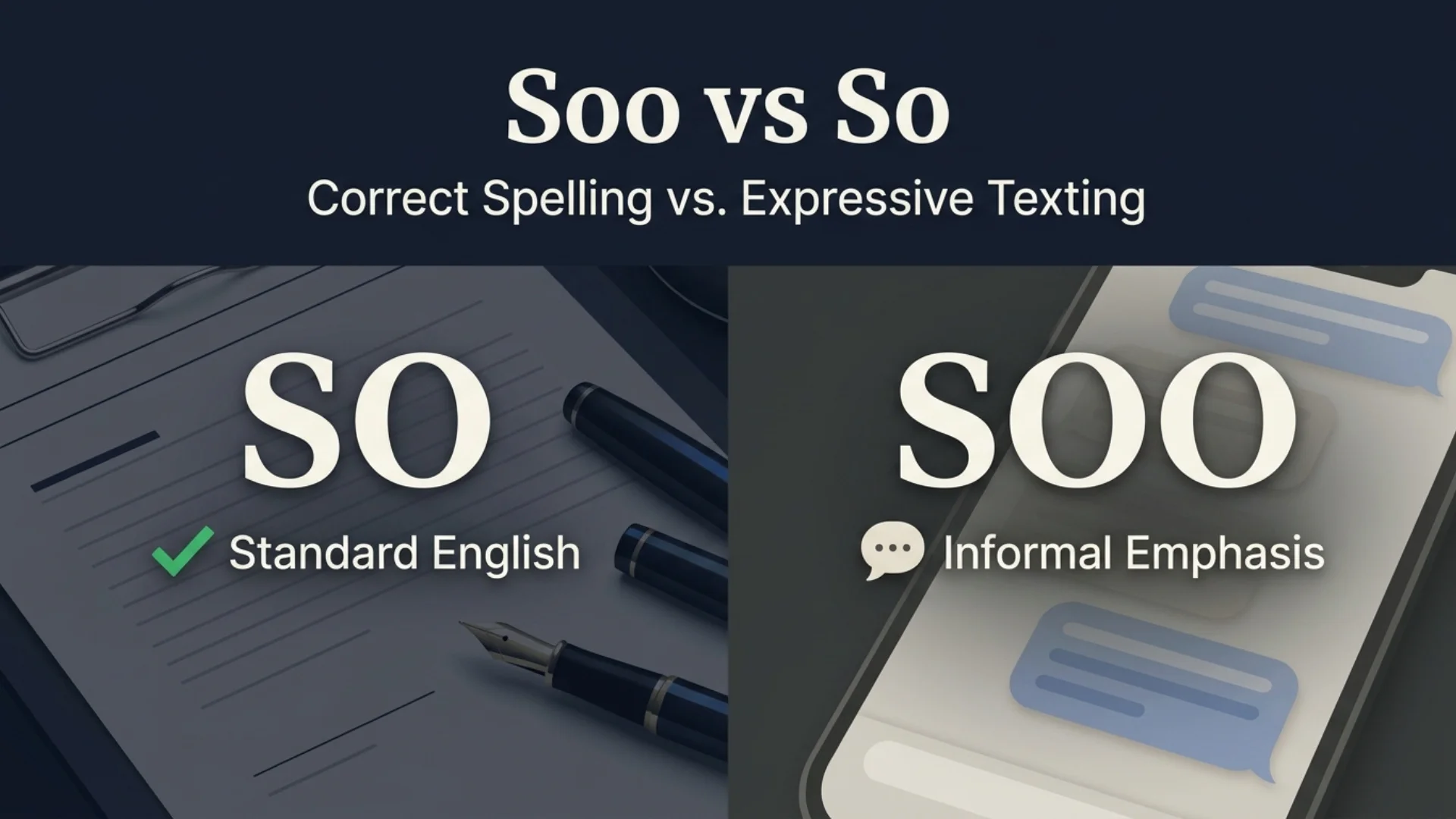
Quick Answer: So is the correct standard English word. Soo is usually a nonstandard, informal spelling used in texting, social media, and casual online writing to exaggerate emotion or emphasis.
Use:
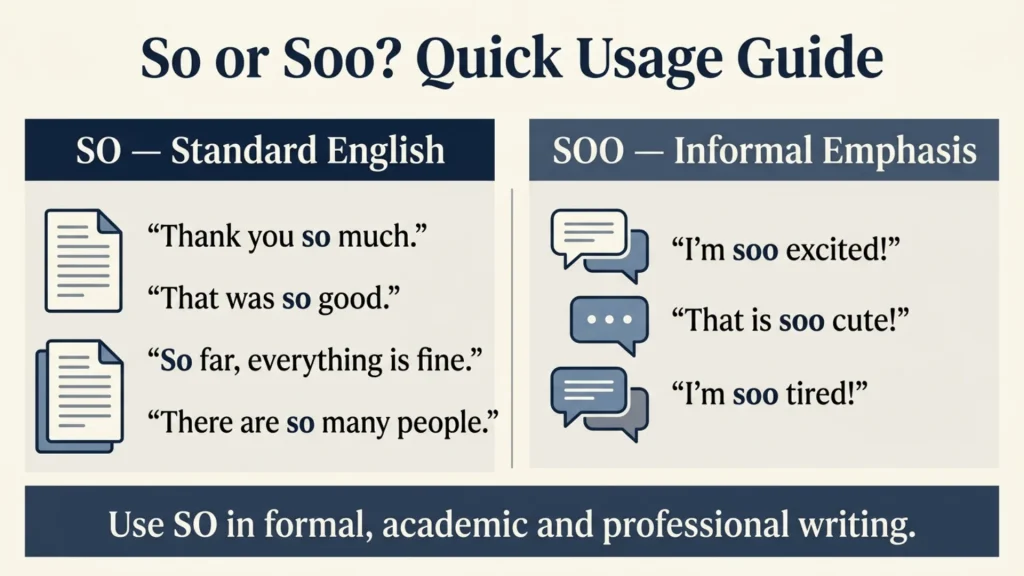
I am so happy. ✅
Thank you so much. ✅
That was so good. ✅
In an informal text, you may see:
I am soo happy!
That spelling can intentionally imitate a stretched pronunciation, but it should normally be avoided in essays, professional emails, academic work, formal articles, and other standard writing.
The simplest rule is:
So = standard English
Soo = informal expressive spelling
Soo vs So at a Glance
| Feature | So | Soo |
|---|---|---|
| Standard English word | Yes | Usually no |
| Formal writing | Correct | Avoid |
| Texting | Correct | Used informally for emphasis |
| Social media | Correct | Common as expressive spelling |
| Meaning | Has several grammatical meanings | Usually an elongated form of “so” |
| “Thank you ___ much” | so | Not standard |
| “That is ___ good” | so | Informal only |
| “___ far” | so | Incorrect in standard English |
| Cause/result connector | Yes | No |
If you are unsure which spelling to use, choose so.
It works in both formal and informal English.
What Does “So” Mean?
So is a very common English word with several grammatical functions.
Depending on the sentence, it can show:
- degree
- emphasis
- result
- agreement
- purpose
- manner
- a previously mentioned idea
Cambridge Dictionary describes so as an adverb that can mean “very” or “to such a great degree,” and also as a conjunction meaning “and for that reason.” You can see the Cambridge Dictionary entry for “so”.
That flexibility is one reason the word appears constantly in everyday English.
“So” Meaning Very or To a Great Degree
One of the most common uses of so is to emphasize an adjective or adverb.
Examples:
- I am so tired.
- She is so kind.
- That movie was so good.
- He drove so slowly.
- The house is so beautiful.
- Why are you so angry?
Here, so means something similar to:
very
or
to a great degree
For example:
The food was so good.
means the food was very good.
“So” as a Conjunction
So can also connect a cause with its result.
Example:
It was raining, so we stayed inside.
The first clause gives the situation.
The second gives the result.
More examples:
- I was tired, so I went home.
- She missed the bus, so she was late.
- The store was closed, so we left.
- He studied hard, so he passed the exam.
In this use, replacing so with soo would simply be a spelling error.
Incorrect:
It was raining, soo we stayed inside.
Correct:
It was raining, so we stayed inside.
What Does “Soo” Mean in English?
In ordinary modern communication, soo is usually an intentionally stretched version of so.
For example:
I am soo excited!
The extra o can suggest that the speaker is emphasizing the word, almost as if they were saying:
I am soooo excited!
It can communicate:
- excitement
- enthusiasm
- frustration
- exaggeration
- affection
- sarcasm
- playfulness
- dramatic emphasis
However, soo is not the standard spelling of so in normal English grammar.
It belongs primarily to informal digital communication.
Is “Soo” a Real Word?
As the normal alternative spelling of so, soo is not standard English.
That does not mean the letters S-O-O can never appear legitimately anywhere.
Soo may occur as:
- a surname
- a personal name
- part of a place name
- an acronym
- a proper noun
But when someone writes:
“I’m soo tired”
they are almost certainly using a creative elongated spelling of so, not a separate standard English adverb.
Context matters.
Why Do People Write “Soo”?
People often stretch words in digital communication because text cannot fully reproduce tone of voice.
In speech, someone might say:
“That is sooooo cute!”
The stretched vowel communicates enthusiasm.
In text, writers imitate that sound by adding extra letters.
Examples:
- soo cute
- sooo cute
- soooo cute
- soo tired
- sooo happy
- soooo done
There is no formal grammar rule deciding exactly how many extra o letters to add.
That is because this is expressive spelling, not standard orthography.
Humans saw perfectly functional spelling and decided it needed adjustable suspension. Naturally.
So vs Soo: The Main Difference
The main difference is standard usage versus expressive informal usage.
So
Use so when you want grammatically standard English.
Examples:
- That is so funny.
- I am so happy.
- Thank you so much.
- We have so many things to do.
- So far, everything is fine.
Soo
Use soo only if you intentionally want an informal stretched tone.
Examples:
I’m soo happy for you!
That puppy is soo cute!
I’m soo done with this homework.
These may be perfectly understandable in casual messaging, but they should not normally appear in formal writing.
So or Soo in Formal Writing?
Use:
so
Formal contexts include:
- academic essays
- school assignments
- professional emails
- business reports
- resumes
- cover letters
- news writing
- articles
- official documents
- formal presentations
Correct:
We are so pleased with the results.
Avoid:
We are soo pleased with the results.
The second looks intentionally casual or simply misspelled.
So or Soo in Texting?
Both may appear in texting, but they do different jobs stylistically.
So
Neutral and correct:
I’m so happy you came.
Soo
Extra emotional emphasis:
I’m soo happy you came!!
The second feels more enthusiastic because the spelling visually imitates a stretched pronunciation.
That is a style choice, not a grammar requirement.
Is It “Thank You So Much” or “Soo Much”?
The correct standard expression is:
Thank you so much.
Not:
Thank you soo much.
Examples:
- Thank you so much for your help.
- I appreciate it so much.
- Thanks so much for coming.
- Thank you so much for everything.
In a highly casual message, somebody might write:
Thank you sooo much!!!
That adds emotional emphasis, but the standard spelling remains so much.
Is It “So Much” or “Soo Much”?
Use:
so much
Examples:
- I love this so much.
- Why is there so much traffic?
- Thank you so much.
- We spent so much time there.
- I learned so much today.
Soo much is not standard spelling.
It may appear informally when someone deliberately stretches so.
Is It “So Good” or “Soo Good”?
The standard form is:
so good
Examples:
- This food is so good.
- The movie was so good.
- You did so good.
A grammar note on that last sentence: in careful standard English, “You did so well” may be preferred when describing how someone performed.
But:
The food is so good
is completely normal.
In casual texting:
This is sooo good!
is understandable as expressive spelling.
If spelling variations interest you, GrammarRead’s guide to Smooth vs. Smoothe explains another case where a tiny spelling difference changes whether a form is standard.
Is It “So Far” or “Soo Far”?
Always use:
so far
when you mean:
until now
or
up to this point
Examples:
- So far, everything is going well.
- I have read three chapters so far.
- So far, nobody has complained.
- This is the best option so far.
Do not write:
soo far
The phrase so far is a fixed standard expression.
Is It “So Many” or “Soo Many”?
Use:
so many
Examples:
- Why are there so many people here?
- I have so many questions.
- She has so many books.
- We made so many mistakes.
In formal and standard writing, soo many is incorrect.
Casual text may stretch the word:
There were soooo many people!
but that is expressive spelling.
So Much vs So Many
Use so much with uncountable nouns.
Examples:
- so much water
- so much money
- so much time
- so much work
Use so many with plural countable nouns.
Examples:
- so many people
- so many books
- so many questions
- so many mistakes
Correct:
I have so much work.
Correct:
I have so many tasks.
The extra o in soo does not change this grammar rule.
So + Adjective
Use so + adjective to express degree.
Examples:
- so beautiful
- so difficult
- so funny
- so tired
- so expensive
- so strange
Sentences:
She is so talented.
The test was so difficult.
That story was so funny.
This structure is standard English.
So + Adverb
So can also modify an adverb.
Examples:
- so quickly
- so slowly
- so carefully
- so beautifully
Sentences:
She finished so quickly.
Why are you driving so slowly?
He explained it so clearly.
Again, soo is not the standard spelling in these structures.
So…That
English commonly uses:
so + adjective/adverb + that
to show a strong degree followed by a result.
Examples:
The movie was so boring that I fell asleep.
She ran so quickly that nobody could catch her.
It was so cold that the lake froze.
He was so tired that he went straight to bed.
The standard form remains so, not soo.
So vs Very
So and very can both strengthen adjectives, but they are not always identical.
Compare:
She is very happy.
This simply describes a high degree of happiness.
She is so happy!
This can sound more emotional or emphatic, especially in conversation.
“So” also works naturally in result structures:
She was so happy that she started crying.
You would not normally write:
She was very happy that she started crying
if you intend the same cause-result structure.
So vs Such
One useful distinction competitors often barely explain is so vs such.
Use so before adjectives and adverbs:
so beautiful
so quickly
Use such before many noun phrases:
such a beautiful day
such nice people
Correct:
She is so kind.
Correct:
She is such a kind person.
Incorrect:
She is so a kind person.
This is a grammar difference, not a spelling issue, but it helps explain how so actually functions.
So as a Substitute
So can replace an idea that has already been mentioned.
Example:
“Will she come?”
“I think so.”
Here, so means something like:
I think she will come.
Other examples:
- I hope so.
- I suppose so.
- I believe so.
- I guess so.
- It seems so.
You cannot replace so with soo in standard writing here.
Incorrect:
I think soo.
Correct:
I think so.
“So Do I” and “So Am I”
So can also show that the same statement applies to another person.
Example:
“I love coffee.”
“So do I.”
Another:
“I’m tired.”
“So am I.”
More examples:
- So can I.
- So did she.
- So have we.
- So will they.
This is a grammatical structure, so elongated soo would be inappropriate.
“Soo” for Emotional Emphasis
The strongest legitimate use of soo is stylistic.
Compare:
That is so cute.
Neutral but enthusiastic.
That is soo cute!
More playful.
That is sooooo cute!!!
Highly exaggerated.
The extra letters function somewhat like:
- repeated punctuation
- emojis
- capital letters
- stretched pronunciation
They add tone rather than a new dictionary meaning.
Can “Soo” Be Sarcastic?
Yes.
The stretched spelling may show sarcasm depending on context.
Example:
“That meeting was soo useful.”
If everyone knows the meeting was pointless, the stretched soo can make the sarcasm more obvious.
The letters themselves do not automatically mean sarcasm.
Tone comes from context.
Can You Use “Soo” in Social Media Captions?
You can if you deliberately want an informal, conversational style.
Example:
Soo excited for tonight!
That is common in casual social-media writing.
But a business caption, formal announcement, educational post, or professional brand may prefer:
So excited for tonight!
Standard spelling usually looks cleaner and more polished.
Can You Use “Soo” in an Email?
It depends entirely on the email.
Professional Email
Use:
so
Example:
Thank you so much for your assistance.
Casual Email to a Friend
An expressive spelling may be acceptable:
I’m soo excited to see you!
So the question is less “Can English physically survive another O?” and more “Does this tone fit the audience?”
Is “Soo” Slang?
It is more accurate to call soo an informal expressive spelling than a completely separate slang word.
The meaning usually remains the same as so.
What changes is the tone.
For example:
I’m so tired.
I’m soo tired.
Both communicate tiredness.
The second visually exaggerates the emotion.
Is “Soo” Used in Spoken English?
You cannot literally hear spelling.
However, people can stretch the vowel sound while speaking:
“I’m sooooo tired.”
Informal spellings such as:
- soo
- sooo
- soooo
attempt to represent that stretched pronunciation in writing.
How Many O’s Should “Soo” Have?
There is no grammatical rule.
Writers may use:
- soo
- sooo
- soooo
- sooooo
The more letters they add, the more exaggerated the visual emphasis usually feels.
Standard English remains:
so
with one o after the s.
Why Is “So” Correct but “Soo” Common Online?
Because standard spelling and expressive online writing serve different purposes.
Standard spelling prioritizes:
- consistency
- readability
- grammar
- professionalism
Casual digital writing often prioritizes:
- personality
- tone
- emotion
- speed
- playfulness
That is why people knowingly write nonstandard forms such as:
heyyy
noooo
yessss
sooo
The extra letters simulate tone.
Soo vs So in Professional Writing
Always choose so unless you are quoting informal writing.
Correct:
The company performed so well that revenue increased.
Incorrect for normal professional prose:
The company performed soo well that revenue increased.
Using soo in a report, cover letter, proposal, or academic paper may look like a typo.
GrammarRead’s Hassle vs. Hastle guide covers a similar issue where a familiar-looking alternative spelling is not the standard form.
Soo vs So in Academic Writing
Use so, but also consider whether a more precise word would improve the sentence.
For example:
Informal:
The result was so important.
More precise:
The result was highly significant.
That does not mean so is grammatically wrong.
It simply means academic writing sometimes benefits from more specific vocabulary.
Soo vs So in Creative Writing
Creative writing has more freedom.
A novelist may intentionally write:
“I’m sooo tired,” Maya groaned.
The nonstandard spelling can represent the character’s voice.
That is different from the narrator accidentally misspelling so.
Creative deviation works best when it is obviously intentional.
“So” After a Comma
When so connects two independent clauses as a coordinating conjunction, writers commonly place a comma before it.
Example:
It was late, so we went home.
Another:
I forgot my umbrella, so I got wet.
In very short informal sentences, punctuation conventions can vary, but polished writing usually benefits from the comma.
Can “Soo” Mean Something Else?
Yes, outside this grammar comparison.
Capitalized Soo can occur as a proper name, surname, geographic name, or abbreviation.
So if you see:
Soo
in a person’s name or organization name, do not automatically “correct” it to So.
The grammar rule applies when soo is being used as a stretched spelling of the English word so.
Is Soo a Typo?
Sometimes.
If someone writes:
Thank you soo much
they may have intentionally added emphasis.
They may also simply have typed an extra o accidentally.
Context helps.
In formal writing, you should generally treat soo in place of so as an error unless there is a clear reason for the spelling.
Common So vs Soo Mistakes
Incorrect in Standard English
Thank you soo much.
Correct:
Thank you so much.
Incorrect
The movie was soo good.
Standard:
The movie was so good.
Incorrect
Soo far, everything is fine.
Correct:
So far, everything is fine.
Incorrect
There were soo many people.
Correct:
There were so many people.
Incorrect
I was tired, soo I left.
Correct:
I was tired, so I left.
That last example is especially important because so functions as a conjunction. Stretching it there does not naturally add emotional emphasis. It mostly looks misspelled.
So, Soo, and Sooo
| Form | Status | Typical Use |
|---|---|---|
| so | Standard English | All normal writing |
| soo | Nonstandard expressive spelling | Casual messages |
| sooo | Nonstandard expressive spelling | Stronger casual emphasis |
| soooo | Nonstandard expressive spelling | Exaggerated emphasis |
Only so belongs in ordinary standard prose.
Easy Trick to Remember Soo vs So
Remember:
Standard spelling = SO
Just two letters.
If you add more O’s, you are no longer following the standard spelling. You are visually stretching the word for effect.
Another trick:
So serious? Use “so.”
Sooo playful? Extra O’s may appear.
For another spelling pair where standard and alternative forms easily get mixed up, see Linchpin vs. Lynchpin.
Soo vs So and Other Informal Spellings
The internet regularly stretches words for tone:
- hey → heyyy
- yes → yesss
- no → noooo
- please → pleeease
- so → sooo
These forms can work in conversation because readers understand the emotional intention.
But the standard spellings remain unchanged.
This distinction between deliberate informal spelling and correct formal spelling is similar to other English usage questions. GrammarRead’s guide to Dammit vs. Damn It explores another expression whose spelling and level of formality matter.
Frequently Asked Questions
Which is correct, SO or soo?
So is the correct standard English spelling. Soo is usually an informal expressive spelling used in texting, social media, or casual messages for extra emphasis.
Is it thank you so much or soo much?
The correct standard phrase is “thank you so much.” “Thank you soo much” may appear informally when someone wants to exaggerate emotion, but it is not standard spelling.
Is it so good or soo good?
Use “so good” in standard English. “Soo good” is an informal spelling that may be used deliberately in texts or social media.
What is the meaning of soo?
In informal digital communication, soo usually means the same thing as so, but the extra letter adds visual emphasis or emotion. It is not the standard spelling of the English word.
When to use the word soo?
Use soo only when you intentionally want a playful, exaggerated, or emotional tone in very informal writing. Use so in normal, formal, academic, and professional English.
Is it so much or soo much?
The standard form is so much.
Examples:
Thank you so much.
I have so much work.
Is it so far or soo far?
The correct expression is so far.
Example:
So far, everything is going well.
Is it soo many or so many?
Use so many in standard English.
Example:
Why are there so many people here?
Is “soo” grammatically correct?
Not as the standard spelling of so. It is better understood as an informal expressive spelling used to imitate a stretched pronunciation.
Can I write “soo” in a text message?
Yes, if you intentionally want extra emotional emphasis. For example, “I’m soo excited!” is common in casual texting. The standard spelling remains so.
Why do Brits say poorly?
In British English, poorly can informally mean unwell or ill, as in “She has been feeling poorly.” This meaning is unrelated to the difference between so and soo.
Final Answer
The Soo vs So difference is straightforward once you separate grammar from texting style.
So is the correct standard English word.
It can express degree:
I am so happy.
It can connect cause and result:
It was late, so we left.
It appears in fixed expressions:
so far
so much
so many
And it can replace a previously mentioned idea:
I think so.
Soo, by contrast, is usually an informal stretched spelling used to add emotion:
I’m soo excited!
That spelling is perfectly understandable in casual messages when it is intentional, but it should normally stay out of academic, professional, formal, and standard written English.
When in doubt, use so.
It is correct everywhere, which is an unusually cooperative thing for English to offer.