Dammit vs. Damn It: Which Spelling Is Correct?
Dammit vs. damn it is mainly a question of spelling and style, not meaning. Both forms are used to express frustration, anger, irritation, disappointment, or strong emphasis.
The key difference is simple:
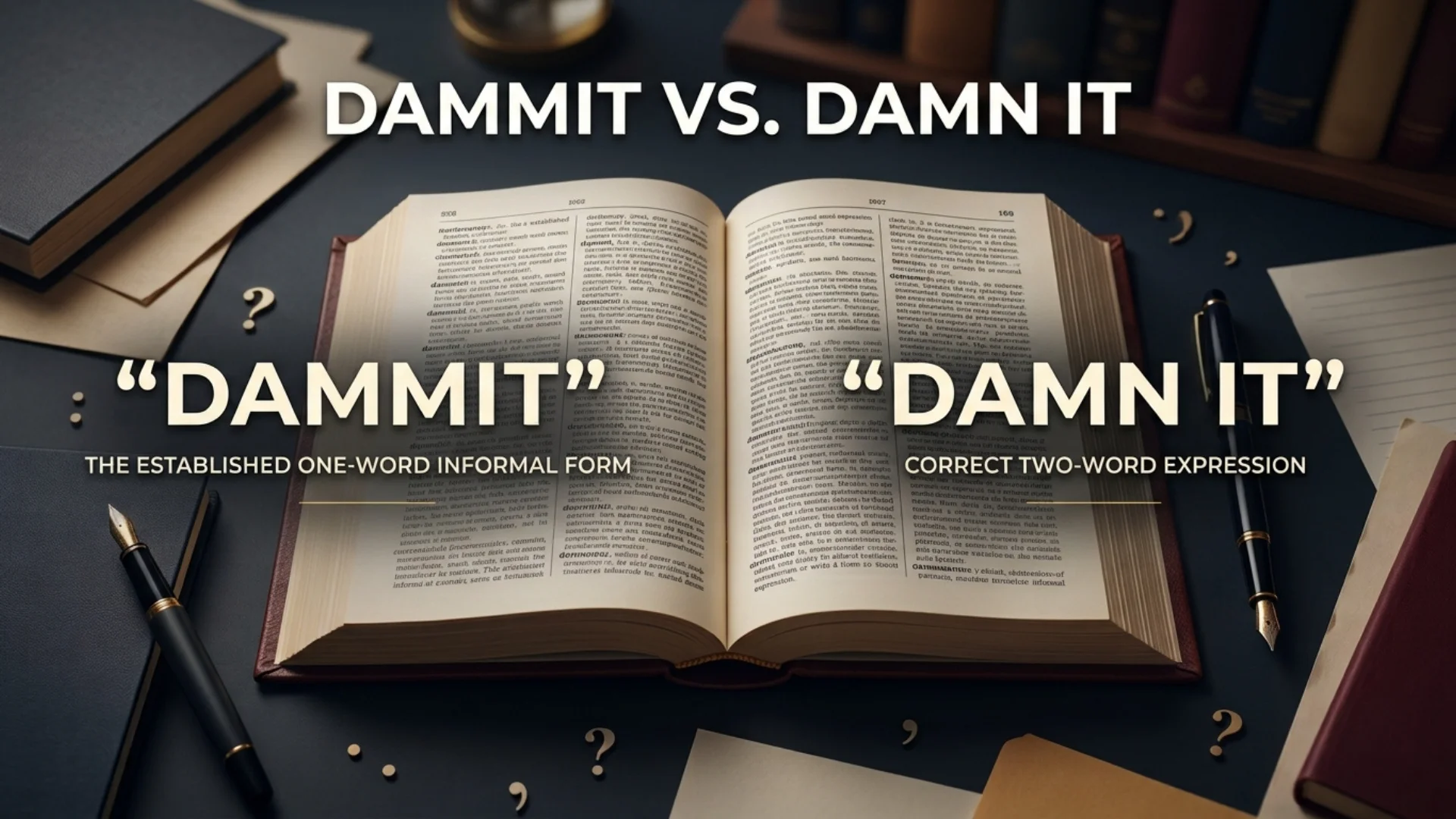
Damn it is the original two-word expression.
Dammit is an established informal one-word form of the same expression.
Damnit also appears in English and is recognized by some dictionaries as a variant, but dammit is the safer one-word spelling in edited writing.
So if you are asking whether to write dammit or damn it, both can be correct. If you want one word, use dammit.
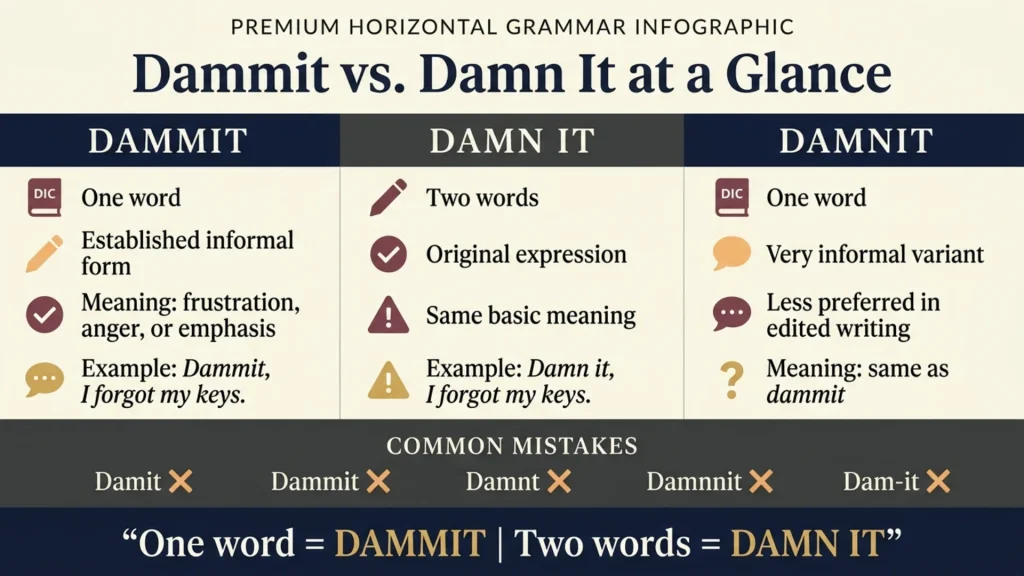
Quick Answer: Dammit or Damn It?
| Form | Status | Meaning | Best Use |
|---|---|---|---|
| Damn it | Correct, two words | Frustration, anger, emphasis | Standard phrase |
| Dammit | Correct informal form | Same basic meaning | Casual writing, dialogue |
| Damnit | Recognized variant in some dictionaries | Same meaning | Very informal, less preferred |
| Damit | Usually a misspelling in English | Intended to mean dammit | Avoid |
| Damnmit | Misspelling | Intended to mean dammit | Avoid |
| Dam-it | Nonstandard spelling | Intended to mean damn it | Avoid |
The easiest rule:
Two words: damn it
One word: dammit
What Does Dammit Mean?
Dammit is a very informal exclamation used when someone is annoyed, frustrated, angry, disappointed, or strongly emphasizing a statement.
Examples:
Dammit! I forgot my keys.
Dammit, we’re going to be late.
Just listen to me, dammit.
In the first two examples, it expresses frustration.
In the third, it adds emotional emphasis.
The Cambridge Dictionary entry for dammit describes it as a very informal expression of anger that can also be used for emphasis.
What Does “Damn It” Mean?
Damn it usually expresses the same emotions as dammit.
Examples:
Damn it! My phone battery died.
Damn it, I knew this would happen.
Finish the job, damn it.
Historically, damn had a stronger religious sense involving condemnation. In ordinary modern conversation, however, damn it is often simply an emotional exclamation.
The meaning depends heavily on tone.
A speaker might use it for:
- frustration
- disappointment
- irritation
- anger
- surprise
- emphasis
- impatience
Dammit vs. Damn It: What Is the Difference?
The main difference is form.
Damn It
Two separate words:
damn + it
Example:
Damn it, I missed the train.
Dammit
One informal word representing essentially the same spoken expression:
Dammit, I missed the train.
The emotional meaning is normally the same.
The choice mostly depends on spelling preference, style, and context.
Is Dammit One Word?
Yes.
Dammit is written as one word.
Correct:
Dammit!
Incorrect:
Dam mit!
If you want the two-word version, write:
Damn it!
Do not mix the spellings.
How Do You Spell Dammit?
The standard one-word spelling is:
D-A-M-M-I-T
Correct:
dammit
A useful memory rule is:
Dammit has two M’s.
Common misspellings include:
- damit
- damnit
- damnmit
- dammit
- dam-it
- damnt
- damnnit
Of these, damnit is a special case because some dictionaries recognize it as a very informal variant. The others are normally spelling errors when the intended word is dammit.
Why Does Dammit Have Two M’s?
The spelling dammit reflects the way damn it is commonly pronounced when the two words run together.
Instead of preserving the silent N from damn, the one-word form represents the spoken sound more directly:
damn it → dammit
That is why the standard one-word spelling contains:
mm
rather than:
mn
English has once again decided that pronunciation, spelling, and historical structure should all negotiate separately.
Is It Dammit or Damnit?
If you want the safest one-word spelling, use:
dammit
Cambridge does recognize damnit as a very informal variant, so calling it completely nonexistent would be inaccurate. However, dammit is the more established spelling for edited English. Cambridge Dictionary
Preferred
Dammit, I forgot my wallet.
Variant
Damnit, I forgot my wallet.
For schoolwork, published content, edited dialogue, or general web writing, dammit is usually the better choice.
Damnit or Damn It?
These forms also share the same basic meaning.
However:
damn it is the normal two-word form.
damnit is a very informal one-word variant.
If you are trying to choose between them in polished writing, use:
damn it
or:
dammit
Is “Damit” Correct?
Usually no.
Damit is normally a misspelling of dammit in English.
Correct:
Dammit, I dropped it.
Incorrect:
Damit, I dropped it.
There is a separate German word damit, but that has nothing to do with the English exclamation.
Is “Damnmit” Correct?
No.
Damnmit combines the N from damn with the double-M spelling of dammit.
Standard options are:
- damn it
- dammit
Not:
- damnmit
Is “Dam-It” Correct?
No.
Dam-it is not the standard spelling.
Use:
damn it
or:
dammit
There is no need for a hyphen.
Is Dammit a Swear Word?
Yes, dammit is generally considered a mild swear word or profanity.
Cambridge labels it very informal, while Oxford identifies damn as a swear word used to express annoyance or emphasis. Cambridge Dictionary
Its strength depends on:
- culture
- age group
- religious beliefs
- workplace norms
- family expectations
- tone
- context
Many speakers consider it fairly mild compared with stronger profanity, but that does not make it appropriate everywhere.
Is Dammit a Cuss Word?
Yes.
Cuss word and swear word are informal ways of referring to profanity.
So dammit can reasonably be described as:
- a swear word
- a cuss word
- profanity
- an expletive
- an informal interjection
Is Dammit a Bad Word?
That depends on the audience.
In casual adult conversation, dammit may sound relatively mild.
In other settings, it may be inappropriate, including:
- classrooms
- religious environments
- formal workplaces
- customer-facing communication
- writing intended for children
- highly professional documents
The safest approach is to match the language to the audience.
Is “Damn It” More Offensive Than “Dammit”?
Usually not in any major way.
They express essentially the same phrase.
Compare:
Damn it!
Dammit!
The first visually preserves the word damn, so some readers may perceive it as slightly stronger or more deliberate.
But there is no universal rule saying one form is officially more offensive than the other.
Dammit vs. Damn: Are They the Same?
Not exactly.
Dammit mainly functions as an exclamation.
Dammit! We missed the train.
Damn can perform several grammatical roles.
As an Exclamation
Damn! We missed the train.
As an Intensifier
That was a damn good meal.
As a Verb
Historically and religiously, damn can mean to condemn.
So dammit is more limited in function than damn.
Dammit Pronunciation
Dammit is pronounced approximately:
DAM-it
IPA:
/ˈdæm.ɪt/
The first syllable receives the stress.
The N from damn is not pronounced separately.
How Do You Pronounce “Damn It”?
In careful speech, damn it consists of two words:
dam + it
In natural conversation, they often blend together so closely that they sound nearly identical to:
dammit
That pronunciation overlap is why people become uncertain about the spelling.
Why Is “Damn” Spelled With an N?
The spelling reflects the word’s history.
Damn entered English through French forms ultimately derived from Latin damnare, meaning to condemn or inflict loss.
The final N remains in the spelling even though it is normally silent when damn is pronounced by itself.
That silent letter also appears in related historical forms.
English spelling frequently preserves older structures long after pronunciation changes. Apparently deleting unused letters would have been too efficient.
Why Is English Spelling So Weird?
English absorbed vocabulary from many languages, including:
- Old English
- French
- Latin
- Greek
- Norse
- Dutch
- German
- and many others
Pronunciation also changed over centuries without spelling always changing at the same speed.
That is why English contains forms such as:
- knight
- doubt
- debt
- damn
- honest
- write
The spelling often preserves linguistic history rather than matching modern pronunciation exactly.
Examples of Dammit in Sentences
Frustration
Dammit, I forgot the password again.
Anger
Dammit! Stop touching that.
Disappointment
Dammit, we were so close.
Emphasis
I told you the truth, dammit.
Surprise
Dammit, that scared me.
Examples of Damn It in Sentences
Frustration
Damn it, I left my keys inside.
Disappointment
Damn it! We missed the deadline.
Emphasis
Damn it, listen to me.
Annoyance
Damn it, the printer stopped working again.
Should You Use Dammit in Formal Writing?
Usually no.
Because dammit is very informal and potentially offensive, it is rarely appropriate in:
- academic essays
- professional reports
- business correspondence
- formal applications
- legal writing
It can still appear naturally in:
- fiction
- scripts
- dialogue
- personal messages
- informal articles
- social media
Better Alternatives to “Damn It”
If you want to express frustration without swearing, use:
- darn it
- dang it
- shoot
- oh no
- seriously?
- for goodness’ sake
- come on
- that’s frustrating
- what a mess
- unbelievable
The best replacement depends on how emotional you want the sentence to sound.
“Darn It” vs. “Damn It”
Darn it is a softened substitute for damn it.
Compare:
Damn it! I forgot the tickets.
Darn it! I forgot the tickets.
The second is normally considered milder and safer around audiences sensitive to profanity.
“Dang It” vs. “Damn It”
Dang it is another euphemistic substitute.
It keeps the emotional rhythm of the original phrase while avoiding the direct swear word.
Example:
Dang it, I missed the bus.
It is especially common in informal American English.
Dammit in Dialogue
In fictional dialogue, dammit can communicate character voice quickly.
It may suggest:
- irritation
- urgency
- anger
- panic
- impatience
- determination
Example:
“Dammit, move!” Alex shouted.
The shorter spelling can look more immediate and conversational than the two-word form.
Damn It in Dialogue
The two-word version may look slightly more deliberate on the page:
“Damn it, don’t walk away from me.”
Neither form automatically creates a different meaning.
Writers can choose based on rhythm and house style.
Dammit in Text Messages and Social Media
Informal digital writing often contains all of these forms:
- dammit
- damn it
- damnit
- damn
- damn!!
- damnnn
Only some are standard spellings, but casual internet writing is not famous for submitting itself to copy editors before publication.
For edited content, stick with:
dammit
or:
damn it
Is “Damn It” a Slur?
No.
Damn it is profanity, not a slur.
A slur targets a person or group based on identity or group membership.
Damn it is an exclamation.
It may be offensive to some listeners, but that does not make it a slur.
Is “Damn” Offensive to Christians?
It can be offensive to some Christians, but beliefs and reactions vary widely.
The word has a religious history connected with condemnation, and some Christians avoid damn, damn it, or stronger religious profanity because they consider such language irreverent.
Other Christians may regard casual modern uses as relatively mild.
So the accurate answer is:
Some Christians consider it offensive; others do not react to it in the same way.
Is “Damn” a Cuss Word in England?
Yes, damn can be considered a swear word in British English, although it is usually regarded as relatively mild compared with stronger profanity.
Oxford’s learner dictionary labels it a swear word used informally for annoyance and emphasis. Oxford Learner’s Dictionaries
Its perceived strength still depends on the situation and speaker.
What Is the Rudest Swear Word?
There is no objective single “rudest” English swear word.
Offensiveness varies by:
- country
- culture
- social group
- generation
- religion
- context
- who the word targets
Identity-based slurs can cause substantially more harm than ordinary frustration-based profanity because they target people or groups rather than merely expressing emotion.
What Are the 12 Cuss Words?
There is no official list of exactly 12 cuss words in English.
English profanity is not governed by a committee issuing a twelve-item annual syllabus.
Lists differ depending on:
- region
- era
- culture
- religious beliefs
- broadcasting standards
- platform rules
Words such as damn are generally classified as relatively mild profanity, while other expressions can be considerably stronger.
Dammit vs. Damn It in American English
Both forms are widely understandable in American English.
For informal everyday writing:
dammit works naturally.
For the original phrase:
damn it is correct.
One notable style distinction is that some professional style guides may prefer the two-word version when the profanity must appear at all.
So context matters more than pretending one version has defeated the other forever.
Dammit vs. Damn It in British English
Both forms are understood in British English too.
Damn it is the straightforward two-word form.
Dammit also occurs as an informal exclamation, though Oxford marks it as old-fashioned in one learner-dictionary entry. Oxford Learner’s Dictionaries
For ordinary modern writing, the intended audience and publication style should guide the choice.
Common Spelling Mistakes
Damnit
Recognized as a variant by Cambridge, but dammit is the safer default one-word form.
Damit
Usually incorrect in English.
Damnmit
Incorrect mixture of damn and dammit.
Dam It
Usually incorrect if you mean the swear expression.
A dam is a structure built across water.
So:
Dam it.
could theoretically mean doing something to a river.
That is very different from:
Damn it!
One silent N has apparently been given considerable responsibility.
Damnt
Incorrect.
Damnnit
Incorrect.
Dam-It
Nonstandard.
Dam It vs. Damn It
These can actually represent different meanings.
Damn It
An emotional exclamation:
Damn it! I broke the screen.
Dam It
Could literally mean:
Build a dam across it.
Example:
The engineers decided to dam it to create a reservoir.
This difference is why dropping the N completely can change the meaning rather than simply simplify the spelling.
Dammit vs. Damn It vs. Damnit
Here is the complete comparison:
| Form | Correct? | Words | Register | Recommendation |
|---|---|---|---|---|
| Damn it | Yes | 2 | Informal/profane | Correct |
| Dammit | Yes | 1 | Very informal | Best one-word choice |
| Damnit | Variant | 1 | Very informal | Less preferred |
| Damit | Usually no | 1 | Nonstandard | Avoid |
| Damnmit | No | 1 | Incorrect | Avoid |
| Dam-it | No | Hyphenated | Nonstandard | Avoid |
Easy Memory Rule
Remember:
Damn it = original two-word phrase
Dammit = established one-word form
Damnit = variant, not the best default
If all three are staring at you from the screen like English has personally betrayed you, just choose dammit for one word and damn it for two.
Related Grammar Guides
Tiny spelling choices causing disproportionate amounts of human suffering are apparently GrammarRead’s natural habitat. These guides cover similar usage problems:
- People Do or People Does? Correct Grammar & Examples
- Was There or Were There? Grammar Rules & Examples
Frequently Asked Questions
Is “damn it” a slur?
No. Damn it is profanity, not a slur. It expresses frustration, anger, or emphasis rather than targeting a protected group or identity.
What can I say instead of “damn it”?
Milder alternatives include darn it, dang it, shoot, oh no, come on, for goodness’ sake, and that’s frustrating.
Is “damit” a cuss word?
If you mean dammit, then yes, it is commonly considered mild profanity. Damit itself is normally a misspelling in English.
Why is “damn” spelled with an N?
The N comes from the word’s historical development through French and Latin forms. Modern pronunciation usually leaves the final N silent, but traditional spelling preserves it.
Why is English spelling so damn weird?
English spelling reflects centuries of borrowing and pronunciation change. Words often preserve older French, Latin, Germanic, or other linguistic forms even after everyday pronunciation changes.
Is “damn” a cuss word in England?
Yes. It can be considered mild profanity in British English, though its strength depends on context.
What is the rudest swear word?
There is no universal answer. Perceived offensiveness changes across cultures, communities, and contexts. Identity-based slurs are generally more harmful than ordinary exclamatory profanity.
Is damn offensive to Christians?
It can be offensive to some Christians because of its historical religious meaning. Other Christians may view casual modern use as relatively mild, so reactions vary.
What are the 12 cuss words?
There is no official list of exactly twelve English swear words. Different cultures, broadcasters, families, schools, and communities classify profanity differently.
Is dammit a swear word?
Yes. Dammit is generally classified as mild profanity or a swear word, though it is considerably more acceptable in some settings than in others.
Is it dammit or damnit?
Use dammit as the safest standard one-word spelling. Damnit is recognized as a very informal variant by some dictionaries.
How do you spell damn it?
As two words:
damn it
If you want the one-word informal form:
dammit
Final Thoughts
For Dammit vs. Damn It, there is no dramatic grammar war to resolve.
Both are legitimate forms of essentially the same informal expression.
Use:
damn it when you want the original two-word phrase.
Use:
dammit when you want the established one-word informal form.
Treat:
damnit as a recognized but less-preferred variant.
And avoid:
damit, damnmit, damnt, damnnit, and dam-it when you are aiming for standard spelling.
The simplest answer is still the best one:
Damn it = two words. Dammit = one word.